- Monitored alarm systems need to periodically prove they are still connected and operational, not just wait for an alarm to fire.
- In the telephone line era, alarm panels sent regular test signals to the monitoring centre; a brief message meaning "I am still alive."
- Testing every day would have required far more telephone lines; so many centres adopted a seven-day schedule as a practical compromise between reliability and infrastructure cost.
- Managing tens of thousands of accounts required careful capacity planning; the diversity ratio determined how many accounts could share a single telephone line.
- Major events; widespread power outages, telecommunications failures; could cause many panels to communicate simultaneously, making capacity planning critical.
- Modern IP monitoring detects communication failures within minutes rather than days; the principle is unchanged, the technology is dramatically faster.
The Alarm That Never Called
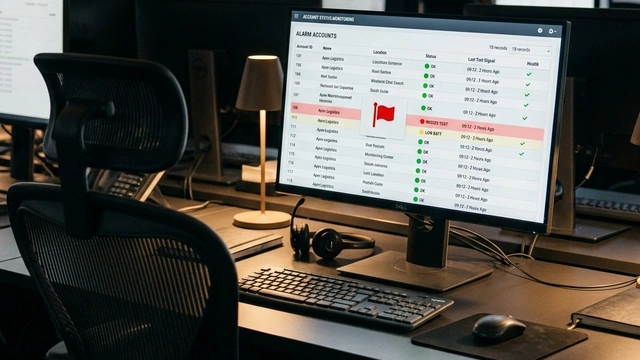
In the previous article, I explained how telephone line alarm monitoring worked; the dialler, the Contact ID protocol, and why path integrity mattered as much as the alarm itself. This article goes deeper on one specific engineering challenge: how monitoring centres managed the communication health of tens of thousands of accounts when each one required an actual telephone call to check in.
Imagine you own a monitored alarm system. For six months, nothing happens. No break-ins, no alarms, no faults. Everything appears normal. That sounds like good news.
But from a monitoring centre's perspective, it creates a serious question. How do we know the alarm panel is still working? How do we know the telephone line is still connected? How do we know the alarm can actually reach the monitoring centre when it needs to? Without some form of regular testing, nobody would know until a real emergency occurred, and the signal failed to arrive.
That is why monitored alarm systems were designed to periodically "call home." Not because something had gone wrong, but to confirm that everything was still right.
KEY POINT
An alarm system that cannot communicate is only half a security system. The monitoring centre needs more than the ability to receive alarms; it needs confidence that every account in its system is reachable at any given moment.
What "Calling Home" Actually Meant
In practical terms, the alarm panel was programmed to send a brief test signal to the monitoring centre at defined intervals. The message was simple: "I am still alive." The monitoring centre would receive this signal, record it against the account, and confirm that the communication path between the panel and the centre was intact.
If the test signal did not arrive within the expected window, the monitoring centre would flag the account. An operator would then contact the customer to find out why. The telephone line may have failed. The premises may have lost power. The alarm panel may have developed a fault. Someone may have accidentally disconnected the line. The cause did not matter as much as the principle: the monitoring centre needed to know about communication failures before a real emergency occurred, not during one.
For the homeowner, this process was completely invisible. The panel made its check-in quietly, in the background, without any visible indication on the keypad or any action required from the user. Most homeowners whose systems were tested every seven days had no idea the test was happening at all.
KEY POINT
The test signal existed not for the homeowner but for the monitoring centre. It was the operational equivalent of a heartbeat; a regular confirmation that the system was alive and connected, independent of whether any alarm events had occurred.
Why Not Test Every Day?
At first glance, testing every day sounds like the obvious answer. The more frequently you test, the sooner you detect a problem. But in the telephone line era, more frequent testing had a direct cost consequence that modern monitoring does not face.
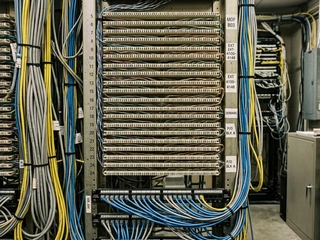
During my years helping to operate Central Monitoring Stations handling approximately 45,000 monitored alarm accounts, every communication decision had infrastructure implications. Unlike modern IP systems where data flows over a shared network, each alarm panel test signal required an actual telephone connection; a physical line seized for the duration of the call.
If every one of those 45,000 panels called the monitoring centre every single day, the volume of incoming telephone lines required would increase dramatically. More lines meant higher rental costs, more receiving equipment, more maintenance, and more capacity to manage. The telephone infrastructure of the monitoring centre was a real physical constraint, not an abstraction.
The challenge was finding a testing frequency that balanced two competing requirements: early detection of communication failures on one side, and manageable infrastructure costs on the other. For most residential accounts, a seven-day interval struck that balance. It meant a communication failure would be identified within a week; long before the average customer had noticed anything was wrong, without placing excessive demand on the telephone capacity.
PLANNING POINT
The seven-day schedule was the standard for most residential accounts. Higher-security commercial sites; banks, data centres, government facilities; often operated on shorter intervals of 24 or 72 hours. The risk profile of the site determined the appropriate testing frequency, not a single universal rule.
The Diversity Ratio Nobody Ever Saw
This is one of those behind-the-scenes details that most customers never knew existed, and one of the more interesting engineering problems in the history of alarm monitoring.
Monitoring centres had to calculate precisely how many alarm accounts could share a single incoming telephone line. This planning figure was known as the diversity ratio. The reasoning behind it was straightforward: not every customer generates an alarm on the same day, not every alarm panel sends its test signal at the same time, and not every account calls the monitoring centre simultaneously. Because alarm communications were distributed across time, a single telephone line could support far more accounts than it could handle if they all called at once.
Planning ratios in the telephone line era were typically in the range of several hundred to around a thousand accounts per incoming telephone line, depending on the monitoring model, the polling frequency, and the expected alarm rate for that account portfolio. A centre monitoring 45,000 accounts at a ratio of 500 accounts per line would need approximately 90 incoming telephone lines to handle normal traffic reliably; more to accommodate spikes.
Getting the diversity ratio wrong had real consequences. Too few lines meant alarm signals queued and delayed during busy periods. A genuine intrusion alarm that took five minutes to get through to an operator because the lines were full was not acceptable. Too many lines meant unnecessary infrastructure cost that the monitoring business had to recover through customer fees.
KEY POINT
The diversity ratio was never visible to customers, but it was one of the most consequential engineering decisions in monitoring centre design. Getting it right meant reliable, fast signal delivery. Getting it wrong meant delays during exactly the moments when speed mattered most.
What Happened During Major Events
One of the engineering concerns that capacity planners always had to account for was what would happen if many alarm panels tried to communicate at the same time. Under normal conditions, the diversity ratio held because alarm events were distributed across time. But certain scenarios could break that assumption.
A widespread power outage across a large residential area would cause every alarm panel in that area to generate a power fault signal simultaneously. If the outage affected thousands of properties, thousands of panels would attempt to dial the monitoring centre within minutes of each other. The diversity ratio; calculated for normal distributed traffic; would no longer apply.
Similarly, a telecommunications failure affecting a particular exchange could cause mass communication faults, all reported at the same time when the line was restored. Or a significant criminal incident in a commercial district might trigger genuine alarms across multiple properties within a short window.
This is why monitoring centre capacity planning went beyond simply calculating normal traffic loads. Planners had to build in headroom for these spike scenarios; extra line capacity, queue management procedures, and operator protocols for handling high-volume events without compromising response times on genuine alarms. At ADT and Optimax, we had procedures specifically for these situations. The engineering challenge was ensuring the monitoring centre could absorb an abnormal spike without the system collapsing under its own traffic.
PLANNING POINT
A monitoring centre designed only for normal traffic will struggle during the events that matter most. Capacity planning for peak and spike scenarios, not just average loads; was one of the disciplines that separated professional monitoring operations from underprepared ones.
Then IP Changed Everything
The arrival of IP communications transformed alarm monitoring in ways that went far beyond simply replacing the telephone line with an internet connection.
With IP, the alarm panel no longer needed to make a discrete telephone call to check in. Instead, it could maintain a persistent connection to the monitoring centre, or poll over the network far more frequently than weekly, without consuming a dedicated telephone line for each communication. The infrastructure constraint that had driven the seven-day compromise largely disappeared.
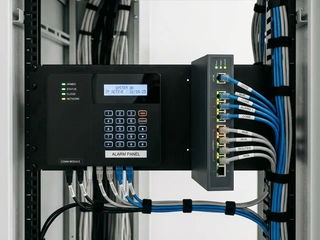
Modern IP monitoring systems can supervise communication continuously, detecting faults within minutes rather than days. A panel that loses its IP connection at 2am will typically be flagged at the monitoring centre within minutes, not after a week-long silence. The diversity ratio as a telephone infrastructure planning concept became irrelevant; IP networks can handle enormous volumes of concurrent lightweight data exchanges in a way that individual telephone circuits never could.
What did not change was the underlying principle. The monitoring centre still needs to know, at any given moment, which accounts are reachable and which are not. The technology changed. The requirement did not.
KEY POINT
IP monitoring did not create the requirement for communication supervision; it made it dramatically faster and cheaper to fulfil. The seven-day test interval was a constraint imposed by telephone infrastructure, not a reflection of how often supervision was actually needed.
The Principle Has Never Changed
Looking back across the transition from telephone line monitoring to IP monitoring, what is striking is how consistent the underlying requirement has been. Whether the communication path is a PSTN telephone line, a leased circuit, a GSM network, or a broadband IP connection, the monitoring centre needs the same thing: confidence that the alarm system is reachable and operational, not just when alarms fire, but at all times.
In the telephone line era, that confidence was maintained through weekly test calls, carefully managed diversity ratios, and infrastructure designed to handle both normal traffic and the spikes that major events could generate. The engineering was substantial, and entirely invisible to the customers whose properties it was protecting.
Today, the same confidence is maintained through continuous IP supervision, automated fault detection, and 4G cellular backup that activates when the primary path fails. The mechanisms are faster and more efficient. The objective is identical. An alarm system that cannot communicate when it needs to is not a monitored alarm system; it is a local siren with a keypad.
Securevision Verdict
Most homeowners never realise that their monitored alarm system spends much of its life quietly proving it is still operational. The challenge of alarm monitoring was never simply about receiving alarms; it was about ensuring the communication path remained healthy and available before an emergency occurred.
In the telephone line era, solving that challenge required engineering decisions that most customers never saw: test intervals, diversity ratios, and capacity planning for worst-case scenarios. Those decisions were what separated a professional monitoring operation from a system that simply waited for alarms and hoped it could get them through. Modern IP technology has made the process faster and more efficient. The discipline behind it remains exactly the same.
In Short
The shift from weekly telephone polling to continuous IP supervision is one of the most significant improvements in alarm monitoring reliability over the past two decades. It is not a change that most users ever notice; it happens invisibly in the background. But the consequence is that a communication failure that would previously have gone undetected for days is now flagged within minutes. This is one of the reasons why IP monitoring is not simply a cheaper alternative to telephone monitoring; it is a meaningfully better system for a property that takes security seriously.

Frequently asked questions
What is alarm panel polling?
Alarm panel polling is the process by which an alarm panel periodically sends a check signal to the monitoring centre to confirm that the communication path between them is working. The monitoring centre acknowledges each poll. If a poll goes unanswered within the expected time, the centre treats this as a fault condition and investigates. Polling allows communication failures to be detected proactively rather than only when an alarm event occurs.
Why did early alarm systems only poll once a week?
Early alarm systems communicated through the public switched telephone network. Making a telephone call had a real cost, and the network had finite capacity. A test call from thousands of properties every day, or every hour; would have created significant network congestion and incurred substantial charges for monitoring centres and their clients. Weekly polling was a practical compromise between cost and detection speed given the constraints of the technology available.
How often do modern alarm panels poll their monitoring centres?
Modern IP-based alarm panels poll their monitoring centres far more frequently than traditional systems, typically every few minutes or even continuously. Because IP communication has negligible marginal cost and the internet has enormous capacity, there is no practical reason to limit polling frequency. Most commercial monitoring platforms receive status confirmations from connected panels every few seconds.
What happens if an alarm panel misses a poll?
If a panel fails to respond to a poll within the expected window, the monitoring centre's software flags a communication fault for that subscriber. An operator then follows the fault procedure, typically attempting to contact the property to advise of the issue. A missed poll does not necessarily mean the panel has been tampered with, but it is treated as an event requiring investigation until the cause is confirmed.
What is supervision in alarm monitoring?
Supervision is the continuous confirmation that communication between an alarm panel and the monitoring centre is intact. A supervised system sends regular heartbeat signals and the monitoring centre tracks whether each signal arrives on schedule. An unsupervised system relies on the panel to initiate contact only when an alarm event occurs; meaning a communication failure could go undetected indefinitely.
What was the diversity ratio problem in telephone alarm monitoring?
In the era of telephone-based alarm monitoring, monitoring centres had a limited number of incoming telephone lines. If all connected alarm systems triggered or polled simultaneously; during a storm or major incident; the lines would be overwhelmed and signals would fail to connect. The ratio of alarm systems to available telephone lines was called the diversity ratio. A high diversity ratio meant that during a major event, many alarms would fail to connect. IP monitoring eliminated this problem.
Does my alarm system poll its monitoring centre?
If your alarm system is connected to a professional monitoring centre, it should be polling that centre. The frequency and method depend on the panel model, the communication path, and the monitoring platform. Ask your monitoring centre to confirm the current polling configuration and frequency for your system. If your system is not polling, for example, if it only communicates when an alarm is triggered; this represents a significant gap in monitoring reliability.
What is the difference between polling and an alarm signal?
A poll is a routine check signal sent by the panel to confirm the communication path is working; no alarm condition is implied. An alarm signal is sent when a detector triggers and indicates a specific event at the property. Both travel through the same communication path, but they carry different message types and trigger different responses at the monitoring centre.
Can I check if my alarm panel is polling correctly?
Most modern monitoring platforms provide a subscriber portal or app where you can view communication status for your panel. Alternatively, contact your monitoring centre and ask them to confirm when they last received a poll from your panel and whether the communication path is showing as healthy. This is a worthwhile check to perform periodically, particularly after any changes to your internet connection or alarm panel configuration.
What should I do if my alarm panel has not polled recently?
Contact your monitoring centre first; they can tell you when the last successful poll was received and whether they have already identified a fault. Check your broadband router and internet connection. If the internet is working normally, contact your alarm installer to inspect the panel and communication module. A persistent polling failure should be investigated promptly, as it means the monitoring centre cannot currently receive signals from your property.