- Most burglar alarm sirens are intentionally programmed to stop after a preset period; this is by design, not a fault.
- The purpose of the siren is to attract attention and deter intruders, not to ring indefinitely.
- Modern alarm systems rely on monitoring centres, mobile apps and notifications; the siren is just the first stage of the response process.
- In many residential installations, around four minutes of siren activity is sufficient to deter an intruder and trigger the response process.
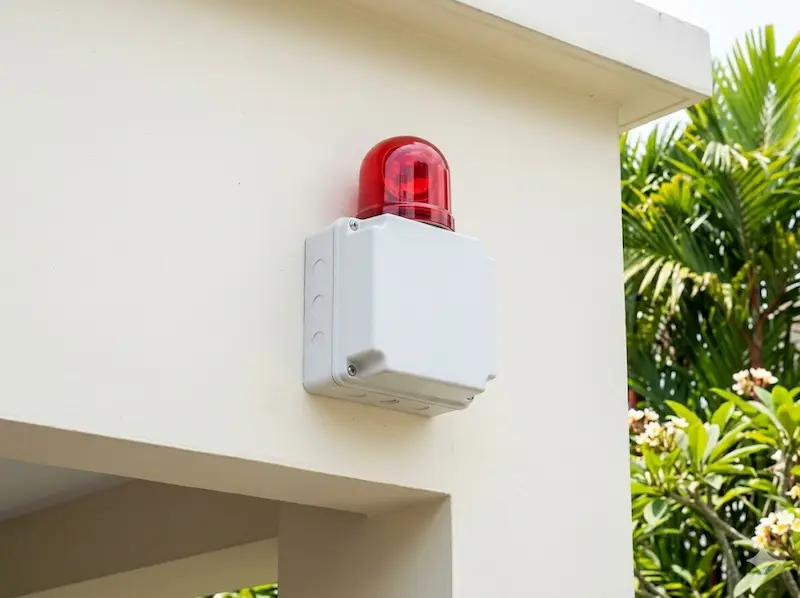
- External sirens usually include a flashing strobe light; the strobe often continues after the siren stops to help identify the affected property.
- Good alarm design is about achieving the right response, not creating the most noise.
Why Did My Alarm Stop Ringing?
One question homeowners occasionally ask is why their alarm sounded for a few minutes and then went quiet. They want to know if something is wrong with the system.
In most cases, nothing is wrong. The system is working exactly as it was designed to.
Many people assume that a burglar alarm should continue sounding until someone arrives and manually switches it off. In reality, modern alarm systems are usually programmed to stop the siren automatically after a preset period. This is not a fault. It is an intentional part of the design, and there are good reasons for it.
KEY POINT
A siren that stops automatically does not mean the alarm has been deactivated. The alarm condition still exists, the panel is still recording the event, and the monitoring centre may still be working through the response process. The siren stopping is not the end of the alarm; it is the end of the noise.
The Purpose of the Siren
To understand why the siren stops, we first need to understand what it is designed to do.
A burglar alarm siren is designed to alert people nearby, attract attention, deter intruders, and inform occupants that something is wrong. Those are its four jobs. All four can be accomplished within the first few minutes of activation.
The siren is not designed to become a permanent source of noise. Once it has achieved its purpose, allowing it to continue sounding indefinitely provides very little additional security benefit, and creates a number of problems that good system design should avoid.
KEY POINT
The siren's job is to trigger a response, not to sustain one. Once the intruder knows they have been detected and the response process has started, the siren has done what it was designed to do.
Why We Often Programme the Siren for Around Four Minutes
Many homeowners are surprised when I tell them this. Although alarm systems may be capable of sounding for up to ten minutes or more, we often recommend a shorter duration for residential properties, and in many cases, around four minutes is more than enough.
By the time four minutes have passed, the intruder already knows they have been detected. The homeowner has received a notification on their mobile. The monitoring centre has received the alarm signal and started the verification process. The response is already in motion.
Allowing the siren to continue for another six minutes rarely improves security. What it does increase is the possibility of disturbing neighbours unnecessarily, especially if the alarm turns out to be false. In a condominium or terrace environment where properties are close together, that matters.
Good alarm design is about achieving the right response, not creating the most noise.
DESIGN RULE
Siren duration should be calibrated to the property type and environment. A standalone industrial property may warrant a longer duration. A condominium unit or terrace house in a dense residential area generally does not. Set it to match the context.
Modern Alarm Systems Are Not Dependent on the Siren
Years ago, the siren was often the primary; sometimes the only; way of alerting people to an intrusion. If nobody heard it, nothing happened.
Today, that is no longer the case. Modern alarm systems send notifications directly to your mobile phone, alert the Central Monitoring Station, notify keyholders, trigger video verification where cameras are linked to the system, and initiate response procedures; all in parallel with the siren, and all continuing after the siren stops.
The siren is the loudest and most visible part of the alarm, but it is no longer the most important. Even after it stops, the alarm event itself remains active. The panel continues to record it. The mobile app continues to display the alarm condition. The monitoring centre may still be verifying and working through the contact list.
The response process does not stop simply because the siren has stopped.
KEY POINT
Think of the siren as the alarm's way of announcing itself to the physical world. Everything that matters in terms of response; notifications, monitoring, verification, despatch; happens through the system's communication channels, not through the speaker on the wall.
What About the Neighbours?
This is one of the biggest practical concerns homeowners raise, and it is a fair one.
Imagine your neighbour goes on a two-week holiday. On the second night, a false alarm occurs at 2am. The siren starts screaming. Nobody is home. Nobody can reset it. Now imagine that siren continuing until the family returns from holiday. By Day 3, the burglar would have left. The police would have attended and cleared. The owner would still be overseas. But the neighbours would be discussing ways to remove the siren themselves.
Alarm systems are not designed that way. The siren stops automatically. The mobile app still receives notifications. The monitoring centre can still receive and process the alarm. Keyholders can still be contacted. The response process continues without the noise.
Good alarm systems protect the property. They should not become the neighbourhood's biggest problem.
PLANNING POINT
In Singapore condominiums, MCST bylaws may impose restrictions on alarm siren duration and audible levels. If you are installing or upgrading an alarm system in a managed estate, check the estate rules before setting siren duration. Four minutes is usually well within any reasonable limit.
The Siren and the Strobe; Two Tools, Two Jobs
Many homeowners focus entirely on the siren and overlook another important component of the external alarm unit; the flashing strobe light.
The siren and the strobe serve different purposes. The siren attracts attention through sound. The strobe helps people identify which property has triggered the alarm. In a residential street where several houses are close together, neighbours may hear the siren but not immediately know where it is coming from. The flashing strobe provides a clear visual indication of the affected property; useful for neighbours, responding security personnel, keyholders arriving at the site, and police officers attending.
This is why external alarm units are installed in visible locations rather than tucked away. The objective is to make them easy to see as well as easy to hear.
In many installations, the siren stops after a few minutes while the strobe continues operating for a longer period. That combination serves both purposes well. The neighbourhood is no longer subjected to continuous noise. At the same time, responders can still identify the property by the flashing light. The strobe acts as a visual beacon that continues directing attention to the correct premises long after the sound has stopped.
DESIGN RULE
Programme the strobe to continue beyond the siren cutoff. It costs nothing in terms of neighbourhood disturbance and provides real value for anyone attending the site. A flashing light is far easier to locate than a memory of where the noise came from.
Good Security Is About Response, Not Noise
One common misconception is that louder and longer automatically means better security. It does not.
The goal of an alarm system is not to make as much noise as possible. The goal is to get the right people to take the right action at the right time. The siren is one tool in that process; an important one, but not the only one and not the most sophisticated one.
An alarm that sounds for four minutes and triggers an immediate monitoring centre response, a mobile notification to the homeowner, and a keyholder call is far more effective than a siren that rings for an hour and reaches nobody. The measure of a good alarm system is not the volume or the duration. It is what happens as a result.
When we design alarm systems, the siren programming is one of the last decisions we make; after the zone layout, the detector selection, the panel specification, and the monitoring arrangement are all in place. The siren serves the system. The system does not exist to serve the siren.
Securevision Verdict
A burglar alarm siren is designed to get attention, not to ring forever. Modern alarm systems rely on much more than just a siren; mobile apps, monitoring centres, keyholders and response procedures all play a part in what happens after the alarm fires.
In many cases, a few minutes of siren activity is enough to deter an intruder and start the response process moving. If a burglar has not left after four minutes of siren, the siren alone was never going to be what stopped them. Good security is not measured by how long the siren rings. It is measured by how effectively the system responds when something happens.
In Short
The siren is the most visible and audible part of an alarm system, but it is not the most important. Its job is to create noise and attention for long enough to prompt a response, not to continue indefinitely. Modern alarm systems do not depend on the siren alone. The communication to the monitoring centre, the mobile notification, the camera verification; these are what turn an alarm event into an effective security response. A siren that runs for four minutes and then stops has done its job. A system that fails to communicate while the siren is sounding has not.

Frequently asked questions
Why does a burglar alarm siren stop ringing after a few minutes?
Alarm sirens in Singapore and most jurisdictions are configured to cut off after a fixed period, typically between 3 and 10 minutes, to prevent continuous noise disturbance to neighbours and the public. This is known as the self-cut-off timer. The alarm system continues to operate and communicate with the monitoring centre after the siren stops; the cut-off affects only the audible output, not the detection or monitoring function.
What is the purpose of the burglar alarm siren?
The siren serves two purposes: deterrence and attention. The noise deters intruders by creating an uncomfortable environment and drawing attention to the property. In the time it takes the siren to cut off, a monitoring centre should have received the alarm signal, begun verifying the event, and initiated a response. The siren buys time for the response process to begin.
Can I set my alarm siren to ring longer than 4 minutes?
The duration of the siren cut-off is configurable in most alarm panels, and your installer can adjust it within the limits permitted by local regulations and the monitoring centre's requirements. However, a longer siren duration does not necessarily improve security outcomes. The critical factor is the response that occurs during the siren's activation; a 4-minute siren with a monitoring centre that responds within 30 seconds is more effective than a 30-minute siren with no monitoring.
What is the difference between a siren and a strobe on an alarm system?
The siren produces the audible alert; the noise. The strobe is a flashing light unit that provides a visual alert, which is useful for identifying the property during an alarm event, particularly at night or in situations where the siren noise alone does not make the alarm location obvious to responding parties. The strobe typically continues to flash after the siren has cut off, maintaining visual identification of the property.
Will the siren work if the power is cut?
Yes. The siren is powered through the alarm panel, which runs on backup battery during a mains power failure. The siren will activate and operate normally on battery power.
What is an external alarm box and why is it important?
The external alarm box; the housing mounted on the outside wall of the property; contains the siren and strobe and provides visible evidence that an alarm system is installed. Its presence alone has deterrent value. A dummy box with no active components provides some deterrent but no actual alarm function. A genuine, fully functioning external siren and strobe is recommended for any property where security is a real concern.
How loud is a burglar alarm siren?
External alarm sirens typically produce between 100 and 120 decibels at one metre distance; comparable to a chainsaw or a rock concert. This level is sufficient to be heard at a distance in a residential environment and uncomfortable enough to discourage intruders from remaining in the property. Internal sounders used for audible warning inside the property are typically quieter.
What happens after the siren stops; is the alarm still active?
Yes. After the siren cuts off, the alarm system remains in alarm state; the panel continues to log events, the monitoring centre is still tracking the activation, and if any further detector triggers occur, the response protocol continues. The siren stopping does not mean the event has ended or been resolved.
Can my neighbours trigger a noise complaint about my alarm siren?
Persistent or repeated false alarm activations can lead to noise complaints from neighbours. Singapore has provisions under the Environmental Protection and Management Act relating to noise nuisance. The most effective way to prevent complaints is to maintain the alarm system properly, address false alarm causes promptly, and ensure the siren cut-off timer is set to a reasonable duration. A well-maintained alarm should not trigger more than once or twice per year under normal circumstances.
How do I stop my alarm siren if I cannot reach the keypad?
Most alarm systems can be silenced through the keypad by entering the correct disarm code. If you cannot reach the keypad, some systems support disarming through the mobile app. If neither is accessible, contact your monitoring centre; they may be able to provide guidance based on your specific panel. As a last resort, removing the battery inside the external siren box will silence the external siren, but this should only be done by the system owner and not as a routine practice.