- The effectiveness of an alarm system depends more on how it is used than on which brand was installed or how much it cost.
- Many homeowners only arm the system when they leave, but arming at night using Stay Mode provides protection while the household is home and asleep.
- Stay Mode keeps the perimeter armed while bypassing interior motion detectors, allowing normal movement inside the property overnight.
- Entry and exit delays should be configured to match your lifestyle; rushing to beat a countdown is a programming setting, not a fixed requirement.
- A beeping keypad is the system communicating a condition that needs attention, not a malfunction to be silenced and ignored.
- A modest alarm system used consistently every day provides more protection than an expensive system that is only armed occasionally.
The Most Expensive Alarm System Is Useless If Nobody Arms It
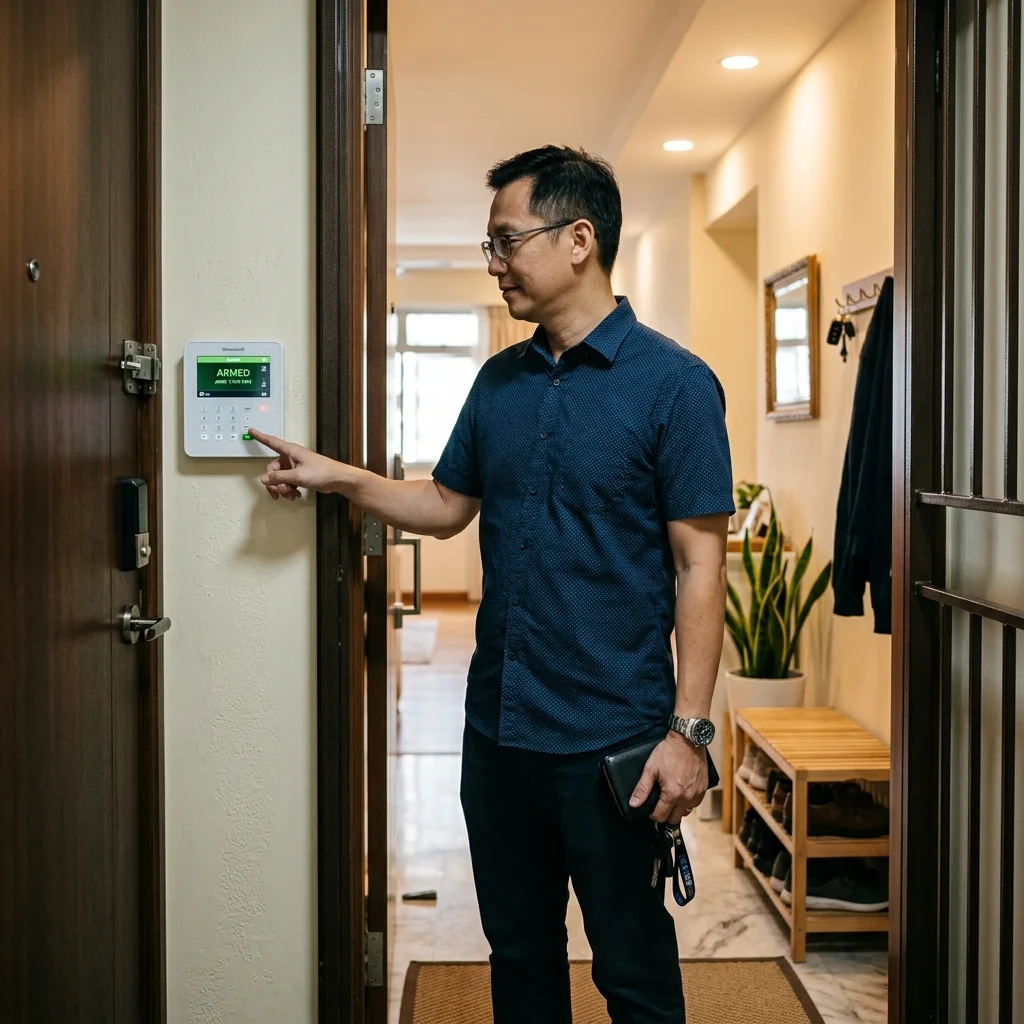
One of the more surprising things I have observed over the years is that most alarm systems are installed correctly but used incorrectly. The installer does their job thoroughly; the system is tested, the detectors work, the siren works, the mobile app is configured, the handover is completed properly. Then six months later, the homeowner has forgotten half of what was explained during the handover.
The alarm is armed occasionally rather than consistently. The keypad starts beeping and nobody investigates why. The mobile app notifications are dismissed without being read. And gradually the alarm becomes something that exists in the house rather than something that actively protects it. The system is still there. It simply is not being used.
The best alarm system in the world cannot protect a property if it is not being used. In my experience, the difference between a useful alarm system and one that provides no real protection is usually not the technology; it is the habit of using it. This article is about the common usage mistakes and the simple changes that make a meaningful difference.
KEY POINT
Technology creates the capability. Habit creates the protection. An alarm system that is armed every day; even a modest one; provides more security than an expensive system that is only switched on after a nearby incident reminds the household it exists.
The Biggest Mistake: Only Arming When You Leave
Most homeowners think of the alarm system as something that protects the property when nobody is home. You arm it when you leave for work. You disarm it when you return. The alarm protects the empty house. That is one valid use. It is not the only one.
One of the most important times to use an alarm system is when the household is home and asleep. A burglar who encounters an occupied property at 2am typically wants to leave quickly. But the occupants may not be aware of the intrusion until it is too late; particularly in larger Singapore landed properties where a ground floor entry is not audible from an upstairs bedroom. An armed perimeter changes that situation entirely.
Most modern alarm panels support two arming modes. The full away mode activates every detector in the system; motion detectors, door contacts, window contacts. This is appropriate when everyone has left the property and the entire space needs protection. Stay mode is the one most homeowners never use. In stay mode, the perimeter detectors; door contacts, window contacts, and external motion sensors; remain active, but the interior PIR detectors are bypassed. The household can move freely through the house, go to the kitchen, walk down the corridor, use the bathroom at night. Normal life continues. But if anyone attempts to enter through a door or window while the household is sleeping, the alarm activates immediately.
In Singapore, where landed properties often have multiple access points and where the ground floor may be separated from sleeping areas, stay mode is not a convenience feature; it is one of the most practically useful configurations available. An alarm armed in stay mode every night protects the people inside the house, not just the possessions.
KEY POINT
If your alarm has a stay mode and you are not using it overnight, you are leaving the most vulnerable period of the day unprotected. Check your panel's manual or ask your installer how to enable it, on most systems it is a single button or a dedicated code from the keypad.
Stop Treating the Entry Delay Like an Olympic Event
Almost every alarm system includes an exit delay; the time you have to leave the property after arming, and an entry delay, the time you have to enter and disarm before the alarm activates. These delays exist to make daily use practical. They are not fixed constraints that the homeowner has to adapt to.
What I find surprisingly common is homeowners who rush through the front door every time they return home, drop their bags, fumble for the keypad, and try to enter their PIN before the countdown ends. If you arrive home regularly carrying groceries, children, shopping bags, or luggage, or if you share the property with elderly residents or young children who move more slowly; there is nothing wrong with increasing the entry delay by ten or fifteen seconds. The system will still arm correctly. The protection will be identical. The daily stress of racing a countdown will disappear entirely.
The same applies to exit delays. If you regularly find yourself rushing out the door because the delay is too short for your routine, ask your installer to adjust it. These are programming settings, not hardware limitations. The objective of the system is security, not a daily test of how quickly you can enter a PIN.
PLANNING POINT
Entry and exit delays are typically adjustable between 15 and 60 seconds on most panels. If you find yourself consistently rushed, a simple reprogramming visit takes minutes. An alarm system that fits your routine is one you will actually use.
The Keypad Is Talking to You
Most homeowners experience a beeping keypad at some point and treat it as an annoyance to be silenced. The instinct is to find the fastest way to stop the noise. What the keypad is actually doing is trying to communicate a condition that requires attention.
The most common causes of an unexpected beeping or trouble indicator are a backup battery that has dropped below adequate voltage, an AC power failure the panel has detected, a communication fault where the panel has lost contact with the monitoring centre, a detector reporting a fault or tamper condition, or a wiring issue that has entered the panel's warning threshold. None of these is a reason to panic. All of them are reasons to investigate and resolve before the condition worsens.
The worst response is to find the silence code, clear the fault indication, and continue without understanding what caused it. That approach works exactly once before the same condition reappears; often at a worse stage. A low battery warning that is silenced without the battery being replaced will eventually result in a flat battery during a power outage. A communication fault that is cleared without investigation may mean the alarm has been unable to reach the monitoring centre for days.
When the keypad starts beeping, the first question to ask is not how to silence it; it is what it is saying. On most modern panels, the display will show a fault code or indicator that identifies the specific condition. If the display is not clear, the event log will show when the fault started and what triggered it. That information usually makes the cause obvious.
KEY POINT
The keypad is the alarm system's way of communicating with you. Silencing it without reading the message is like ignoring a warning light on a car dashboard; the problem does not go away, it simply becomes invisible until something more serious happens.
The Alarm Went Off. Now What?
Sooner or later, almost every alarm owner accidentally triggers their own system. Someone opens the wrong door before disarming. A family member enters through an unusual route. Someone forgets the system is armed and walks through a motion detector zone. It happens, and it is not a reason for concern if handled correctly.
The important thing is not to panic and not to simply clear the alarm and move on without investigating what triggered it. Disarm the system, then check the keypad or the app to see which zone activated and at what time. Most alarm systems maintain a detailed event history. A few seconds reviewing that history usually makes the cause obvious, and that understanding prevents the same false alarm from recurring.
A false alarm is only a problem if you never understand why it happened. An alarm that activates repeatedly from the same zone without explanation deserves investigation; a loose door contact, a detector in a problematic position, an environmental trigger that was not present when the system was installed. The system is trying to communicate something. Finding out what is almost always more useful than resetting and hoping it does not happen again.
KEY POINT
Never clear an alarm activation without noting which zone triggered and why. One unexplained activation might be user error. The same zone triggering repeatedly is a pattern that needs to be identified and addressed.
The Feature Most People Never Know About
Many professional alarm systems support a feature called a duress code; a separate PIN that disarms the alarm normally when entered but simultaneously sends a silent emergency signal to the monitoring centre in the background.
The scenario it addresses is a forced disarm; someone compelling the homeowner to disarm the system under duress. Entering the duress code rather than the normal user code disarms the alarm as expected, so the situation does not escalate. To an observer, everything appears normal. But the monitoring centre receives a silent alert that something is wrong and initiates an emergency response without any visible indication at the keypad.
Fortunately, very few people will ever need to use this feature. But it is one of those functions that is worth understanding before you need it rather than trying to recall in a stressful moment. If your alarm system is connected to a professional monitoring centre, ask your provider whether a duress code has been programmed, what the code is, and how it should be used. On many installations this is configured during setup but never explained to the homeowner.
PLANNING POINT
Ask your monitoring centre provider whether a duress code is configured on your account. If it is not, ask them to set one up. If it is, make sure you know what it is and that you can recall it under stress, not a number that requires thought to remember.
The Habit That Matters Most
People often ask which alarm panel they should buy, or which brand is best. Those are reasonable questions. The brand matters. The technology matters. The installation quality matters. But after many years in this industry, I have become convinced that none of those factors matters as much as the habit of using the system consistently.
A modest alarm system that is armed in stay mode every night and in away mode every time the household leaves; checked regularly, responded to when it generates a notification, maintained annually; provides meaningful protection every single day. An expensive, well-specified system that is armed occasionally, whose notifications are ignored, whose beeping keypad has not been investigated in months, and whose backup battery has never been replaced, provides almost none.
Building the habit is simpler than it sounds. Arm the system in stay mode when the last person goes to bed; make it part of the same routine as locking the front door. Arm in away mode when leaving; treat it the same way you treat checking you have your keys. When the app sends a notification, read it. When the keypad generates a warning, investigate it the same day. These are small actions that take seconds each. Accumulated over weeks and months, they are the difference between a security system that earns its installation cost and one that becomes a dormant box on the wall.
Securevision Verdict
Most alarm systems do not fail because of technology. They fail because people stop using them properly. The homeowners get busy. Routines change. The alarm is no longer armed consistently. And eventually the system becomes something that is only switched on after a nearby incident reminds everyone why it was installed in the first place.
The best alarm system is not necessarily the newest or the most expensive one. It is the one that becomes part of the daily routine; armed every night, armed every time you leave, maintained regularly, and responded to when it tries to communicate something. An alarm system used consistently provides protection every day. An alarm system that is ignored provides none.
In Short
The most expensive burglar alarm in Singapore cannot protect a property that is never armed. Consistent daily use; arming when you leave, arming when you sleep, using partial arming, responding correctly when the alarm sounds; is what determines whether a system provides real security or simply provides the appearance of it. The habits that matter most are not technically complicated. They are simply habits, and habits require formation. The first few weeks with a new system are the most important period for building the routines that will define how the system performs for years afterwards.

Frequently asked questions
Why do people not arm their burglar alarm consistently?
The most common reasons are: the entry delay is too short and generates repeated false alarms when the user is slightly late to disarm; the system is inconvenient to arm and disarm; the user has experienced a false alarm and lost confidence in the system; or the habit was simply never established in the early days after installation. Most of these are fixable; either through system adjustment or through deliberate habit formation.
What is the best time to arm my burglar alarm?
Arm when you leave the property and arm when you go to sleep. These two habits provide the most significant security benefit. Some homeowners also arm during the day if they are working from home in a specific area and want to protect other parts of the property; this is where partial arming is useful.
What is partial arming and when should I use it?
Partial arming; also called stay arm or home arm; activates only selected zones of the alarm while leaving others disabled. This allows you to arm the perimeter of the property while remaining able to move freely inside. It is useful for overnight arming when occupants are present, or during the day when you are in one part of the property and want the rest protected.
What is the entry delay and how should I set it?
The entry delay is the period between an entry point triggering and the alarm sounding, giving you time to disarm after entering. It should be set to the minimum duration that is practically achievable; long enough that a person entering normally can reach the keypad and disarm, but short enough that an intruder cannot benefit from it. For most Singapore homes, 20 to 30 seconds is sufficient.
Why does my alarm go off when I come home?
This is almost always an entry delay issue; either the delay is too short, the keypad is too far from the entry point, or the user is not disarming quickly enough. Check that the entry delay is set to a practical duration and that the route from the entry point to the keypad is unobstructed. If the problem persists, ask your installer to review the entry delay configuration.
What should I do when my alarm goes off?
If you are at home and know the activation was caused by user error, disarm the system. If you are away from home and receive a notification, assess what the monitoring centre has told you before deciding whether to attend or wait for keyholder confirmation. Never assume a genuine activation is a false alarm until you have had the opportunity to verify. Contact the monitoring centre if you are unsure how to respond.
What keypad messages should I pay attention to?
Pay attention to: any fault indicator (a flashing or lit fault light); a low battery warning; a zone shown as open when the corresponding door or window should be closed; and any tamper warning. These messages are not background information; they indicate that something needs attention. Contact your installer if any of these appear and you cannot identify and resolve the cause.
Can I arm my alarm from my phone?
Most modern alarm panels support smartphone apps that allow remote arming and disarming. This is useful for confirming the system is armed after leaving home, or for disarming remotely to allow access for a visitor or contractor. Remote arming should be done with care; confirm that the property is unoccupied before arming remotely to avoid triggering the alarm with an unexpected person present.
How do I get my family members to use the alarm consistently?
Ensure everyone who uses the property knows how to arm and disarm, understands the entry and exit delays, and knows what to do if the alarm sounds. A brief demonstration at the time of installation is rarely sufficient; follow up after the first week and address any difficulties that have arisen. The first month of use is the most critical period for establishing consistent habits.
What is a duress code and when should I use it?
A duress code is a special PIN that disarms the alarm normally in appearance but silently sends an alert to the monitoring centre indicating that the user is under duress and the response should be treated as a genuine emergency. If you are forced to disarm your alarm by an intruder, entering the duress code instead of your normal PIN will appear to comply with the demand while notifying the monitoring centre. Ask your installer whether your system supports a duress code and ensure you remember the correct code.