- Most security-related site variations are coordination failures, not equipment failures; the camera is easy; the missing conduit is what creates a costly variation.
- Security systems touch architecture, M&E, IT, fire protection, and civil works simultaneously; no single discipline owns the coordination, which is exactly why it fails.
- The architect's role is not to design the security system but to ensure the design can accommodate it; equipment locations, cable routes, rack space, and reader positions should be resolved during design, not discovered during construction.
- Any electronically locked door on an escape route must release during a fire emergency; this is a mandatory BCA/SCDF requirement, not a design preference, and it requires a confirmed interface between the fire alarm system and the access control system.
- Rough-in provisions; conduit, sleeves, trunking, power points; should be identified and included in the construction drawings before the security contractor arrives on site.
- Good tender documentation defines functional requirements, not just product schedules; it is the difference between obtaining comparable prices and obtaining incomparable ones.
The Problem Nobody Owns
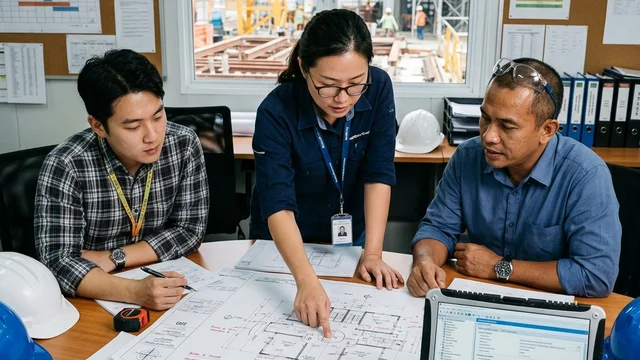
One of the most consistent patterns in security system installations across Singapore construction projects is the coordination gap. The architect assumes the M&E consultant will handle the security provisions. The M&E consultant assumes the security contractor will sort it out later. The IT consultant assumes it belongs to the electrical contractor. The builder assumes it is somebody else's problem. Then six months into construction, everyone is standing on site asking where the conduit for the camera is, how power is getting to the access control panel, and who coordinated the fire alarm interface.
At that point, the problem becomes expensive. Hacking into completed plastered walls to chase conduit. Cutting into finished ceiling voids to run cable routes. Raising variations for work that should have been included in the original scope. Delaying the handover while interfaces between systems are resolved retrospectively. Every one of these outcomes was preventable, not through better technology, but through better coordination earlier in the design process.
Security systems are unusual in construction because they genuinely touch almost every discipline. They require architectural coordination for equipment locations and aesthetic integration. They require M&E coordination for power supplies and conduit. They require IT coordination for network infrastructure. They require fire protection coordination for emergency release interfaces. They require civil works for vehicle management infrastructure. The projects that run smoothly are almost always the ones where these coordination points were identified and resolved during design rather than discovered during construction.
KEY POINT
Security systems have no natural owner in a typical construction project team. That absence of ownership is the root cause of most security-related site problems. Someone needs to take responsibility for coordination, and on most projects, the architect is best positioned to do it.
The Architect's Role in Security Coordination
Many architects believe their involvement with the security system begins and ends with the client's product selection. In practice, that is when the coordination work starts. The architect is not expected to design the security system, that remains the responsibility of the specialist security consultant or integrator. The architect's responsibility is to ensure the building design can actually accommodate the system that has been specified.
That means resolving specific questions during the design stage. Where will the cameras be mounted, and at what heights, to achieve the required coverage without conflicting with architectural features, light fittings, or sprinkler heads? Where will the security equipment room or rack be located, and does it have adequate space, ventilation, power supply, and cable entry provisions? How will cables travel from camera positions back to the rack; through what ceiling voids, conduit routes, and risers? Are card reader positions coordinated with door ironmongery, finished wall surfaces, and the structural elements of the door frame? Does the equipment room location make sense for the cable routes required, or will it create unnecessarily long runs that affect system performance?
None of these questions require security expertise to ask. They require exactly the same coordination discipline that architects apply to any other building service. The difference is that security is often treated as a late addition rather than an integrated building service, which means these questions get asked on site rather than on paper, at a cost that is always significantly higher.
KEY POINT
Good coordination is invisible; it means a security contractor who arrives on site finds the conduit already in place, the power points already installed, and the equipment room already sized correctly. Poor coordination is very visible and very expensive.
The Four Security Layers Every Designer Should Understand
Architects and interior designers do not need to become security specialists. But understanding the four major security layers found in most modern Singapore projects, and their specific coordination requirements; is sufficient to avoid the most common and most expensive problems.
CCTV and surveillance systems are primarily a coordination challenge around visibility, cable routing, and equipment location. Camera positions need to be identified on the architectural drawings, with confirmed mounting heights and angles, so that structural provisions and conduit routes can be incorporated during construction. The recording equipment location needs to be confirmed with adequate space, network connectivity, and power supply. One missing conduit sleeve through a concrete slab or structural wall can easily generate a variation that costs more than the camera it was meant to serve.
Access control introduces a more complex set of coordination requirements because it sits at the intersection of the architectural design, the door hardware schedule, the electrical services, and; critically; the fire protection system. Reader positions need to be coordinated with door ironmongery and finished wall surfaces. Locking devices need to be confirmed with the door supplier and the electrical contractor. Controller locations need network and power connections. And every door with electronic locking that forms part of a required escape route needs a confirmed fire alarm interface; a subject covered in detail in the next section.
Vehicle management systems; barriers, LPR cameras, gantries, inductive loops; require civil and structural provisions that must appear on site plans long before construction begins. Gantry positions determine traffic flow geometry and queuing distances. Inductive loop detectors require saw-cuts or pre-formed channels in the road surface. LPR camera positions require specific sightlines that may conflict with landscaping, signage, or structural elements if not resolved during design. Power and data connections to remote barrier positions require underground ducting that is most economically installed before the road surface is laid.
Platform integration; the sharing of network infrastructure between CCTV, access control, intercom, visitor management, and building management systems; requires IT coordination that is increasingly significant as these systems converge on common IP infrastructure. The same network switch may serve cameras, access control panels, and intercoms simultaneously. That convergence creates bandwidth, security, and VLAN design considerations that need to be resolved between the IT consultant and the security integrator before equipment is specified, not after it is installed.
KEY POINT
Each security layer has its own coordination requirements. CCTV primarily needs cable routes and equipment space. Access control needs door hardware coordination and fire alarm interfaces. Vehicle management needs civil provisions. Platform integration needs IT infrastructure planning. Treating them as a single undifferentiated requirement misses the specific coordination actions each one demands.
The Fire Code Requirement That Gets Missed Most Often
If there is one coordination issue I wish every architect and interior designer understood before specifying access control, it is this: fire code requirements override security requirements. Under Singapore's fire safety regulations, any door forming part of a required means of escape must be capable of being opened from the inside at all times. Any electronically locked door on an escape route must release automatically when a fire alarm activates, without requiring any action from the occupant and without depending on manual override by security staff or building management.
This is not a design preference or a best-practice recommendation. It is a mandatory requirement enforced by SCDF. A building that fails to comply; because the access control system was specified without a confirmed fire alarm interface, because the interface was designed but not correctly installed, or because the fire alarm contractor and the access control contractor never coordinated their respective works; is a building that will not receive its Temporary Occupation Permit until the non-compliance is rectified. Rectification after construction is complete is expensive, disruptive, and sometimes structurally complex.
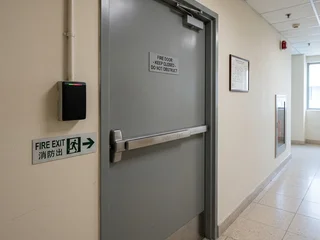
The practical implication for the design team is straightforward: whenever access control is specified for a door, the question of how that door behaves during a fire emergency must be answered and documented before the tender package is issued. The fire alarm contractor and the access control contractor need a confirmed interface specification, typically a dry contact output from the fire alarm panel that triggers fail-safe release of the locking device. Both contractors need to understand their respective responsibilities for that interface, and both need to be on site for the commissioning and testing of the combined system.
The design stage is also the right time to resolve any apparent conflicts between security requirements and fire egress requirements. A high-security server room that requires two-factor authentication for entry cannot maintain that requirement during a fire emergency; the means of escape provisions take precedence. Resolving those conflicts on paper, with the client's agreement on the acceptable design solution, is significantly less costly than discovering them during the fire safety inspection.
KEY POINT
Every access-controlled door on an escape route requires a confirmed, tested interface to the fire alarm system. This interface needs to be specified in the tender documents, coordinated between contractors during construction, and jointly commissioned and tested before occupation. It is not optional and it cannot be retrofitted without significant cost and disruption.
Rough-In Requirements; The Most Cost-Effective Coordination
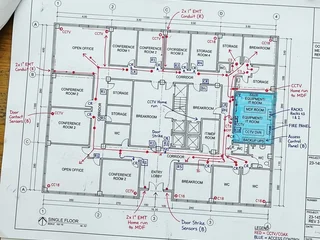
The single most cost-effective coordination action available to a project team is identifying security rough-in requirements; conduit, cable sleeves, trunking, power points, equipment wall plates, and incorporating them into the construction drawings before the structure is built. The cost of a 25mm conduit sleeve through a reinforced concrete slab during construction is negligible. The cost of core-drilling and making good after the slab is poured is orders of magnitude higher, and the structural consequences may be significant depending on the location.
This sounds obvious but it requires a specific discipline in the design process. Someone needs to prepare a security rough-in schedule; a drawing or schedule that identifies, for every security device in the project, what conduit size is required, where it needs to go, and what power supply provisions are needed. That schedule needs to reach the M&E engineer and the structural engineer before their drawings are finalised, so that the provisions can be incorporated into the construction documents rather than added as late variations.
The security integrator is the right person to prepare this schedule; they understand the cable requirements, the conduit sizing, and the power needs of every device in the system. But they can only prepare it if they are engaged early enough in the design process to contribute meaningfully. A security integrator appointed after the structural drawings are complete cannot change what is already in the concrete. Early appointment; even at schematic design stage for complex projects; is what makes this coordination possible.
KEY POINT
A security rough-in schedule, prepared by the integrator and incorporated into the construction drawings before structure is built, is the single highest-return coordination investment available on any project. The cost is a few hours of coordination effort. The saving is the elimination of the variations that would otherwise arise.
Four Coordination Meetings Worth Having Early
If I could insist on four meetings for every Singapore construction project with a significant security scope, these are the ones that prevent the most problems. None of them needs to be long. All of them need to happen before construction reaches the stage where the relevant provisions can no longer be incorporated without variation.
The first is the security integrator meeting with the architect and interior designer. The agenda is equipment locations; confirming camera positions on the architectural drawings, reader locations on the door schedule, equipment room size and location, and any aesthetic coordination issues such as camera housings, reader finishes, and cable concealment. This meeting should happen during schematic or design development stage, when changes to the architectural drawings are still straightforward.
The second is the security integrator meeting with the M&E engineer. The agenda is infrastructure; conduit routes, cable sleeves, power supply points, containment, and any shared trunking with other building services. The output should be a coordinated services drawing showing security conduit routes alongside electrical, data, and mechanical services, confirming that no conflicts exist and that all rough-in provisions are captured in the M&E drawings.
The third is the security integrator meeting with the IT consultant. The agenda is network infrastructure; switch locations, VLAN design, bandwidth requirements, and the demarcation between active IT infrastructure and security infrastructure. This meeting is increasingly important as more security systems converge on shared IP networks, and it often reveals assumptions on both sides that need to be resolved explicitly rather than discovered after installation.
The fourth is the security integrator meeting with the door supplier and ironmongery consultant. The agenda is locking hardware; confirming that every door with electronic locking has been specified with the correct locking device, the correct power supply arrangement, and the correct fire alarm interface. This is the meeting that prevents the single most common and most expensive access control site problem: discovering after the doors are hung that the locking hardware is incompatible with the access control system.
KEY POINT
These four meetings address the four most common sources of security-related site variations. Most of the problems they prevent take a fraction of the time to resolve on paper that they take to resolve on site, and on site, they are always more expensive.
What Good Tender Documentation Actually Contains
Many security tender documents issued for Singapore construction projects are essentially product schedules; a list of camera models, reader types, and recorder specifications, with a request for prices. This approach produces tenders that are difficult to compare, prone to omissions, and frequently the starting point for disputes about what was and was not included in the original scope.
A properly prepared security tender document defines the requirement rather than just the product. It starts with functional requirements; what the system needs to achieve, which areas it needs to cover, what behaviours are required under different conditions; so that tenderers understand the intent and can propose solutions that meet it. It includes performance requirements where relevant; recognition accuracy for LPR, detection sensitivity for intrusion systems, retention period for CCTV. It includes a bill of quantities or equipment schedule that defines what is to be priced, so that all tenderers are pricing the same scope. And it includes drawings that show equipment locations, cable routes, and interface points, so that the physical installation scope is defined rather than assumed.
Compliance requirements; licensing, certification, testing standards, commissioning procedures; should be explicit rather than implied. Integration requirements; the specific interfaces between security systems and other building systems; should be specified with enough detail that the security contractor and the other contractors involved can confirm they understand their respective responsibilities before pricing.
The objective of a tender document is not simply to obtain prices. It is to obtain comparable prices from tenderers who understand the same scope, and to create a contract document that defines the delivery clearly enough that disputes about scope, quality, and completeness can be resolved by reference to the document rather than by argument. Security tenders that are prepared as product schedules rarely achieve either objective.
Securevision Verdict
The most successful security projects are rarely the most technologically advanced. They are the best coordinated. When architects, M&E consultants, IT teams, and security specialists engage early and work through the coordination requirements methodically; equipment locations, rough-in provisions, fire alarm interfaces, network infrastructure, tender documentation; installation becomes straightforward and handover happens on time.
When security is left until late in the design process and treated as something the security contractor will sort out on site, the problems become expensive and the project team spends more time managing variations than managing the build. The technology itself is almost never the hard part. Getting everyone to plan for it properly is where the real work, and the real value; lies.
In Short
Security is not an add-on to a building design; it is a dimension of the design that affects every system in the building and every stage of the construction programme. The architects and consultants who get it right are those who treat security coordination as a design discipline, not a contractor procurement exercise. Rough-in for conduit, cable routes, and containment costs almost nothing during construction and saves many thousands during fit-out. Getting the fire-access door configuration right during design prevents years of operational compromise. The decisions that matter most are made before a single cable is installed.

Frequently asked questions
What security systems does an architect need to coordinate during a building project?
The main security systems requiring architectural coordination are: burglar alarm and intruder detection, CCTV surveillance, door access control, video intercom, vehicle access management, and in larger projects, integrated security management platforms. Each system has physical space requirements, cable routing needs, power provisions, and interface requirements with fire safety, BMS, and M&E systems that must be resolved during the design phase.
When should security planning begin in a building project?
Security planning should begin at the schematic design stage; before detailed design is finalised. The decisions that most affect security system cost and performance are made during early design: door locations and security classifications, cable containment routes, equipment room allocations, and the integration strategy between security and other building systems. Starting late means retrofitting, which always costs more and compromises the outcome.
What is the rough-in requirement for security systems?
Rough-in refers to the installation of conduit, cable trays, back boxes, and containment pathways during construction; before the security equipment itself is installed. Rough-in must be coordinated with M&E and structural contractors and completed before finishes are applied. The cost of installing conduit during construction is a fraction of the cost of core-drilling or surface-mounting trunking after completion.
How does fire code affect security system design in Singapore?
The SCDF Fire Code in Singapore requires that fire-rated doors, including stairwell doors and certain corridor doors; are kept closed at all times. Access control on fire doors must use fail-safe locks that release upon fire alarm activation, and the integration between the access control system and the fire alarm panel must be designed and tested during commissioning. This is one of the most commonly missed coordination requirements in Singapore building projects.
What is a fail-safe lock and when is it required?
A fail-safe lock is a lock that releases; allowing the door to open freely, when power is removed. This is required on any door that is on a designated fire egress route, ensuring that occupants can exit in an emergency even if the access control system loses power. Specifying a fail-secure lock (which locks when power is lost) on a fire egress door is a serious fire safety error that creates a legal liability for the project team.
What information should security tender documentation include?
Good security tender documentation should include: a detailed system specification describing coverage, zone layout, and performance requirements; equipment schedules specifying the type and quantity of each component without unnecessarily restricting to a single brand; installation methodology requirements; testing and commissioning procedures; handover requirements including documentation and training; and post-installation maintenance and warranty terms.
How should an architect coordinate between the security and fire alarm contractors?
The integration between fire alarm and security systems; particularly access control on fire doors and CCTV integration with fire alarm events; must be defined in the project specification and coordinated between the two contractors under the architect's direction. A coordination meeting between the fire alarm, access control, and security contractors early in the project, with the fire consultant present, is the most effective way to resolve integration requirements before installation begins.
What are the most common security coordination failures in Singapore building projects?
The most common failures are: conduit and cable routes not included in the rough-in programme, discovered during fit-out; fire door access control specified without coordination with the fire consultant, resulting in the wrong lock type; security equipment room space not allocated or inadequately sized; power provisions for security equipment not included in the M&E design; and security system integration requirements discovered after practical completion when changes are expensive.
What are the four security layers an architect should understand?
The four layers are: deterrence (making the property appear difficult to approach undetected; lighting, visibility, signage); detection (identifying an intrusion when it occurs; alarm detectors, CCTV, access control logs); delay (physical barriers that slow an intruder and extend the response window; quality locks, reinforced doors, perimeter barriers); and response (the human or automated action taken when an intrusion is detected; monitoring, patrol, police). A well-designed building incorporates all four layers.
How should a security consultant be engaged in a building project?
A security consultant can be engaged at the schematic design stage to develop a security concept aligned with the building's risk profile, advise on system integration strategy, and prepare performance specifications for contractor tender. They should also be involved in reviewing contractor proposals and commissioning the installed systems. For complex projects, engaging a security consultant alongside the M&E team from the outset is the most cost-effective approach.