- The gate itself is usually more important than the motor; a poorly aligned, heavy, or mechanically unsound gate will wear out even the best motor prematurely.
- Motor selection starts with gate type (swing or sliding), gate weight, hinge condition, and daily usage frequency, not brand or price.
- If the gate feels heavy when operated manually, it will feel heavy to the motor, that resistance shortens motor life significantly.
- Undersizing a motor is almost always a mistake. Oversizing purely for the sake of it provides diminishing returns. Correct matching to the application is the goal.
- Safety sensors are as important as the motor; a gate that does not detect obstacles puts children, elderly residents, pets, and vehicles at risk.
- Before the installer leaves, the manual release procedure should be demonstrated to every member of the household, not just the person who signed the order.
Most Homeowners Start by Looking at the Motor
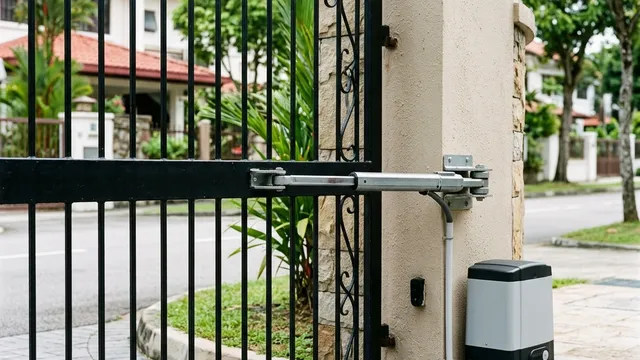
When people contact us about automating their gate, the first question is almost always which motor to recommend. It sounds reasonable. But after many years installing and maintaining gate systems across Singapore, I have learned that it is often the wrong place to start.
Before I discuss any motor, I want to know what type of gate the property has, how heavy it is, whether it is properly aligned, and how many times it opens each day. Because the motor is only as good as the gate it is attached to. I have seen expensive motors fail within a few years because the gate was dragging on the ground. I have also seen modest motors continue working reliably for many years because the gate was properly maintained and correctly balanced. The condition of the gate often matters more than the brand of the motor.
KEY POINT
A motor recommendation without a gate assessment is an incomplete recommendation. The two components are interdependent; specifying the motor before understanding the gate is working in the wrong order.
Think of the Motor as the Engine
The analogy I find most useful is a car towing a heavy trailer. The car may manage it. But a small engine towing more than it was designed for will run hotter, wear faster, and reach the end of its useful life significantly sooner than one operating within its design parameters. The same principle applies to gate motors with considerable precision.
A motor that is constantly working against an oversized gate, a gate that is out of alignment, or one whose hinges are stiff and resistant will age far faster than one that opens a well-balanced gate within its specified weight range. Every operation cycle puts stress on the motor's gearbox, its drive mechanism, and its thermal management. Multiply that stress across ten, twenty, or thirty operations per day; a typical Singapore household with a busy driveway, and the cumulative effect over two or three years becomes significant.
This is why motor selection should always begin with the gate. Not with the brochure, not with a brand comparison, and not with the cheapest option available. Begin with the gate.
KEY POINT
Motor lifespan is determined as much by what it is attached to as by its own build quality. The best motor in the market will underperform and fail early if it is fighting a gate that was never suitable for automation.
The First Decision: Swing or Sliding?
Most residential gates in Singapore fall into one of two categories, and the choice between them is usually determined by the property layout rather than personal preference.
Swing gates open like a door; rotating on hinges at one or both sides of the opening. They are the more common configuration in Singapore landed homes where the driveway has sufficient depth to accommodate the gate's arc as it opens. A single-leaf swing gate covers the full opening width from one side; a double-leaf system splits the gate into two panels that open from the centre. The motor for a swing gate is typically mounted at the gate post or embedded in the ground at the pivot point, driving the gate through a mechanical arm or underground actuator.
Sliding gates move laterally along a track, requiring space beside the opening to park the gate leaf when open. They are often the preferred or only practical option when the driveway slopes; a swing gate on a slope requires careful design to clear the ground across its full arc, or when the driveway is too short for a swing gate to open fully without hitting a parked vehicle. Sliding gates require a clean, level track and rollers in good condition; a track that has settled unevenly or rollers that have worn flat create exactly the kind of resistance that shortens motor life.
PLANNING POINT
If you are installing a gate for the first time, establish whether your driveway geometry supports a swing gate before defaulting to one. A sliding gate on a property where the driveway allows it is often the more mechanically forgiving option; there is no arc clearance issue and the weight is carried on rollers rather than cantilevered from hinges.
Not All Swing Gates Are Equal
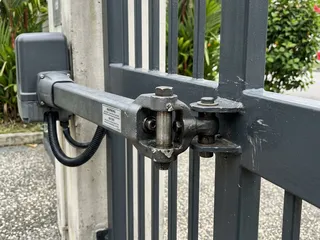
One of the most common assumptions homeowners make is that all swing gates require the same motor. They do not. A lightweight aluminium gate and a heavy wrought iron gate of the same width present completely different loads to the motor. A well-balanced gate that pivots smoothly on well-maintained hinges and a gate that places its full weight on a cantilever arm behave very differently under power.
Gate width is only part of the picture. A wide aluminium gate may weigh less than a narrow wrought iron one. Hinge condition matters; hinges that have not been lubricated in years or that have developed play from wear will add resistance that the motor must overcome on every cycle. The opening geometry affects the torque required at the start of the swing, which is the moment of highest mechanical stress. A gate that opens outward onto a slope requires the motor to work against gravity during part of every opening cycle.
In Singapore's climate, there is also the question of material maintenance. Steel gates that have been exposed to the tropical humidity without adequate rust treatment can develop surface corrosion on hinges and frame joints that is invisible from a distance but creates significant added resistance. A gate that looks perfectly functional from the street may be considerably harder to move than its physical weight suggests.
PLANNING POINT
Before any motor is specified, test the gate manually. Open it fully by hand, without any motor assistance, and notice whether it moves freely or requires effort. If there is resistance, find and address the source before installing the motor. Mechanical problems do not disappear under power; they become the motor's problem.
The Problem Is Often the Gate, Not the Motor
This is the insight that surprises customers most consistently. Someone calls to report that their motor keeps breaking down; the third failure in two years, the same motor replaced twice already. After inspection, it becomes clear that the motor is not the primary problem at all.
The gate is dragging slightly on the concrete at the furthest point of its swing; a consequence of one hinge post having settled a few millimetres over the years as the ground around it compacted. The drag is subtle enough that the gate still opens, but the motor must overcome that resistance on every cycle. It is also out of alignment in the vertical plane, so the motor arm is not pushing the gate in a clean arc but fighting a slight twist through the entire range of motion. Neither of these problems is immediately obvious to the homeowner, who sees a gate that opens and closes and concludes that the issue must be with the motor.
The motor is simply the first component to complain. It is doing what motors do when they are working beyond their comfortable operating range; wearing faster, running hotter, and eventually failing. The correct intervention is to realign the gate, adjust the hinge, and address the ground clearance issue. Then, and only then, does replacing or repairing the motor make sense. If your gate feels heavy when operated manually, it will feel heavy to the motor too, and that resistance compounds over every operation cycle for years.
KEY POINT
If a gate motor has failed more than once within a few years, the probability is high that the motor is not the underlying cause. Assess the gate mechanics before replacing the motor again; otherwise the replacement will follow the same failure path.
Bigger Is Not Always Better; But Undersizing Is a Mistake
A common instinct when specifying a gate motor is to choose the largest available on the assumption that more power means more reliability. This is not quite right. The objective is not the largest motor; it is the correctly matched motor. A motor rated for a gate significantly heavier than the actual gate will operate at a small fraction of its capacity, which may affect the smoothness and control of the movement and does not deliver meaningfully longer life compared to a correctly sized unit.
Undersizing, on the other hand, is almost always a mistake. A motor operating near the top of its rated capacity on every cycle has no reserve. Every operational variable that adds load; a slightly sticky hinge, a warm day that increases the thermal load, a gate that has accumulated some surface corrosion; pushes the motor beyond its comfortable range. A correctly specified motor operates well within its rated capacity under normal conditions and has headroom to absorb the variability of real-world use. Good engineering is about matching the equipment to the requirement, not about applying the biggest available option.
DESIGN RULE
Specify a motor rated for at least 20 to 30 per cent more than the gate's estimated weight. This headroom absorbs the natural variability in gate condition over time; some surface rust, minor hinge wear, seasonal temperature effects, without pushing the motor to its limits.
Safety Sensors Deserve as Much Attention as the Motor
The motor operates the gate. The safety sensors determine whether operating the gate is safe. This distinction matters; a gate that moves reliably but does not detect obstacles is a gate that can injure a child, trap a pet, or strike a vehicle. In Singapore residential properties where children, elderly residents, and domestic helpers are regularly in the vicinity of the gate, safety sensor specification is not a peripheral detail.
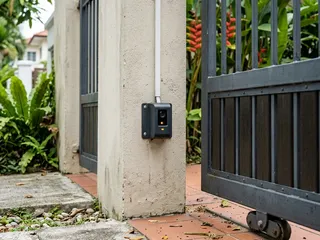
Photo-electric sensors mounted at the gate opening detect objects in the gate's path and stop or reverse movement when something is detected. Ground-level sensors are particularly important for low obstacles; a child crouching, a small dog, a bicycle wheel, that a higher-mounted sensor might miss. Some motors include current-sensing logic that detects resistance in the drive mechanism and reverses if an unexpected load is encountered, providing a secondary layer of protection when sensors are obstructed or fail.
These sensors need to be tested during installation and included in any maintenance programme. A sensor that has been obscured by vegetation, displaced by a recent paint job on the gate post, or simply failed without generating a visible fault indicator provides no protection at all while creating the false impression that the safety system is functional. The motor is the visible component that gets attention. The sensors are what determine whether the system is actually safe to use.
PLANNING POINT
During installation acceptance, test every safety sensor deliberately; place an object in the gate's path and confirm that the gate stops or reverses. Do not assume the sensors are working because the motor installer says they have been set up. Test them yourself before the installer leaves.
What to Verify Before the Installer Leaves
The handover after a gate motor installation is as important as the installation itself, and it is the part most often treated as a formality. A few specific things should be confirmed before the installer's vehicle leaves the driveway.
The gate should open and close smoothly through its full range of motion without unusual noise, hesitation, or visible strain on the motor arm. Safety sensors should be tested with a physical object in the gate path, not just verbally confirmed as installed. The remote controls should be handed over and tested on all units, including any spares. The motor model should be confirmed against what was quoted, because substitutions happen and discovering them after the fact is more difficult than confirming at handover.
Most importantly, the manual release procedure should be demonstrated to every member of the household who might need to use it, not just the person who managed the installation. The manual release is the mechanism that allows the gate to be operated by hand during a power failure, and in Singapore where electrical storms are frequent and prolonged power outages do occur, this is not a theoretical scenario. Nobody should be discovering how the manual release works during a thunderstorm at midnight.
Securevision Verdict
An auto gate motor is not a commodity appliance. It is a machine that performs physical work multiple times every day, in Singapore's tropical climate, for many years. The key to reliability is not simply choosing a well-known brand; it is ensuring the motor, the gate, and the installation work together correctly from the start.
The best installations begin with an honest assessment of the gate itself. Once the gate is confirmed to be in good mechanical condition and correctly aligned, selecting the right motor becomes straightforward. A well-matched motor on a well-maintained gate should provide many years of reliable service. The ones that fail early are almost always revealing a gate problem that the motor was never designed to solve.
In Short
The motor is the most visible component of a gate automation system, but it is rarely the component that determines whether the system works well over the long term. Gate weight, balance, structural condition, safety sensor specification, and integration with the rest of the property's security and access management are the decisions that matter most. Getting these right before selecting a motor, and verifying that the installation meets the specified requirements before the installer leaves; is what distinguishes an auto gate that performs reliably for a decade from one that becomes a recurring maintenance problem.

Frequently asked questions
What is an auto gate motor and how does it work?
An auto gate motor is an electromechanical device that opens and closes a gate automatically in response to a control signal, typically from a remote control, a keypad, a card reader, a vehicle loop detector, or a smartphone app. The motor drives the gate through a mechanical linkage; either a rack-and-pinion system for sliding gates or an arm mechanism for swing gates. A control board manages the motor operation, safety sensor inputs, and access control integration.
What is the difference between a swing gate and a sliding gate motor?
A swing gate motor drives a gate that hinges at one or both sides and opens inward or outward like a door. A sliding gate motor drives a gate that moves horizontally along a track. The choice between swing and sliding is determined primarily by the space available; a swing gate requires clear space in the direction of swing, while a sliding gate requires clear space along the fence line for the gate to travel into.
How do I know if my existing gate can be automated?
An existing gate can be automated if it is structurally sound, correctly balanced, and compatible with the motor type required for its configuration. A gate that is warped, heavily corroded, or poorly hung may need to be repaired or replaced before automation is practical. An assessment of the gate's condition and weight is an essential first step before specifying the motor.
What size motor do I need for my gate?
Motor sizing is determined by the weight and size of the gate, the frequency of use, and whether the gate is in a sheltered or exposed location. Undersizing is a common mistake; a motor specified for a lighter gate than the actual installation will work initially but will overheat and fail prematurely under regular use. Always specify the motor for the actual gate weight with a margin, not for the minimum rated load.
What safety sensors are required for an auto gate?
Safety sensors prevent the gate from closing onto a person or vehicle. The main sensor types are: obstruction sensors that detect objects in the gate's path during closing; safety edges that trigger when the gate physically contacts an obstacle; and loop detectors that detect vehicles in the gate's path. Safety sensors are not optional; a gate that closes without obstruction detection is a safety hazard and a legal liability.
Can I control my auto gate from my smartphone?
Yes. Most modern gate motor control systems support smartphone app control through a WiFi or GSM module connected to the gate controller. This allows you to open, close, and check the status of the gate remotely. Smartphone integration can be added to most gate systems through a compatible module, even if the gate was not originally installed with this capability.
How often does an auto gate motor need to be serviced?
Annual servicing is recommended for residential auto gate motors. A service visit should include: lubricating the mechanical components (rack, pinion, bearings, arm pivot); testing safety sensor operation; inspecting the control board and wiring for signs of corrosion or damage; checking the motor mounting and mechanical alignment; and testing all access control inputs. More frequent servicing may be needed for high-cycle commercial applications.
What is a vehicle loop detector and do I need one?
A vehicle loop detector is a wire loop embedded in the driveway surface that detects the presence of a vehicle by sensing changes in the electromagnetic field caused by the metal of the car. It is used to hold the gate open while a vehicle is in the gate opening, preventing the gate from closing onto a car that is still passing through. Vehicle loop detectors are strongly recommended for sliding gate installations and any gate used by vehicles.
Why does my auto gate motor fail prematurely?
The most common causes of premature motor failure are: undersizing (the motor is working at or near its maximum rated load continuously); inadequate lubrication of the mechanical components; electrical damage from power surges (a surge protector on the control board prevents this); gate misalignment that causes the motor to work against resistance; and poor-quality components that do not perform to their rated specifications under Singapore's climate conditions.
What is the difference between a rack-and-pinion and arm drive for a sliding gate?
Rack-and-pinion drive uses a toothed rack mounted on the gate and a pinion gear driven by the motor to move the gate smoothly along its track. It is the most common and reliable drive type for sliding gates. Arm drive systems use a mechanical arm that pushes and pulls the gate rather than driving it through a gear system. Rack-and-pinion is generally preferred for heavy or high-frequency applications.
How much does an auto gate motor installation cost in Singapore?
The cost depends on the gate type, weight, the motor specification, safety sensor requirements, and any access control integration. A basic single swing gate motor installation for a landed property might start from around $1,500 to $2,500. A sliding gate motor installation or a double swing gate system will typically cost more. Contact us for a site assessment and proposal based on your specific gate configuration.