- The detector is the most important component in an alarm system; match the right type to each zone from the start.
- Start with doors and windows before moving to motion sensors inside the property.
- Magnetic contacts are the most reliable detector and should be fitted to every accessible door and window.
- Standard PIR sensors work well in most indoor residential areas. Dual-technology sensors are better suited to demanding commercial and industrial environments.
- Photobeam sensors are ideal for protecting large outdoor areas such as car parks and compound perimeters.
- Panic buttons and fire detectors remain active whether the alarm system is armed or not.
Start With What You Already Know
Three days ago, I wrote about how most alarm systems are zoned wrong from day one, and how good design starts with understanding the threat, mapping your zones, and setting your response priorities before a single piece of equipment goes up on the wall. How to Design a Burglar Alarm System
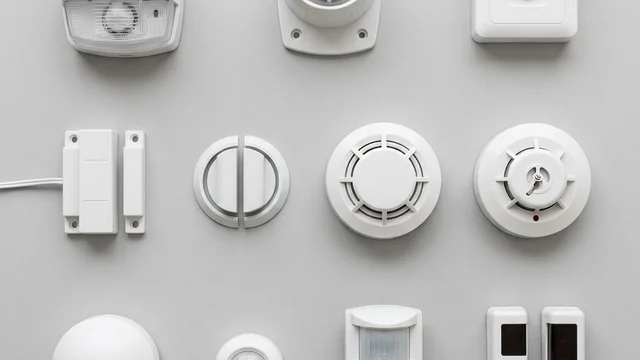
Today I want to continue that train of thought. Assuming you have done that groundwork; you know your weak points, you have drawn your zones; the next question is: which detector goes into each zone?
In our designs, we always work from the outside in. We cover the exterior first; the doors, the windows, the perimeter; before moving to the interior spaces. The reason is simple. An intruder has to get through the exterior to reach the interior. If you catch the breach at the perimeter, everything inside stays protected.
KEY POINT
The detector is the part of the system that decides whether something is wrong. If you choose the wrong detector, the rest of the system does not stand a chance. Spend the time getting this right.
Magnetic Door and Window Contacts
The most fundamental detector in any alarm system, and the most reliable. A magnet goes on the moving part of the door or window. A reed switch; a small sensing component; goes on the fixed frame beside it. When the door or window opens, the magnet moves away from the switch, the circuit breaks, and the zone triggers.
No moving parts. No calibration. No sensitivity to heat, light, or airflow. A correctly installed magnetic contact will outlast most other components in the system.
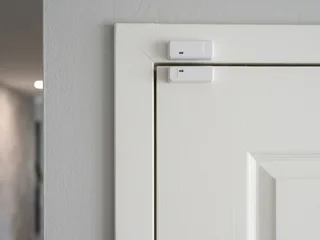
If I could choose only one detector for a home, this would be it. It is simple, reliable and rarely gives trouble when installed properly. In fact, many alarm problems I encounter have nothing to do with the magnetic contact because there is very little that can go wrong with it.
They come in two forms. Surface-mount contacts sit visibly on the door frame; straightforward to install and easy to inspect. Flush-mount contacts are concealed inside the door or frame; cleaner to look at and harder for an intruder to tamper with. For most residential installations, surface-mount is practical. For higher-security applications, flush-mount is worth the extra installation effort.
One thing to watch in Singapore: many homes and commercial properties have metal door frames. Metal can interfere with the reed switch and cause false readings. For metal frames, use contacts specifically rated for that purpose; your installer should know this without being asked.
DESIGN RULE
Put a magnetic contact on every accessible door and window in your perimeter zone. No exceptions. It is the simplest and most reliable protection you can put on an entry point.
Glass Break Sensors
Glass break sensors are acoustic detectors; they listen for sound rather than detecting heat or blocking a beam. They are tuned to recognise the specific combination of the initial impact and the high-pitched shatter of breaking glass.
Mount one on the wall or ceiling near a glazed area and it will trigger the zone when it hears that characteristic sound. Effective range is typically 6 to 9 metres.
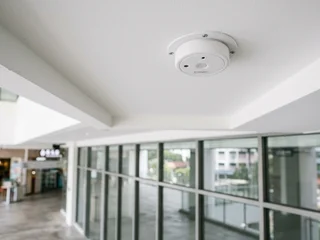
Positioning matters. Too close to the glass and the sensor may trigger from other sharp impacts nearby. Too far away and it may miss a quieter break. As a general guide, place it within 1.5 to 6 metres of the glass and ensure there is a clear line of sight; meaning no thick curtains or solid partitions between the sensor and the glazing it is protecting.
Glass break sensors are most useful where glazed panels are too large or too numerous to run magnetic contacts on each pane; shopfronts, curtain wall systems in commercial offices, and floor-to-ceiling glazing in showrooms.
KEY POINT
A glass break sensor protects the glass itself; it does not replace magnetic contacts on windows that can be opened. If a window opens, it needs a contact. If the glass is fixed and too large for contacts to be practical, that is where a glass break sensor belongs.
PIR Motion Sensors
PIR stands for Passive Infrared. It is the standard interior detector for most residential and commercial alarm installations in Singapore.
Here is how it works. Every person gives off body heat in the form of infrared radiation. As you move through a room, that heat signature moves across the sensor's field of view. The PIR detects that change and triggers the zone.
A standard PIR covers a horizontal sweep of roughly 90 degrees and a range of about 10 to 12 metres. Mount one in the corner of a room and it will usually cover the entire space.
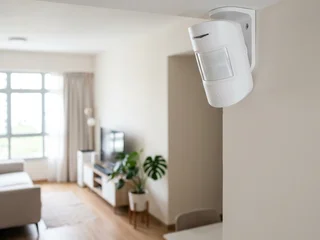
Where PIR works well: living rooms, corridors, stairways, offices, reception areas; any interior space with a stable temperature and no large pets.
One common mistake I see is placing a PIR directly opposite a large west-facing window. Everything works perfectly in the morning. Then the afternoon sun heats up the room and the false alarms start. The detector is not faulty. It is simply in the wrong place.
Where PIR causes problems:
- Rooms where direct sunlight hits the sensor
- Spaces where air-conditioning vents blow directly at the unit
- Areas with large dogs moving freely
- West-facing rooms where afternoon heat creates thermal movement
KEY POINT
PIR false alarms are almost always an installation problem, not a detector problem. The sensor was placed without accounting for sun angles, airflow patterns, or pets. A walk-through before installation catches most of these issues before they become problems.
Dual-Technology Sensors
A dual-technology sensor combines PIR with microwave detection in a single unit.
Think of microwave detection as a small radar inside the detector. When something moves within its range, the reflected signal changes and the sensor picks that up. By combining the two technologies, the detector requires both to trigger simultaneously before the alarm activates. A thermal change alone will not trigger it. A microwave anomaly alone will not trigger it. You need both at the same time.
For a typical home, you are unlikely to need dual-technology sensors. Standard PIR sensors, correctly placed, do the job well in most residential environments.
Where dual-technology earns its place is in more demanding conditions; commercial kitchens, warehouses, large open-plan factories, and spaces where temperatures swing significantly throughout the day. You will also find them used in outdoor detection applications, though this is less common in Singapore. In those environments, the combination of two independent detection methods gives you a much more robust result than either technology on its own.
A dual-technology sensor typically costs two to three times more than a standard PIR. In the right environment, that cost is justified. In a straightforward residential space, it is not necessary.
DESIGN RULE
Dual-technology sensors are the right choice for demanding commercial and industrial environments, not a standard fitting for homes. Match the sensor to the environment it is actually working in.
Perimeter Photobeam Sensors
Photobeam sensors are designed for large outdoor areas where motion sensors are not practical. They work using a transmitter and receiver positioned opposite each other. When someone crosses the beam, the alarm is triggered.
Photobeams are commonly used for car parks, perimeter walls, loading bays, rooftop areas, and industrial compounds.
To reduce false alarms from animals and debris, modern photobeams use multiple beams stacked vertically. The alarm only activates when all beams are interrupted together. A cat crossing one beam in a four-beam stack does not set off the alarm. A person walking through all four at once does.
One important requirement is a clear line of sight between the transmitter and receiver. Trees, shrubs, and structures can interfere with the beam and should be considered during installation.
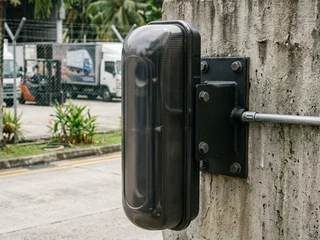
Singapore's heavy rain can also affect outdoor beams. Look for systems with automatic gain control; this allows the system to adjust to changing weather conditions so a passing thunderstorm does not set off the alarm. It is a standard feature on quality systems. Make sure it is there before you commit.
For condominium car parks and industrial compounds, I usually recommend pairing photobeams with CCTV cameras covering the same area. The photobeam detects the intrusion. The camera shows what actually happened. Together, they provide a much clearer picture for the monitoring centre before they decide whether to despatch a response team.
PLANNING POINT
Photobeams need maintenance. Outdoor installations should be checked at least once a year to confirm alignment, clean the lenses, and verify performance. Build this into your maintenance contract from day one.
Panic Buttons, Vibration Sensors, and Fire Detectors
These devices share one important characteristic: they remain active whether the alarm system is armed or not.
Panic buttons provide an immediate emergency trigger. They are commonly installed at reception counters, cashier points, and beside beds. Press the button and the alarm activates instantly, sending an immediate signal to the monitoring centre. Wireless panic buttons are also available, allowing the user to carry the trigger on their person.
Vibration sensors protect high-value assets such as safes, vaults, and server cabinets. They detect the specific vibration patterns associated with drilling, cutting, or forced attack. Normal building vibration from foot traffic or nearby doors does not trigger them; the sensor is calibrated to the intensity and frequency of an actual attack, not everyday movement.
Fire detectors; smoke detectors, heat detectors, and carbon monoxide detectors; are life-safety devices that integrate into the alarm panel as emergency zones. Smoke detectors go in corridors and sleeping areas. Heat detectors go in kitchens, where a smoke detector would produce too many cooking-related false alarms. Carbon monoxide detectors protect spaces with gas appliances or vehicle access. Unlike intrusion sensors, these trigger immediately because protecting lives takes priority over whether the alarm system is armed.
Securevision Verdict
After more than three decades in the security industry, I have found that most alarm problems are not caused by faulty equipment. They are caused by poor detector selection or poor placement.
Before specifying any detector, I always walk the site. I look at the doors and windows, check where the sun hits the room, note the air-conditioning vents, and ask whether there are pets. Twenty minutes of assessment before installation is never wasted.
Choosing the Right Detector for Your Situation
Every property is different. The right detector for a shopfront is not the right detector for a bedroom. The right detector for a warehouse loading bay is not the right detector for a condominium lobby.
What I have covered here are the basics; the main detector types, where each one belongs, and how each one works. In practice, the specification goes deeper. Ceiling heights, structural materials, airflow patterns, sun orientation, the specific layout of the site; all of these affect which detector goes where and how it is set up.
Getting this right from the start is what separates a system that works quietly in the background from one that causes problems from day one.
In Short
No single detector type is right for every location. The strength of a well-designed alarm system lies in matching the right detector to the conditions of each specific zone; the physical space, the expected sources of movement, the environmental conditions, and the level of security required. A system built around the cheapest available detector installed everywhere is an alarm system that either generates constant false alarms or misses intrusions. Getting detector selection right at the design stage is what separates a system that works reliably from one that becomes an inconvenience.

Frequently asked questions
What are the main types of burglar alarm detectors?
The main detector types used in Singapore burglar alarm systems are: magnetic door and window contacts, passive infrared (PIR) motion detectors, glass break sensors, dual-technology detectors, perimeter photobeam sensors, and vibration detectors. Each is designed for a specific detection scenario and performs best when matched to the right location and conditions.
What is a PIR detector and how does it work?
A PIR (passive infrared) detector senses the heat signature of a person moving through its detection zone. It detects the contrast between the heat emitted by a moving body and the background temperature of the room. PIR detectors are the most widely used indoor burglar alarm sensor and are effective for covering open areas such as living rooms, corridors, and reception areas.
What is a magnetic contact and where should it be used?
A magnetic contact consists of two parts; a magnet and a reed switch; mounted on the door or window frame and the door or window itself. When the door or window opens, the magnet moves away from the switch, breaking the circuit and triggering the alarm. Magnetic contacts are the most reliable detector type for entry points and should be fitted to every accessible door and window in a protected property.
What is a glass break detector?
A glass break detector uses a microphone to detect the specific acoustic pattern of breaking glass; the initial impact followed by the high-frequency tinkle of glass fragments. It is designed to detect forced entry through glazed areas without requiring a contact to be fitted to each individual pane. Glass break detectors are useful where large glazed areas cannot be protected by contacts alone.
What is a dual-technology detector?
A dual-technology detector combines PIR and microwave sensing in a single unit. Both technologies must detect movement simultaneously before an alarm is raised. This significantly reduces false alarms caused by heat sources, insects, or environmental disturbances that would trigger a standard PIR, because a non-human trigger is unlikely to activate both sensors simultaneously.
When should I use a dual-technology detector instead of a standard PIR?
Use a dual-technology detector when: the zone has a history of false alarms with standard PIR detectors; the area is subject to significant heat variation from direct sunlight or HVAC; there are small animals present that might trigger a standard PIR; or the location is in a high-security zone where minimising false activations is particularly important.
What is a photobeam sensor?
A photobeam sensor consists of a transmitter and a receiver positioned opposite each other across a protected area. The transmitter emits an invisible infrared beam. When a person crosses the beam, the signal is interrupted and an alarm is triggered. Photobeam sensors are used for perimeter protection of large outdoor areas, driveways, or garden spaces where PIR coverage would be impractical.
Can burglar alarm detectors detect pets?
Standard PIR detectors can be triggered by pets. Many modern detectors have a pet immunity setting; a sensitivity adjustment that reduces the detector's response to heat signatures below a certain height or mass. Pet-immune detectors are useful for properties where small animals move freely through the alarm zones during the armed period. They are not effective against large dogs.
Where should I not install a PIR detector?
Avoid installing PIR detectors where they face: direct sunlight or a window with strong sunlight; air conditioning or heating vents that produce sudden temperature changes; ceiling fans or moving objects; areas frequented by pets that should not trigger the alarm. All of these can generate false alarms with standard PIR detectors.
How do I choose the right detector for each zone in my property?
For entry points; doors, windows, gate; use magnetic contacts. For open interior spaces; living rooms, corridors, reception areas; use PIR detectors. For large glazed areas that cannot be covered by contacts; use glass break detectors. For outdoor perimeter areas; use photobeam sensors or outdoor-rated PIR detectors. For environments with persistent false alarm issues; use dual-technology detectors.
How often do alarm detectors need to be replaced?
Wired PIR detectors and magnetic contacts can remain functional for 15 years or more. The practical driver for replacement is usually deterioration rather than sudden failure; sensitivity drift, lens contamination, or corrosion of contacts over time. Wireless detectors with internal batteries have a shorter effective lifespan because the battery and radio module degrade alongside the detector itself. Annual servicing should include testing all detectors and flagging any that are underperforming.