- AI analytics can often be added to an existing CCTV system without replacing every camera; the answer depends on where the AI processing takes place.
- AI can be delivered at three levels: inside the camera itself, inside the recorder, or inside a dedicated analytics server. Each has different retrofit implications.
- The most practical near-term AI upgrade for most existing systems is through the recorder; an AI-capable NVR can analyse streams from compatible existing cameras without camera replacement.
- Hardware constraints are real and cannot be bypassed by firmware updates. If a camera was never built with the necessary processing capability, no software update can add it.
- Facial recognition, licence plate recognition, and thermal analytics all require specialised hardware that cannot be retrofitted; any claim to the contrary should be tested before money is spent.
- A phased approach; adding AI to the highest-value camera positions first; delivers most of the benefit at a fraction of the cost of replacing everything simultaneously.
The Question Most Customers Ask First
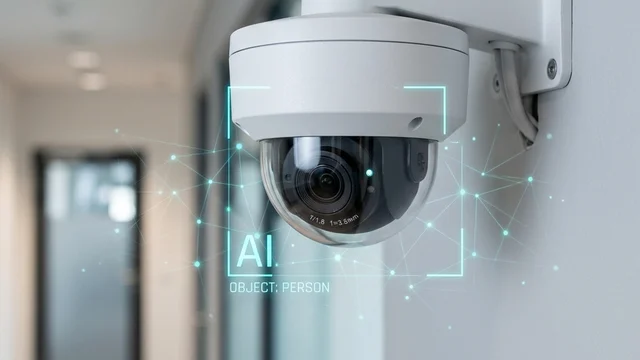
When customers hear about AI-powered CCTV; cameras that distinguish people from animals, ignore swaying trees, count visitors, or trigger intelligent alerts based on behaviour rather than motion; the natural assumption is that everything currently installed becomes obsolete. In most cases, that assumption is wrong, or at least significantly overstated.
AI analytics has become one of the most significant developments in CCTV technology over the past several years. The capabilities are genuine and practically useful. But the question of whether those capabilities require a complete system replacement is not a simple yes or no. It depends on where the AI processing takes place, which determines which parts of the existing system can be retained and which need to change. Understanding that distinction is what allows a sensible upgrade decision to be made rather than an unnecessary one.
KEY POINT
The right question is not whether AI requires new cameras; it is where the AI processing will take place in the upgraded system, and whether the existing infrastructure can support that processing location.
AI Is Not One Thing
Before discussing upgrade options, it helps to understand that AI analytics is not a single feature. It is a category of capabilities, each requiring different levels of processing power and different hardware to deliver. Human and vehicle detection, line crossing alerts, and perimeter intrusion detection represent one tier; relatively computationally efficient, well within the capability of current-generation IP cameras and recorders. People counting and occupancy monitoring sit at a similar tier for basic implementations but require more precision as the application becomes more demanding.
Facial recognition, licence plate recognition, and thermal analytics represent a very different tier; computationally intensive, often requiring specialised optical hardware, and in the case of licence plate recognition, demanding specific camera positioning and lens characteristics that standard security cameras are not designed to provide. Treating all of these as a single category called AI leads to either over-investment in hardware that is not required for the desired capability, or under-investment based on assumptions that certain features can be delivered by hardware that was never designed for them.
KEY POINT
Identify the specific AI capability being sought before evaluating any hardware. Human detection and vehicle detection have very different hardware requirements from facial recognition or thermal analytics, and conflating them leads to poor specification decisions in both directions.
Three Places AI Can Live
There are three architectural locations where AI processing can take place in a CCTV system, and understanding which one is relevant to a given upgrade determines everything about what needs to change and what can stay.
The first location is inside the camera itself. Current-generation IP cameras with onboard AI processing perform the analysis at the point of capture; the camera's own chip determines whether what it sees is a person, a vehicle, an animal, or irrelevant environmental movement such as a tree or a shadow. Because the analysis happens at the camera, only a small, pre-classified event stream is sent across the network to the recorder rather than a continuous full-resolution video stream. This is computationally efficient, produces faster alert response times, and dramatically reduces false alarm rates compared to traditional motion detection. It is the most capable approach for perimeter protection and intelligent alerting. The limitation is that it requires cameras that were designed with the necessary AI processing hardware; older cameras, regardless of their image quality, cannot gain this capability.
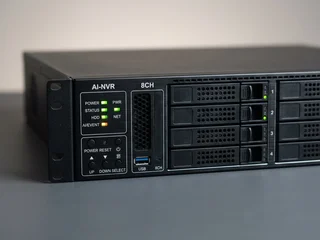
The second location is inside the recorder. Modern AI-capable NVRs can perform analytics processing on the video streams they receive from connected cameras. In this architecture, the camera's role is unchanged; it captures and transmits video, and the recorder does the analytical work. This is where existing system upgrades become most practically interesting, because an AI-capable recorder can in many cases analyse streams from cameras that were never designed for onboard AI, extracting human detection, vehicle detection, and basic intrusion alerts from footage that was previously analysed only by traditional motion detection. The recorder upgrade path has genuine constraints, not every camera model is compatible, and the AI quality delivered at the recorder level is generally less precise than onboard camera AI, but it represents a real upgrade for many existing installations without requiring a single camera to be replaced.
The third location is a dedicated analytics server or appliance, separate from both the cameras and the recorder. This architecture is typical of larger sites; industrial facilities, multi-building commercial properties, logistics centres with dozens or hundreds of cameras, where the analytical workload exceeds what individual cameras or a single recorder can handle. The cameras provide video feeds, and the server performs analysis at scale. This approach is the most capable and the most expensive, requiring both the server hardware and the software licensing to support it. For most Singapore commercial and residential property installations, the camera-level or recorder-level approach is the more practical consideration.
KEY POINT
For most existing CCTV installations considering an AI upgrade, the recorder path offers the most practical starting point; genuine AI capability without necessarily changing a single camera.
The Firmware Myth
A question I hear periodically is whether AI capabilities can be added to existing cameras through a firmware update. The appeal is obvious, if the existing cameras can simply be updated rather than replaced, the upgrade cost is minimal. Unfortunately, it does not work that way.
AI processing requires dedicated silicon; a chip architecture specifically designed for the neural network calculations that image classification and object detection depend on. If a camera was manufactured without that chip, no firmware update can create it. The analogy is straightforward: asking whether a software update can turn a family sedan into a sports car. The software is constrained by the hardware it runs on, and the hardware in a camera manufactured before AI processing chips were a standard component simply does not have the computational resources to perform those calculations, regardless of how the firmware is written.
Model numbers matter in this context precisely because camera capability is determined at manufacture. Two cameras that look physically identical may have very different internal architectures depending on their generation. When evaluating whether an existing camera can participate in an AI upgrade, the specific model number, not the brand, not the series name, not the approximate age; is what determines the answer. This is why a proper system assessment, reviewing the actual hardware installed, is the only reliable way to determine upgrade options.
KEY POINT
If someone claims that AI capabilities can be added to any existing camera via firmware, ask for a live demonstration on the specific camera model installed. The hardware architecture of a camera is fixed at manufacture and cannot be changed by software.
What Can Usually Be Added
For most existing IP CCTV systems, an AI upgrade through the recorder or through selective camera replacement at key positions can deliver human detection, vehicle detection, line crossing detection, perimeter intrusion alerts, and basic people counting. These capabilities address the most common and most practically significant limitation of older systems; the false alarm problem.
Traditional motion detection responds to any change in the pixels of a frame. A tree moving in the wind. A shadow crossing a wall as the sun moves. A cat walking across the car porch. A delivery vehicle reversing past the camera position. Each of these triggers an alert that requires someone to review, assess, and dismiss. In a system with multiple cameras operating around the clock, this alert volume becomes unmanageable, and the consequence is that operators and homeowners start ignoring alerts entirely, because the ratio of genuine events to false triggers is so low that individual notifications lose their meaning.
AI detection that classifies what it sees before triggering an alert changes this entirely. A camera or recorder that can distinguish a person from a cat, or a vehicle from a tree, generates a dramatically lower alert volume with a much higher proportion of genuine events. For a Singapore landed property owner who has disabled motion alerts because too many notifications were coming from the cat or the frangipani tree, this is the upgrade that makes the system useful again. For a commercial property manager receiving dozens of overnight alerts from cameras covering outdoor areas, it is the upgrade that allows alerts to be taken seriously again.
KEY POINT
False alarm reduction is typically the highest-value AI upgrade for most existing systems, and it is achievable through the recorder path without replacing cameras. The improvement in alert quality often has more practical impact than any image resolution upgrade.
What Cannot Usually Be Added
Three capabilities consistently require purpose-built hardware that cannot be provided by retrofitting existing standard security cameras, regardless of recorder or server AI capability.
Facial recognition at a meaningful level of accuracy requires cameras with sufficient resolution at the point of face capture, typically at least 2MP equivalent resolution of the face at the capture distance; along with suitable lighting and consistent subject approach geometry. More importantly, the processing pipeline for facial recognition involves comparing captured facial geometry against a stored database, which requires both specialised AI processing and a system architecture designed around that use case from the start. A standard perimeter camera, even one with good overall image quality, is not positioned or specified to deliver this.
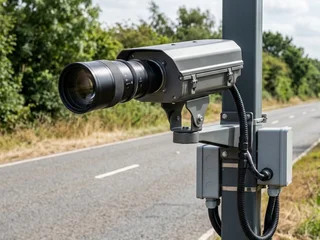
Licence plate recognition requires cameras with specific focal length characteristics to capture a usable plate image at the vehicle's approach speed and the installation distance from the plate. It also requires positioning that presents the plate to the camera within a defined angle range consistently on every vehicle pass. Standard security cameras are not designed for this and cannot deliver reliable recognition rates regardless of how capable the recorder or server analytics software is. This is why LPR installations are always specified with dedicated cameras at defined positions; the camera hardware is not incidental to the capability.
Thermal analytics requires an entirely different imaging sensor; a thermal camera detects infrared radiation rather than visible light and produces a fundamentally different type of image. No visible-light camera can be converted to thermal imaging through software or firmware. If a thermal capability is needed, a thermal camera is needed. Any proposal suggesting otherwise should be tested before any financial commitment is made.
KEY POINT
If facial recognition, licence plate recognition, or thermal analytics are genuine requirements, they need to be specified from the start with appropriate dedicated hardware. They cannot be added to a standard security camera installation retrospectively.
A Smarter Upgrade Strategy
One of the most consistently useful pieces of advice I give to customers considering an AI upgrade is that AI does not need to be deployed on every camera simultaneously. In most sites, the cameras that would deliver the highest value from AI analytics are a small subset of the total, typically the main entrance cameras, vehicle entry points, perimeter fence lines, and loading or service access areas. These are the positions where human and vehicle detection matters most and where the false alarm problem is most acute.
A phased upgrade approach that starts by adding AI capability to these critical positions; either through targeted camera replacement with current-generation onboard-AI units at those specific positions, or through an AI-capable recorder upgrade that benefits all compatible cameras simultaneously; delivers the majority of the practical benefit at a fraction of the cost of replacing every camera in the system. The remaining cameras continue in their current configuration, recording video and contributing to the overall system coverage without requiring immediate replacement.
This approach also provides a natural evaluation period. Operating AI detection at the critical positions for three to six months before making decisions about the rest of the system gives the property owner real data on how the capability performs in their specific environment; how the alert quality compares to the previous system, whether the detection accuracy meets operational needs, and whether additional coverage positions would benefit from the same upgrade. The phased approach is almost always a better investment decision than replacing everything based on a brochure comparison.
Securevision Verdict
Many existing CCTV systems can gain meaningful AI capabilities without a complete replacement. Whether that upgrade is possible, and which upgrade path makes the most sense; depends entirely on the specific camera and recorder models installed, and on the AI capability being sought. Human and vehicle detection through the recorder path is a genuine retrofit option for many systems. Facial recognition, licence plate recognition, and thermal analytics are not.
The technology should always follow the requirement. Before any upgrade decision is made, the right starting point is understanding what is already installed and what specific problem the AI is intended to solve. Very often there is more upgrade potential in the existing system than people assume, and sometimes the smartest upgrade is not replacing everything but adding AI precisely where it delivers the most value.
In Short
Most existing CCTV systems can gain meaningful AI capabilities without starting from scratch. Whether the upgrade requires new cameras, a new recorder, or an additional server depends on where the AI processing needs to live and what the system is being asked to detect. The practical starting point is always an assessment of what is already installed; the recorder model, the camera specifications, and the network infrastructure. In our experience, a thoughtful partial upgrade almost always delivers better value than a complete replacement.

Frequently asked questions
What is AI in CCTV and what can it actually do?
AI in CCTV refers to software that analyses video footage automatically to detect specific objects, behaviours, or patterns; rather than simply recording and storing what the cameras see. Practical capabilities include person detection, vehicle detection, face recognition, people counting, heatmapping, loitering detection, perimeter intrusion alerts, and object classification.
Do I need to replace all my cameras to get AI analytics?
Not necessarily. AI can be delivered at three levels; inside the camera, inside the recorder, or in a dedicated server. If your recorder supports AI analytics, existing cameras can often continue to supply the video feed. Camera replacement is only required when the AI capability you need must run inside the camera itself and your existing cameras do not support it.
What is the difference between edge AI and server-based AI?
Edge AI runs the analytics processing inside the camera or recorder itself; no separate server is required. Server-based AI uses a dedicated analytics appliance that receives video streams from multiple cameras and processes them centrally. Edge AI is simpler to deploy but limited in scope. Server-based AI is more powerful and can handle complex analytics across many cameras simultaneously.
Can my existing NVR be upgraded with AI firmware?
Some NVR models from certain manufacturers can receive AI capability through a firmware update. Whether this applies to your recorder depends on the model and the manufacturer's product roadmap. This is worth checking before assuming a recorder replacement is necessary. Firmware-delivered AI is typically limited to basic person and vehicle detection rather than complex behavioural analytics.
What AI features are most useful for Singapore commercial properties?
For Singapore commercial and residential properties, the most practically useful AI features are perimeter intrusion detection, loitering alerts for common areas, people counting for occupancy management, and vehicle detection for car park and estate entrance monitoring.
How accurate is AI detection in CCTV systems?
Detection accuracy depends on camera placement, lighting conditions, the quality of the AI engine, and how well the system has been configured for the specific environment. False alarm rates, where the system triggers on non-relevant events; are the more common practical problem, and are managed through careful placement and sensitivity calibration.
Will AI CCTV work with my existing camera brand?
This depends on the AI platform being used. Some AI analytics servers are brand-agnostic and accept video streams from any ONVIF-compliant camera. Others are proprietary and work only with cameras from the same manufacturer. Confirm compatibility with your integrator before specifying the analytics platform.
Is AI CCTV compliant with Singapore's PDPA?
CCTV with AI analytics is subject to the same PDPA obligations as standard CCTV. Face recognition specifically has additional considerations because it processes biometric data, which is treated as sensitive personal data under Singapore's PDPA framework. Seek guidance from the Personal Data Protection Commission before deploying face recognition.
How long does it take to add AI to an existing CCTV system?
For firmware-based upgrades on compatible recorders, the process can be completed in hours. For analytics server installations requiring new hardware and network configuration, the process typically takes one to two days. Commissioning and fine-tuning the detection rules may require several adjustment visits before the system performs consistently.
What does an AI CCTV upgrade cost in Singapore?
The cost depends on which upgrade path applies to your system. A firmware upgrade on a compatible recorder may have minimal cost. An analytics server capable of handling ten to twenty camera streams might cost several thousand dollars plus installation. A site assessment is the only way to give a reliable figure; contact us to arrange one.
Can AI CCTV replace a security guard?
AI analytics augments security operations rather than replacing personnel. The system can monitor a large number of camera feeds simultaneously and alert on specific conditions. However, it cannot make judgements, respond physically to incidents, or handle situations outside its configured detection rules. AI CCTV works best when it extends the capability of the security team.