- Most analogue CCTV upgrades do not require complete rewiring; the coaxial cable infrastructure installed years ago is often still serviceable and can carry modern HD signals.
- HD-over-coax technology delivers significant image quality improvements over the same existing cable, replacing only the cameras and recorder.
- Hybrid recorders allow analogue and IP cameras to operate on the same system simultaneously, enabling a phased upgrade without disrupting existing coverage.
- Ethernet-over-Coax adapters can convert existing coaxial cable into a network connection for standard IP cameras; useful in specific situations but not always the preferred approach.
- Full cable replacement is genuinely necessary only in specific circumstances: physical cable damage, major renovation with walls already open, or entirely new camera positions.
- Every upgrade decision should start with an assessment of the existing infrastructure; the cables are often the last component to fail and may have many years of useful life remaining.
The First Thing Customers Worry About
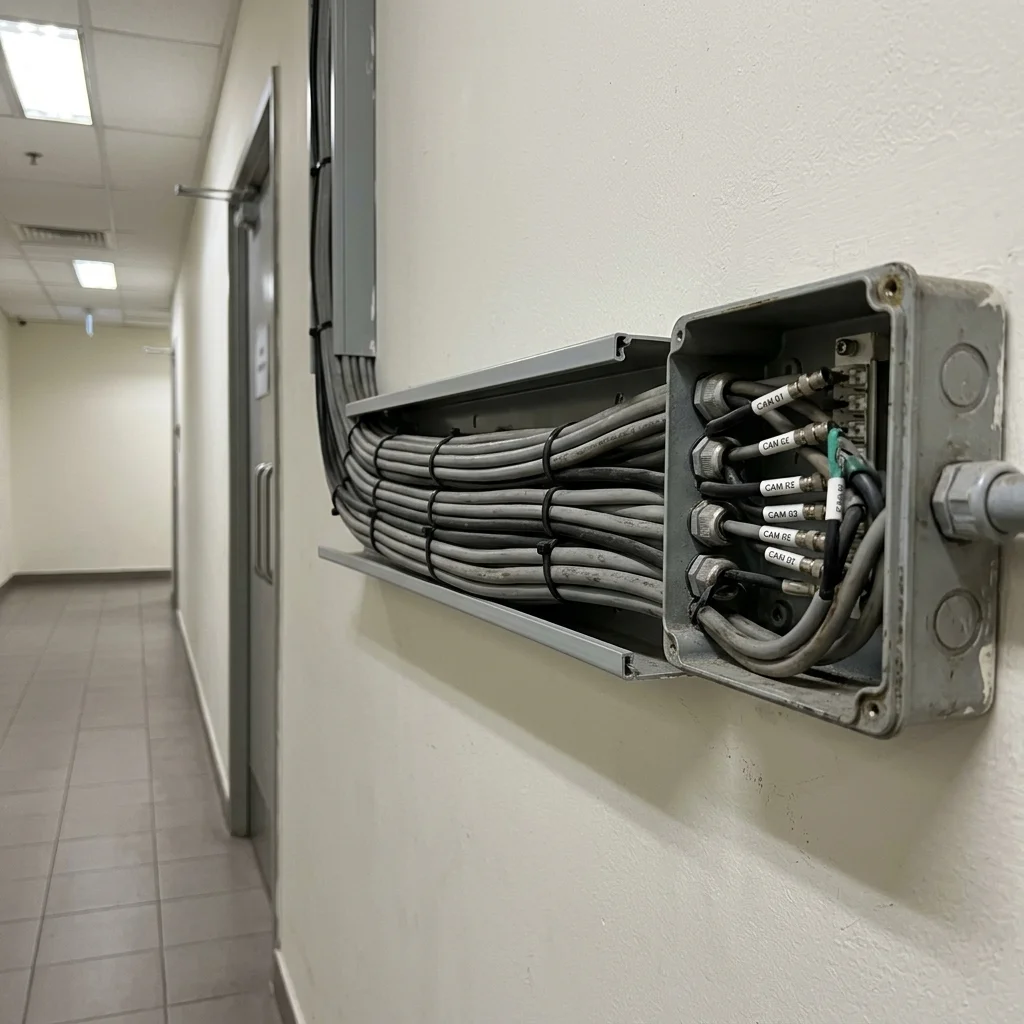
Whenever I tell a customer that their CCTV system is due for an upgrade, I can almost predict the next question. Do we need to replace all the cables? And I understand why it comes up immediately. The moment people think about replacing cables, they start thinking about hacking into plastered walls, removing ceiling panels that were installed during a renovation, running new trunking through a completed building, business disruption during the work, and costs that could rival the original installation.
Many people assume that upgrading a CCTV system automatically means rewiring the entire property. The good news is that this assumption is wrong in the majority of cases. In many Singapore properties; landed homes, shophouses, commercial units, factory buildings; the most valuable component of the existing CCTV system is not the cameras or the recorder. It is the cable infrastructure running inside the walls and ceilings. That infrastructure was expensive and disruptive to install the first time. Before recommending that it be replaced, the right question is whether it needs to be replaced at all.
KEY POINT
The cable is often the last component of a CCTV system to fail. Electronics become obsolete. Software loses support. Cameras degrade. The physical cable, if it was properly installed and has not been physically damaged; may still be perfectly functional years after everything connected to it has been replaced.
Understanding What You Already Have
Before any upgrade recommendation can be made responsibly, the existing infrastructure needs to be assessed. Not assumed, not estimated; assessed. The cable type matters: RG59 coaxial cable, which was the standard for analogue CCTV for decades, has different characteristics and upgrade implications from CAT5e or CAT6 network cable, which was used in earlier IP installations. The cable condition matters: a coaxial run that has been physically damaged, kinked, or exposed to moisture behaves very differently from one that has been inside a wall untouched since installation.
Cable length matters for certain upgrade technologies that have distance limitations. Camera positions matter because they determine whether new cable runs would be needed for cameras moving to different locations or whether all existing positions are being retained. The existing power supply arrangement matters because it affects whether PoE infrastructure needs to be added. And the existing recorder matters because it determines what it is compatible with and whether it represents a constraint or a foundation for the upgrade.
Each of these factors influences which upgrade path is practical, which is cost-effective, and which would require work that the customer may not have anticipated. Without this information, any recommendation is guesswork, and guesswork in the wrong direction leads either to unnecessary expenditure on cable replacement that was not needed, or to a proposed upgrade that will not work with the actual infrastructure present.
KEY POINT
A site assessment before any CCTV upgrade specification is not a sales step; it is an engineering requirement. The infrastructure determines the options. Nobody can responsibly specify an upgrade without knowing what they are upgrading from.
The Most Practical Upgrade: HD Over Existing Coax
For properties with existing RG59 coaxial cable in good condition, HD-over-coax technology represents the most practical and cost-effective upgrade path available. These are transmission standards; several exist in the market, that allow high-definition video signals to be carried over the same coaxial cable that was previously carrying standard-definition analogue signals. The cable does not change. The conduit does not change. The trunking does not change. The camera mounting positions do not change. The cameras and the recorder are replaced, and the result is a system delivering substantially better image quality over identical physical infrastructure.
To put the image quality difference in concrete terms: a standard-definition analogue system from ten years ago typically recorded at the equivalent of approximately 0.4 megapixels. A current-generation HD-over-coax camera records at 2 megapixels or higher; five times the resolution or more, over the same wire. For a property where the existing cable is sound, this upgrade delivers the kind of image quality improvement that makes face identification and vehicle detail genuinely usable, without a single wall being opened or a single cable being replaced.
For Singapore properties where the original CCTV installation involved significant structural work; cabling through reinforced concrete, running in conduit within brick walls, or concealed in finished ceiling voids; the practical value of retaining that infrastructure is substantial. The cost and disruption of reproducing that cable installation is often comparable to the cost of the cameras and recorder themselves. HD-over-coax eliminates that cost entirely for the portions of the system where the existing cable can be reused.
KEY POINT
HD-over-coax is not a compromise technology; it is a genuine upgrade path. For properties with sound existing coaxial cabling, it delivers modern image quality without rewiring, and represents the most cost-effective upgrade option in many installations.
The Hybrid Approach; Upgrading in Stages
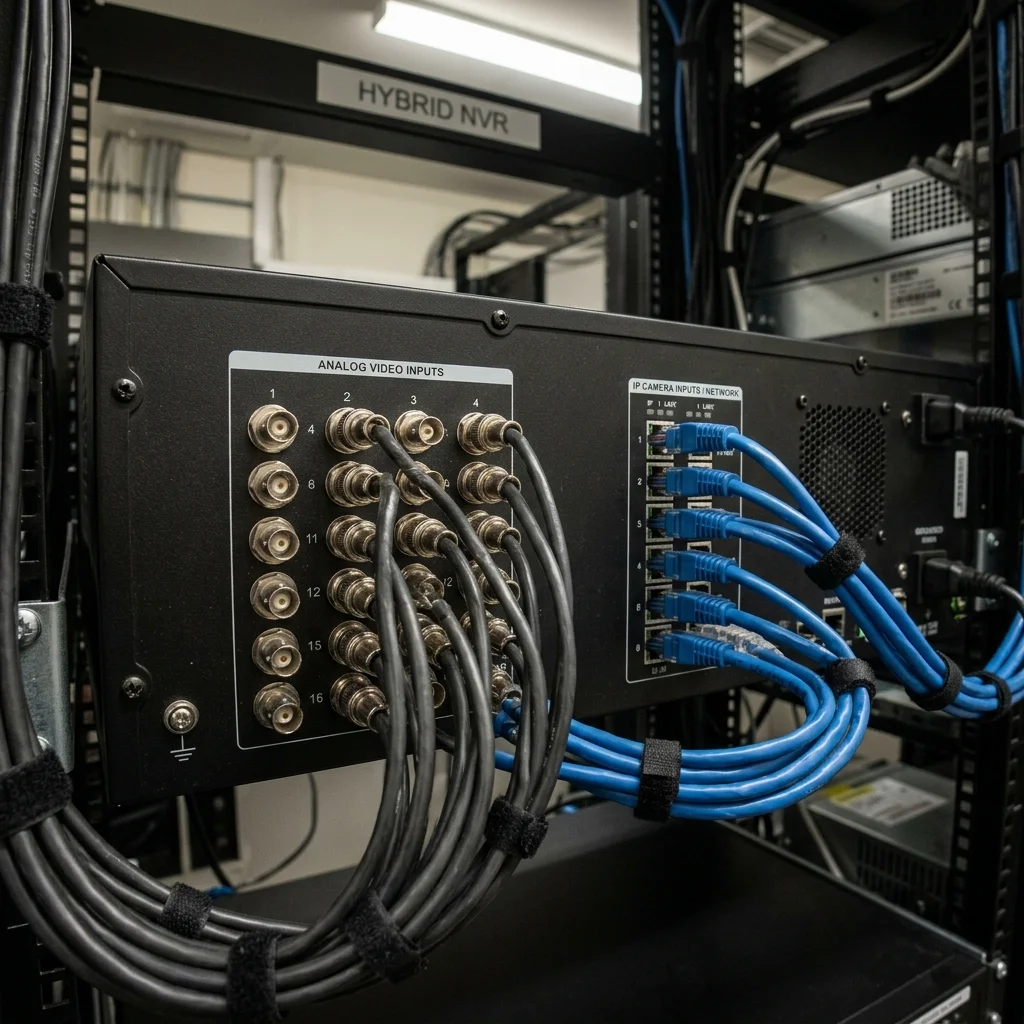
Sometimes a customer wants to move toward full IP camera technology, for the AI analytics capability, the remote management features, or the longer-term upgrade path it provides, but cannot or does not want to replace everything simultaneously. This is where hybrid recorders become the enabling technology for a sensible phased migration.
A hybrid recorder accepts both analogue camera inputs and IP camera inputs simultaneously. The analogue cameras already installed continue operating exactly as before, connected via their existing coaxial cable runs. New IP cameras added at selected positions connect via network cable to a PoE switch and then to the recorder. The entire system; old cameras and new; is managed through a single interface, recorded to a single storage location, and viewed through a single application. There is no parallel system to manage, no period of reduced coverage, and no forced decision about every camera in the building at once.
For a Singapore commercial property with, say, sixteen cameras across multiple areas, a practical phased approach might replace the four entrance cameras with IP units featuring onboard AI analytics in the first year; these are the positions where improved image quality and intelligent detection deliver the most immediate value. The remaining twelve analogue cameras continue operating via the existing infrastructure. In subsequent years, as budget allows or as specific cameras reach end of life, those cameras are upgraded in batches. The hybrid recorder accommodates the full range throughout the transition without requiring any forced timing on the upgrade sequence.
KEY POINT
A hybrid recorder converts an either/or decision; replace everything now or keep everything as is; into a planned migration that can proceed at any pace the business requires, without disrupting existing coverage at any point.
IP Over Coax; When It Makes Sense
There is a third option that sits between HD-over-coax and full IP camera installation: Ethernet-over-Coax adapters, which convert the existing coaxial cable into a network connection capable of carrying IP camera signals and PoE power. A pair of adapters; one at the camera end, one at the recorder end of each cable run; effectively turns the coaxial cable into a network cable segment. Standard IP cameras can then be connected at each camera position without any new cable being pulled.
This option is not always my first recommendation, because it adds components to each camera run that represent additional points of potential failure and additional cost per camera position. It also has practical limitations around distance and bandwidth that do not apply to native coaxial HD systems. But it has a specific application where it performs well: situations where IP camera capability is a firm requirement, for onboard AI analytics, for specific integration with other IP-based systems, or for cameras with capabilities not available in the HD-over-coax camera range, and where the cable infrastructure would be expensive or disruptive to replace. In those situations, Ethernet-over-Coax can bridge the gap without requiring a single cable to be replaced.
KEY POINT
Ethernet-over-Coax is a useful option when IP camera capability is a genuine requirement and the existing coaxial cable is worth preserving. It is not the first choice for a straightforward analogue-to-HD upgrade, where the simpler HD-over-coax path is usually more cost-effective.
When New Cabling Is Actually the Right Answer
Having made the case for retaining existing cabling wherever possible, it is worth being clear about the circumstances where new cabling is the correct decision. These situations exist and are worth recognising, because recommending cable retention when replacement is actually justified would be as poor an outcome as recommending unnecessary replacement.
Physical cable damage is the clearest case. Coaxial cable that has been cut, crushed, kinked at a sharp angle, or exposed to persistent moisture does not perform reliably regardless of what is connected to it. The degradation may not manifest as a complete failure; it may show up as interference, intermittent signal loss, or reduced image quality that is difficult to diagnose. If a cable test reveals damaged or degraded infrastructure, replacement is the right answer.
Major renovation with walls already open is another clear case. If ceilings are being removed, walls are being hacked for other services, or the building is undergoing significant structural work that exposes the cable routes, the incremental cost of running new cables while access is available is modest compared to the cost of reopening those walls specifically for cable replacement later. The right time to install new cabling is when the building is already open for other reasons.
Entirely new camera positions, where cameras are moving to locations that are not served by any existing cable run; obviously require new cabling to those positions, regardless of what is done with the existing infrastructure. And for properties planning a long-term structured cabling infrastructure that will support not just CCTV but access control, IP intercoms, and network connectivity across a building, a properly designed Cat6 network installation may be worth specifying from scratch even if individual existing cable runs are technically serviceable. These are genuine exceptions, but they are the minority of upgrade scenarios rather than the rule.
KEY POINT
New cabling is justified by specific physical conditions or strategic planning reasons, not by the age of the cable alone. Cable age is not a reliable indicator of cable condition.
The Third Option Most People Never Consider
Most customers arrive at an upgrade conversation assuming there are two choices: keep everything as it is, or replace everything at once. In reality, there is almost always a third option; keep what still has value, upgrade what no longer serves its purpose, and plan the transition at a pace and cost that the property owner can manage.
This approach requires an honest assessment of what the existing system actually contains. Which cables are in good condition and can be retained? Which camera positions are suitable for HD-over-coax? Which positions would benefit most from IP camera capability? Which recorder is compatible with a hybrid approach? The answers to these questions define a migration plan that is specific to the property rather than generic, and a plan that is specific to the property is almost always more cost-effective than one that applies a uniform recommendation regardless of what is actually installed.
Good engineering is not about replacing the most equipment. It is about achieving the best result with the resources available. For most Singapore properties with existing CCTV infrastructure, the most valuable resource available is the cable already in the walls; paid for once, installed once, and in many cases still perfectly capable of supporting a significantly better system than the one currently connected to it.
Securevision Verdict
Most analogue CCTV systems do not need to be ripped out and replaced overnight. The cables can often stay. The conduit and trunking can stay. The camera mounting positions can stay. The disruption that property owners fear when they hear the word "upgrade" is, in many cases, avoidable. What needs to change is the cameras and the recorder, and in some cases, only the recorder.
The key is understanding what you already have before deciding what needs to change. Every successful CCTV migration starts with an assessment of the existing infrastructure, not because we want to find reasons to sell new equipment, but because the best upgrade decisions are always based on what is actually present, not on assumptions about what might need to be replaced.
In Short
Most analogue CCTV systems in Singapore do not need to be replaced entirely when the time comes to upgrade image quality. The coaxial cable infrastructure is often still serviceable and can carry modern HD signals using technology that was not available when the original system was installed. The practical question is not whether to keep or remove the existing cables, but which upgrade path; HD over coax, hybrid recorder, or selective IP addition; delivers the right balance of image quality, cost, and disruption for the specific property. We assess these options on every project before recommending a direction.

Frequently asked questions
Do I need to replace all my CCTV cables when upgrading my system?
Not necessarily. Existing coaxial cables can often carry modern HD video signals using HD-over-coax technology, delivering significantly better image quality without any rewiring. Whether your existing cables are suitable depends on their condition, length, and the connectors at each end. A site assessment will confirm which cables can be reused and which need replacement.
What is HD over coax and how does it work?
HD over coax is a family of technologies that transmit high-definition video signals over standard coaxial cable. The same RG59 or RG6 cable that carried analogue video can carry 2MP, 4MP, or higher resolution signals. The upgrade requires replacing the cameras and the recorder, but not the cable infrastructure between them.
What resolution can I get with my existing coaxial cables?
HD-over-coax technology typically supports resolutions from 1MP (720p) up to 8MP (4K) depending on cable quality, run length, and the specific technology used. For most Singapore commercial and residential applications, 2MP to 4MP over existing coax is achievable and represents a significant improvement over standard definition images.
What is a hybrid CCTV recorder?
A hybrid recorder accepts both analogue and IP camera inputs simultaneously. This allows an upgrade to be done in stages; some cameras can be replaced with IP models while others remain on the existing analogue or HD-over-coax feed, all recording to the same system. A hybrid approach is useful when budget requires the upgrade to be spread across multiple phases.
How do I know if my existing cables are still in good condition?
The practical test is signal quality. During an assessment, the existing cables can be tested to confirm whether they can carry HD signals reliably. Common issues include damaged insulation, corroded connectors, excessive run lengths, and joints that introduce signal loss. Cables installed in conduit and undisturbed since installation generally perform well.
Can I mix old and new cameras on the same system?
Yes; a hybrid recorder allows both older cameras and new HD cameras to operate on the same system. The recorder consolidates all feeds into a single interface for monitoring and playback, regardless of camera type or resolution. Over time, older cameras can be replaced with newer models as budget allows.
When does it make sense to run new IP cabling instead of reusing coax?
New IP cabling makes sense when the existing coax is in poor condition, when cable runs exceed practical distance limits for HD-over-coax, when the building is undergoing renovation, or when the cameras need network connectivity for features beyond video such as AI analytics or two-way audio.
What happens to my existing DVR during an upgrade?
Most existing DVRs are replaced as part of a CCTV upgrade, as newer recorders offer better compression, longer storage, and compatibility with HD cameras. The transition can be phased; an existing DVR can continue operating cameras that have not yet been upgraded while a new recorder handles the upgraded cameras.
How long does a CCTV upgrade take in Singapore?
A straightforward upgrade involving camera and recorder replacement without new cabling typically takes one to two days for a system of eight to sixteen cameras. Larger systems or installations in occupied buildings where access must be coordinated with tenants may take longer.
Will my footage be interrupted during the upgrade?
There will typically be a period during which recording is interrupted as cameras are disconnected and reconnected to the new system. For properties where continuous recording is a security requirement, a detailed transition plan, including temporary recording provision; should be discussed before work begins.
What does a CCTV upgrade cost in Singapore?
The cost depends on the number of cameras, whether cables need replacement, the recorder specification, and any additional features. A straightforward eight-camera upgrade using HD-over-coax might start from around $1,500 to $3,000 installed. Larger systems or those requiring new cabling will cost more. Contact us for a site assessment and proposal.