- CCTV and burglar alarms are not competing technologies; they solve different problems and work best together.
- CCTV tells you what happened. An alarm tells you it is happening now. That timing difference is significant.
- Modern CCTV with person-detection can send notifications, but it is not designed with the supervision, backup power, and monitoring integration that alarm systems are built around.
- The strongest security is layered; physical protection, intrusion detection, visual verification, and a coordinated response. Each layer compensates for the limitations of the others.
- For frequently vacant properties, businesses, and landed homes, a burglar alarm adds a layer of reliability and monitoring integration that CCTV alone does not provide.
- The question is not CCTV or alarm; it is what level of protection do you actually need, and which combination delivers it most reliably.
A Question I Hear More Often Today
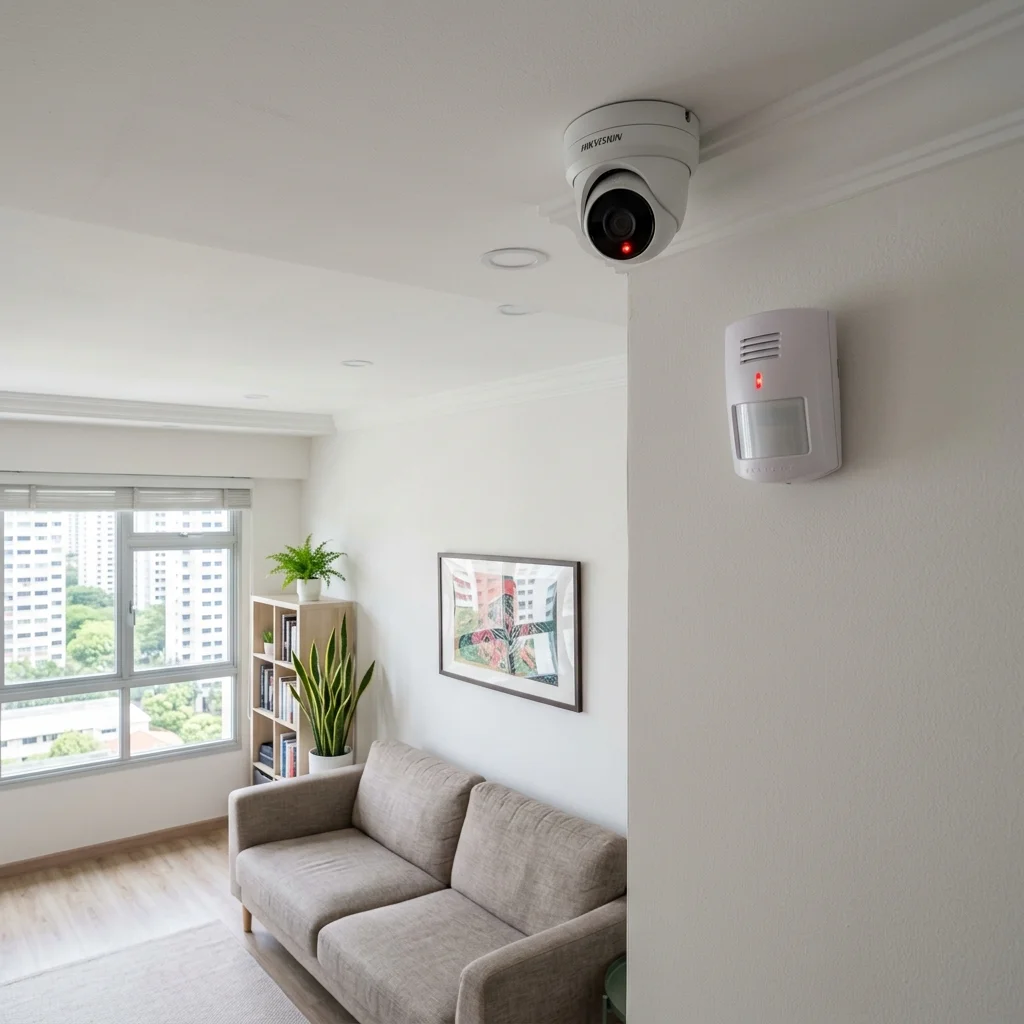
Twenty years ago, most homeowners asked whether they should install a burglar alarm. Today, the question has changed. The version I hear most often is this: I already have CCTV; do I still need an alarm system?
It is a fair question. Modern CCTV systems are significantly more capable than they used to be. Many cameras now detect people, filter out irrelevant movement, send push notifications directly to your phone, and allow you to view live footage from anywhere. With all of that capability, it is easy to assume that CCTV has replaced what a burglar alarm once did.
The reality is that they perform different jobs, and understanding that difference is the most useful starting point for deciding what your property actually needs.
KEY POINT
The question is not CCTV or alarm. It is what each technology does, where each one falls short, and what the gap between them looks like when something actually happens.
One Tells You What Happened. The Other Tells You It Is Happening.
The most useful way to understand the difference between CCTV and an alarm system is this: CCTV helps you understand what happened. An alarm system helps you respond while it is happening. Both are valuable. They solve different problems.
CCTV is built around observation and recording. When something occurs, the camera captures it; images, video, timestamps, a visual record of the sequence of events. This is extremely valuable for investigation, for evidence, and for understanding exactly what happened and when. If an incident occurs at your property, CCTV answers the retrospective questions: who was there, what did they do, which direction did they come from, what did they take.
An alarm system is built around detection and immediate response. A door contact opens; the alarm triggers. A motion detector activates; the alarm fires. The purpose is not to create evidence. The purpose is to create a response right now, while the event is still in progress. The notification goes to you, to a monitoring centre, to keyholders. The siren activates. The window for intervention is open.
A CCTV recording may show that somebody entered your property at 2.15am. An alarm system may notify you at 2.15am. That is the difference, and depending on the situation, that difference is the entire outcome.
KEY POINT
The camera provides the context. The video provides the evidence. The alarm provides the trigger. Together they are significantly more powerful than either alone.
But My CCTV Already Sends Notifications
This is where the question gets more nuanced. Modern CCTV systems with AI-based person detection can send push notifications when a person is detected, and the accuracy of these notifications has improved considerably. For many homeowners, this feels functionally similar to an alarm system alert. If the camera detects someone at the front gate and sends a notification, is that not effectively the same as an alarm?
In some scenarios, for some properties, it is close enough. A homeowner who is reliably available, living in a managed estate with on-site security, and primarily interested in being informed rather than triggering an escalation response may find that a smart CCTV system with person-detection notifications is adequate for their needs.
But the comparison starts to break down when you look at how the two systems are actually designed; because the similarities on the surface conceal significant differences underneath.
KEY POINT
The notification a CCTV camera sends and the alert an alarm system generates may feel similar from the homeowner's phone. The infrastructure behind each of them is designed very differently, and those design differences matter when things go wrong.
How CCTV and Alarm Systems Are Designed Differently
A consumer CCTV system is typically built around a camera feeding into a recorder; an NVR or DVR, which then pushes events to a mobile app. This architecture works well for its intended purpose: recording video, sending event notifications, and allowing remote viewing. It is not designed around the additional requirements that professional alarm monitoring demands.
A properly configured alarm system continuously supervises its own health. It monitors power status, battery condition, communication path integrity, detector operational status, and tamper conditions on every component. If the communication path fails, the monitoring centre is alerted. If the backup battery weakens, the panel logs a fault. If a detector is tampered with, an immediate alert is generated. The system is designed on the assumption that it will be attacked or disrupted, and that the monitoring centre needs to know about any disruption immediately.
Most consumer CCTV systems are not built to this standard. Ask a few specific questions about a typical home CCTV installation: does the NVR continue operating during a power failure, and for how long? If the broadband connection fails, does the system report that loss of communication to anyone? Is the NVR tamper-protected, if an intruder who knows what they are doing unplugs it before entering, what alerts are generated? These are not questions designed to criticise CCTV; they are questions that reveal where its design priorities lie, and they are different priorities from those of an alarm system.
DESIGN RULE
An alarm system is designed on the assumption of adversarial conditions; power cuts, communication disruption, physical tampering. A consumer CCTV system is designed for normal operating conditions. The difference matters most precisely when abnormal conditions are created deliberately.
Security Has Always Been About Layers
One lesson that has stayed with me across many years in the security industry is that good security is rarely achieved with a single technology. We think in layers, because each layer compensates for the limitations of the others.
The first layer is physical protection; gates, doors, locks, fences, grilles. These slow an intruder down and create barriers that take time and effort to overcome. They do not detect or respond; they resist.
The second layer is detection; door contacts, motion detectors, glass break sensors, the alarm system itself. This layer identifies that a breach has occurred or is occurring and generates an immediate alert. It does not explain what happened; it tells you that something is happening now.
The third layer is verification; CCTV cameras, video verification, AI analytics. This layer provides context. Who is there? Are they authorised? What are they doing? This is where CCTV delivers its greatest value; it transforms an alarm signal from "something triggered" into "here is what is actually happening."
The fourth layer is response; monitoring centres, security officers, police activation. This layer converts detection and verification into action. It is the layer that determines whether an alarm results in an intervention or simply in a record of what occurred.
Each layer has limitations on its own. Physical barriers can be overcome. Detection systems generate false alarms. CCTV without an alarm may not trigger a response until after the fact. Response without verification may be delayed or misdirected. Together, the layers address each other's weaknesses. That is why banks, warehouses, offices and many landed homes use both CCTV and alarm systems, not because they cannot choose between them, but because both serve distinct and necessary roles.
KEY POINT
Choosing between CCTV and an alarm system assumes that one can substitute for the other. They cannot; they occupy different layers of the same security architecture. The question is not which one, but which combination matches the risk profile of the specific property.
How Integration Changes the Picture
The security industry has steadily moved towards closer integration between alarm and CCTV systems, and that integration changes what each technology can deliver individually.
When a door contact triggers an alarm, the integrated system can immediately display camera footage from the relevant zone on the monitoring centre's screen or the homeowner's app. The operator or homeowner does not have to search through camera feeds to find what triggered; the alarm event and the associated video arrive together. Verification that previously took minutes of manual footage review can happen in seconds.
This is the operational model behind video verification as described in the earlier article on video verification; the alarm provides the trigger, the camera provides the evidence, and the combination gives the monitoring centre something concrete to act on rather than just a zone signal. The result is faster decisions, more accurate responses, and fewer unnecessary police dispatches on events that turn out to be false alarms.
Integration does not make the alarm redundant in favour of CCTV, or CCTV redundant in favour of the alarm. It makes both more effective by allowing each to do what it is best at while filling the other's gaps.
KEY POINT
An integrated alarm and CCTV system is not the sum of its parts; it is more than that. The alarm's detection precision combined with the camera's visual context produces a verification capability that neither system achieves independently.
So Do You Still Need a Burglar Alarm?
For many Singapore homeowners, the honest answer is that it depends on the property and how it is used.
If you live in a condominium that is almost always occupied, with CCTV covering the main entry points, a managed estate with security guards, and you are reliably available to receive and act on notifications; a smart CCTV system may provide adequate day-to-day security for your situation. You are not in a high-risk scenario, you have multiple compensating factors, and the gap that an alarm system fills may be narrow enough that the additional cost is not justified.
If you own a landed property that is frequently vacant, a retail business that is empty overnight, a warehouse, or any premises where the consequences of a missed alarm would be serious; a dedicated alarm system adds a layer of reliability and monitoring integration that CCTV alone cannot replicate. The supervision architecture, the backup power, the monitoring centre integration, the communication path redundancy; these matter precisely in the scenarios where the property is most vulnerable.
The strongest answer for most properties, particularly those with any meaningful period of vacancy, is both, with the two systems integrated so that each does what it does best. The alarm detects and alerts. The CCTV verifies and evidences. The monitoring centre responds. That is not over-engineering. That is the standard model for properties where security actually matters.
Securevision Verdict
Modern CCTV systems are significantly more capable than they were a decade ago. They can detect people, generate alerts, and provide valuable real-time information. But CCTV and alarm systems are not competing technologies. They are complementary ones; each occupying a different layer of the same security architecture.
The alarm provides reliable detection and immediate response. The CCTV provides verification, context, and evidence. One tells you something is happening. The other tells you what is happening. When used together, they deliver a level of security that neither achieves alone. In security, we rarely rely on a single layer, and there is a good reason for that.
In Short
CCTV and burglar alarms are not competing systems. They answer different questions; one tells you what happened, the other tells you it is happening. A CCTV system with push notifications can alert you to movement, but it cannot determine whether what it detected is an intrusion, and it cannot trigger a professional monitoring response or sound a siren automatically. For properties where active deterrence and monitored response matter, both systems working together deliver something that neither can deliver independently. The question is not which one to choose; it is how to integrate them effectively.

Frequently asked questions
Do I still need a burglar alarm if I have CCTV?
For most properties where active deterrence and monitored response are important, yes. CCTV records what happens and can send motion notifications, but it does not trigger an audible deterrent or automatically alert a monitoring centre. A burglar alarm detects intrusion, sounds a siren, and initiates a professional monitoring response. The two systems address different aspects of security and are more effective together than either is alone.
What does a CCTV system do that a burglar alarm cannot?
CCTV provides continuous visual recording of what occurs at a property, allowing events to be reviewed after the fact. It shows who was present, what they did, and how they entered or exited. This is invaluable for investigation and evidence purposes. A burglar alarm detects the intrusion and triggers a response, but it cannot show you what happened or provide footage that could assist in identifying an intruder.
What does a burglar alarm do that CCTV cannot?
A burglar alarm sounds an audible siren that actively deters intruders and drives them away. It automatically alerts a monitoring centre, which initiates a response protocol including keyholder contact and potential police notification. It can detect intrusion in total darkness or through walls; conditions where CCTV footage would be of limited quality. And it does all of this without requiring anyone to watch a screen.
Can CCTV motion alerts replace a burglar alarm?
Not effectively. CCTV motion alerts require someone to receive the notification, view the footage, assess whether it represents a genuine intrusion, and then decide what to do. This chain of events takes time and depends on the recipient being available and responsive. A burglar alarm with professional monitoring triggers a structured response automatically, 24 hours a day, without requiring the property owner to act.
What is video verification in alarm monitoring?
Video verification is a monitoring approach where cameras capture images or short video clips at the moment an alarm is triggered. These clips are transmitted to the monitoring centre alongside the alarm signal, allowing the operator to assess whether an intrusion appears to be occurring before deciding on a response. This reduces false alarm responses while improving the quality of genuine alarm activations.
How does CCTV integration with a burglar alarm work?
In an integrated system, the alarm panel triggers cameras to begin recording at the moment a detector activates. The same event can cause the NVR to flag and bookmark the relevant footage for easy retrieval. Some systems allow the monitoring centre to access camera footage directly during an alarm activation, supporting faster and more informed response decisions.
What is the difference between a monitored alarm and a self-monitored alarm?
A monitored alarm is connected to a professional central monitoring station that receives alarm signals and follows a response protocol; contacting keyholders and potentially the police. A self-monitored alarm sends notifications to the property owner's smartphone. Self-monitoring relies on the owner being available and responsive at all times; professional monitoring provides continuous coverage regardless of whether the owner is reachable.
Is a CCTV system cheaper than a burglar alarm?
A basic CCTV system and a basic burglar alarm are comparable in cost at the residential level. The ongoing cost of professional alarm monitoring adds a recurring expense that CCTV does not have unless a video monitoring service is also subscribed to. The total cost of ownership over several years should be compared rather than the initial installation cost alone.
Can a single system provide both CCTV and alarm functions?
Some integrated security platforms combine alarm detection and camera functions in a single system, with a shared app and interface. However, dedicated alarm systems and dedicated CCTV systems each perform their individual functions better than integrated consumer-grade alternatives. For properties where both functions are important, specifying each system appropriately and then integrating them is generally more effective than buying a combined product.
What should I prioritise; CCTV or an alarm, if I can only afford one?
For a property where deterrence and active response are the primary concern; particularly for a full-time occupied home; a properly monitored burglar alarm typically provides more immediate security value than CCTV alone. For a property where recording and evidence are the priority; a commercial space, a car park, a common area; CCTV may be the more appropriate first investment. The right answer depends on the specific security concern being addressed.