- Most security upgrade proposals fail because they start with the solution instead of the problem; residents cannot support a spending decision they do not understand the need for.
- The first section of any proposal should establish what is currently installed, when it was installed, and what its limitations are; facts are more persuasive than opinions.
- Maintenance records are one of the most persuasive documents in any upgrade proposal; a pattern of repeated faults over time answers the repair question before residents ask it.
- The repair-versus-replace question must be answered explicitly; proposals that ignore it lose credibility with residents who will ask it regardless.
- Budget transparency; showing where every dollar goes across equipment, installation, cabling, maintenance, and training; converts suspicion into constructive discussion.
- Most residents do not vote for technology. They vote for outcomes; reliability, convenience, and confidence that the money is being spent wisely.
One Question Every Resident Asks
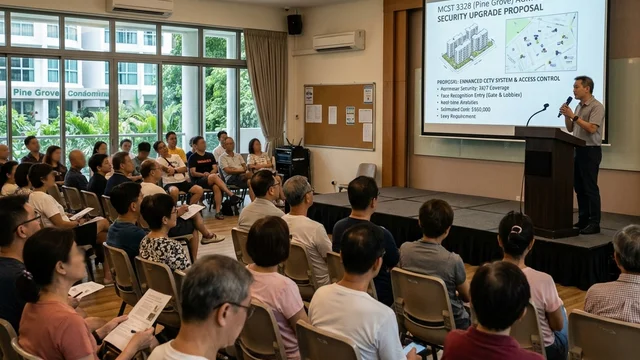
I have attended many AGM and EGM meetings over the years, and whether the proposal on the table is for CCTV, intercom, access control, or vehicle management, the first question from the floor is almost always the same: why do we need to spend this money? That is a fair question. Residents are being asked to approve a significant expenditure; sometimes $100,000, sometimes $200,000, sometimes considerably more, from the estate's sinking fund or through a special levy. They are entitled to understand what they are paying for and why it is necessary.
The mistake most proposals make is jumping straight to the solution. They open with camera specifications, resolution comparisons, mobile app features, and AI analytics capabilities. Residents are not thinking about technology at that point. They are thinking about value. Before they can support any solution, they need to understand the problem the solution is addressing. A proposal that starts with the answer before establishing the question will struggle to build the consensus it needs; regardless of how good the solution actually is.
KEY POINT
The order of a proposal matters as much as its content. Problem first. Solution second. This sequence builds the foundation of understanding that makes approval possible, and it is the sequence that most proposals get wrong.
Start With the Current Situation
The first substantive section of any upgrade proposal should answer a simple question: what do we have today? This sounds obvious, yet many proposals skip over it entirely and move directly to what the estate will have after the upgrade. Establishing the current situation is not just good communication practice; it is the evidence base that makes every subsequent section of the proposal credible.
For a CCTV upgrade, this means documenting what cameras are currently installed, when they were installed, what resolution they record at, and what the known coverage gaps are. For an intercom upgrade, it means documenting which handsets are faulty, which floors have recurring connectivity problems, and what the spare parts situation looks like. For an access control upgrade, it means showing which entry points are covered, which are not, and what the current credential management situation looks like across the estate's unit mix. The detail matters because it replaces opinion with evidence.
Saying the CCTV system is outdated is an opinion. Showing that it was installed in 2011, records at a resolution that cannot identify a face beyond three metres, has seven known blind spots in the carpark, and last had a full maintenance visit eighteen months ago is evidence. Residents who would argue with the opinion will find the evidence much harder to dismiss.
KEY POINT
Facts are always more persuasive than opinions. The current situation section of a proposal should contain specific figures; installation year, camera count, resolution, known faults, maintenance history, not general characterisations of the system's condition.
Maintenance Records Tell a Story
One of the most powerful documents available to any MCST proposing a security upgrade is the maintenance history of the existing system. Most managing agents and councils have this information; service call records, fault logs, parts replacement histories, contractor invoices, but it is rarely presented as part of the upgrade proposal. When it is, the effect on resident perception is significant.
Residents often arrive at an AGM with a reasonable assumption: if the system can still be repaired, why replace it? A single fault is not a compelling reason. But a maintenance record showing seventeen service calls in the past three years, the same handset units generating repeated faults, a component that has been replaced twice because the original part is no longer manufactured, and a contractor's written advice that the central controller is beyond reliable service life, that is a story. It is a story about a system that is costing the estate money and reliability while still appearing functional on the surface.
When residents can see that pattern in the maintenance data, the conversation changes. The proposal stops being about spending money on new technology and becomes about resolving an ongoing operational problem. That is a fundamentally different discussion, and one that is significantly easier to build consensus around. The security upgrade becomes the solution to a problem the residents now understand, rather than a spending decision they were asked to approve without context.
KEY POINT
Request the full maintenance history from the managing agent before preparing any upgrade proposal. A pattern of repeated faults is more persuasive than any technical specification, and it answers the repair-versus-replace question before residents raise it.
The Repair Question Must Be Answered
Every resident will eventually ask why the estate cannot simply repair the existing system rather than replace it. They should ask; it is a legitimate question, and a proposal that does not address it head-on will have it raised from the floor at the AGM, where it will be harder to answer convincingly under pressure. Anticipating the question and addressing it in the written proposal is always the more effective approach.
The answer requires honest assessment across four dimensions. Whether spare parts are still available from the manufacturer or distributors, and if so, at what cost and lead time compared to two years ago. Whether the manufacturer still supports the platform with firmware updates and technical assistance, or whether it has reached end of support and the estate is now operating an unpatched system with no recourse if a security vulnerability is discovered. Whether further repair is economically rational given the cost trajectory of the maintenance history. And whether even a fully repaired version of the existing system would meet the estate's current operational needs; coverage, remote access, retention period, integration with other systems, or whether it would simply restore a system that was adequate for 2012 to working order in 2026.
Residents do not expect a perfect system. They do expect an honest answer to a fair question. A proposal that addresses the repair question clearly and factually; acknowledging where repair remains viable and explaining specifically why replacement is nonetheless the more appropriate decision; builds the credibility that carries a vote.
KEY POINT
Address the repair question in writing before the AGM. The answer should cover parts availability, manufacturer support status, cost trajectory, and whether the repaired system would meet current operational requirements. A clear written answer is more persuasive than a verbal one given under pressure.
Make the Gaps Visible
One of the most effective things an upgrade proposal can do is make the current system's gaps visible rather than merely describing them. A floor plan or site diagram with cameras marked and coverage areas shaded, clearly showing the blind spots in the carpark, the unmonitored pedestrian entrance at the side of the estate, and the intercom dead zone on the upper floors of Block C, communicates more immediately than three paragraphs of text.
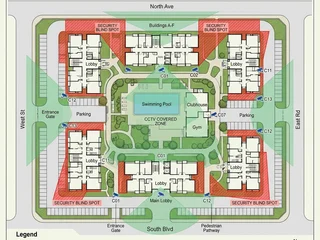
The visual representation serves two purposes. It gives residents who are not familiar with the technical details of security systems an intuitive understanding of what protection they currently have and where it ends. And it makes the specific improvements proposed in the upgrade directly legible; residents can see exactly what the new camera at position X will cover that is not covered now, and why the intercom replacement in Block C addresses a specific known problem rather than simply being a general improvement.
Beyond CCTV blind spots, the gap analysis should surface all the security limitations that are relevant to the proposal; unprotected entrances, ageing intercom infrastructure with no mobile forwarding capability, vehicle access points that rely entirely on manual guard management, and access control gaps where resident movement cannot be managed or audited. Each gap should be linked directly to a specific component of the proposed solution, so residents can see exactly what each element of the expenditure is addressing.
KEY POINT
A single floor plan showing current camera coverage and identified blind spots is often more persuasive than any written description. Visual evidence of a gap is harder to dismiss than a verbal characterisation of it.
Then Present the Solution
Only after the current situation, the maintenance history, the repair question, and the gap analysis have been established should the proposal present the proposed upgrade. This is where most proposals begin. In my view, it is where they should arrive, as the logical conclusion of the evidence presented in the preceding sections rather than as the opening proposition the evidence is meant to justify retrospectively.
The solution section is most effective when it is structured as a direct response to the identified problems. The blind spot in the secondary carpark entrance is addressed by the additional camera at that position. The recurring intercom failures in the three affected blocks are addressed by the replacement of the central controller and the unsupported handset generation. The absence of remote visitor management capability; consistently the most requested resident feature in the estate's annual satisfaction survey; is addressed by the mobile-enabled intercom platform. Each line item in the solution should trace directly back to a problem that has been documented in the proposal.
This structure means that residents reviewing the proposal can understand not just what is being proposed but why each element is included. A proposal where every component is traceable to a documented problem is a proposal that is difficult to argue against on the merits, which is precisely the position the committee wants to be in at the AGM.
KEY POINT
Structure the solution section as a direct response to the gap analysis. Every component of the proposed upgrade should be traceable to a documented problem. Residents should be able to see exactly what each element of the expenditure is solving.
The Budget Should Never Be a Single Number
Nothing generates suspicion at an AGM faster than a large number with no explanation. When residents see a budget line of $180,000 for a "security system upgrade" with no further detail, the questions that follow are predictable: what exactly are we paying for, how does that compare to what we paid last time, and how do we know this is a fair price? Those questions are harder to answer convincingly from the floor than they are to pre-empt in a transparent written budget.
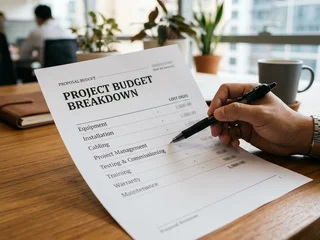
A properly presented budget breaks the total expenditure into its component categories; equipment, installation labour, cabling and infrastructure, project management and supervision, testing and commissioning, staff training, warranty provisions, and ongoing maintenance. This breakdown does two things. It demonstrates that the committee has understood and reviewed the scope in detail rather than simply approving a total. And it gives residents who raise questions about specific items a precise answer; the $18,000 cabling cost reflects the need to replace the existing coaxial infrastructure rather than assume reuse, which the assessment identified as unsuitable.
When residents understand where the money is going and why each category is included, objections typically shift from general cost concerns to specific questions about scope and value, which is a significantly more productive discussion. The transparency itself communicates that the committee has done its due diligence, which is one of the most important signals a proposal can send to residents who are being asked to trust their committee's judgement with a significant sum.
KEY POINT
Present the budget by category, not as a single total. The breakdown signals due diligence, pre-empts the most common questions, and converts general cost objections into specific discussions about scope and value.
Address the Disruption Honestly
Every security upgrade causes some inconvenience; installation noise, temporary access changes, periods when specific cameras or intercom points are offline, guard procedures that change during the transition. Residents know this. A proposal that does not acknowledge it will have residents assuming the worst, and the questions raised at the AGM will reflect those assumptions rather than the actual disruption profile of the project.
A good proposal is specific about what disruption to expect. How long will the project take, broken down by phase? Which areas will have temporary gaps in CCTV coverage during installation, and what interim arrangements will be in place? How will residents be informed about changes to intercom or access control procedures during the transition? What is the contingency plan if the project extends beyond its planned timeline? People are consistently more accepting of disruption when they know specifically what to expect than when they are left to imagine it.
KEY POINT
Residents who know what disruption to expect are far more accepting of it than residents who are left to imagine it. Be specific about timeline, affected areas, interim arrangements, and communication plans.
What Makes Residents Vote Yes
After many years attending AGMs and EGMs for security upgrade proposals across Singapore condominiums, the pattern of what produces a yes vote is consistent. It is not the specification of the cameras. It is not the features of the mobile app. It is not the brand of the access control system. Most residents do not vote for technology. They vote for outcomes; reliability, convenience, and confidence that the money is being spent wisely by a committee that has done its homework.
Proposals that earn that confidence have four things in common. They clearly explain the problem, not in general terms, but with specific evidence from the maintenance history and gap analysis that makes the need for change undeniable. They answer the repair question honestly and in advance, so residents arrive at the AGM with their most likely objection already addressed. They present a transparent budget that shows residents exactly where the money is going and why each category is necessary. And they describe the benefits in practical terms that residents recognise from their daily experience; no more missed visitor calls because the intercom handset is unreliable, no more blind spot in the carpark where the motorbike thefts have been occurring, no more manual visitor logbook at the guardhouse.
The relationship between the committee and the residents matters too. A committee that is seen to have engaged the problem seriously; commissioning a proper site assessment, reviewing multiple proposals, applying a structured evaluation framework, and presenting findings transparently; earns a level of trust that makes approval significantly easier to achieve. For guidance on how to evaluate competing proposals before bringing a recommendation to residents, the framework for comparing security integrators fairly covers that process in detail.
Securevision Verdict
The most successful security upgrade proposals do not start by selling technology. They start by explaining reality; what is currently installed, what its limitations are, what the maintenance history shows, and what the gap between the current system and the estate's actual security needs looks like. When residents understand that reality clearly, the proposed solution becomes the logical conclusion of the evidence rather than a spending decision they are being asked to approve on faith.
A good proposal builds confidence. It demonstrates that the committee has understood the problem, considered the options, and is recommending a solution that is proportionate, transparent, and defensible. That confidence; more than any technical specification, any brand comparison, or any mobile app feature; is what turns a deferred proposal into an approved one.
In Short
A condominium security upgrade proposal that wins AGM approval is not necessarily the most technically sophisticated one; it is the one that presents a clear problem, a proportionate solution, an honest budget, and a realistic plan for managing the disruption that installation will cause. Residents vote for proposals they trust. Trust comes from transparency: showing the current state honestly, explaining the gaps clearly, giving a range of costs rather than a single figure, and committing to communication throughout the project. The committee that gets this right converts a difficult AGM agenda item into a straightforward resolution.

Frequently asked questions
What does a condominium security upgrade proposal need to include?
An effective proposal should include: a clear assessment of the current security system's condition and gaps; the specific outcomes the upgrade will achieve; the proposed scope of work with equipment specifications; a realistic budget range (not a single fixed figure); a project timeline including disruption periods; a plan for communicating with residents during installation; and the rationale for why this is the right time to proceed.
Why do some condo security upgrade proposals fail at the AGM?
Proposals fail most often because: the problem is not clearly established (residents do not understand why the current system is inadequate); the budget is a single figure that residents distrust; the disruption implications are not addressed; the scope is not well explained; or the proposal is seen as coming from the committee rather than from independent professional advice. Residents are more likely to support proposals that demonstrate transparency and credibility.
How do I justify the cost of a security upgrade to residents?
The most effective justification combines the current system's maintenance record (showing escalating repair costs), the identified gaps in coverage or response capability, and a cost comparison between the ongoing cost of maintaining the existing system and the one-time investment in replacement. Presenting a cost range rather than a single figure, and explaining what drives the variation; also builds confidence that the budget has been thought through realistically.
What is the difference between repairing and replacing a condo security system?
Repair addresses specific component failures while keeping the existing system architecture. Replacement installs a new system, typically with improved coverage, technology, and management capability. The decision depends on: the age and overall condition of the existing system; the availability of spare parts; whether the existing system can support the features residents expect; and whether the cumulative cost of ongoing repairs makes replacement the more economical choice over a five-year horizon.
How should a proposal address disruption to residents?
Disruption from security system installation is unavoidable but manageable. The proposal should: identify which areas will be affected and when; confirm the minimum period of time that specific security measures will be reduced during installation; describe the temporary measures that will be in place during the transition; and commit to a resident communication plan with advance notice of access restrictions or service interruptions.
What maintenance records should a MCST review before proposing an upgrade?
Review service call logs for the past three years; specifically the frequency of calls, the components that have required repeated attention, and the time taken to resolve faults. Escalating call frequency or recurring faults in specific components indicate a system approaching end of life. Maintenance cost trends are also useful: if annual maintenance costs have increased significantly, this is relevant to the cost comparison with replacement.
How should the budget be presented in a security upgrade proposal?
Present a cost range rather than a single figure, and explain what drives the variation. For example: 'The upgrade is estimated to cost between $X and $Y depending on the extent of rewiring required and the final specification of the access control system.' This is more credible than a single number, and it gives the AGM a realistic understanding of the financial commitment. A contingency allowance of 10 to 15 percent should also be included.
What security upgrades typically require AGM approval in a condominium?
Capital expenditure above the threshold set in the management corporation's standing orders typically requires AGM approval. Security system replacements, which usually involve significant capital outlay; normally fall above this threshold. Routine maintenance and like-for-like component replacements may fall within the council's delegated authority. Check the MCST's standing orders and seek legal confirmation if the threshold is unclear.
How long does a typical condominium security upgrade take in Singapore?
A typical condominium security upgrade; covering CCTV, intercom, and access control; takes between three and six months from AGM approval to system handover. The pre-installation phase (finalising specifications, procuring equipment, and obtaining approvals) typically takes four to eight weeks. Physical installation for an estate of 200 to 500 units typically takes six to twelve weeks. A detailed programme should be agreed with the contractor before work begins.
What should the MCST do after the security upgrade is complete?
After completion: conduct a formal system walkthrough with the contractor to verify that all specified elements have been installed correctly; obtain all documentation including zone maps, user manuals, monitoring centre contact details, and warranty certificates; confirm the monitoring centre connection is active; brief the security team and management staff on the new system; and schedule the first annual service visit for twelve months after handover.