- A condominium security upgrade in Singapore typically takes eight to eighteen weeks from contract signing to full handover; the installation itself is usually the shortest stage.
- AGM approval is the beginning of the project, not the trigger for immediate work; contracts, procurement, and planning all happen after approval.
- Equipment lead time is the most commonly underestimated factor; specialist intercom and access control hardware can take four to six weeks to arrive.
- Resident onboarding; card distribution, app activation, face enrolment, and resident briefings; consistently takes longer than the technical installation in large developments.
- Biometric enrolment cannot be made compulsory under Singapore's PDPA; every system must provide an alternative credential for residents who opt out.
- The projects that complete on time are almost always the ones where the council invested adequately in the planning stage, not the ones that compressed planning to start installation sooner.
Why Security Upgrade Timelines Often Slip

One of the first questions MCST councils ask when a security upgrade is being considered is how long the project will take. It sounds like a simple question, but the answer is often more complicated than people expect. Most project schedules focus on the installation work itself; cameras are installed, readers are replaced, intercom panels are upgraded. What residents see on site is only part of the story.
Behind the scenes, equipment needs to be ordered, drawings need to be reviewed, communication plans need to be prepared, and various stakeholders need to be aligned. We have seen projects where the installation was completed on schedule but the overall project still took longer because equipment delivery was delayed or resident onboarding required additional time. That is why we generally encourage councils to focus on the overall project timeline rather than just the installation period.
Security upgrade timelines in condominiums are consistently underestimated for three reasons. Procurement takes longer than expected, from AGM approval to contract signing typically takes four to eight weeks alone. Equipment lead times are real; certain products, particularly specialist intercom equipment and access control controllers, may require four to six weeks from order to delivery. And installation in a live condominium is slower than in an empty building; residents are present, noisy works must be scheduled around peak usage hours, and access to certain areas requires coordination that adds time to every phase. A project that an integrator estimates will take three weeks in an empty building will typically take five to seven weeks in a live condominium.
The Project Does Not Start When the AGM Approves It
Many councils assume that once the AGM approves a project, work can begin immediately. In practice, that is rarely the case. AGM approval authorises the project to proceed, but the project itself begins after contracts are finalised, equipment is ordered, and the project schedule is agreed. For most projects, several weeks pass between approval and the first day of on-site work. This is normal and should be factored into the overall timeline from the outset.
The earlier councils understand this, the easier it becomes to manage expectations with residents, who will inevitably ask when work is starting and why nothing appears to be happening immediately after the vote. Contracts need to be finalised, site conditions need to be verified, equipment needs to be ordered, project schedules need to be coordinated, and resident communication plans need to be prepared. None of this is visible to residents, but all of it is essential before the first technician arrives on site.
PLANNING POINT
Build at least four to six weeks of pre-mobilisation time into your project timeline between AGM approval and the first day of on-site work. Use this period to finalise contracts, confirm equipment availability, and prepare your resident communication plan.
What Actually Happens During a Security Upgrade
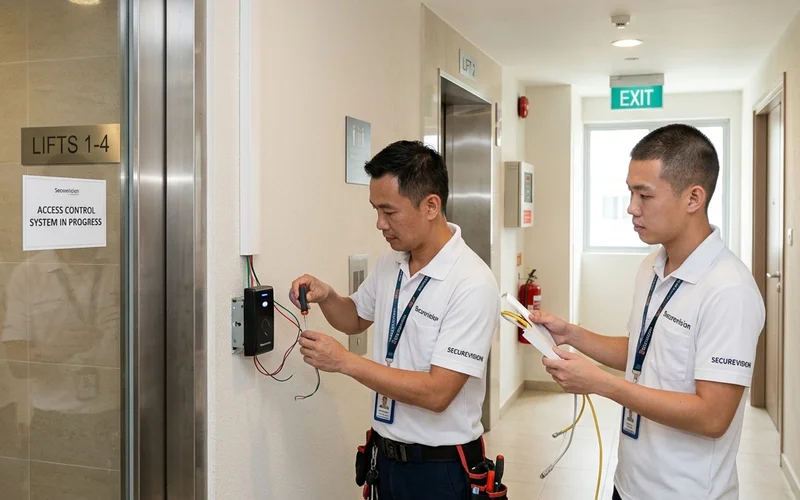
Many residents imagine a security upgrade as a few technicians arriving with ladders and tools. In reality, a condominium upgrade moves through several distinct stages, each with its own requirements, dependencies, and potential for delay. The planning and procurement stage is where the project is actually designed; drawings are reviewed, equipment is ordered, schedules are agreed, and the resident communication plan is prepared. This stage is invisible to residents but determines whether everything that follows runs smoothly.
The infrastructure works stage involves new cabling, network upgrades, equipment cabinets, and preparation work in communication rooms and cable risers. Depending on the age of the property, this stage can be straightforward or surprisingly challenging; older developments sometimes have cabling conditions that only become apparent once work begins. The system installation stage is the part residents notice; cameras installed, access readers replaced, visitor panels upgraded, equipment mounted and connected. Testing and commissioning follows, during which every camera, reader, intercom station, and controller is tested, permissions are verified, and security officers are trained. The final stage; resident onboarding; is consistently the most underestimated of all.
How Long Does Each Stage Take?
| Stage | Typical Duration | Key Activities |
|---|---|---|
| Planning and procurement | 3–6 weeks | Drawings reviewed, equipment ordered, schedules agreed, communication plan prepared |
| Infrastructure works | 1–3 weeks | Cabling, network upgrades, equipment cabinets, comms room preparation |
| System installation | 1–3 weeks | Cameras, readers, intercom panels, controllers installed and connected |
| Testing and commissioning | 1–2 weeks | Full system test, permissions verified, security officer training |
| Resident onboarding | 2–4 weeks | Card distribution, app activation, face enrolment, resident briefings |
| Total typical range | 8–18 weeks | From contract signing to full handover |
The Most Underestimated Part of Any Upgrade

Most councils worry about the installation. In our experience, the bigger challenge is almost always resident onboarding. Consider a condominium with 200 units; you could easily have 400 to 600 residents. Every access card needs to be issued, every card needs to be documented, mobile applications need to be activated, and face recognition systems require in-person enrolment. Residents who are overseas or frequently travelling need special arrangements. The logistics of this exercise should not be rushed; we recommend allocating a minimum of two to four weeks for resident onboarding alone, and more for larger developments.
We have seen projects where the technical installation was completed ahead of schedule but resident onboarding continued for several weeks afterwards. The technology was ready. The residents were not. A smooth transition depends just as much on people as it does on technology. Residents who understand what is changing, when it is changing, and what they need to do will always transition more smoothly than those who encounter changes without advance notice. We typically conduct resident briefing sessions or townhall meetings before system cutover, in our experience, these sessions significantly reduce confusion and complaint volumes in the first weeks after activation.
KEY POINT
For a 200-unit development, plan for 400 to 600 access cards to be issued, documented, and activated. If biometric enrolment is included, every participating resident must attend in person. Two to four weeks is a realistic minimum for this stage, not two to three days.
What Can Go Wrong, and How to Reduce the Risk
Understanding the most common sources of delay helps councils plan around them before they become problems on site. Equipment delivery delays are the most common cause of programme slippage. Specialist products; particularly custom intercom panels, lift interface modules, and certain access control hardware; are sometimes subject to import or manufacturing delays. Confirming stock availability before signing contracts, and building buffer time into the schedule, reduces this risk significantly. A realistic project schedule always includes procurement lead time.
Riser and cabling conditions in older developments are sometimes worse than anticipated once work begins. Hidden joints, damaged cable segments, or inadequate conduit capacity can add time and cost to the infrastructure stage. A thorough pre-installation survey helps identify these issues before they affect the programme rather than during it. Scope changes during the project are another common source of delay; additional cameras requested during installation, access control points added after the original scope was agreed, or integration requirements not identified during planning all add time and cost.
In our experience, the projects that complete on time are almost always the ones where the council committed adequate time to the planning stage, not the ones that tried to compress planning in order to start installation sooner.
PLANNING POINT
Commission a pre-installation survey before finalising the project scope and timeline. Issues identified during the survey can be addressed in the specification; issues discovered during installation become variations that affect both cost and programme.
Resident Communication; What to Send and When
Resident communication is a project management requirement, not an afterthought. Residents who are informed accept disruption. Residents who are surprised by it generate complaints. We recommend a minimum of three resident communications for any security upgrade project: an advance notice four to six weeks before work begins explaining what is changing and why, a phase-specific notice three to five days before any work that will affect specific areas or access points, and a post-activation guide explaining how to use the new system and who to contact with questions.
For larger projects or estates with a history of sensitive resident relations, we recommend a resident engagement session or townhall meeting before the system goes live. These sessions allow residents to ask questions, understand the new system, and prepare for the transition before it happens. Contractor identification is also part of resident communication; residents seeing unidentified workers in corridors generates anxiety. Proper identification through branded uniforms and site access controls manages this effectively. Every Securevision engineer working on site is clearly identifiable, and we brief residents on what to expect before work begins in each area of the estate.
The Technical Work Is Often the Easy Part
One thing many people do not realise is that the actual installation is often the easiest part of a condominium security upgrade. In a commercial building, decisions are typically made by a relatively small group; the architect, the consultant, the developer, and the contractor. The project moves at a professional pace with clear decision-making authority at each stage.
Condominiums work differently. The managing agent coordinates with the council. The council reviews options and provides direction. Questions are discussed across multiple stakeholders. Decisions are made through a governance process that, appropriately, involves more people and takes more time. Then comes the resident population; even after a decision has been made at council level, residents still need to understand what is changing, when it is changing, and how it affects them directly. The human side of a security upgrade; helping 300 or 400 residents adapt to a new system, change access habits that may be years old, and trust infrastructure they did not choose themselves; is where most projects either succeed or struggle. The technology is almost always the easier problem to solve.
Securevision's View
The most common mistake we see in condominium security upgrade projects is treating the contractor's installation period as the project. It is not. The project begins when the council decides to proceed and ends when the last resident has been onboarded, trained, and is using the new system confidently.
Councils that understand this from the outset allocate appropriate time for planning, communicate early and clearly with residents, and treat the resident onboarding stage with the same seriousness as the technical installation. The result is a smoother transition, fewer complaints, and a system that delivers its intended benefits from day one rather than weeks after handover.
Frequently Asked Questions
How long does a condominium security upgrade take in Singapore?
For most developments, the full project, from contract signing to final handover; takes between eight and eighteen weeks depending on the scope of work, equipment lead times, and the size of the resident population requiring onboarding. The installation phase alone is typically one to three weeks. Councils that plan only for the installation phase and not the surrounding stages consistently find the overall timeline longer than expected.
Does AGM approval mean work can start immediately?
No. AGM approval authorises the project to proceed, but the project itself begins after contracts are finalised, equipment is ordered, and the project schedule is agreed. For most projects, several weeks pass between approval and the first day of on-site work. This is normal and should be communicated to residents from the outset to manage expectations.
How far in advance should residents be notified?
We recommend a minimum of four weeks notice before any work that affects residents directly; access card replacement, indoor monitor installation, or system cutover. For estates with a high proportion of overseas or frequently travelling residents, six to eight weeks provides enough time for special arrangements to be made. Longer notice periods consistently result in smoother transitions and fewer post-activation complaints.
What happens to access during the transition period?
In most projects, the existing access system remains operational until the new system is fully tested and ready for cutover. We do not deactivate the old system until the new one is confirmed working and all residents have received their new credentials. The cutover itself is typically planned for an off-peak period; early morning on a weekday is the most common choice for Singapore condominium projects.
Do residents need to be home during the installation?
This depends on the scope. If the upgrade involves replacing indoor intercom handsets or access readers inside residential units, a visit to each unit is required. For many modern IP intercom upgrades, in-unit work is minimal; the main installation takes place at lobbies, comms rooms, and common areas, and residents receive a new handset or app rather than a contractor visit. The pre-installation assessment will confirm which applies to your development.
How do we manage residents who are overseas during the upgrade?
This is one of the most common operational challenges in Singapore condominium projects, given how frequently residents travel. We typically address this by providing alternative card collection arrangements, allowing proxy collection by an authorised family member, and keeping the previous access credential active for a defined period after cutover. A clear policy should be agreed with the council and managing agent before the project begins.
What if a resident refuses to enrol in a biometric system?
Biometric enrolment; face recognition or fingerprint; cannot be made compulsory for residents under Singapore's Personal Data Protection Act. Systems that include biometric access must always provide an alternative credential such as an access card or PIN for residents who prefer not to enrol. This is a design requirement, not an optional feature, and should be confirmed with the contractor during the specification stage before any equipment is ordered.
How many access cards does a typical upgrade involve?
This varies by development size and the number of access points. As a general guide, most Singapore condominiums issue between one and three cards per residential unit, plus additional cards for registered vehicles, domestic helpers, and facility access. For a 200-unit development, it is common to issue between 400 and 700 cards in total. Card distribution, registration, and activation, not the cards themselves; is where the time and effort is concentrated.
What should security officers be trained on?
Security officers should be trained on visitor management workflows, system alerts and responses, access override procedures, and what to do when a resident reports a system fault. Training is typically conducted during the commissioning stage before the system goes live. For estates where security officers rotate or where the guarding contract may change, we recommend producing a simple operations guide that can be used to onboard new officers without requiring the contractor's involvement each time.
What is the best way to reduce resident complaints during an upgrade?
Early, clear, and repeated communication. Residents who understand what is changing, when it is changing, and what they need to do consistently report fewer complaints than those who encounter changes without advance notice. We recommend a minimum of three resident communications; an advance notice four to six weeks before work begins, a reminder one week before cutover, and a post-activation guide. A resident briefing session before cutover significantly reduces confusion in the first week of operation.
How do we know if the upgrade was successful?
A successful upgrade delivers three outcomes: the technical system performs reliably from day one, security officers are confident operating it, and residents can use it without difficulty. The most reliable early indicator is the volume of calls to the management office in the first two weeks after cutover; a low call volume indicates residents have adapted well. We typically conduct a post-installation review four to six weeks after handover to address any residual issues and confirm the system is performing as intended.
Who is responsible if something goes wrong during the upgrade?
The contractor is responsible for the technical installation and commissioning. The managing agent is typically responsible for resident communication and coordination. The MCST council is responsible for project governance and decision-making. Clarity on these roles before the project begins prevents confusion when issues arise. The contract should clearly define the scope of works, the commissioning acceptance criteria, and the defects liability period so the council has a clear basis for holding the contractor accountable if the system does not perform as specified.
In Short
A condominium security upgrade in Singapore typically takes between eight and eighteen weeks from approval to full handover. The installation itself is often the shortest and most straightforward part of that timeline. What takes longer, and what determines whether the project succeeds in practice; is the planning that happens before work begins, the procurement that happens in parallel, and the resident onboarding that happens after installation is complete. Councils that plan for the whole project, not just the installation, consistently achieve better outcomes and fewer post-handover complaints.