- Rising PWM wages and recruitment challenges are making the traditional manpower-led model increasingly difficult to sustain; the guarding companies succeeding today are asking how to help their officers do more, not just deploy more officers.
- Technology does not replace good security officers; it handles routine tasks so officers can focus on situations requiring judgement, communication, and intervention.
- Two guarding companies can propose identical headcount for an estate tender and deliver very different service outcomes, depending on whether they support their officers with the right technology.
- The biggest advantage of technology in guarding operations is not automation; it is visibility. Data on patrols, incidents, response times, and visitor activity changes the conversation from opinions to evidence.
- PLRD-licensed guarding companies that deploy verifiable digital patrol records and incident documentation are better placed to demonstrate compliance and defend their service quality in disputes.
- The question in Singapore's guarding industry is no longer whether technology should be used; it is how effectively it is being integrated into the operation.
The Conversation We Are Hearing More Often
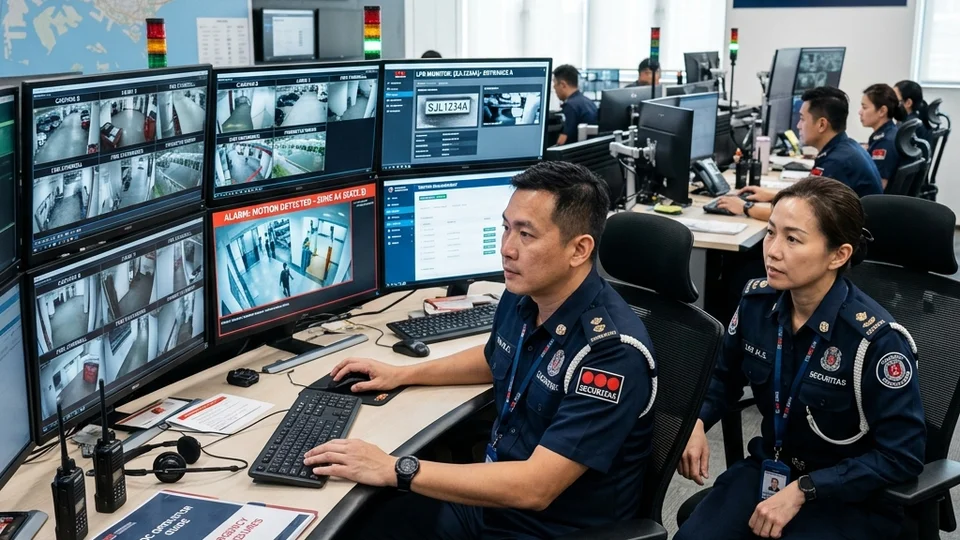
Over the past few years, we have noticed a change in the conversations we have with security guarding companies in Singapore. Ten years ago, the discussion was usually about upgrading a CCTV system, replacing an intercom, or installing a new barrier gate. Today, the conversation is often different.
It usually starts with a question like: "How can we remain competitive when manpower costs keep increasing?" Or: "How do we justify our pricing when every tender seems to be driven by cost?" The challenge is not unique to one guarding company. It is affecting the entire industry. PWM wages continue to rise. Recruitment remains difficult. Clients expect better reporting, faster response, and more accountability than ever before. Yet most contracts are still being evaluated under tight budget constraints.
This creates a difficult situation. The traditional response has been to add manpower. The problem is that manpower is becoming both more expensive and harder to find. That is why many of the more successful guarding companies are changing the question. Instead of asking "How do we deploy more guards?" they are asking "How do we help our guards do more?" That is where technology starts becoming more than a support tool. It becomes part of the guarding company's competitive strategy.
The PWM Squeeze; Why the Old Model Is Getting Harder to Sustain
The Progressive Wage Model has raised salary levels across the security industry, improving career progression and professionalism within the sector. This is a positive development for security officers. However, it also means that every guarding company in Singapore faces increasing and largely uniform manpower costs. When everyone in the industry faces the same wage floor, the ability to compete on price alone is structurally constrained.
At the same time, recruitment remains a persistent challenge. Finding qualified officers willing to work rotating shifts, weekends, and public holidays is not getting easier. Many guarding companies are competing for the same pool of PLRD-licensed officers. The supply of licensed security personnel has not expanded at the pace that demand requires. The result is not only higher wages but also the operational challenge of maintaining coverage with a workforce that is increasingly difficult to recruit and retain.
The arithmetic is straightforward. If manpower costs continue to increase while clients continue to expect competitive pricing, the margin between what clients pay and what it costs to deliver the service narrows. For companies relying almost entirely on manpower, that margin eventually becomes unsustainable. For companies that have used technology to make their officers more effective, the same headcount delivers more value, which creates more room to absorb wage increases without proportionally increasing contract costs.
Securevision's View
Many guarding companies initially view technology as an additional expense to be avoided when margins are already under pressure. What often changes their perspective is seeing how technology allows the same officer to supervise more effectively, cover more ground, and spend more time on the situations that actually require a person to be there. The objective is not to replace manpower. The objective is to allow officers to focus on situations that require judgement, communication, and intervention while routine tasks are handled automatically. The guarding companies seeing the greatest success are treating technology as a force multiplier, not a cost centre.
What Technology Can and Cannot Do
One concern we occasionally hear from both guarding companies and estate clients is that technology is being used to replace manpower. That is not how we see it, and it is not how the most effective operations use it.
A camera can detect movement. A licence plate recognition system can identify a vehicle. An intercom can connect a visitor to a resident. An electronic patrol system can record that a checkpoint was reached at a specific time. All of these things are useful. None of them can exercise judgement. None of them can de-escalate a confrontation. None of them can reassure a resident who is anxious about something they have seen in the car park. None of them can decide when a situation requires intervention and when it does not.
The most effective security operations combine capable officers with the right technology. Technology handles the routine, the repetitive, and the recordable. Officers focus on the situations where human presence, judgement, and communication actually matter. When technology is deployed with this principle in mind, the outcome is not fewer guards doing more work. It is the same number of guards doing better work, and delivering a service experience that is measurably different from an operation relying entirely on manual processes.
KEY POINT
Technology and manpower are not competing with one another in a well-run guarding operation. They are complementary. The officer's value lies in what technology cannot do; presence, judgement, and human interaction. Technology's value lies in what would otherwise consume that officer's time without requiring those qualities.
Technology-Assisted Operations; Helping Officers Do More
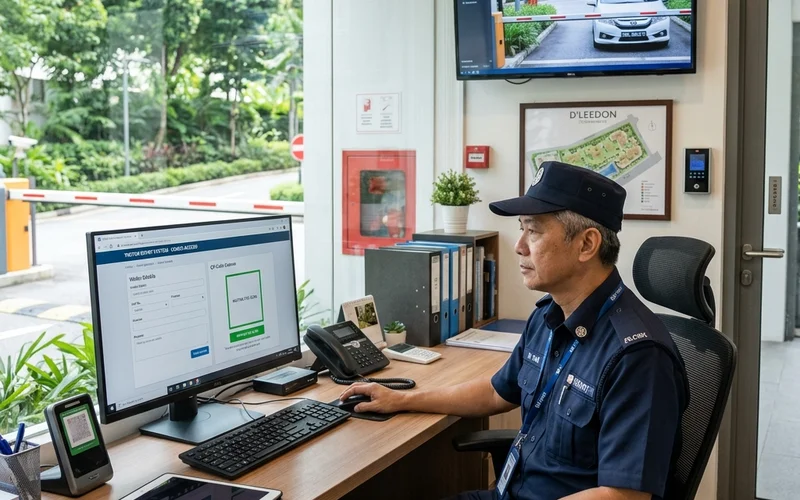
Consider a typical condominium guardhouse. A security officer on duty may spend a significant portion of the shift recording vehicle entries manually, calling residents to verify visitors, answering the guardhouse phone, managing deliveries, monitoring multiple CCTV screens simultaneously, and writing up patrol records by hand. Individually, each task seems minor. Collectively, they consume much of the officer's attention; attention that is not available for genuine security situations when they arise.
Technology can streamline many of these routine activities without reducing the officer's role; it redirects the officer's attention from administrative processing to security judgement.
Licence plate recognition automatically identifies registered vehicles and records every transaction at the barrier. Instead of manually noting vehicle numbers or lifting barriers for residents, the officer's attention shifts to vehicles that are not recognised, situations that require intervention, and visitors who cannot be pre-verified. Digital visitor management allows residents to pre-register visitors through an app. Visitors receive a QR code before arriving. Verification at the guardhouse becomes faster and more consistent, and the officer spends less time making phone calls and more time watching who is actually coming in and how they are behaving.
Modern CCTV systems with analytics can automatically detect events such as perimeter intrusion, loitering, or unusual activity in restricted areas. Rather than watching multiple screens continuously, officers receive alerts for situations that warrant attention. Electronic patrol systems replace paper logs with timestamped digital records; both the guarding company and the client gain accurate visibility into patrol compliance and response times without the officer spending time on paperwork.
To put this in concrete terms: in a Singapore condominium with 300 units and a single guardhouse shift, a manually processed visitor log typically consumes 15 to 20 minutes of officer attention per shift; time spent making phone calls to residents, writing entries, and filing records. Digital pre-registration eliminates most of this. The same shift now has 15 to 20 additional minutes available for patrol, perimeter checks, or responding to situations that require an officer's presence. Multiplied across a full year and across multiple estates in a guarding company's portfolio, this is not a marginal improvement. It is a structural change in how officer time is allocated.
We have managed transitions from manual visitor logs to digital pre-registration at Singapore estates where the time officers spent on visitor administration dropped from over 20 minutes per shift to under five. The officers did not change. The headcount did not change. What changed was how that headcount was being used, and what the estate's managing agent could see about the service being delivered.
Securevision's View
The most successful technology deployments we have been involved in are the ones where the guarding company thought carefully about what their officers actually spend time on, and identified which of those activities technology could handle reliably. The result is almost never a reduction in headcount. It is a change in how that headcount spends its time, and a measurable improvement in the service the client experiences.
Extending Coverage Through Technology
Many guarding companies are now exploring how to support on-site officers through centralised operations and remote assistance. This does not mean replacing the guardhouse. It means providing additional capability when it is needed.
A centralised operations centre can provide remote verification of alarms, review CCTV footage from multiple sites, monitor patrol compliance across an estate portfolio, and support lone officers during unusual situations; all without requiring an additional officer on site. For guarding companies managing multiple estates, this allows expertise and supervisory attention to be made available across the portfolio rather than limited to wherever a supervisor happens to be physically present.
For PLRD-licensed guarding companies, the ability to produce verifiable digital records of patrol activity, incident reports, and access logs is increasingly relevant not just operationally but from a regulatory and liability perspective. When a dispute arises; a resident claims a patrol was not conducted, a client questions the response time to an incident, or an MOM audit requires documentation; digital records with timestamps and GPS confirmation are significantly more defensible than handwritten logs. Technology that creates this audit trail automatically does not just make operations more efficient. It reduces the guarding company's exposure when accountability is questioned.
Winning on Capability Instead of Price
For many years, guarding tenders were evaluated heavily on price. That is becoming increasingly difficult to sustain as a competitive strategy when everyone in the industry faces similar wage structures. When manpower costs are largely uniform across the industry, the question a guarding company needs to answer is not "How do we be the cheapest?" It is "What else can we offer?"
A guarding company that can demonstrate real-time reporting, verified patrol records, visitor analytics, incident documentation, and digital audit trails is presenting a genuinely different value proposition from one that relies solely on headcount. The conversation with the estate client shifts from cost to capability, and that is usually a healthier discussion for everyone involved.
Two Companies, Same Headcount, Very Different Service
We see this contrast regularly during tender evaluations. Two guarding companies propose the same number of officers for an estate. The monthly contract costs are similar. On paper, the proposals look comparable. But one company supports its officers with licence plate recognition at the barriers, digital visitor management, electronic patrol verification, CCTV analytics alerts, and a reporting dashboard the managing agent can access in real time. The other relies almost entirely on manual processes; handwritten logs, phone calls to verify visitors, officers watching multiple CCTV screens simultaneously, and monthly reports compiled from paper records.
The manpower numbers are identical. The service experience the estate residents will receive is not. The first company's officers spend more of their time on genuine security. The second company's officers spend more of their time on administration. And the managing agent of the first estate has evidence; patrol compliance rates, response time records, visitor statistics, incident logs; while the managing agent of the second estate has an officer's written account.
What the Difference Looks Like in Practice
| Function | Traditional Operation | Technology-Assisted |
|---|---|---|
| Vehicle access | Manual barrier, written vehicle log | LPR; automatic recognition, barrier release, and digital record |
| Visitor verification | Officer calls resident to confirm each visitor | Resident pre-registers visitor; QR code presented at guardhouse |
| Patrol records | Handwritten log, signed by officer at end of shift | GPS-timestamped digital record, accessible remotely in real time |
| CCTV monitoring | Officer watches multiple screens continuously | Analytics alerts officer to specific detected events |
| Incident reporting | Written report prepared after the fact | Digital report with photos and timestamps submitted in real time |
| Client reporting | Monthly summary compiled manually from paper records | Dashboard accessible by managing agent at any time |
What Managing Agents Gain From Technology-Supported Operations
Managing agents sit between the estate council and the guarding company; they are accountable to the council for the quality of the security service and responsible for managing the contractor relationship. Technology-supported guarding operations change this relationship in a practical way. When a resident complains that a patrol was not conducted, the managing agent no longer has to rely on the officer's word or a handwritten log that could have been completed at any point during the shift. A GPS-verified patrol record with timestamps shows precisely when each checkpoint was visited. When the council asks at a quarterly meeting how the security service is performing, the managing agent can produce data rather than an impression. When a security incident occurs and the insurer or legal counsel asks for documentation, the digital record is already there. Managing agents who have experienced this level of visibility consistently prefer it, and they tend to be more confident renewing contracts with guarding companies that provide it.
This is why we encourage estate managers and councils to look beyond headcount when evaluating proposals. The question is not just how many officers a company is proposing. The question is how those officers will spend their time, what systems will support them, and what evidence the company can produce to demonstrate that the service was delivered as promised.
5 QUESTIONS TO ASK EVERY GUARDING COMPANY BEFORE SIGNING
1. What technology does your company deploy at this type of estate, and how does it integrate with your officers' daily routine, not just in theory but on each shift?
2. What data will you provide to us on a regular basis; patrol compliance, visitor statistics, incident logs, in what format, and with what frequency?
3. Can you show us what a monthly performance report looks like from one of your existing estates?
4. What happens when the technology fails; what is the backup procedure and who is responsible for restoring service?
5. How do you onboard new officers to your systems when staff rotate or when the contract changes hands?
Securevision's View
Many estate councils begin tender evaluations by comparing manpower numbers and monthly contract costs; because those figures are easy to compare. What often receives less attention is how the guarding company intends to deliver the service. We encourage estate managers to ask every tender respondent to describe specifically what technology they deploy, how it integrates with their officers' daily operations, and what data they will provide to the estate on a regular basis. The answers to those three questions tell you more about the likely service outcome than the headcount figure alone.
Data Changes the Conversation
One of the biggest advantages of technology in guarding operations is not automation. It is visibility. When every patrol, visitor registration, barrier transaction, and incident is recorded digitally, the reporting conversation changes completely.
Instead of a guarding company saying "We believe the service is good," they can show patrol compliance rates against the contracted schedule, average response times to incidents, visitor traffic patterns by time and day, access log summaries for management review, and trend data that identifies recurring issues before they become complaints. The conversation moves from opinions to evidence. That benefits the guarding company, which can demonstrate service quality objectively. It benefits the managing agent, who has the information needed to manage the contract and respond to resident questions. And it benefits the estate council, which can make renewal and tender decisions based on performance data rather than impressions.
Better information leads to better decisions; about staffing, about patrol routes, about where camera coverage needs to be improved, and about when an incident pattern suggests a security concern that needs to be addressed proactively rather than reactively.
The Real Competitive Advantage Is Not the Technology
It may sound unexpected from a security technology company, but the technology itself is rarely what separates guarding companies in a competitive market. Most technologies can be purchased. Most systems can be installed. The equipment is available to anyone willing to pay for it.
The real differentiator is how well the technology is integrated into the operation. A guarding company that understands how to use LPR, visitor management, patrol verification, and CCTV analytics as part of a coherent operational model delivers a very different outcome from one that installs the same equipment but does not change how officers work around it. In the second case, the technology becomes additional complexity rather than genuine support.
The goal is not to have more systems. The goal is to create a better security operation. That means thinking carefully about which routine tasks technology can handle reliably, training officers to use the systems effectively, and building reporting processes that give clients genuine visibility into the service they are receiving. Guarding companies that approach technology this way are not simply adding equipment to their proposals. They are changing what they can deliver, and that is what clients ultimately care about.
Frequently Asked Questions
What is the Progressive Wage Model and how does it affect guarding companies?
The Progressive Wage Model (PWM) is a Singapore government framework that sets out mandatory minimum wages and career progression pathways for workers in specific sectors, including security. For guarding companies, the PWM defines the minimum monthly wages for security officers at different levels of experience and certification, and requires regular wage increments as officers progress through the framework. Because the PWM applies to all licensed guarding companies equally, it creates a largely uniform wage floor across the industry, which means guarding companies cannot compete by simply paying officers less than the competition. This is one of the primary reasons technology is becoming a competitive differentiator: when wage costs are similar across the industry, what distinguishes one company from another is what each officer is able to deliver.
Can technology replace security guards?
No. Technology can automate routine tasks and improve operational visibility, but security officers remain essential for the functions that technology cannot perform; exercising judgement in ambiguous situations, de-escalating confrontations, providing a reassuring presence, and deciding when and how to intervene. The most effective security operations use technology to free officers from administrative and routine tasks so they can focus on these higher-value functions. Technology and manpower are complementary, not competing.
How can guarding companies remain competitive despite rising PWM wages?
The most sustainable approach is to improve what each officer can deliver rather than simply competing on the cost of the officer. Guarding companies that use technology to support their officers; automating visitor processing, patrol verification, vehicle access, and CCTV monitoring; can deliver more effective service with the same headcount. This creates a value proposition that is not directly comparable to a company quoting on manpower numbers alone, and it makes price less the central issue in tender evaluations.
What technologies are most commonly used in Singapore guarding operations today?
The most commonly deployed technologies in Singapore estate guarding operations include licence plate recognition for vehicle access management, digital visitor management systems with QR code verification, electronic patrol systems with GPS checkpoints and timestamped records, CCTV analytics for automated event detection, and reporting dashboards that give managing agents real-time access to operational data. The most effective deployments integrate several of these rather than deploying them independently.
Do estate clients actually value security technology?
Increasingly, yes; particularly managing agents and estate councils that have experienced the difference in practice. What clients most commonly say they want is better reporting, greater accountability, faster incident response, and evidence that the service is being delivered as contracted. Technology that provides these things directly addresses what clients are asking for. Clients who have moved from a manpower-only operation to a technology-supported one rarely want to go back.
How do we convince an estate council to pay more for a technology-enhanced service?
The most effective approach is to demonstrate the difference rather than describe it. In proposal presentations, show the estate council what real-time patrol reporting looks like, what a digital visitor log looks like, and what a monthly performance dashboard looks like. Most council members have never seen these in practice and do not know to ask for them. When the comparison is between a paper log and a timestamped GPS patrol record, or between a phone call to verify a visitor and a QR code at the barrier, the value becomes immediately apparent without needing to be argued for in the abstract.
What is the ROI on security technology for a guarding company?
Return on investment in security technology typically comes through three channels. First, contracts retained longer because the service quality is demonstrably better and harder to replicate at a lower price. Second, contracts won that would not have been won on price alone, where the client is choosing on capability rather than cost. Third, operational efficiency improvements that allow the same headcount to manage more or to spend more time on genuine security rather than administration. The investment required varies significantly by technology type, but for most guarding companies the question is not whether technology pays for itself but how quickly.
Which technology has the biggest single impact on guarding operations?
In our experience across Singapore estate operations, licence plate recognition at vehicle barriers consistently has the most immediate and visible impact. It eliminates one of the most time-consuming routine tasks at the guardhouse, creates an accurate and automatic vehicle movement record, and frees officer attention for non-routine situations. Digital visitor management is typically the second most impactful, particularly for estates with high visitor volumes. Electronic patrol systems are the most important for demonstrating service quality to clients and for protecting the guarding company in the event of disputes.
How does PLRD licensing interact with technology deployment?
Under Singapore's Private Security Industry Act, security officers must hold valid PLRD licences and guarding companies must be licensed to provide security services. Technology does not change these requirements; it supports compliance with them. Digital patrol records with GPS timestamps and incident documentation tools make it significantly easier to demonstrate that licensed operations are being conducted as required and to produce evidence when compliance is questioned. For guarding companies that take their licensing obligations seriously, technology that automatically creates this audit trail is an operational asset as well as a compliance tool.
How do we integrate technology into existing operations without disrupting service?
The most successful integrations are phased rather than implemented all at once. Starting with one or two technologies that address the most visible operational pain points, typically LPR and visitor management; allows officers to develop familiarity with the systems before additional tools are added. Training should be practical and site-specific rather than generic. The guarding company's supervisors need to understand the technology well enough to troubleshoot it on site, and the reporting outputs need to be set up to be useful to the managing agent from day one rather than treated as an afterthought. Technology that is installed but not used, or that generates reports no one looks at, does not improve competitive position.
What should estate managers look for in a security technology proposal?
Beyond the list of technologies proposed, estate managers should ask three specific questions. First, how will the technology integrate with the officers' daily routine, not just what it does in theory, but how officers will actually use it on each shift. Second, what data will be provided to the estate on a regular basis, in what format, and with what frequency. Third, what happens when the technology fails; what the backup procedure is and who is responsible for restoring service. A guarding company that can answer all three questions clearly has thought through the operational reality rather than simply adding technology to a proposal to make it look more impressive.
Is technology mainly about reducing manpower?
In most Singapore guarding operations, no. The primary goal of technology deployment is not to reduce headcount; it is to improve what existing officers can deliver and to make that delivery visible to clients through data and reporting. Headcount reductions occasionally occur as a secondary outcome when technology makes certain roles genuinely redundant, but this is not the primary driver for most guarding companies deploying technology in estate environments. The far more common outcome is the same number of officers delivering a service that is measurably better than before.
In Short
The future of Singapore's guarding industry is not about choosing between manpower and technology. It is about combining both effectively. Security officers bring judgement, presence, and human interaction that technology cannot replicate. Technology brings visibility, consistency, and scalability that manpower alone cannot provide. The guarding companies that succeed in the years ahead will not necessarily be the ones with the largest workforce. They will be the ones that use technology to help their officers perform at a higher level, deliver a more accountable service, and demonstrate that quality to clients through data rather than opinion. The question is no longer whether technology should be part of the guarding operation. The question is how effectively it is being integrated into the operation, and whether that integration is creating a service that clients can see, measure, and choose to renew.