- Property type determines what you control, what you are responsible for, and what a security system needs to cover; this matters more than brand or product selection.
- HDB homeowners are responsible for their unit entrance and interior only; the common corridor and lift lobby are Town Council territory already covered by the SPF's PolCam network.
- Since May 2023, HDB flat owners no longer need approval to install corridor-facing CCTV cameras, provided the camera does not point at a neighbour's door or window.
- Condominium owners benefit from estate-level security but must still protect their own unit entrance, interior, and balcony access points independently.
- Landed homeowners control the entire perimeter; gate, driveway, garden, side passages, and all external doors, and are responsible for securing all of it.
- The best time to plan and install security is during renovation, before walls are closed; retrofitting cables afterwards is significantly more expensive and disruptive.
Why Property Type Shapes System Design
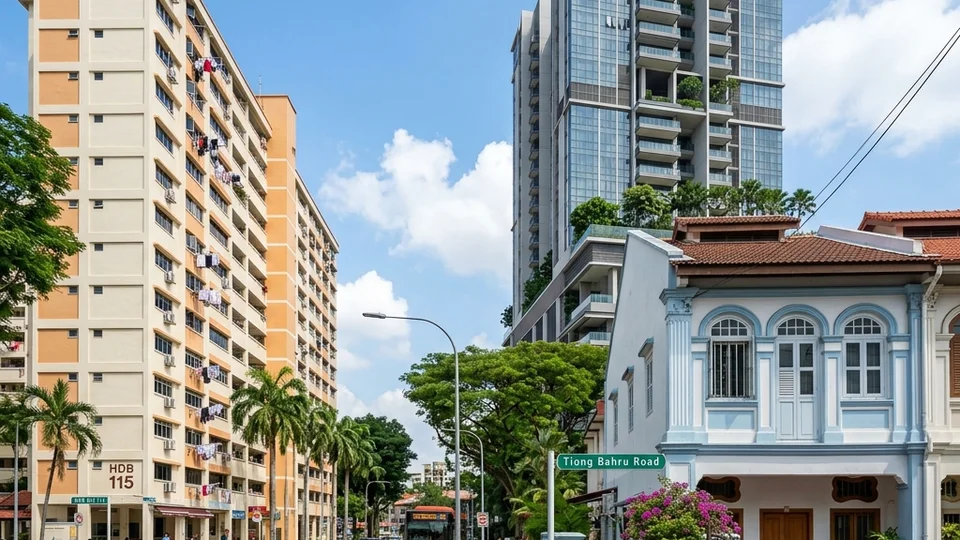
One of the most common mistakes we see is homeowners copying someone else's security setup. A friend installs eight cameras in his landed house, so you think you need eight too. A neighbour installs a burglar alarm, so you assume you should do the same. The problem is that every property is different, and the biggest difference is not the technology. It is the level of control you have over the property and the number of entry points you need to protect.
Security system design starts with a site survey, not a product catalogue. The first thing we assess is the property type; because property type determines entry points, perimeter characteristics, existing infrastructure, and what the occupant actually controls. A homeowner in an HDB flat controls their front door and their unit. Everything outside that door is common property managed by the Town Council. A landed homeowner controls the entire plot; gate, perimeter walls, driveway, garden, all external doors and windows. A condominium unit owner sits somewhere in between, with sophisticated shared infrastructure managing the common areas.
These differences have direct consequences for what you should install, where you should install it, and what the system needs to cover. The goal is not to install more equipment. The goal is to address the actual risks and concerns that matter to your specific property and the people living in it.
HDB Flats; What You Control and What You Do Not
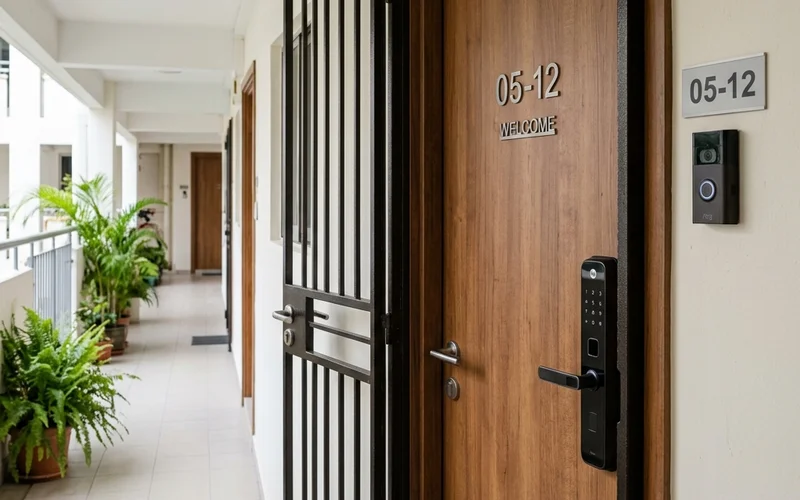
In an HDB flat, your security perimeter is essentially the front door, the service door if present, and your windows. The common corridor outside is Town Council territory. For most HDB homeowners, security starts and ends at the front door, and in most of the HDB units we service, a good digital lock and video doorbell combination resolves the majority of the homeowner's concerns directly and practically.
What makes sense for most HDB homeowners is focused rather than extensive. A burglar alarm covering the front door contact, window contacts, and one or two interior motion detectors provides the protection most residents need. A wireless system such as AJAX works particularly well in HDB flats because it avoids cable-chasing through finished concrete walls. A video intercom or doorbell with smartphone integration allows residents to vet visitors and receive deliveries remotely, which matters significantly for households where both adults work during the day.
Where internal cameras are appropriate; monitoring elderly parents, domestic helpers, or young children at home during the day; these can be placed freely inside the unit. Corridor-facing cameras are subject to specific rules discussed below.
KEY POINT
What we rarely recommend for HDB homeowners is overcomplicating the system. A simple, reliable and easy-to-use setup; digital lock, video doorbell, wireless alarm; is often significantly more effective than extensive camera coverage that rarely gets reviewed.
HDB Estates Already Have More Surveillance Than Most Residents Realise
One aspect of HDB security that is often overlooked is the level of surveillance infrastructure already present in the estate; infrastructure that is not installed by the homeowner and does not appear on any security proposal. Since 2012, the Singapore Police Force has been operating the PolCam system; a network of police cameras installed across HDB blocks throughout Singapore. These cameras cover lift interiors, lift lobbies, staircases, and common areas of public housing blocks across the island.
There are now more than 90,000 PolCams deployed island-wide, monitored and reviewed by the Police Operations Command Centre, with plans to expand to over 200,000 cameras by the mid-2030s. The system has assisted in solving more than 7,500 crime cases since its launch. The deterrence impact on HDB estates has been measurable; loan shark harassment incidents involving property damage fell by more than 80 percent between 2015 and 2023, housebreaking in housing estates fell by 50 percent over the same period, and motor vehicle theft in estate car parks fell by more than 80 percent.
For HDB homeowners, this means the common areas of the estate; the lift, the lift lobby, the staircase, the corridor; are already under a level of surveillance coverage that most private developments simply do not have. This does not remove the need for unit-level security, but it does change the risk profile. The primary concern for most HDB homeowners is what happens at and inside their own front door, not what happens in the common areas, which are already well covered by SPF infrastructure.
Condominium Units; Shared Infrastructure vs Unit Responsibility
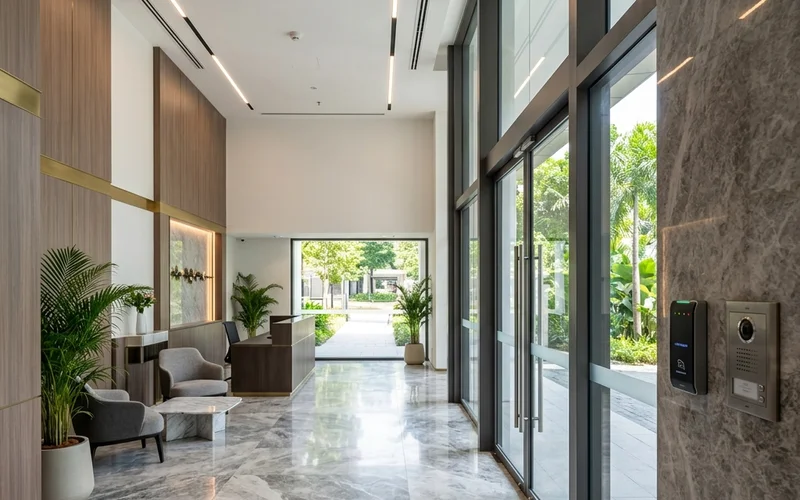
Most condominiums provide strong perimeter security through guards, access control at lobbies and car parks, and CCTV coverage in common areas. This provides a solid first layer of protection that HDB homeowners and landed homeowners do not share in the same way. The mistake many condo owners make is assuming that shared security protects everything.
It does not. The guard cannot see what is happening inside your unit. The estate CCTV does not monitor your living room. The access control system does not protect your balcony. Condominium security and unit security serve different purposes and operate independently. Common areas and lobby access are managed by the MCST; your front door and any windows accessible from balconies or adjacent units are your individual responsibility.
For most condominium owners, the focus should be on the unit entrance, balcony access points, and visitor verification. A private burglar alarm covering the front door and balcony windows provides protection regardless of the estate's external security quality. For those who want visibility while away; monitoring domestic helpers, elderly parents, or deliveries; internal cameras are appropriate and straightforward to install.
KEY POINT
Many condominium owners assume that living in a guarded development means they do not need to think about security inside their unit. The estate protects the perimeter. Your responsibility starts at your front door. The most effective approach is recognising that both layers work together rather than assuming one replaces the other.
Landed Homes; The Full Perimeter Challenge
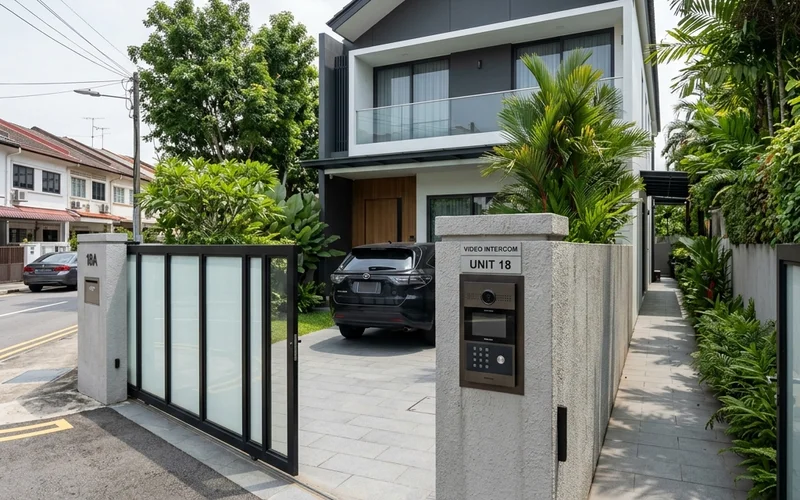
Landed homes present a completely different challenge. Unlike HDB flats and condominium units, the homeowner controls the entire property; the gate, driveway, garden, side passages, rear access, and every external door and window. With greater control comes greater responsibility. A visitor enters through the front gate. An intruder may not. That is why we spend significant time looking at side access routes, rear gardens, and poorly lit areas during landed home surveys, not just the front gate where visitors arrive.
Many homeowners invest heavily in cameras facing the front gate because that is where visitors arrive. Yet some of the most vulnerable areas are often the side passage or backyard. These areas typically receive less attention, less lighting, and less foot traffic. Security is not about where authorised visitors enter; it is about where unwanted visitors might enter. For many landed properties, the perimeter is where security planning begins, and CCTV, burglar alarms, gate intercoms, and access control should work together as a complete system rather than as individual products.
Many homeowners moving from a condominium into a landed property are surprised by how much responsibility shifts to them. In a condominium, the estate manages the perimeter, visitor access, and common area surveillance. In a landed property, all of those responsibilities become the homeowner's. The gate, driveway, side passage, and backyard suddenly become areas that need attention. The security mindset changes from protecting a unit to protecting an entire property, and the planning required reflects that difference.
KEY POINT
For most landed properties, effective coverage requires external cameras at the driveway, gate, side passages, and rear garden; magnetic contacts on all external doors and ground-floor windows; a video intercom at the front gate integrated with the auto-gate motor; and interior motion sensors on each floor with partial-arm capability for overnight use.
Side-by-Side Comparison
The table below provides a practical starting point for understanding how security requirements differ across the three property types. Every property is different and a site survey is always required before specifying any system, but this gives a useful framework for initial planning.
| System | HDB Flat | Condominium Unit | Landed Home |
|---|---|---|---|
| Digital lock | Primary recommendation; front door | Recommended; front door | Recommended; main entrance door |
| Burglar alarm | Front door, windows, 1–2 PIR sensors | Front door and balcony windows | Full perimeter; all external doors, ground-floor windows, all floors |
| CCTV | Internal and entrance area only; corridor rules apply | Internal and unit entrance; estate covers common areas | External perimeter including driveway, side passages, rear garden, and interior |
| Intercom / doorbell | Video doorbell with smartphone integration | Shared MCST system; unit handset or app | Gate video intercom station integrated with auto-gate |
| Auto gate | Not applicable | Not applicable; shared gantry | Driveway gate motor; essential for remote access |
| Access control | Digital lock serves this purpose | Unit door only; estate manages common areas | Gate, side entrances, utility areas where multiple access points need management |
Security and Convenience; Two Goals, One System
Twenty years ago, most homeowners thought about security systems mainly in terms of protection; keeping unwanted visitors out. That remains important today, but expectations have changed significantly. Many homeowners now want the convenience that modern systems provide alongside the protection. They want to answer visitor calls from their phones while at work. They want to receive deliveries without needing to be home. They want to open the gate remotely for family members. They want to check on elderly parents when travelling.
In many projects, convenience becomes just as important as security. The best systems achieve both; improving protection while making everyday life easier. This applies across all three property types. For HDB homeowners, smartphone access to the video doorbell means missed deliveries become manageable. For condominium residents, a modern intercom system means visitor access no longer requires a physical presence. For landed homeowners, remote gate control and smartphone camera access means the property can be monitored and managed from anywhere.
If You Are Renovating, This Is the Best Time
One of the most consistent observations we share with homeowners is about timing. The best time to plan and install security infrastructure is during renovation, before walls are closed and ceilings are plastered. Cable runs that can be concealed easily during active construction become significantly more expensive and disruptive as retrofits on finished surfaces. Even if you are not ready to install the full system immediately, preparing cabling and conduits during renovation means future upgrades are straightforward rather than complicated.
The most common regret we hear from homeowners is that they wish they had thought about this before the renovation was completed. Power points in the wrong locations, no cable pathway to the gate, intercom conduits that do not reach the right rooms; these are problems that are trivial to solve during renovation and expensive to fix afterwards. Planning for security during renovation costs relatively little in the context of the overall project and saves significantly more later.
Securevision's View
We work across all three property types throughout Singapore. The right security system is not the one with the most cameras, sensors, or features; it is the one that matches the property, addresses the homeowner's actual concerns, and remains easy to use in daily life. An HDB flat, a condominium unit, and a landed home each present different risks and different opportunities. Understanding which one you have is always the starting point before any product is discussed.
Frequently Asked Questions
What is the most important security upgrade for an HDB flat?
For most HDB homeowners, a good digital lock and a video doorbell or video intercom with smartphone integration provides the most significant security improvement. The front door is where almost all security concerns for an HDB unit are concentrated, and these two products address both access control and visitor verification directly. A wireless burglar alarm adds a further layer of protection for homeowners who want monitoring and alert capability.
Can I install CCTV outside my HDB unit facing the corridor?
Yes. Since May 2023, HDB flat owners no longer need approval from HDB to install corridor-facing CCTV cameras. The key conditions are that the camera must be focused on your own entrance area; your door and its immediate approach, and must not point directly at a neighbour's door or window. The installation must be tidy and must not obstruct the common corridor. Inside your unit, cameras can be installed freely without any approval. For residents facing specific safety concerns such as loan shark harassment, a temporary installation at the main door can be approved with a police report and Town Council approval for a six-month period.
Do HDB estates have their own surveillance cameras?
Yes, and more than most residents realise. The Singapore Police Force operates the PolCam system across HDB blocks island-wide, covering lifts, lift lobbies, staircases, and common areas. There are over 90,000 PolCams deployed across Singapore, with plans to expand to 200,000 by the mid-2030s. This infrastructure is separate from any cameras homeowners install themselves and provides meaningful crime deterrence and detection capability in the common areas surrounding HDB units.
Are condominium units already secure enough without additional measures?
Condominiums generally provide strong perimeter security through guards, access control, and CCTV in common areas. However, these measures protect the estate perimeter; they do not protect the inside of individual units. The guard cannot see inside your apartment. The estate CCTV does not cover your front door from the inside or your balcony. Unit-level security; a digital lock, burglar alarm, and possibly internal cameras; should still be considered independently of whatever the estate provides.
What is the difference between estate security and unit security in a condominium?
Estate security; managed by the MCST; covers lobby access, common corridor cameras, car park barriers, and security officer operations. It protects the common areas and controls who enters the development. Unit security; the homeowner's responsibility; covers the front door of the individual unit, balcony access points, and the interior. Both are necessary for comprehensive protection. Neither replaces the other.
How many CCTV cameras does a landed home need?
There is no fixed number; the right coverage depends on the layout of the property, the number of entry points, the size of the garden, and the areas that need monitoring. As a starting point, most landed homes we assess require between four and ten cameras to cover the front gate and driveway, side passages, the rear garden or yard, and the main entrance door. A site survey is always required before any specific configuration is recommended.
Do I need a burglar alarm if I live in a condominium?
It depends on your specific concerns. If you travel frequently, if elderly parents or a domestic helper are home alone during the day, or if you simply want to know immediately if someone enters the unit without authorisation, a private burglar alarm covering the front door and balcony windows provides significant additional peace of mind beyond what the estate's shared security delivers. Many condominium owners choose a wireless system that can be self-monitored through a mobile app or connected to a professional monitoring centre.
Can I use the same security system in an HDB flat and a landed home?
Some components are common across property types; wireless alarm systems, digital locks, and IP cameras can all be used in different property types. However, the scope, configuration, and what needs to be covered are very different. An HDB installation typically involves a handful of devices focused on the unit entrance and interior. A landed home installation typically involves external cameras, perimeter alarm coverage, gate intercoms, auto-gate integration, and a more complex system design. The products may overlap; the design does not.
Do I need a burglar alarm if I live in a landed home?
For most landed homes in Singapore, yes. A landed property has multiple external entry points; doors, windows, side gates, utility access, that are entirely the homeowner's responsibility to secure. A burglar alarm with perimeter detection provides immediate alert capability if any of these points are breached, and connects to a monitoring centre or mobile app for response. In our experience, properties without alarm systems are significantly more likely to be targeted than those with visible alarm equipment, particularly deterrent sirens and monitoring company signage.
When is the best time to install security systems?
During renovation, before walls and ceilings are closed. This is the single most important timing consideration in home security planning. Cabling for cameras, alarm sensors, intercom runs, and access control can be concealed properly during construction at relatively low cost. The same work as a retrofit on finished surfaces requires hacking, patching, repainting, and often results in compromised cable routes and equipment placement. Even if you are not ready to install the full system during renovation, running conduits and pulling cables to planned locations costs very little and saves significantly in the future.
How do I know if my current security is adequate?
A site survey by a licensed security integrator is the most reliable way to assess this. During a survey, we look at all entry points, assess lighting, check camera coverage gaps, review alarm zone coverage, and compare what is installed against what the property's risk profile actually requires. Many homeowners discover that their existing system; particularly if it was installed more than five years ago; has coverage gaps that are straightforward to address. A survey takes around 30 to 45 minutes for a residential property and costs nothing if conducted as part of a proposal process.
What should I prioritise if I can only afford one security upgrade?
For HDB and condominium homeowners, a digital lock on the main door is usually the single most impactful upgrade; it controls who can access the unit and eliminates the vulnerability of conventional key-based locks being duplicated or picked. For landed homeowners, the priority depends on the specific vulnerability, but in most cases, a video intercom and auto-gate control at the front gate, combined with cameras covering the side passage and rear, addresses the highest-risk entry points first.
In Short
The right security system is not the one your neighbour has; it is the one that matches your property type and addresses your actual concerns. HDB homeowners control their unit entrance and interior, supported by the SPF's PolCam network in the common areas. Condominium owners benefit from estate-level perimeter security but are still responsible for their own unit. Landed homeowners control everything and must plan accordingly. Understanding which of these situations applies to you is always the starting point, and a site survey is the most reliable way to translate that understanding into a system that actually works.