- Start with the problem, not the camera. Before discussing resolution or features, ask what incidents you are concerned about, what you need to see clearly, and what questions the footage must be able to answer.
- A CCTV system should be able to answer four questions after an incident: Can you identify the person? Can you identify the vehicle? Can you understand what happened? Can you establish the sequence of events?
- Camera placement matters more than camera quantity. A well-positioned four-camera system consistently outperforms a poorly planned twelve-camera system.
- For most new installations in Singapore, IP cameras are the correct specification. HD analogue remains viable where significant coaxial cabling already exists.
- PTZ cameras require active monitoring to deliver their full value, for homes and small businesses without a staffed monitoring room, well-positioned fixed cameras are usually more reliable.
- Installing CCTV in Singapore creates obligations under the Personal Data Protection Act; footage is personal data and requires a defined retention policy and restricted access.
Start With the Problem, Not the Camera

One of the most common questions we hear is "Which camera should I buy?" It sounds reasonable. The problem is that it is usually the wrong place to start. Over the years, we have seen expensive CCTV systems that failed to provide useful evidence when an incident occurred, and relatively simple systems that performed exceptionally well. The difference was rarely the camera. The difference was whether the system was designed around a clear objective before any equipment was specified.
Before discussing resolution, night vision, or analytics, the right questions are: What am I trying to protect? What incidents am I concerned about? What do I need the CCTV system to show me? A homeowner may want to see who is approaching the front gate. An office may need to monitor visitors entering the reception area. A warehouse may need to track vehicle movements and loading activities. A condominium council may need to investigate incidents in common areas. Each situation requires a different approach, which is why we rarely start by recommending a camera model.
The test of whether a CCTV system is doing its job comes when an incident occurs. Can you identify the person? Can you identify the vehicle? Can you understand what happened? Can you establish the sequence of events? If the answers are yes, the system has done its job regardless of how many cameras it has or what they cost. If the answers are no, more cameras of the same type in the same positions will not fix the problem.
Securevision's View
One of the biggest misconceptions is that more cameras automatically mean better security. We have seen sites with dozens of cameras where important events were still missed because the cameras were positioned poorly. We have also seen relatively small systems perform extremely well because every camera was placed with a clear objective in mind. The number of cameras is secondary. The coverage they provide, and the questions they can answer; is what matters.
What Type of CCTV System Is Right for Your Property?
Different property types in Singapore have different CCTV requirements. Understanding which category your property falls into is the starting point for any system design.
| Property Type | Primary Concern | Typical Approach |
|---|---|---|
| HDB flat | Unit entrance and interior monitoring | 1–2 cameras; corridor-facing cameras permitted since May 2023 without HDB approval, provided they do not point at neighbours' doors |
| Condominium unit | Unit entrance and interior | 1–4 cameras; common areas are MCST responsibility; unit owner covers own entrance and interior |
| Condominium estate (MCST) | Common areas, lobbies, car parks, perimeter | Networked IP system covering all common areas; 30-day minimum retention; PDPA signage required |
| Landed home | Full perimeter; gate, driveway, side passages, rear | 4–12+ cameras; external night-vision essential; integration with intercom and alarm recommended |
| Office | Entry points, reception, server room, sensitive areas | IP system; access-event triggered recording; PDPA data handling policy required for employee footage |
| Warehouse or industrial | Vehicle access, loading areas, perimeter, stock areas | Wide-angle and LPR cameras; longer retention often required; weather-rated cameras for external areas |
IP, HD Analogue, or Legacy Analogue; Which Should You Choose?
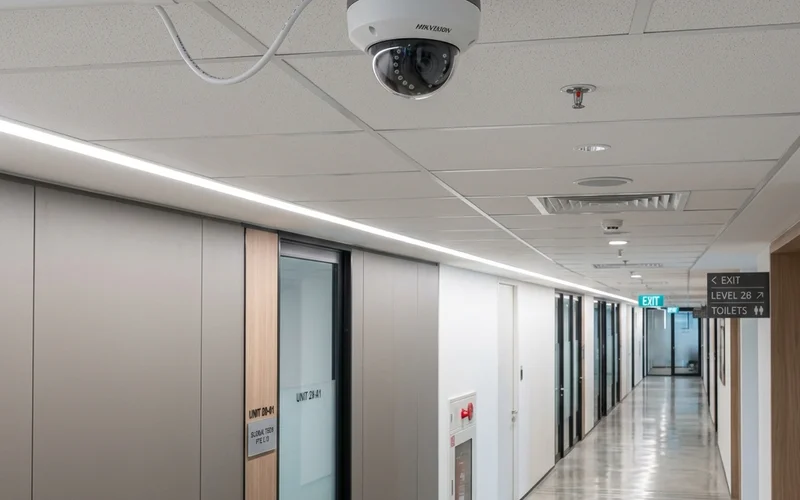
One of the most common questions we receive is whether analogue cameras are still relevant today. For most new installations, the answer is no, not because analogue technology was poor, but because modern security requirements have moved well beyond simply recording video. Today's systems need to support remote viewing on smartphones, video analytics, licence plate recognition, and integration with access control and visitor management platforms. That is where IP technology excels.
Traditional analogue systems transmit video over coaxial cables. They were reliable and cost-effective for many years and many are still operating today. However, image quality and system capability are limited compared to modern alternatives, and the gap continues to widen as IP technology develops. HD analogue systems improved image quality while allowing existing coaxial cable infrastructure to be retained, for sites with significant existing cabling, this remains a practical and economical upgrade path that avoids the cost of full rewiring. For most new projects, we recommend IP systems. For sites with extensive existing coaxial cabling, HD analogue may still make sense. Legacy analogue should be viewed as technology approaching the end of its lifecycle rather than a specification for new work.
Securevision's View
Many businesses continue operating CCTV systems that are ten or fifteen years old. The cameras may still record. The challenge is that expectations have changed. People now expect to view footage from their phones, receive alerts for specific events, search recordings quickly, and integrate CCTV with other security systems. The question is often no longer whether the system works; it is whether the system still meets the operational needs of the site. A system that records but cannot be viewed remotely, searched efficiently, or integrated with anything else is increasingly difficult to justify as a long-term specification.
Camera Placement Matters More Than Camera Quantity
When discussing CCTV, most people immediately focus on the number of cameras. In reality, camera placement is almost always more important than camera quantity. A well-positioned camera covering the right angle at the right height can provide useful identification evidence. A poorly positioned camera may record hours of footage without being able to answer the questions that matter when an incident occurs.
One mistake we encounter regularly is homeowners focusing cameras on the spaces they use rather than on the routes people take. A homeowner may request cameras covering the living room and main gate while overlooking the side gate or rear access. A camera inside the house may show what happened after someone entered, which is useful. A camera covering the approach shows how they entered in the first place, which is often more important for investigation and prevention. In many cases, understanding movement is more valuable than simply seeing the final event. That is why we spend considerable time studying entry points, approaches, and transition zones before discussing camera quantities.
Camera height is also critical for identification. A camera mounted at three to four metres can cover a wide area but may only capture the top of a person's head. A camera at two to two-and-a-half metres captures face-level detail that is useful for identification. The right height depends on the specific purpose of each camera; overview cameras and identification cameras are different tools serving different functions, and a well-designed system uses both.
PLANNING POINT
Before counting cameras, map the entry points, approach routes, and transition zones of your property. Each camera should have a defined purpose; what specific question does this camera need to answer? A camera without a clear purpose is a camera that will probably not deliver useful footage when it is needed.
Fixed Cameras or PTZ Cameras?
PTZ cameras; Pan, Tilt and Zoom; can move, zoom in, and track activity. They look impressive during demonstrations and have genuine value in certain applications. But they are not always the right choice, and the reason is straightforward: somebody usually needs to control them.
A PTZ camera covering a car park can track a suspicious vehicle across the entire area. A PTZ camera at a condominium entrance can zoom in on a visitor's face or a vehicle registration plate. When actively operated by a trained officer with eyes on a monitoring screen, a PTZ camera is a powerful tool. The problem is that most homes and small businesses do not have someone actively watching a monitoring screen. If the camera is in auto-patrol mode, it may be looking in the wrong direction when an incident occurs. The incident is not recorded from the angle that would have provided useful evidence.
For most homes and small businesses, a properly positioned fixed camera covering the right angle provides more reliable evidence than a PTZ camera that nobody is actively operating. PTZ cameras have their place, in larger estates, active monitoring environments, and sites with dedicated security personnel, but they are not automatically the better option simply because they do more things.
| Camera Type | Best For | Limitation | Active Monitoring Needed? |
|---|---|---|---|
| Fixed camera | Defined coverage zones; entrances, corridors, specific areas | Cannot move to track activity | No |
| PTZ camera | Large open areas, active monitoring environments | May miss events if pointing the wrong way | Yes, for best results |
| Panoramic / fisheye | Wide overview of large open areas; lobbies, car parks | Resolution per area lower than fixed camera; may not provide identification-quality images | No |
Choosing the Right Recorder
The recorder is the heart of the CCTV system. Its job is to store footage, manage recording schedules, and provide reliable playback when needed. Two decisions matter most: storage capacity and room for future growth.
Storage capacity determines how many days of footage the system can retain. The number of cameras, their resolution, the frame rate, and whether the system records continuously or only on motion all affect how much storage is consumed. For most Singapore commercial and residential installations, 30 days of continuous recording is the practical standard; it covers the period within which most incidents are reported and investigated. High-security areas, financial institutions, or sites with specific regulatory requirements may justify longer retention. For most homes and small offices, 30 days provides adequate coverage without requiring impractical storage volumes.
One of the most consistent regrets we hear from property owners is that they wish they had bought the larger recorder. Most sites eventually expand; a homeowner adds cameras to a side gate, an office extends into an adjoining unit, a warehouse adds loading bays. The additional cost of choosing a recorder with room to grow at the time of installation is almost always significantly less than replacing the recorder entirely when expansion happens. When in doubt, leave room for at least twice the current number of cameras.
KEY POINT
Specify the recorder based on where the system might be in three to five years, not just where it is today. Adding camera channels to a recorder with spare capacity is straightforward. Replacing a recorder that is full requires taking the system offline and transferring existing footage, which is disruptive and often more expensive than the cost difference would have been at the start.
Night Vision and Low-Light Performance
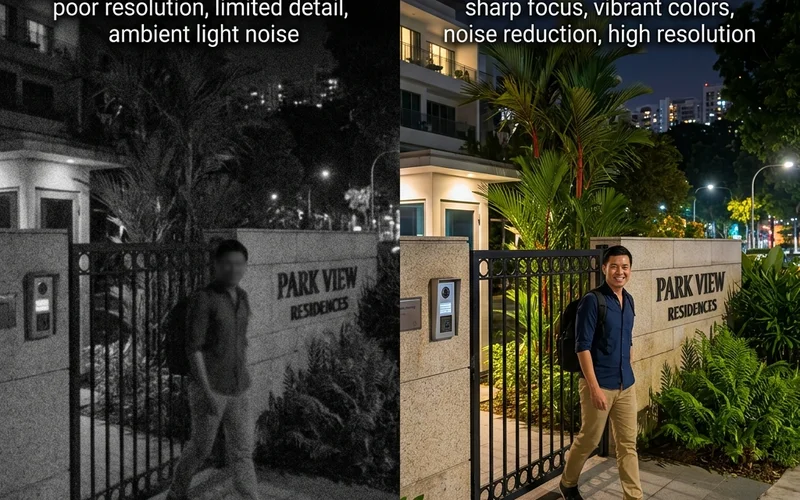
Most modern cameras produce good images in bright daylight. The real test begins after dark, and many incidents occur at night, in poorly lit areas, or in conditions that are nothing like a product demonstration.
Camera manufacturers measure low-light performance in lux; the lower the minimum lux rating, the better the camera performs in darkness. Cameras with colour night vision use larger sensors and sometimes additional white-light LEDs to capture colour images at night rather than switching to black-and-white infrared. For identification purposes; seeing the colour of a vehicle, reading a registration plate clearly, distinguishing between people; colour night vision is significantly more useful than standard infrared. For perimeter coverage where the primary purpose is detecting movement rather than identifying individuals, standard infrared is often adequate and more cost-effective.
We have attended sites where cameras produced excellent images during the day but failed to capture usable identification evidence at night. When CCTV footage is needed, it is most often needed under less-than-ideal conditions; a break-in at 3am, a vehicle incident in a dimly lit car park, a confrontation in a corridor with a faulty light. Low-light performance is where camera quality becomes most consequential, and it should be evaluated under realistic conditions before a system is specified.
Securevision's View
When evaluating cameras, ask to see night-time footage from the specific model being proposed, taken in a location with lighting conditions similar to your installation. Daytime demonstrations in a well-lit showroom tell you very little about whether the camera will provide useful evidence when an incident occurs at night. The gap between cameras that perform adequately in daylight and cameras that perform well in darkness is much larger than most people expect.
The Best Time to Plan Your CCTV Installation
The best time to think about CCTV is during design or renovation, before ceilings are closed and walls are finished. Running cables while the structure is open is significantly easier, less expensive, and produces a cleaner result than retrofitting through finished surfaces. Even if you are not ready to install every camera immediately, preparing cable runs and conduit during renovation costs very little compared to opening walls and ceilings later.
We have attended properties where the CCTV system was planned after renovation was completed. In every case, some compromise was necessary; a camera in a slightly wrong position because the ideal cable route was no longer accessible, surface trunking where concealed cabling would have been cleaner, or a camera count reduced because of the cost of retrofitting. None of these compromises are fatal, but all of them were avoidable. The single most effective way to reduce the total cost of a CCTV installation is to discuss it at the start of the renovation rather than at the end.
Integration; Where the Real Value Often Lies
A standalone CCTV system records events. An integrated security system helps manage them, and that difference becomes significant when something goes wrong.
Modern CCTV systems can integrate with access control systems, visitor management platforms, intercom systems, licence plate recognition, and burglar alarms. When these systems work together, the value multiplies. When a visitor taps an access card at a door reader, the CCTV system automatically saves an image from the nearest camera at that exact moment, without anyone having to search the footage manually. When an alarm triggers at a specific zone, the CCTV system jumps to the relevant camera view automatically. When a vehicle enters the car park, the licence plate is matched against a database and flagged if it does not belong. Each individual system is useful. Together they create a significantly more capable picture of what is happening across a property.
Many organisations start with individual systems purchased at different times from different vendors. Each works independently. The challenge comes when an incident occurs and information needs to be pieced together from multiple sources; manually pulling footage, checking access logs separately, comparing timestamps across different systems. When CCTV, access control, and visitor management are integrated, investigations that would previously take hours can be completed in minutes, and the resulting evidence is more comprehensive and more credible.
CCTV and PDPA; What Singapore Property Owners Need to Know
Installing CCTV in Singapore creates obligations under the Personal Data Protection Act (PDPA). CCTV footage that captures identifiable individuals, which is essentially all CCTV footage of any usefulness; is personal data. This applies whether the system is at a home, an office, or a condominium common area.
The key obligations are defining how long footage is retained and deleting it beyond that period, restricting access to footage to authorised personnel, placing PDPA-compliant notices informing people that CCTV is in operation, and handling any data access requests from individuals who appear in the footage. For most residential installations, these obligations are straightforward to meet. For commercial premises and condominium common areas, a formal CCTV data handling policy is advisable. The most common compliance gap we see is CCTV footage retained indefinitely with no deletion policy and no restriction on who in the organisation can access it.
For a full treatment of CCTV and PDPA obligations in Singapore, see our companion article: CCTV and PDPA; What Singapore Property Owners Need to Know.
Frequently Asked Questions
How many CCTV cameras do I need?
The right number depends on what you need to see, not on the size of the property. A well-designed four-camera system consistently outperforms a poorly planned twelve-camera system. The starting point is mapping every entry point, approach route, and area of concern, then determining how many cameras are needed to cover each one adequately. We have specified systems ranging from two cameras for a small HDB unit to over sixty cameras for a large condominium estate, in both cases, the number followed from the coverage requirement, not from a formula.
What is the difference between IP and analogue CCTV?
Analogue cameras transmit video signals over coaxial cables to a Digital Video Recorder (DVR). IP cameras transmit digital data over standard network cables to a Network Video Recorder (NVR). IP cameras support higher resolutions, remote viewing via smartphone, video analytics, and integration with other security systems. They are more flexible and scalable. HD analogue is a hybrid that improves image quality while retaining existing coaxial cabling; useful where significant cabling infrastructure already exists. For most new installations in Singapore, IP is the correct specification.
Are PTZ cameras worth the money?
It depends entirely on whether someone will be actively monitoring the system. A PTZ camera operated by a trained officer watching a live screen is a powerful tool; it can track, zoom, and follow activity across a wide area. A PTZ camera in auto-patrol mode at a site with no active monitoring may be pointing in the wrong direction when an incident occurs. For homes and small businesses without dedicated monitoring staff, well-positioned fixed cameras are usually more reliable. PTZ cameras are most appropriate for larger estates, active guard operations, and environments with consistent monitoring coverage.
How long should CCTV footage be stored?
For most Singapore residential and commercial installations, 30 days of continuous recording is the practical standard. This covers the period within which most incidents are reported and investigated, and aligns with common PDPA practice for data minimisation. High-security areas, financial institutions, or sites with specific compliance requirements may justify 60 or 90 days. The retention period should be defined in a written policy, the system should be configured to delete footage automatically beyond that period, and access to recordings should be restricted to authorised personnel.
Can I view CCTV footage on my smartphone?
Yes; all modern IP CCTV systems support remote viewing via smartphone app. You can view live feeds and recorded footage from anywhere with an internet connection. Most systems also support motion alert notifications sent directly to your phone. The quality of the remote viewing experience depends on the NVR platform, the camera resolution, and the internet connection at the installation site. For remote viewing to work reliably, a stable internet connection at the property is required; mobile broadband connections can be used but may affect image quality during peak usage periods.
Does CCTV need to comply with PDPA in Singapore?
Yes. CCTV footage that captures identifiable individuals is personal data under Singapore's Personal Data Protection Act. Property owners must define how long footage is retained, restrict access to authorised personnel, and place notices informing people that CCTV is in operation. For residential installations, these requirements are generally straightforward. For commercial premises and condominium common areas, a formal data handling policy is advisable. See our article on CCTV and PDPA compliance for a full discussion.
What resolution do I need for my CCTV cameras?
Resolution determines whether you can identify faces, read vehicle registration plates, and distinguish between people in the footage. For identification purposes at normal distances; a person at an entrance from two to four metres; 2MP (1080p) cameras provide adequate detail. For wider coverage areas where identification is also required, 4MP or 8MP cameras provide more usable detail when zooming into recorded footage. Licence plate recognition at vehicle barriers typically requires purpose-specified LPR cameras rather than general-purpose cameras at high resolution. Higher resolution also requires more storage capacity, so the specification should balance image quality against storage requirements.
When should I plan my CCTV installation?
During renovation or construction, before ceilings are closed and walls are finished. This is when cable runs can be concealed cleanly and camera positions can be planned properly without compromise. Even if you are not ready to install the full system immediately, preparing conduit and pulling cables to planned camera positions costs very little during active construction and avoids significantly more expensive retrofitting later. If renovation has already been completed, a surface-mounted installation is entirely feasible; it simply requires more careful planning to minimise the visual impact of exposed cable management.
Can CCTV integrate with other security systems?
Yes, and integration is where much of the practical value of a modern CCTV system lies. IP CCTV systems can integrate with access control (automatically saving a camera image when a door is accessed), video intercoms (recording visitor calls), licence plate recognition (flagging unregistered vehicles), burglar alarms (switching to the relevant camera when a zone triggers), and visitor management platforms. When these systems share data, investigations that would previously take hours can be completed in minutes, and daily operations become more efficient for the people managing the property.
Is there a difference between indoor and outdoor cameras?
Yes; outdoor cameras require weather protection rated to at least IP66 (dust-tight and protected against heavy rain) for Singapore's climate. They also require adequate low-light performance for night operation, infrared or white-light illumination, and housings that manage heat in direct sunlight. Indoor cameras used outdoors will deteriorate rapidly in Singapore's humidity and rainfall. Outdoor cameras can generally be used indoors without issue, though they are typically more expensive than purpose-built indoor cameras for equivalent image quality.
How much does a CCTV system cost in Singapore?
Costs vary significantly by property type and system scope. As a rough guide: a basic 2–4 camera IP system for an HDB flat or small condominium unit runs from $1,200 to $2,000 installed; an 8-camera system for a landed home runs $2,500 to $4,500 depending on camera specification; a 12–16 camera system for a larger property or small commercial premises runs $5,000 to $9,000. These figures are for professional installation with surveillance-grade equipment. For a full breakdown by property type and system configuration, see our companion article on home security system costs in Singapore.
What is the most common mistake people make when buying CCTV?
Starting with the camera instead of the problem. The second most common mistake is underspecifying the recorder; buying a four-channel recorder when the site will almost certainly need eight channels within two years. The third is not evaluating low-light performance; a camera that looks excellent in a showroom demonstration may produce inadequate footage at night in the actual installation environment. All three mistakes share the same root cause: making specification decisions based on the best-case scenario rather than on what the system needs to deliver when something actually goes wrong.
In Short
After more than three decades working with CCTV systems across Singapore, one principle remains consistent: successful CCTV projects are about evidence, not cameras. The technology will continue to evolve; resolutions will increase, analytics will improve, new features will appear. But the fundamental objective does not change. When an incident occurs, can you identify who was involved, understand what happened, and establish the sequence of events? If the system can answer those questions, it has done its job. Start with the problem you are trying to solve, choose technology that addresses that problem specifically, and plan the installation before renovation closes off the options. Once the objective is clear, choosing the right CCTV system becomes significantly easier.