- VESTA is one platform with three distinct views; resident, guard, and management; all sharing the same underlying data in real time, eliminating duplicate data entry between groups.
- Today, each estate operates within its own VESTA environment. Portfolio-level visibility across multiple estates from a single login is on the platform roadmap but not yet available.
- The most immediate operational gains are in visitor management: residents pre-register visitors, guards see expected arrivals, and gantries open automatically for pre-approved vehicles, without guard intervention.
- MCST audit documentation; access logs, incident reports, facility booking records; is generated directly from the management dashboard rather than compiled manually from multiple sources.
- Deploying VESTA does not replace existing access cards. The platform is additive; residents who prefer their card continue to use it; VESTA adds capability without removing what already works.
- VESTA delivers the most value where visitor traffic is high, multiple access points exist, and facility bookings create administrative workload. Smaller simple-operation estates may not need every feature immediately.
Why managing multiple estates becomes difficult
Most managing agents in Singapore are running their estates the same way they always have; one system per estate, one support number per vendor, one set of login credentials per property, and a working knowledge of which guard team is on which shift at which development. It is a system that functions. Until several estates have problems in the same week, at which point the friction compounds rapidly.

The challenge is not that managing agents lack capability. The challenge is that most of the tools available were designed for single-estate operations, not portfolio management. Different visitor management systems, different access control platforms, different reporting formats, different vendor support lines; none of which communicate with each other. When a council member requests a security report for the next committee meeting, the estate manager may need to log into multiple platforms, export separate reports, and assemble the information manually before a coherent answer is possible.
This is the operational reality that VESTA, Securevision's estate management platform, was built to address. Not by adding more technology, but by consolidating the functions that residents, guard teams, and managing agents already need into a single operational environment where information flows between them in real time rather than being transcribed, telephoned, or manually compiled.
KEY POINT
The goal is not to manage more technology. The goal is to reduce the number of systems, processes, and vendors that require separate attention. Every additional platform introduces another login, another support contact, another reporting format, and another point of failure. Across a portfolio of five or more estates, these small frictions become a significant administrative burden.
One platform, three different views
The most important thing to understand about VESTA is that it is not a single app with a single interface. It is one platform with three distinct views; each designed for a different group with different responsibilities and different levels of access. The resident view, the guard view, and the management view all run on the same underlying system, which means data flows between them in real time without manual transfer.
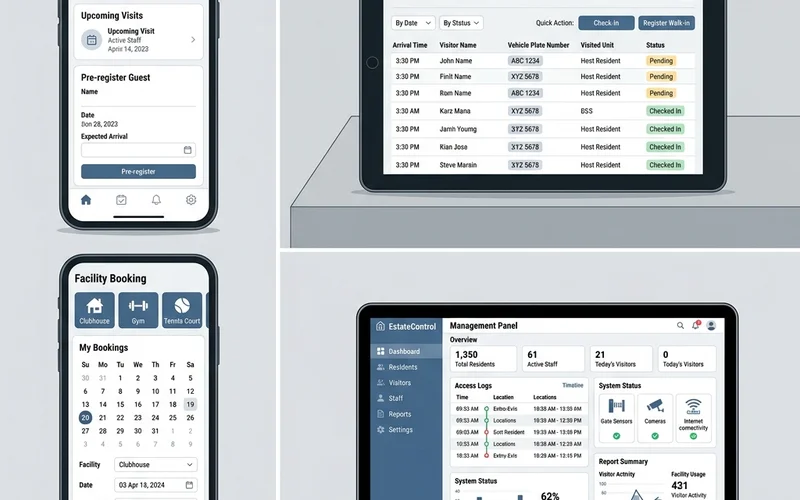
When a resident pre-registers a visitor through the resident app, that information appears immediately in the guard view at the guardhouse. When a guard logs an incident during a shift, it appears immediately in the management view. Nobody is transcribing information between systems. Nobody is calling the guardhouse to confirm whether a visitor was expected. The resident view, the guard view, and the management view share information continuously while each presenting only the functions relevant to its user.
Residents can book facilities, submit forms, manage visitor pre-registration, open gates remotely, and receive intercom calls on their phones from anywhere, including overseas. Pedestrian visitors receive a QR code that opens the pedestrian gate on arrival. Driving visitors have their vehicle plate pre-registered, when they arrive, the gantry reads the plate and opens automatically without guard intervention or logbook entry. Residents who prefer not to use the app continue to use their existing access card; VESTA is additive, not a replacement for what already works.
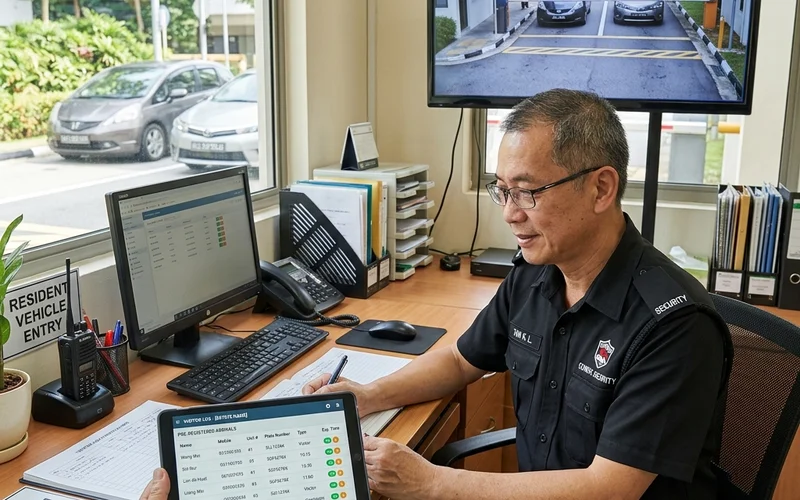
The guard view is the operational interface for the on-site security team. When a visitor arrives without pre-registration, the guard logs them through VESTA; name, identification, purpose, vehicle plate where applicable. That log is immediately visible in the management view and creates a searchable digital record rather than a handwritten entry in a paper logbook that may be difficult to retrieve weeks later. Pre-registered visitor arrivals are visible to the guard before the visitor reaches the gate, eliminating the friction of guests who arrive claiming to be expected while the guard searches manually for a confirmation.
The management view gives the managing agent operational oversight of everything happening on the estate. Access logs, vehicle movement records, facility booking history, incident reports, and system status are all accessible from one interface. MCST audit reports; access event summaries, incident logs, activity records; can be generated directly from the dashboard rather than assembled manually from multiple exports. User permissions can be managed directly: adding a new resident, issuing a temporary contractor credential, revoking a lost access card; all done from the management view without needing to contact the integrator.
PLANNING POINT
The management view is web-based and accessible from any browser on any device. Most estate managers become comfortable with the core functions; user management, report generation, access credential management, and system status monitoring; within one day of training. The guard interface runs on a tablet or desktop at the guardhouse and is covered in a hands-on session before go-live.
What changes when an estate goes live
Today, VESTA operates on a per-estate basis. Each estate has its own VESTA environment; its own login, its own configuration, its own resident database, and its own reporting. For a managing agent overseeing five estates, that currently means five VESTA logins. This is not the portfolio-level single-dashboard experience that multi-estate management ideally needs, and the honest answer to where that is heading is addressed in the next section. But even on a per-estate basis, the operational picture changes significantly for estates that have been managed with fragmented or manual systems.
The most immediate change is in visitor management. The most common source of guardhouse friction in Singapore condominiums; expected visitors who cannot enter because the guard cannot locate a pre-registration in a paper logbook; is eliminated. Residents pre-register through the app, guards see expected arrivals before visitors reach the gate, and gantries open automatically for pre-approved vehicles. A process that previously involved a call from the guard to the resident, a manual logbook entry, and a barrier raised by hand is reduced to an automated sequence requiring no human intervention for expected visitors.
Facility booking disputes become resolvable because records are centrally stored and time-stamped. When a resident claims to have booked the BBQ pit and someone else is using it, the booking record is in the system with a timestamp and the resident's identity. There is no ambiguity and no argument. MCST audit preparation, which previously required the estate manager to compile access logs, incident reports, and maintenance records from multiple sources before each AGM, becomes a process of generating reports from the management dashboard on demand; the committee receives a consistent, complete report without anyone having to assemble it manually.
Lost access card management improves immediately. When a resident reports a lost card, the credential is revoked from the management view in under a minute; no call to the integrator, no wait for remote access, no uncertainty about whether the revocation has taken effect. After-hours gate access requests become self-service: residents who need to admit a late visitor or a delivery can handle it through the app without calling the guard or the management office, which reduces after-hours call volume significantly on estates with active resident populations.
The multi-estate dashboard; what is coming
The honest answer to the question managing agents most frequently ask: "can I see all my estates from one login?"; is: not yet. But this is exactly where VESTA is heading, and the architecture is already built for it.
The current per-estate structure is a foundation, not a ceiling. The underlying platform is designed to support multi-estate views; a single management login that aggregates access logs, incident reports, system status, and audit documentation across all estates in the portfolio. The resident and guard layers remain estate-specific. The management layer is built to scale across sites. What this means in practice is portfolio-level visibility into which estates have open incidents, which systems have flagged faults, and which maintenance visits are due, from one interface without logging into each estate separately. Centralised user management across multiple estates, and MCST audit reports accessible and comparable from one view, are part of the same capability.
PLANNING POINT
We are transparent about the timeline because managing agents make long-term decisions. Estates deploying VESTA today are building on the platform that multi-estate capability will run on. The transition from per-estate to portfolio view will not require a system replacement; it is a platform evolution, not a hardware change. Estates already live on VESTA will not need to reinvest to access portfolio management features as they become available.
What deploying VESTA on an estate actually involves
Managing agents who recommend VESTA to their MCST committees sometimes hesitate because they are uncertain what the transition involves, for residents, for the guard team, and for the estate manager. The short answer is that VESTA is designed to be additive rather than disruptive: it extends what existing systems can do rather than replacing the infrastructure residents and guards already rely on.
For residents, VESTA is downloaded as an app on iOS or Android. Residents register with their unit number and a verified contact; the estate manager approves each registration, which prevents unauthorised access to the resident interface. Onboarding takes most residents under ten minutes. For residents who prefer not to use the app, their existing access card continues to work without any change. The app is an additional option, not a mandatory replacement for existing credentials.
For the guard team, the VESTA interface runs on a tablet or desktop at the guardhouse. A hands-on training session is conducted with every guard team before go-live; covering visitor logging, pre-registration checking, incident reporting, and shift handover. This typically takes two hours. Follow-up support is available through a named project manager for the first thirty days after go-live, which covers the period when most edge cases and process questions arise.
For the estate manager, the management view is web-based and requires no software installation; it is accessible from any browser on any device. Training covers user management, report generation, access credential management, and system status monitoring. Most estate managers are comfortable with the core functions within one working day. The learning curve is low because the platform is built around tasks estate managers already perform; the difference is that those tasks take significantly less time and produce a more complete audit record.
PLANNING POINT
For MCST committees considering VESTA, the most useful framing is not a feature comparison but a problem inventory. Which specific operational friction points does the estate experience regularly? High visitor management workload, frequent resident complaints about gate access, MCST audit preparation that consumes days rather than hours, or after-hours call volume to the management office? The value of the platform is proportional to the severity of the problems it addresses on that specific estate.
Is VESTA right for every estate?
Not necessarily, and the honest answer to this question matters more than a sale. VESTA delivers the most immediate value in estates where visitor management is a daily friction point: high-traffic developments with multiple gantry entry points, large unit counts with active facility usage, or estates where the current visitor logbook system is generating regular resident complaints. For these estates, the operational improvement is visible within days of go-live and the administrative reduction for the estate manager is significant.
For smaller boutique developments with low visitor volume, a single gantry, and minimal facility booking activity, the full VESTA platform may provide more capability than the estate currently needs. In these situations, the access control integration and intercom mobility; residents receiving gate calls on their phones; delivers useful value without necessarily requiring the full resident app layer and the associated onboarding effort. The platform can be deployed at the scope that matches the estate's actual operational needs rather than as an all-or-nothing commitment.
The right conversation to have with an MCST committee is not "should we get VESTA" but "what are the operational problems this estate is experiencing, and which of those would this platform actually solve?" We have that conversation at the estate assessment stage, before any proposal is made. An estate that deploys a platform because it is available, rather than because it addresses a real operational need, will not use it well, and will not see the return on the investment the committee approved.
What to look for when evaluating any estate management platform
The principles that make VESTA useful are the same principles that should guide any evaluation of estate management technology. The first is whether the platform reduces the number of separate systems, logins, and reporting processes that estate management requires, or adds to them. A platform that solves one problem while creating three new administrative requirements has not improved the managing agent's situation.
The second is whether information flows between the groups that need it; residents, guards, and management, without manual transfer. A visitor pre-registration that a resident records in one system but a guard must be telephoned about separately has not eliminated the process; it has just moved it. The value of integration is that the information is already where it needs to be when it is needed.
The third is whether the platform is honest about what it does today versus what it plans to do. A managing agent who deploys a platform based on a roadmap feature rather than a currently available capability has made a commitment on behalf of the MCST council based on a promise rather than a product. Ask what the platform does now, confirm it in a demonstration, and treat the roadmap as context, not justification.
The fourth is whether deploying the platform simplifies or complicates the contractor relationship. A platform that requires constant vendor intervention for routine tasks; revoking a credential, generating a report, adding a new resident; has created a dependency rather than a capability. The managing agent should be able to perform the day-to-day operational tasks without needing to contact the integrator every time.
Securevision's View
The platforms that succeed over the next decade in Singapore's condominium management sector will not be the ones with the most features. They will be the ones that reduce friction for residents, guards, and managing agents in equal measure, and that are honest about what they do today versus where they are heading. That is the standard we hold VESTA to, and it is the standard any competing platform should be held to when your MCST committee is making the decision.
In Short
VESTA is a single platform with three views; resident, guard, and management; all sharing data in real time. Today it operates per estate, with one login per estate. Portfolio-level management across multiple estates from a single dashboard is on the roadmap but not yet available. The most immediate operational gains are in visitor management, facility booking administration, MCST audit documentation, and lost credential management. The platform is additive; existing access cards continue to work, and residents who prefer not to use the app are unaffected. Deployment involves guard training, resident onboarding, and estate manager familiarisation, typically completed within days, not weeks. VESTA delivers the most value where visitor volume and administrative complexity are high; smaller simple-operation estates should evaluate which specific problems they need it to solve before committing.

Frequently asked questions
Can I manage all my estates from one VESTA dashboard today?
Not yet. Each estate currently operates within its own VESTA environment with its own login. Portfolio-level management; a single dashboard aggregating access logs, incident reports, and system status across multiple estates; is on the platform roadmap. Estates deploying VESTA today are building on the architecture that portfolio management will run on, so the transition will be a platform update rather than a system replacement.
Do residents have to use the VESTA app?
No. VESTA is additive; existing access cards continue to work without any change. The app gives residents additional capabilities: mobile gate access, intercom calls on the phone, visitor pre-registration, and facility booking. Residents who prefer not to use the app are entirely unaffected by the deployment.
How long does it take to deploy VESTA on an estate?
Deployment timelines vary by estate size and complexity, but the core components; guard training, resident onboarding, and estate manager familiarisation; are typically completed within days rather than weeks. Guard training is a hands-on session of approximately two hours. Most estate managers are comfortable with core management functions within one working day. Resident onboarding is self-service through the app and takes most users under ten minutes.
What happens to a visitor who arrives without pre-registration?
Unregistered visitors are logged through the guard view in VESTA; name, identification, purpose, vehicle plate where applicable. The log is immediately visible in the management view and creates a searchable digital record. The guard process is the same as before; what changes is that the record is digital rather than handwritten, and immediately accessible to the estate manager without needing to retrieve a paper logbook.
Is VESTA suitable for smaller condominiums with low visitor volume?
Not necessarily at full deployment. For smaller developments with a single gantry and low visitor traffic, the access control integration and mobile intercom capability may provide sufficient value without deploying the full resident app layer. The right scope of deployment depends on which specific operational problems the estate is trying to solve. We assess this at the estate review stage before any proposal is made.
Can the managing agent revoke access credentials without contacting the integrator?
Yes. Credential management; adding a new resident, issuing a temporary contractor access, revoking a lost card; is handled directly from the management view without needing to contact Securevision. This is one of the most immediate practical benefits for estate managers who have previously needed to contact the integrator and wait for remote access for what should be a routine administrative task.
How are MCST audit reports generated?
Access event summaries, incident logs, visitor records, and facility booking history are all generated directly from the management dashboard. Reports can be produced on demand rather than assembled manually from multiple exports before each AGM. The format is consistent across reporting periods, which makes year-on-year comparison straightforward for committee members.
Does VESTA integrate with existing access control hardware?
VESTA integrates with access control infrastructure deployed as part of a Securevision installation. Estates with existing third-party access control systems should discuss integration compatibility at the assessment stage; the degree of integration possible depends on the specific hardware and software already in place on the estate.
What support is available after go-live?
A named project manager is available for support during the first thirty days after go-live; the period when most operational questions and edge cases arise for the guard team and estate manager. Ongoing support is provided under the estate's maintenance agreement. The platform is web-based, so updates and improvements are delivered without requiring on-site visits or software installations.
What is the right question for an MCST committee to ask before approving a VESTA deployment?
Not "should we get VESTA" but "what are the specific operational problems this estate is experiencing, and which of those would this platform actually solve?" The committee should expect to see a clear mapping between identified friction points; visitor management volume, MCST audit preparation time, after-hours call load, and the specific platform capabilities that address them. A deployment justified by features rather than by problems will not deliver the return the committee expects.
How does VESTA handle shift handovers for the guard team?
Shift handover reporting is partially handled through VESTA; guards can log incidents and flag system issues through the platform during their shift. This creates a searchable digital record of each shift rather than relying entirely on paper handover books. Incoming guards can review the shift log for the preceding period before taking over, which reduces the information loss that commonly occurs during manual verbal handovers.