- A Central Monitoring Station (CMS) receives alarm signals from thousands of properties around the clock.
- Alarm operators do much more than answer calls. They verify alarms, follow response procedures and escalate incidents.
- Not every alarm signal is a burglary. Many are caused by user errors, power failures or equipment faults.
- False alarms are one of the biggest challenges faced by monitoring centres, and most trace back to poor system design or wrong detector placement.
- Good alarm design and proper zoning give monitoring operators the information they need to respond effectively.
- Understanding how monitoring centres work helps property owners make better decisions about their alarm systems.
What Happens After the Alarm Goes Off?
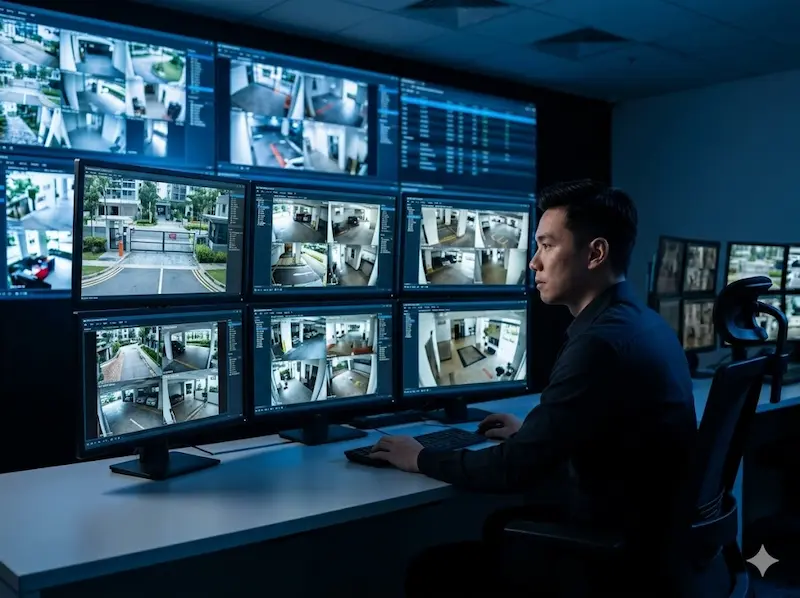
In the previous articles, we talked about alarm system design, detector selection and alarm panels.
But what happens after the alarm is triggered?
Most people never think about it. They assume the alarm sounds, somebody gets notified and help is on the way. The reality is a little more complicated.
The moment an alarm signal is generated, it needs to be received, interpreted, verified and acted upon. That process usually happens inside a Central Monitoring Station; commonly known as a CMS.
Think of it as the control room behind the alarm system. While your alarm panel protects a single property, the monitoring centre may be watching thousands of properties at the same time.
KEY POINT
An alarm signal by itself is only information. The real challenge is deciding what that information means and what action should be taken next.
What Is a Central Monitoring Station, and What I Learned Running One
A Central Monitoring Station is a secure facility staffed by trained operators who monitor alarm signals 24 hours a day.
When an alarm panel sends a signal, it arrives at the monitoring centre almost immediately. The operator's screen displays information such as the customer name, property address, zone description, type of alarm, contact numbers and the set of instructions for that account.
The operator then follows those instructions. Every account may be slightly different. A residential customer may want a phone call before any action is taken. A factory may require a supervisor to be contacted first. A bank may have a completely different escalation process.
Earlier in my career, I was involved in setting up and operating Central Monitoring Stations for both ADT and Optimax. At one stage, we were monitoring approximately 45,000 alarm accounts.
That experience taught me something important. Most people think the challenge is receiving the alarm signal. It is not. The challenge is deciding what to do next, and doing it correctly, quickly, for thousands of different properties, around the clock.
Every day, operators received signals from homes, offices, factories, retail shops and commercial buildings. Some were genuine emergencies. Many were not. The monitoring centre had to determine which was which and respond appropriately.
A burglar is only one cause of an alarm signal. The next section explains what else the monitoring centre sees.
KEY POINT
The monitoring centre's job is not simply to receive alarms. Its job is to manage them correctly, and that means working with whatever information the alarm system provides. The better the system, the better the operator can do their job.
Not Every Alarm Is a Burglary
This surprises many homeowners.
When people imagine alarm monitoring, they usually picture someone breaking into a property. In reality, monitoring centres receive many different types of signals every day.
Examples include:
- Intrusion alarms
- Fire alarms
- Panic alarms
- Power failures
- Low battery warnings
- Communication failures
- Detector faults
- User errors
Genuine burglary events are often a small percentage of the total signals received. Many are generated by everyday operational issues. Someone forgets to disarm the system. A cleaner enters after hours. A door is not closed properly. A detector battery reaches the end of its life.
The monitoring centre sees all of these. This is why good alarm design matters so much, not just for the property owner, but for the operator trying to assess what is actually happening.
PLANNING POINT
A poorly designed alarm system generates unnecessary alarm signals. A well-designed system allows operators to focus on genuine events rather than avoidable ones.
How Alarm Verification Works
One of the first tasks of a monitoring centre is verification.
Before escalating an alarm, the operator needs to determine whether the event is likely to be genuine. The exact procedure varies between monitoring centres and customer accounts, but it typically includes reviewing the alarm type, checking the affected zone, looking at recent alarm history, contacting the customer and verifying identity using a password or security code.
For example, a motion detector activating in a living room at 2am may require a different response from a front door opening at 10am.
The monitoring centre gathers as much information as possible before deciding on the next step. If the alarm is assessed as genuine, the operator can request police assistance. In Singapore, monitoring centres can contact SPF directly, though police response depends on the situation and available resources; it is not automatic.
Good zone descriptions help enormously. "Zone 1" tells the operator very little. "Front Door" immediately provides useful context. This is one reason why I always emphasise proper zone labelling during installation. It is a small thing that makes a real difference when an operator is working quickly at 3am.
PLANNING POINT
Give every zone a clear, plain-English description. The operator responding to your alarm at 3am has never seen your property. Zone labels are the only map they have.
The Challenge of False Alarms
If there is one issue that every monitoring centre struggles with, it is false alarms.
False alarms consume operator time, delay responses, create unnecessary dispatches and frustrate customers. They also affect how seriously an account is treated over time.
From my years running monitoring operations, most false alarms traced back to one of three causes: poor detector placement, poor system design, or user error.
This is exactly why the first three articles in this series covered design, zoning and detector selection in that order. Everything is connected.
A PIR detector placed opposite a west-facing window may generate repeated signals from afternoon sun. A poorly defined zone structure confuses the response process. A badly programmed panel creates unnecessary signals.
The monitoring centre can only work with the information it receives. The better the alarm system, the better the monitoring outcome.
DESIGN RULE
Every false alarm is a cost, to the monitoring centre, to the police, and to your own credibility as an account. Investing in good design at the start is far cheaper than managing false alarms after installation.
How Monitoring Centres Prioritise Events
Not every signal receives the same response. Monitoring centres typically categorise events by priority, and the response is scaled accordingly.
Life safety events; panic alarms, fire alarms, medical emergency signals; are treated as the highest priority. Operators act immediately, without waiting for verification calls. These are situations where seconds matter.
Security events; intrusion alarms, perimeter breaches, after-hours access alarms; follow next. Operators will typically attempt to verify before escalating, unless the account is set to immediate dispatch.
Technical events; power failures, low battery conditions, communication faults; are handled last. They do not require an emergency response but they do need to be logged and communicated to the customer so the issue can be resolved before it affects system performance.
The important point is that operators are constantly assessing and prioritising a live stream of information across thousands of accounts simultaneously. Clear, well-labelled alarm data makes that process faster and more accurate.
KEY POINT
Priority categorisation exists because not every alarm signal is equal. A well-configured system sends signals that are easy to classify. A poorly configured one sends signals that force the operator to guess.
Putting It Together
Many people see alarm monitoring and alarm design as separate topics. They are not.
The monitoring centre depends entirely on the quality of the alarm system feeding it. A well-designed system provides clear zone descriptions, accurate detector placement, reliable communication paths, and meaningful alarm information. A poorly designed system does the opposite, and the monitoring centre has no way to compensate for it.
During my years with ADT and Optimax, I watched operators handle tens of thousands of accounts. The accounts that generated the least trouble, and received the fastest and most effective responses, were almost always the ones with the best-designed systems behind them.
Good monitoring starts with good design. That has not changed.
Securevision Verdict
The effectiveness of a monitoring centre depends heavily on the quality of the alarm system feeding it. Good design, proper zoning and reliable detectors make faster and better responses possible.
If you are considering professional monitoring for your property, do not treat it as a separate decision from the alarm system itself. The two are inseparable. A monitoring centre can only act on what it receives. Give it clear, accurate information and it will serve you well. Give it noise and it will struggle; regardless of how good the operators are.
In Short
The value of alarm monitoring is not in the technology; it is in the human judgement that sits behind it. A trained operator who receives an alarm signal, reviews the available information, makes a verification call, and decides whether to dispatch a response is providing something that no automated system can replicate. Having personally managed a monitoring centre operation, the lesson I would take from that experience is that the difference between a good monitoring centre and a mediocre one is not the software or the screens; it is the quality of the operators and the rigour of the protocols they follow.

Frequently asked questions
What is a central monitoring station?
A central monitoring station (CMS) is a staffed facility that receives alarm signals from connected properties around the clock and responds according to pre-agreed protocols. When an alarm is triggered, the panel sends a signal to the monitoring station, where a trained operator reviews the event, follows verification procedures, and initiates the appropriate response; contacting keyholders, dispatching patrol attendance, or notifying the police.
What happens when my alarm signal reaches the monitoring station?
The signal is received by the monitoring station's alarm management software, which identifies the subscriber, the event type, and the zone involved. An operator is alerted and reviews the information. They then follow the response protocol, typically beginning with an attempt to contact the property to verify whether the activation is genuine, before deciding whether to escalate to keyholder contact or police notification.
Why doesn't the monitoring station call the police immediately when an alarm triggers?
The vast majority of alarm activations are false alarms. If monitoring stations called the police for every activation, emergency resources would be overwhelmed with unnecessary responses, and police would begin treating alarm notifications as low priority. Verification before police contact ensures that when the police are called, there is a genuine reason to believe an intrusion may be occurring.
What is alarm verification?
Alarm verification is the process of confirming whether an alarm activation represents a genuine emergency before escalating the response. Verification methods include: contacting the property by telephone to speak with an authorised person; reviewing video footage if the system includes cameras; receiving a duress code that indicates the property is occupied and under threat; or observing a specific pattern of zone activations that indicates an intrusion rather than a false alarm.
What are keyholders and why does a monitoring station need them?
Keyholders are persons designated by the alarm subscriber to be contacted when an alarm is activated and verified. They have keys to the property, know the alarm code, and are authorised to attend and assess the situation. Most monitoring stations require at least two keyholders on record with current contact details. The quality and responsiveness of the keyholder list directly affects the usefulness of professional monitoring.
How do monitoring stations prioritise alarm events?
Monitoring stations typically prioritise events based on the nature of the activation; a panic button or hold-up alarm receives immediate police notification without verification, while a standard PIR activation follows the full verification protocol. Properties with a history of false alarms may receive a more cautious response. Some monitoring platforms also use video verification to assess the severity of an activation before determining priority.
Is my alarm monitoring centre in Singapore or overseas?
Monitoring centres serving Singapore properties may be based locally in Singapore or in regional facilities that operate across multiple markets. The location of the monitoring centre affects response times, language capability, and familiarity with Singapore-specific response protocols, including the correct way to contact Singapore Police Force. Ask your alarm provider to confirm where your monitoring centre is located and what its operating hours are.
What is the difference between a monitoring centre and a key holding service?
A monitoring centre receives alarm signals and manages the response protocol; making calls, coordinating keyholders, and liaising with the police. A key holding service physically attends the property when the monitoring centre cannot reach the primary keyholders or when an intrusion is suspected. Some companies provide both services; in other cases, they are provided by different organisations.
How do I know if my monitoring centre is responding to my alarms?
Ask your monitoring centre to provide activation reports; a log of all signals received from your panel and the actions taken in response. Review this periodically to confirm that activations are being received and responded to correctly. If you conduct an annual system test, include a test of the monitoring communication as part of that process.
What should I look for when choosing an alarm monitoring centre?
Key criteria include: 24-hour staffing with trained operators; response time standards that are clearly defined; PSRM or equivalent certification if applicable; clear escalation protocols for different event types; transparent reporting of activations and responses; and a Singapore-based or Singapore-familiar operation with appropriate knowledge of local emergency contacts and procedures.