- Industry estimates consistently place false alarms at around 80 per cent of all burglar alarm activations in Singapore. Every false alarm has a specific, identifiable cause, and every cause has a fix.
- User error during entry and exit is the most common cause. Entry and exit delay settings, forced-arming prevention, and clear zone labelling on the keypad eliminate most of these incidents.
- Standard PIR detectors are vulnerable to Singapore's afternoon sun and heat movement. Dual-technology detectors; requiring both infrared and microwave triggers simultaneously; virtually eliminate environment-related false activations.
- Pets, insects, and dust all cause false alarms from PIR detectors. Pet-tolerant sensors, sealed-optics detectors, and regular lens cleaning address each of these causes.
- Low backup battery voltage and degraded communication modules cause false alarms that appear to have no trigger. Proactive battery replacement and supervised communication tests identify these before they become a pattern.
- A burglar alarm that triggers more than once without a valid cause in any twelve-month period needs investigation, not just reset. Repeated false alarms erode confidence in the system and eventually lead to it being disarmed.
Why false alarms are a security problem, not just an annoyance
Industry estimates consistently place false alarms at around 80 per cent of all burglar alarm activations in Singapore. The proportion varies by site type and system age, but the general finding is consistent: most alarm activations are not caused by intruders. They are caused by detectors responding to the wrong trigger, users making errors during arming or disarming, or components that have degraded without being investigated.
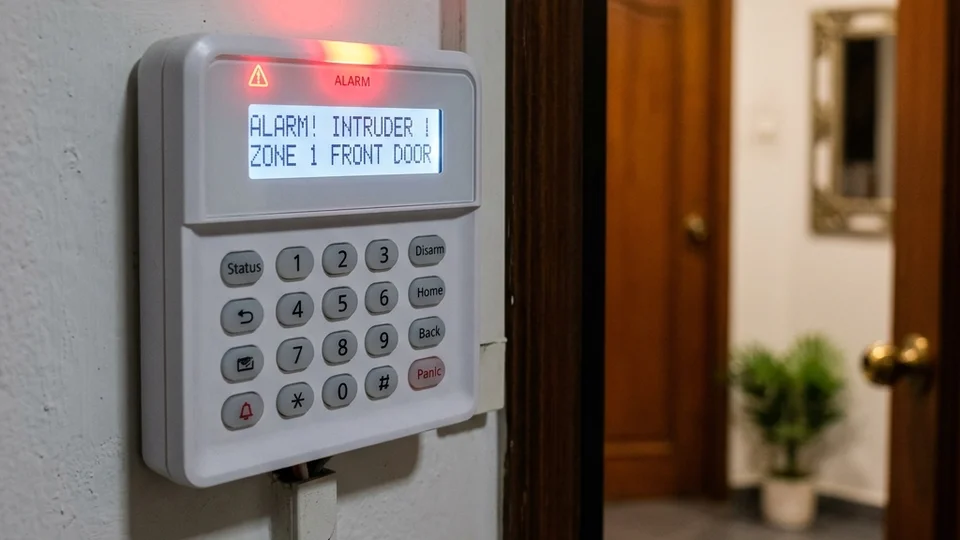
The consequence of repeated false alarms is not simply inconvenience. A system that triggers without cause loses the confidence of the people who are supposed to respond to it. Monitoring centre operators who receive repeated false activations from the same account begin to treat incoming signals with less urgency. Residents who have been woken at 3am by a system triggering for no visible reason begin to leave it disarmed. Neighbours who have been disturbed repeatedly stop paying attention to the siren. The alarm system that was installed to deter and detect gradually becomes background noise, and the property is less protected than it was before the system was installed.
In Singapore, the Singapore Police Force has a formal position on excessive false alarms. Repeated nuisance activations from monitored alarm accounts can result in conditions being placed on police response; meaning the police may not respond to further activations from a system with a poor false alarm history. This makes addressing the underlying cause not merely a matter of convenience but a matter of maintaining the system's operational effectiveness. The sections below work through each cause systematically. For guidance on the broader maintenance programme that prevents many of these issues from developing, see How to Maintain Your Burglar Alarm System.
KEY POINT
A false alarm is not a minor inconvenience to be reset and forgotten. It is the system telling you that something is triggering it that should not be. Every false alarm has a specific cause. Identifying and addressing that cause is the correct response, not simply resetting the panel and hoping the problem resolves itself.
User error; the most common cause
The majority of false alarms occur not because the detection hardware is faulty but because of how the system is operated. Entry and exit events; the moments when a user arms the system before leaving or disarms it after returning; are the highest- risk periods. Someone is rushing, distracted, or unfamiliar with the procedure, and the alarm activates before they can reach the keypad, or the system is armed while a door or window is still open.

Entry delay and exit delay settings are the primary tool for managing this. The exit delay gives the user time to leave the property after arming, typically 30 to 60 seconds for a residential property, long enough to exit calmly without rushing. The entry delay gives the user time to reach the keypad after entering, typically 20 to 45 seconds. Both delays should be calibrated to the actual time a user needs, not set to an arbitrary default. A delay that is too short creates false alarms. A delay that is too long creates a vulnerability; an intruder who enters while the entry delay is running has time to reach the keypad before the alarm sounds.
Forced-arming prevention is a configuration option on most modern alarm panels that prevents the system from arming if any zone is showing as open; a door or window that has not been properly closed. When this is enabled, the keypad indicates which zone is preventing arming, so the user can close the door or window before leaving rather than arming the system with an open zone that will trigger immediately. Clear zone labelling on the keypad is also important: a panel that shows "Zone 3; Front Balcony Door" is more useful than one that shows "Zone 3 Open" when the user is trying to identify what needs to be closed before they can leave. For a detailed treatment of alarm zone design and how zone labels should be configured, see How to Design a Burglar Alarm System.
PLANNING POINT
For commercial premises with multiple staff members arming and disarming at different times, an auto-disarm schedule, where the system disarms automatically at a set time before the first staff member typically arrives; prevents the scenario where someone walks into a building that is still armed and triggers the alarm before reaching the keypad. Auto-disarm should be combined with a mobile notification so the business owner knows the system has disarmed.
Detector placement and Singapore's climate
Standard passive infrared (PIR) detectors work by sensing changes in heat signature as a warm body moves through the detector's field of view. In Singapore's climate, this creates a specific and common false alarm pattern: afternoon sun heating a floor, wall, or piece of furniture through a window creates thermal turbulence; rising warm air, that a PIR detector positioned nearby interprets as a person moving through its detection zone.
The solution is not to reduce the detector's sensitivity, which would create a genuine security gap. The correct approach is either to reposition the detector so that it is not facing a surface that receives direct afternoon sun, or to replace the standard PIR with a dual-technology detector. Dual-technology detectors require two independent triggers to fire simultaneously; a passive infrared trigger and a microwave motion trigger; before they will activate an alarm. Thermal turbulence from sunlight will trigger the PIR element but will not produce a microwave motion signal. A person walking through the detection zone will trigger both. This combination virtually eliminates sun-related and heat-related false activations without compromising detection capability.

Air-conditioning vents are the other common climate-related cause of false alarms. A PIR detector positioned in the direct airflow from an air-conditioning unit experiences rapid temperature fluctuations as the unit cycles on and off, which the detector can interpret as movement. The fix is straightforward: the detector should not be positioned in the direct airflow path of any air-conditioning outlet. This is a placement decision that is best made at design stage, but can be corrected by repositioning after installation if the pattern of false alarms makes the cause clear.
KEY POINT
When investigating a false alarm pattern, note the time of day the activations occur. Alarms that trigger consistently in the afternoon, in the same zone, are almost always caused by sun exposure or thermal effects in that area. Alarms that trigger when the air-conditioning starts or stops are caused by detector placement relative to a vent. Time-of-day patterns make diagnosis straightforward.
Pets, insects, and environmental triggers
Pets are one of the most common causes of false alarms in residential properties and the one most frequently overlooked at the design stage. A standard PIR detector is designed to detect human-sized heat signatures moving through its field of view. A medium-to-large dog moving at floor level produces a heat signature within the detector's sensitive range and will reliably trigger it. Pet-tolerant sensors are designed to distinguish between the heat signature of a human at standing height and that of an animal at floor level; either by using detection lobes that focus above a certain height, or by applying weight-based logic that discounts signals below a threshold. If there are pets in the property, pet-tolerant sensors are not optional; they are a basic design requirement for a system that will function reliably.
Insects inside a PIR detector create a different but equally reliable false alarm pattern. A small insect crawling across the Fresnel lens of a PIR detector occupies most of the detector's field of view at very close range; the optics magnify the heat signature of even a small insect into something that registers as a significant thermal event. This is particularly common in Singapore's ground-floor residential and industrial environments where insects are more prevalent. The solution is to use sealed-optics or insect-proof detectors in environments where insects are a known presence, and to include lens inspection in the routine maintenance programme for all detectors regardless of environment.
Dust accumulation on the PIR lens produces a subtler but persistent false alarm cause. Dust particles on the lens create diffraction patterns that can be interpreted as movement, particularly when lighting conditions in the space change, when the sun moves, when lights are switched on or off, or when a nearby window is opened and a breeze moves air across the detector. Regular lens cleaning; wiping the exterior of each detector with a dry lint-free cloth every six months; prevents this from developing. A detector that has not been cleaned for two or more years in a Singapore environment should be inspected before concluding that a false alarm has an unknown cause.
Securevision's View
The most common mistake when dealing with false alarms from pests or environment is to increase the detector's tamper threshold or reduce its sensitivity as a temporary fix. This trades one problem for another; the false alarms stop, but so does reliable detection. The correct response is to identify the specific cause and address it directly: change the detector type, change the position, clean the lens, or seal the environment. A system that has been de-sensitised to stop false alarms is a system that may not detect a genuine intrusion.
Battery and communication failures; the hidden cause
Not all false alarms are caused by detectors responding to the wrong trigger. A significant proportion of unexplained alarm activations; activations with no visible trigger in any detector zone; are caused by system components operating outside their normal parameters due to degraded backup batteries or failing communication modules.
A backup battery that has degraded to the point where it can no longer sustain the alarm panel at stable voltage causes the panel to behave erratically. Voltage fluctuations as the battery struggles to maintain output; particularly during the early morning hours when mains power demand is low and the panel is running on battery backup; cause the panel to generate spurious zone triggers or communication events that register as alarms. The activations appear to have no cause because no detector has triggered: the cause is in the power supply, not the detection hardware. Replacing the battery resolves the false alarm pattern immediately.
Communication module failures produce a different symptom: the monitoring centre or mobile app receives a signal that the panel interprets as an alarm condition, but no zone has triggered and the keypad shows no fault. This is most commonly caused by a degraded or intermittently failing communication module, typically the SIM-based mobile communicator that reports alarm signals to the monitoring centre; generating spurious signals as it fails. A supervised communication test, where the monitoring centre confirms receipt of a deliberately triggered test signal, helps identify whether the communication path is stable. If the test reveals intermittent communication, the module should be replaced rather than monitored.
KEY POINT
If an alarm activation occurs with no zone trigger and no fault condition on the keypad, check the backup battery age before looking at the detectors. A battery more than three years old in Singapore's climate is a prime suspect for unexplained activations. Replace it proactively and monitor whether the pattern continues. In most cases, this single step resolves what appeared to be an inexplicable false alarm history.
Video verification; confirming before responding
Video verification is the most effective way to manage alarm activations once a false alarm pattern has been established, or where the site's operating environment makes it difficult to eliminate all false alarm causes completely. Rather than every alarm activation triggering a full emergency response, video verification allows the monitoring centre operator or the property owner to confirm whether the activation was caused by a genuine intrusion before despatching a response.
In a video-verified system, when the alarm triggers, the panel pushes a short video clip, typically 10 to 15 seconds from the camera nearest the triggered zone, to the monitoring centre and simultaneously to the property owner's mobile app. The monitoring centre operator reviews the clip and confirms whether an intruder is visible before contacting the keyholder or despatching police. The property owner can review the same clip on their phone and confirm or dismiss the activation without travelling to site. An activation caused by a curtain moving in front of a PIR, or by an animal, or by thermal turbulence, is visible as such in the clip and can be dismissed in seconds.
Video verification does not replace the need to address the underlying cause of false alarms; a system that requires verification for every activation is a system that has not had its false alarm problem resolved. But it provides a practical safety net for activations that cannot be completely prevented, reduces the burden on monitoring centre operators, reduces unnecessary police call-outs, and gives the property owner confidence that they can confirm events remotely without an emergency response being triggered on their behalf.
What to do when the alarm keeps triggering
A burglar alarm that triggers more than once without a valid cause in any twelve-month period needs investigation, not just reset. The investigation follows a systematic process: review the alarm event log to identify which zone triggered, at what time, and whether there is a pattern. If the same zone triggers repeatedly at the same time of day, the cause is almost certainly environmental; sun exposure, air-conditioning, or a local heat source, and the fix is a detector reposition or replacement. If activations occur across different zones with no pattern, the cause is more likely a power supply or communication issue.
Bypassing the triggering zone as a long-term measure is not acceptable. A bypassed zone is an unprotected zone; the system arms normally and appears to be functioning, but part of the property is not monitored. If a zone is generating repeated false alarms, the cause must be identified and resolved so the zone can be reinstated, not permanently excluded from the system.
If the cause cannot be identified through the event log, a supervised walk-test; conducted with the monitoring centre on notice and a technician present; will identify which detector is generating the trigger and under what conditions. Most false alarm causes are identified and resolved within a single maintenance visit. The rare exception is an intermittent fault in a communication module or panel component that only manifests under specific conditions, in these cases, component replacement is the practical solution rather than extended investigation.
| Cause | Typical pattern | Fix |
|---|---|---|
| User error; entry or exit | Activates at the same time as a legitimate entry or departure | Adjust entry/exit delay; enable forced-arming prevention; improve zone labels |
| Afternoon sun / thermal turbulence | Same zone, same time of day, typically afternoon | Reposition detector away from sun-exposed surface, or replace with dual-technology detector |
| Air-conditioning airflow | Triggers when A/C starts or stops; correlates with temperature cycling | Reposition detector out of direct A/C airflow path |
| Pets | Triggers when pet is in the protected area; no other obvious cause | Replace with pet-tolerant detector sized for the animal's weight |
| Insects on lens | Intermittent; may correlate with insect season or time of night | Use sealed-optics detector in affected zones; inspect and clean lens |
| Dust on lens | Gradual increase in false alarms over time; correlates with lighting changes | Clean detector lens with dry lint-free cloth; consider sealed-optics in dusty environments |
| Degraded backup battery | No zone trigger; no fault on keypad; may occur in early morning hours | Replace backup battery, especially if over three years old in Singapore's climate |
| Failing communication module | Monitoring centre receives alarm signal; no zone triggered; no keypad fault | Supervised communication test; replace module if intermittent signals confirmed |
Securevision's View
We do not accept "the alarm just went off for no reason" as a conclusion. Every activation has a cause. The cause is either in the detection hardware, the system configuration, the operating environment, the power supply, or the communication path. Working through these systematically; starting with the alarm event log and the time pattern of activations; identifies the cause in the large majority of cases without needing specialist diagnostic equipment. If an alarm system has been triggering repeatedly for months and nobody has investigated why, the problem is not with the alarm; it is with the process around it.
In Short
False alarms are not random. Every activation has a cause: user error during arming or disarming, a detector responding to heat, sunlight, air-conditioning, a pet, an insect, or dust, a degraded backup battery causing erratic panel behaviour, or a failing communication module generating spurious signals. Identifying the cause requires reviewing the alarm event log and noting the time and zone pattern of activations. Addressing the cause requires either a configuration change, a detector reposition or replacement, a battery change, or a communication path test. A system that has been triggering repeatedly without investigation is a system that will eventually be disarmed, at which point it protects nothing.

Frequently asked questions
Why does my burglar alarm keep going off for no reason?
There is always a reason; finding it requires reviewing the alarm event log to identify which zone triggered and at what time. Common causes include a PIR detector responding to afternoon sun or air-conditioning airflow, a pet or insect triggering the detector, a degraded backup battery causing erratic panel behaviour, or a failing communication module. The time pattern of activations; same zone, same time of day; usually points directly to the cause.
What is a dual-technology detector and should I have one?
A dual-technology detector combines a passive infrared sensor with a microwave motion sensor. Both must trigger simultaneously for the alarm to activate. This combination eliminates most environmental false alarm causes; sunlight, thermal turbulence, air-conditioning effects; because these typically trigger only the infrared element, not the microwave element. For any detector position that faces a window receiving afternoon sun, or that is near an air-conditioning vent, a dual-technology detector is the correct specification.
Can my pets set off the burglar alarm?
Yes, if standard PIR detectors are used. A dog or cat of any significant size moving at floor level produces a heat signature that a standard PIR interprets as a person. Pet-tolerant sensors use detection lobes focused above a certain height or weight-based logic to distinguish between a human at standing height and an animal at floor level. If there are pets in the property, pet-tolerant sensors are a basic design requirement, not an optional upgrade.
What is the entry delay and how should it be set?
The entry delay is the time the alarm system allows between a protected entry point being opened and the alarm sounding. This gives the user time to reach the keypad and disarm after entering. For most Singapore residential properties, 20 to 30 seconds is sufficient for a person who knows where the keypad is and is not carrying heavy items. A delay that is too short causes false alarms from legitimate users. A delay that is too long gives an intruder a window to reach the keypad before the alarm sounds; so the delay should be no longer than genuinely necessary.
Can the Singapore Police Force stop responding to my alarm?
The SPF has a formal position on accounts with poor false alarm histories. Repeated nuisance activations from a monitored alarm account can result in conditions being placed on police response to that account; meaning the police may deprioritise or not respond to further activations until the false alarm problem is resolved. This makes addressing the underlying cause a matter of maintaining the system's operational effectiveness, not merely reducing inconvenience.
My alarm went off but no zone is showing as triggered. What happened?
An activation with no zone trigger and no fault condition on the keypad is most commonly caused by a degraded backup battery or a failing communication module. A battery more than three years old in Singapore's climate can cause erratic panel behaviour, including spurious alarm signals, as its output voltage fluctuates. Replace the battery first, then monitor whether the pattern continues. If it does, the communication module should be tested with a supervised check to the monitoring centre.
Is it safe to bypass a zone that keeps triggering false alarms?
No, except as a very short-term temporary measure while the cause is investigated. A bypassed zone is an unprotected area; the system arms normally and appears functional, but that part of the property is not being monitored. If a zone is generating repeated false alarms, the cause must be identified and the zone must be reinstated once the cause is resolved. A permanently bypassed zone is a security gap, not a solution.
How do insects cause false alarms from PIR detectors?
A small insect crawling across the Fresnel lens of a PIR detector is optically magnified by the lens into a heat signature that appears very close to the sensor element. At that proximity, even a small insect produces a thermal event large enough to trigger the detector. This is most common in Singapore's ground-floor residential, industrial, and warehouse environments. Sealed-optics or insect-proof detector variants are available for environments where insects are a known presence.
How often should PIR detectors be cleaned to prevent false alarms?
A light wipe of the exterior lens face with a dry lint-free cloth every six months is sufficient for most residential environments. Industrial and warehouse environments with higher dust or particulate levels may benefit from quarterly cleaning. Do not use cleaning chemicals or wet cloths; solvent-based products damage the Fresnel lens permanently. A detector that has not been cleaned for two or more years in a Singapore environment should be inspected as part of any false alarm investigation before other causes are considered.
What is video verification and does it replace fixing the false alarm problem?
Video verification links the alarm trigger to a camera and pushes a short clip to the monitoring centre and the property owner's phone when the alarm activates. This allows the activation to be confirmed or dismissed without a site visit. It does not replace identifying and fixing the underlying false alarm cause; a system that requires verification for every activation has not had its problem resolved. Video verification is a practical management layer for activations that cannot be completely prevented, not a substitute for addressing the cause.
How many false alarms per year is acceptable?
In our view, one unexplained false alarm per year is the practical limit before investigation is warranted. A single isolated activation; perhaps during a power fluctuation, or from a detector that was not perfectly positioned at installation; can be a one-off event. Two or more unexplained activations in a twelve-month period indicate a recurring cause that needs to be identified and addressed. The cost of the investigation is almost always lower than the cumulative cost, in disruption, monitoring centre response, and eventual erosion of confidence in the system, of leaving the cause unresolved.