- Residents rarely vote against security. They vote against proposals they do not understand or proposals from committees they do not trust. Preparation and communication matter more than technical detail.
- Start with the problem, not the solution. Document operational failures; gantry faults, unusable CCTV footage, failed intercoms; before mentioning costs or equipment. The documented problem is the case for change.
- The AGM is usually not where approval is won. By the time the vote is taken, most residents have already formed their view. Circulate information, hold briefings, and address concerns before the meeting.
- The sinking fund objection is best answered by framing the upgrade as planned capital expenditure on estate infrastructure; exactly what the sinking fund exists for, not by arguing that security is important.
- A written proposal must include a problem statement, proposed solution in plain language, a fixed-price cost, a disruption plan, and post-installation support commitments. Ranges feel like blank cheques.
- If the proposal does not pass, listen to the specific objection. Do not reduce the scope to win approval; a partial upgrade often creates more problems than it solves. Return with a stronger case.
Start with the problem, not the solution
Every MCST committee member who has tried to get a security upgrade approved at an AGM has felt this moment. You know the system needs replacing. You have done your homework. You have a proposal from a reputable integrator. Then a resident raises their hand and asks why the sinking fund should pay for this. The room shifts. Suddenly you are defending a line item instead of presenting a solution.
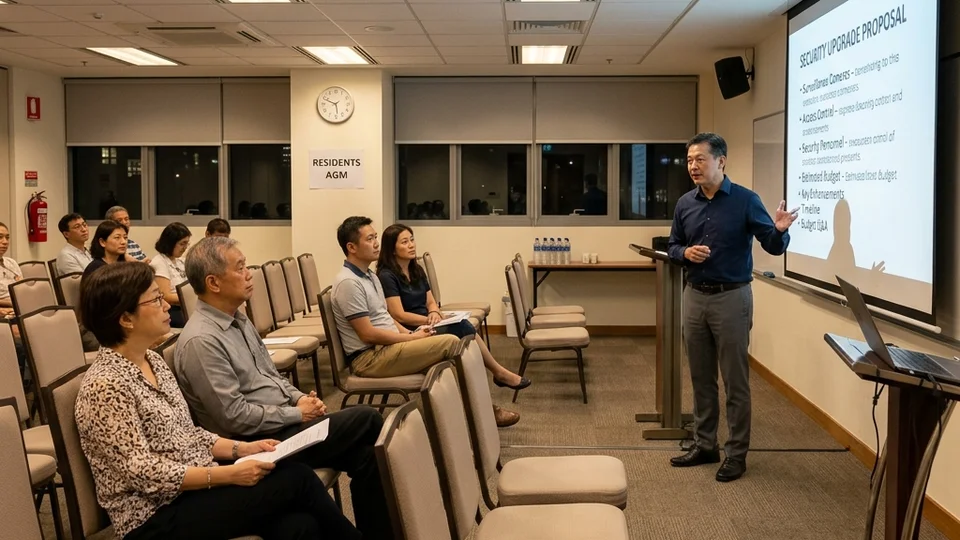
This happens not because residents are unreasonable. It happens because security upgrades are invisible until they fail. Nobody in the room has seen the footage that was too blurry to identify a suspect. Nobody has waited at the guardhouse while the gantry jammed and a queue formed behind them. The committee member sees the problem every day. The resident sees only the cost.
The most common mistake is leading with the solution. "We propose replacing the existing CCTV system with a 32-camera IP network." The moment residents hear that, most are already thinking about money. Start with the problem instead. Before any AGM, document the current operational failures in writing. Not opinions; documented incidents and system limitations. How many times in the past twelve months did the guardhouse log a complaint about the gantry? How many times was CCTV footage requested for a police report and was unusable because of resolution or retention issues? How many access cards were reported lost or cloned? How many times did the intercom fail and residents could not reach the guard?
These are not hypothetical risks. They are operational failures that have already occurred. Written down, dated, and presented as a sequence of events, they become the case for change before you have mentioned a single dollar figure. If this documentation does not exist, compile it. Ask the managing agent for the fault log from the past year. Ask the guard team for their incident register. Ask the integrator for a maintenance history report. This preparation typically takes a few weeks and it is the most important thing a committee can do before any upgrade proposal.
PLANNING POINT
Photographs of existing system issues are among the most persuasive elements in any AGM proposal. A photograph of a corroded access control panel, a camera housing full of water, or an intercom system held together with cable ties communicates in seconds what paragraphs of technical explanation cannot. Residents may not understand system specifications. They understand visible evidence of neglect or failure.
Three things every committee member must be able to explain
An AGM is not a technical presentation. It is a business case. Committee members do not need to understand every specification, but they need to be able to explain three things clearly enough to answer a resident's question without hesitation.
The first is what is failing and why it matters. The integrator should provide a written system health report listing every component, its age, its current support status, and what happens when it fails. The committee does not need to understand the technical details, but it should be able to say: our CCTV cameras are eleven years old, the manufacturer no longer supports the software, and when a camera fails we cannot replace it with a compatible unit. That is a complete, credible explanation any resident can follow.
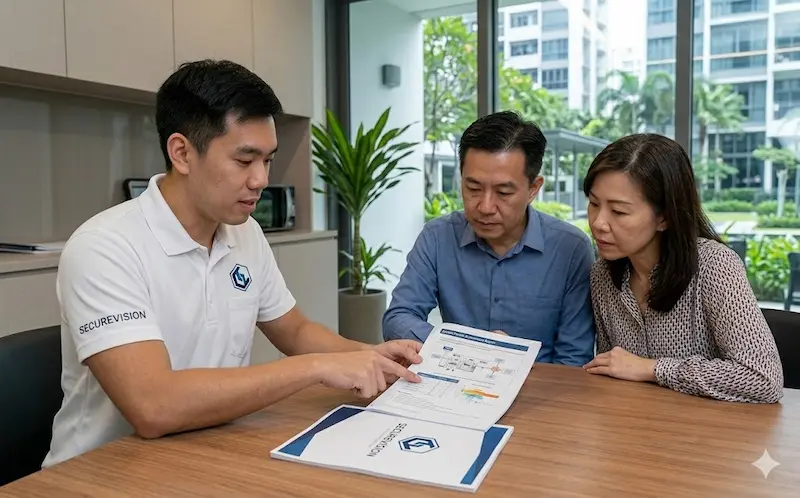
The second is what the upgrade will do differently. Focus on two or three outcomes that matter to residents; faster visitor entry at the guardhouse, camera footage that is actually usable for police reports, a phone app that lets residents open the gate for their own visitors. These are tangible benefits. Residents vote for outcomes, not specifications.
The third is why now rather than later. If the system is end-of-life, explain what end-of-life means in practical terms: no spare parts, no manufacturer support, and the next failure may not be repairable at any cost. If maintenance costs are rising, show the numbers over three years. If the estate has had a security incident in the past year, reference it, not to alarm residents, but to make the cost of inaction concrete rather than theoretical.
One concern that occasionally arises is whether the integrator is recommending an upgrade primarily because they want the project. This is a reasonable concern and the committee should address it directly rather than waiting for a resident to raise it. Obtaining a second opinion, from a different integrator, from a consultant, or from a formal independent system audit; before the AGM demonstrates that the recommendation has been properly evaluated rather than simply accepted. Residents are consistently more comfortable approving expenditure when they see that more than one source has reached the same conclusion.
KEY POINT
Most residents are not evaluating technology when they vote on a security upgrade. They are evaluating trust. They want to know whether the problem is real, whether the solution is reasonable, whether the cost is justified, and whether the committee has genuinely done its homework. The strongest proposals answer all four questions before a resident has to ask them.
The AGM is not where approval is won
One of the most consistent mistakes committees make is treating the AGM presentation as the moment residents will form their view. In our experience, most residents have already decided before they enter the room. For a major security upgrade, the AGM should be the final step in a process that began weeks or months earlier, not the first time residents are hearing about it.
By the time the AGM notice is issued, many residents have already read the agenda, formed an opinion, and discussed it with their neighbours. If they are hearing about the security upgrade for the first time from the agenda item, the committee has lost significant ground before the meeting has started. The resident who arrives surprised is almost always the resident who votes against.
For larger projects, the most effective approach is to circulate information early; a summary of the current system's condition and the proposed solution, with photographs; before the AGM notice is issued. Hold an optional resident briefing session where the committee or the integrator answers questions in a low-stakes environment. Invite residents to submit questions in advance so they can be answered clearly at the meeting rather than improvised under pressure. Share the key facts of the proposal before the AGM notice, not only in it.
The objective is to ensure that residents arrive at the AGM informed, not surprised. A resident who already understands the problem, has seen the evidence, and has had their questions answered is far more likely to vote yes than one who is processing the proposal for the first time while listening to a presentation. This does not mean pre-deciding the vote; it means doing the communication work that the AGM itself cannot substitute for. For managing agents supporting a committee through this process, the broader framework for managing estate security decisions is covered in The Managing Agent's Guide to Estate Security Systems.
PLANNING POINT
Many AGM discussions are dominated by a small number of vocal residents. Most residents, however, simply want confidence that the committee has thought this through carefully and is not asking them to approve something that has not been properly evaluated. The objective is not to win every argument in the room. It is to provide enough information that the reasonable majority feels comfortable supporting the proposal.
How to handle the sinking fund objection
This is the question that derails more security upgrade proposals than any other. A resident stands up and asks why the sinking fund should be used for this. The instinct is to defend the proposal on grounds of safety or necessity, but these responses rarely address the actual concern, which is not about safety but about whether this is a justified use of the fund and whether the committee has been responsible with it.
Several framings work consistently better than a safety argument. The most effective is to frame the upgrade as planned asset maintenance; the security system is part of the estate's infrastructure, no different in principle from the lifts or the roof. When the lift requires a major overhaul, nobody asks why the sinking fund should pay for it. The question answers itself because residents understand intuitively that infrastructure requires periodic investment. A security system that has been in service for ten or twelve years occupies exactly the same position.
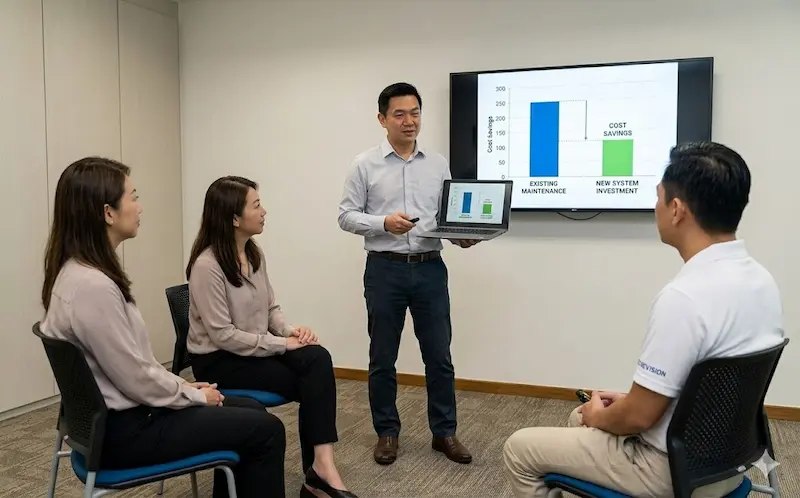
A cost comparison framing is also effective: present what the estate currently spends on reactive maintenance and emergency call-outs for the existing system over three years alongside the fixed cost of a new, warranted system. Most residents in Singapore find it easier to approve a known investment than to continue approving an unpredictable series of repair costs; particularly when the trend line on maintenance costs is upward and the system's reliability is declining.
A third framing worth using where the sinking fund is healthy is to note that major planned capital expenditure on common property infrastructure is precisely what the sinking fund was accumulated for. If it is not used for this, residents are entitled to ask what it is for. This is not an argument to be made aggressively, but it is accurate, and residents who understand that the fund exists for exactly this purpose are often more comfortable with a well-justified withdrawal than they would be with a special levy for the same amount.
KEY POINT
Avoid three specific responses that consistently undermine security upgrade proposals. Do not argue that the upgrade is for residents' safety; safety arguments are too abstract to overcome concrete cost resistance. Do not say that other condominiums are doing it; peer pressure undermines the committee's independent judgment. And do not say that the cost is not that high; relative cost comparisons are a trap that invites a counter-argument about what else the money could be spent on.
What the written proposal must contain
Residents need a written proposal document they can read before the meeting. Whatever is presented verbally at the AGM, the written document is what residents will refer back to when deciding how to vote. It must be clear, complete, and free of technical jargon that a non-specialist cannot parse.
The proposal must begin with a concise problem statement; no more than two paragraphs describing the current failures and limitations in plain language. This sets up everything that follows. If a resident reads the problem statement and understands why the situation cannot continue, the rest of the proposal is explaining the response rather than defending the need for one.
The proposed solution should be described in terms of outcomes rather than specifications. Residents do not need to know the camera resolution in megapixels; they need to know that footage will be usable for police reports and that the retention period will be sufficient to investigate incidents that are reported a week after they occur. The integrator's SPF licence number and BCA registration should be included, not buried in an appendix, but stated clearly in the contractor section of the proposal as evidence of the committee's due diligence in contractor selection.
The cost must be presented as a fixed figure, not a range. Residents vote against ranges because they feel like blank cheques with the upper number being the relevant one. A fixed-price commitment from the integrator, with any cost variables clearly defined and bounded, gives residents something concrete to approve. The disruption plan should specify the duration of works, which areas will be affected, and the proposed work schedule. Well- planned disruption is a signal of competence; it tells residents that the committee has thought about implementation, not just the end state.
Finally, post-installation support commitments must be stated explicitly; warranty period, response times for faults, and the maintenance arrangement that will follow installation. Residents who understand that the new system comes with a defined support structure are more confident than those who feel they are approving a one-time transaction with no ongoing accountability. For a detailed treatment of the MCST's legal obligations regarding security system maintenance under Singapore's BMSMA, see What Are the MCST's Legal Obligations for Security Systems?
PLANNING POINT
One of the most effective ways to build confidence in a proposal is to include a brief section on alternatives considered; maintenance and repair of the existing system, partial replacement, full replacement, and explain clearly why the recommended option was selected over the others. Residents who see that the committee evaluated alternatives before recommending a specific course of action are far more likely to trust the recommendation than those who feel a single solution was presented without comparison.
On the day; questions you cannot answer, and the silent majority
Brief the integrator before the AGM and ask them to attend in person or be available by phone for technical questions. A licensed professional who can answer a resident's specific technical question directly is a significant asset in the room. When the integrator speaks to their own proposal, it carries a different weight than the committee member repeating what the integrator told them.
When a question arises that the committee cannot answer confidently, the correct response is direct and unhesitating: "That is a good question and I want to give an accurate answer rather than an incorrect one. We will get the answer from our integrator in writing and circulate it to all residents within five working days." This response demonstrates exactly the competence and honesty that residents are looking for. Attempting to answer a technical question without the knowledge to do so accurately, and being visibly uncertain; is far more damaging to a proposal than acknowledging that a follow-up is needed.
Be aware that most AGM discussions are shaped by a small number of vocal residents. The residents raising objections are not necessarily representative of the room. The majority of residents present are usually waiting to be confident that the committee has done its homework; they are not looking for reasons to vote against. The committee's job in the room is not to win every argument with the most vocal objector. It is to provide enough clarity and transparency that the reasonable majority feels informed and comfortable supporting the proposal. If the loud objector cannot be satisfied, acknowledge the concern, note that it will be followed up, and let the vote proceed. The silent majority often surprises committees who have spent the preceding hour focused on the three most vocal opponents.
Securevision's View
The most common reason security upgrade proposals fail at an AGM is not cost and not technology; it is that residents do not feel they have been given enough information to vote with confidence. The committee that has done the preparation described in this article; documented failures, obtained independent assessment, circulated information before the meeting, prepared a clear written proposal, and briefed the integrator; will almost always find that the vote is not as difficult as they feared. The work happens before the meeting. The AGM is usually just the confirmation.
If the proposal does not pass the first time
A failed vote is not a rejection of security. It is information. The committee that treats a failed proposal as feedback rather than defeat is in a significantly stronger position for the next attempt than one that simply resubmits the same proposal.
Listen carefully to the specific objections raised. If cost was the primary concern, the response is not to reduce the scope; it is to strengthen the cost justification. Present a more detailed comparison of current maintenance expenditure against the upgrade investment. Explore whether a phased approach would address the concern without compromising the outcome of the full programme. If trust was the issue; residents who felt the committee had not consulted them sufficiently; invite the integrator to an open session before the next meeting where residents can ask questions directly. If the concern was about the scope being too large, obtain an independent assessment that confirms the full scope is necessary rather than simply preferred.
Do not reduce the scope simply to gain approval. A partially implemented security upgrade often creates more operational problems than it resolves; a new CCTV system connected to an end-of-life access control platform, or a new intercom installed without replacing the cabling it depends on. The residents who voted against the full proposal at the first meeting will be the first to raise the resulting issues at the next one. If the full upgrade is necessary, present the full upgrade again with improved justification and, where practical, adjusted phasing or financing arrangements.
Securevision's View
In our experience, the committees that succeed on a second attempt are almost always the ones that genuinely listened to why the first attempt failed, not the ones that came back with the same proposal and hoped the room would be different. A failed proposal with a clear lesson is a better outcome than an approved proposal that was right by accident. Address the specific objection, improve the specific weakness, and return with a stronger case. That is how most large security upgrades in Singapore condominiums eventually get done.
In Short
Security upgrade proposals fail when residents do not understand the problem being solved or do not trust the committee presenting it. They succeed when the committee has documented the current failures, obtained independent validation of the recommendation, communicated with residents before the meeting rather than only at it, presented a clear written proposal with a fixed cost and a plain-language description of outcomes, and briefed the integrator to handle technical questions on the day. The AGM is where the vote happens. The work that determines the outcome happens in the weeks before it.

Frequently asked questions
Why do security upgrade proposals fail at AGMs?
In our experience, proposals fail because residents do not fully understand the problem being solved, not because they oppose security. A proposal that leads with cost or equipment before establishing why the current system cannot continue asks residents to approve a solution before they accept the problem. The documentation and communication work before the meeting is what determines the outcome more than the presentation itself.
How much notice should residents receive before a security upgrade proposal?
Beyond the minimum statutory AGM notice period, we recommend circulating a summary of the proposal; the problem, the recommended solution in plain language, and the approximate cost, at least four to six weeks before the meeting. This gives residents time to read, think, and ask questions before the AGM, which means the meeting itself is a confirmation rather than a surprise. The BMSMA sets minimum notice requirements for AGMs; check with the managing agent for the specific requirement applicable to the estate.
Should the integrator attend the AGM?
In most cases, yes. Technical questions are consistently better answered by the integrator directly than by a committee member repeating what the integrator told them. Brief the integrator beforehand on the likely objections and the specific concerns that have been raised in pre-meeting discussions. A licensed professional speaking to their own proposal carries credibility that a committee member relaying technical information does not.
What if residents think the upgrade is too expensive?
Focus the response on three elements: the cost of not upgrading (ongoing maintenance expenditure on a declining system, plus the risk of an unrepairable failure), the alternatives the committee considered and why they were rejected, and the long-term value of a new system with a defined warranty and support structure. If the objection persists, offer to circulate a written cost comparison showing the trajectory of current maintenance costs against the upgrade investment over five years.
Is it acceptable to present multiple quotations at the AGM?
Where appropriate, yes, and it is often beneficial. Presenting two or three quotations demonstrates that the committee evaluated options rather than accepting the first proposal it received. It also gives residents visibility into the market range for the work. The committee should be prepared to explain clearly why the recommended option was selected over the others, rather than simply presenting the cheapest or assuming residents will prefer the lowest price.
What if the system is still working; how do we justify an upgrade?
The question is not whether the system is working today. The question is whether it remains supportable, maintainable, and fit for purpose over the coming years. A system that is working but unsupported has no recovery path when it eventually fails, and it will fail. Frame the proposal around the cost and disruption of an unplanned emergency replacement versus a planned, budgeted upgrade conducted on the committee's timeline rather than the system's failure timeline.
Should we obtain an independent assessment before the AGM?
For larger projects, yes. An independent assessment, from a consultant, a second integrator, or a formal system audit; addresses the concern that the integrator is recommending an upgrade because they want the project. Residents are consistently more comfortable approving significant expenditure when the recommendation is supported by more than one source. The cost of an independent assessment is modest relative to the total project value and the confidence it provides is disproportionate.
Can the sinking fund be used for a security upgrade?
Security systems installed in common areas are common property under the BMSMA. The sinking fund is intended for major repairs and replacement of common property. A security upgrade that replaces end-of-life infrastructure in common areas is generally an appropriate use of the sinking fund. The managing agent and the MCST's legal advisers can confirm the specific requirements applicable to the estate, particularly for expenditure above the thresholds that require a general meeting resolution.
What should the committee do if the proposal fails?
Listen to the specific objections and treat them as information rather than defeat. Identify whether the concern was cost, trust, scope, or timing. Address the specific concern; do not simply resubmit the same proposal, and return at the next AGM or EGM with a stronger case. Do not reduce the scope merely to gain approval; a partial upgrade that leaves underlying problems unresolved will generate its own complaints at the next meeting.
How do we handle a vocal resident who objects to everything?
Acknowledge the concern, note that it will be followed up in writing, and let the vote proceed. A vocal objector who cannot be satisfied in the room should not be allowed to derail a proposal that the reasonable majority is prepared to support. The committee's obligation is to provide enough information for residents to make an informed decision, not to achieve consensus with every individual. If the objection raises a genuine issue that has not been addressed, that is worth taking seriously. If it is a matter of principle that no amount of additional information would resolve, the vote will reflect the room, not the objector.
What is the most important thing a committee can do to improve the chances of approval?
Start the communication process before the AGM notice is issued. Residents who arrive at the meeting already understanding the problem, having seen the evidence, and having had their questions answered are overwhelmingly more likely to vote yes than those who are processing the proposal for the first time during the presentation. The work that determines the outcome of an AGM vote on a security upgrade happens in the weeks before the meeting, not during it.