A design-and-build IP CCTV deployment delivered for LTA under W'Ray - 53 cameras, five NVRs, and 28-day retention, planned in 3D before the first cable was pulled.
When LTA needed to rebuild the existing Sengkang Bus Interchange, an interim interchange was built at Sengkang East Way to keep the bus network running without disruption. Securevision was engaged by main contractor W'Ray to design and build the IP CCTV system to a published LTA tender specification - ensuring the temporary facility met the same surveillance, retention, and resilience standards as a permanent terminal.
| Client | Land Transport Authority (LTA) |
|---|---|
| Stakeholders | LTA (owner) · W'Ray (main contractor) · SBS Transit / SMRT (operating bus operators) |
| Location | Sengkang East Way, Singapore |
| Sector | Institution - Transport Infrastructure |
| Project Type | Design & Build (CCTV scope under main contractor) |
| Tender Reference | 40_RD285_PS22 CCTV Specification (Revised 14 October 2015) |
| Awarded | August 2016 |
| Completion | June 2017 (handover to LTA / operator) |
| Scale | 53 IP cameras · 5× 16-channel NVRs · 3× 21" PSO monitors · 3× 32" entrance monitors · 3kVA UPS · private CCTV LAN |
An interim interchange has the same operational reality as a permanent one. Thousands of commuters pass through every day. Buses arrive and depart on schedule. A Passenger Service Office runs in real time. The fact that the facility would eventually be decommissioned did not lower the bar - LTA's specification required the same coverage percentages, retention period, and resilience as a permanent interchange.
The published tender specification (40_RD285_PS22, revised 14 October 2015) defined coverage in measurable terms: a person 1,600 mm tall standing at the furthest field-of-view edge had to appear at no less than 10% of monitor vertical height. The concourse and bus parking areas required 95% coverage at 10%R. Designated commuter entrances required 50%R frontal capture. Vehicle entrances required both frontal and rear-facing views. Emergency exits, perimeter fence lines, and the server room all had their own coverage rules.
Specifying enough cameras was not the hard part. Specifying them in the right places - verified before installation, against geometry that left no gaps for someone walking the concourse or moving through the bus parking islands - was the engineering problem this project was built to solve.
| Coverage Requirement | Tender Specification | Securevision Delivered |
|---|---|---|
| Concourse Coverage | 95% coverage at 10%R | 95% coverage at 10%R achieved with overlapping IP camera fields |
| Bus Bay & Parking | 95% coverage at 10%R; 100% perimeter coverage | Met across all bus bay islands and the full bay perimeter |
| Designated Entrances | 50%R frontal capture | Met at every designated commuter entrance / exit |
| Vehicle Entrances | Frontal and rear views of all vehicles | Dual-angle coverage for every vehicle entry / exit point |
| Recording Retention | 28 days @ 6fps, 704×576 | 28 days @ 6fps, 720p (1280×760) - exceeds spec resolution |
| NVR Spare Capacity | ≥10% spare storage; ≥20% spare video inputs | 12TB per NVR (3× 4TB); 27 spare channels across 5 NVRs (~34%) |
| Power Standby | 1-hour UPS for full CCTV system | 3kVA UPS sized for cameras, switches, NVRs, monitors, and workstations |
A coverage specification written in percentages - 95% at 10%R, 50%R frontal, 100% perimeter - is not the same thing as a camera schedule. The spec tells you the outcome the auditor will measure; it does not tell you where to mount each camera, what focal length to set, or how to handle the worst-case viewing angles where two columns block each other's lines of sight. Getting this wrong means rework on a site already running a live bus operation.
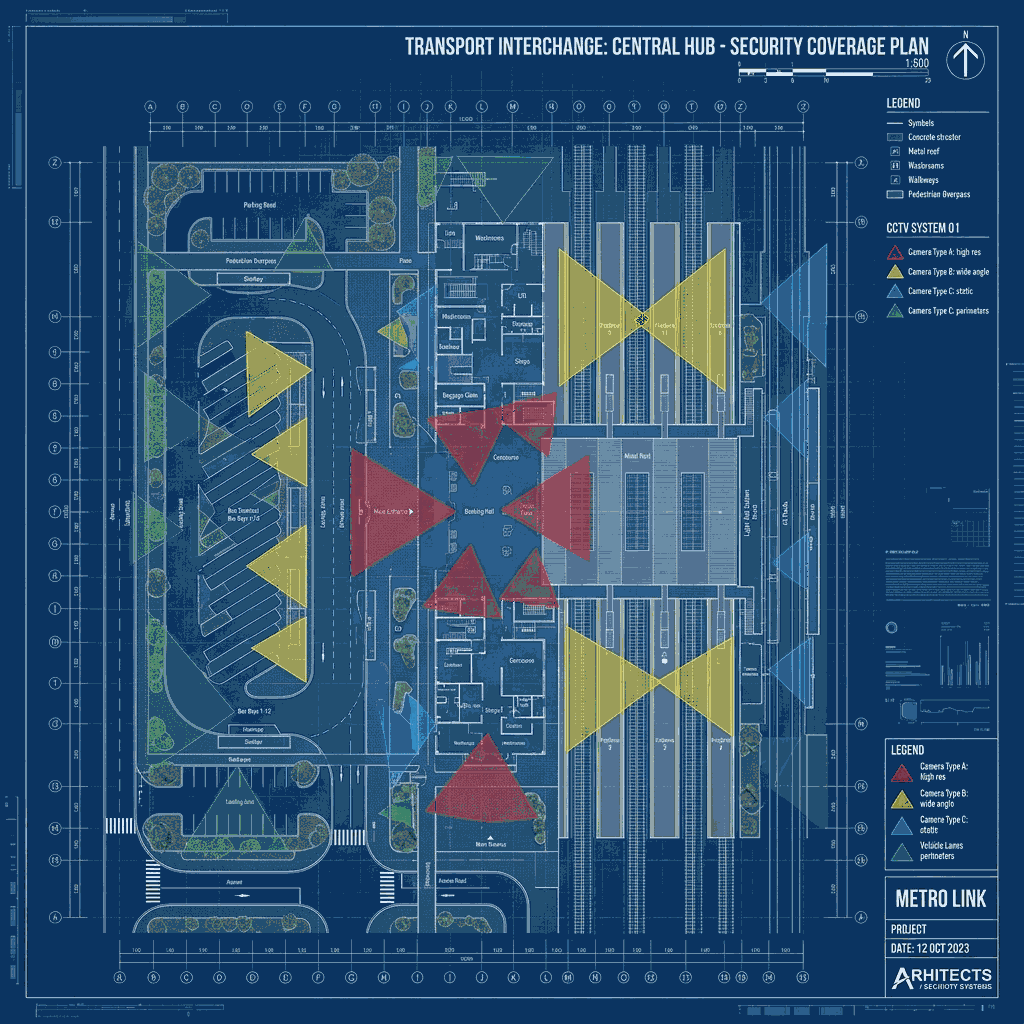
We modelled the entire interchange in a 3D coverage visualisation tool before specifying the camera schedule. Each camera's field of view was projected onto the plan, vari-focal lens settings were tuned for the worst-case position in each zone, and the design was iterated until every walking path on the concourse and bus parking area was covered by at least two camera views. Only after the geometry was verified did we lock the equipment list.
The result was a deployment that met the tender specification on day one. There was no on-site recalibration round, no missed coverage zones discovered during commissioning, and no need to add cameras after handover. The 3D coverage diagrams also became part of the handover documentation - giving LTA's auditors and the operator's PSO team a verifiable map of what each camera sees and why.
Securevision treated the interchange as five distinct coverage zones, each with its own spec clause and geometry challenge. The design verified each zone against its tender requirement before the equipment list was finalised, then phased the installation to fit the main contractor's programme.
Cameras mounted on island poles at 2.5m, with overlapping fields covering both bus bays and the full parking perimeter. Two-camera-view planning ensured no commuter or boarding passenger appeared in only one view.
Wall and column-mounted IP cameras with vari-focal lenses set for the worst-case furthest field. Coverage verified at 95% at 10%R against pedestrian flow lines from boarding queues to the PSO.
Frontal-view cameras at every designated commuter entrance set for 50%R capture. Emergency exits covered at 20%R as specified, with framing tuned to capture clear identification without backlight.
Pole-mounted cameras along the perimeter fence covering 100% of the bus bay boundary. The Passenger Service Office and adjacent server room were covered at 20%R for the external access area, with all NVRs racked inside the secured server room.
Once the zones were verified against the spec, the installation programme was phased to match W'Ray's main works - power, network, camera mounts, NVR commissioning, and operator training in sequence - so that handover to LTA and the operator could happen on the agreed date.
A private CCTV LAN linking 53 cameras to five NVRs in the server room, with display monitors at the PSO and at every entrance, and a 3kVA UPS providing one-hour battery standby for the entire system.
2-megapixel IP cameras with vari-focal 2.8–12mm lenses, IP65 weatherproof housings outdoors, and IP54 housings in protected interior areas. Each camera mounted at 2.5m as specified, with focal length tuned to the worst-case viewing position in its zone.
Surveillance & Detection →NVRs racked in the secured server room, each carrying three 4TB drives for 12TB usable capacity. The aggregate of 80 input channels across five recorders left ~34% spare beyond the 53 cameras assigned - well above the 20% spare-input requirement in the tender spec.
Platform & Management →Three 21" monitors at the Passenger Service Office for live viewing and incident interrogation. Three 32" monitors - one at each main entrance - displaying live coverage to anyone walking into the terminal, both as a deterrent and as a transparency signal. A second workstation in the server room for maintenance staff.
Platform & Management →A 53-camera IP CCTV system across the concourse, bus parking islands, perimeter, and entrances - recorded on five 16-channel NVRs with 28-day retention, displayed at the PSO and at three main entrances, and backed by a 3kVA UPS.
Cameras: 53× High-Resolution IP Cameras.
Recording: 5× 16-Channel Network Video Recorders.
PSO Control Room: 3× 21" Industrial Monitors.
Public Display: 3× 32" Entrance Monitors.
Power Standby: 3kVA UPS Deployment.
Private Network: Dedicated CCTV LAN.
Coverage percentages at 10%R, 20%R, and 50%R verified during commissioning against the same geometry modelled at design stage - no rework rounds, no missed clauses.
Every walking path through the concourse and bus parking area was covered by at least two camera views - meaning a person of interest could be tracked even if one angle was obstructed.
27 unassigned input channels across five NVRs and headroom for 13 additional drives per recorder - the system shipped with substantial growth capacity built in, well above tender minimums.
The interim interchange opened on schedule and remained in service throughout the rebuild of the permanent Sengkang Bus Interchange - with the CCTV system supporting daily operations for LTA, the PSO team, and the operating bus operators across the full handover-to-decommissioning lifecycle.
Tender specifications are written in percentages and rules: 95% coverage at 10%R, two-camera-view, IP65 housing, 28-day retention. Those numbers tell you what the auditor will measure on commissioning day. They do not tell you which column blocks which sightline, where the worst-case viewing angle is in the bus parking area, or which vari-focal setting to lock in for a camera 18 metres from its furthest field. We learned on this project that the engineering judgement happens in the gap between the spec and the geometry - and that modelling the coverage in 3D before pulling cable is not an extra step, it is the cheapest way to get the spec right the first time.
Every project Securevision delivers draws on multiple systems working together - cameras, access control, intercoms, vehicle management, network infrastructure, and platform software. The cards below show the full range of systems we design and install. Each one links to a deeper explanation of how it works, when it is needed, and what to look for when specifying it.
Tell us about your site. We'll assess it and design a system that works as one.
Serving Singapore Since 2006