
An auto gate is one of those things most people do not think about until something goes wrong. This guide covers everything you need to know: gate types, motor selection, access methods, safety, power failure behaviour, installation, maintenance and the mistakes we see most often.
Both swing gates and sliding gates can be used in residential, condominium, commercial and industrial properties. The right choice depends on the site, not the property type.
For swing gates, leaf width is the primary variable: it affects leverage and wind loading. For sliding gates, gate weight is the primary variable because the motor pushes the gate horizontally.
Motor selection should be based on gate weight and expected daily usage, not price alone. A heavier gate or higher usage level requires a more powerful motor with a higher duty cycle rating.
Rolling-code remotes provide significantly better security than older fixed-code remotes. Most modern installations should use rolling-code as the minimum standard.
Modern gate systems can be integrated with smartphones, access cards, intercoms and licence plate recognition systems.
Safety beams should be considered essential on every automatic gate installation. Built-in obstacle detection is a secondary layer: it reacts after contact. A safety beam prevents contact from occurring.
Most motor failures are not caused by the motor itself. They are caused by worn hinges, damaged rollers, poor alignment or excessive gate weight placing continuous stress on the motor.
Proper maintenance of the gate is just as important as maintenance of the motor: and often more so.
1. What Is an Auto Gate System?
Securevision holds a PLRD security service licence and is BCA-registered: the credentials required to design and install access and security systems in Singapore.
Most homeowners think about convenience first. They want to press a button and drive in without getting out of the car. There is nothing wrong with that: convenience is one of the main reasons people install an auto gate in the first place.
But from a security perspective, the gate is doing something more important. It is the first decision point on the property. It decides who gets in, who stays out and how access is managed.
Once an auto gate is integrated with an intercom system, access control reader or licence plate recognition system, it becomes much more than a motor opening a gate. It becomes part of the property's overall security and access management strategy.
That is why we always encourage property owners to think beyond the motor itself. The motor is important, but it is only one part of the overall system.
Key Components of an Auto Gate System
The Gate Motor
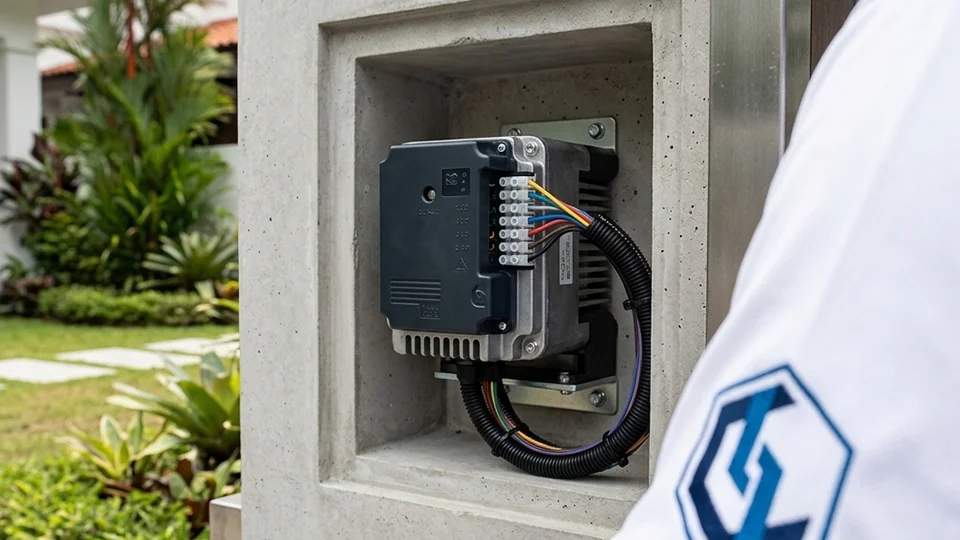
The motor provides the force required to move the gate. It is the most critical component in the system and the one most likely to be incorrectly specified. The motor must be matched to gate weight, gate width, daily cycle count and site conditions. A motor operating comfortably within its design limits runs cooler, experiences less stress and lasts significantly longer than one that is constantly working at or near its limits.
The Control Board
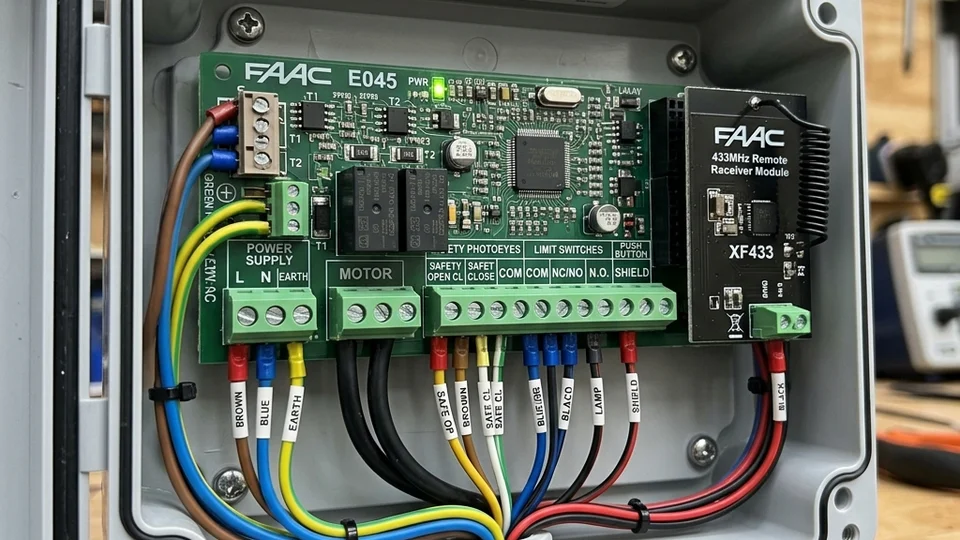
The control board is the brain of the system. It receives signals from remote controls, access readers, intercom systems, safety beams, loop detectors and smartphone applications, and determines when the motor should open, stop, slow down or reverse. Modern control boards also manage auto-close timers, partial opening modes, obstacle detection, smartphone integration and access control integration.
Safety Devices
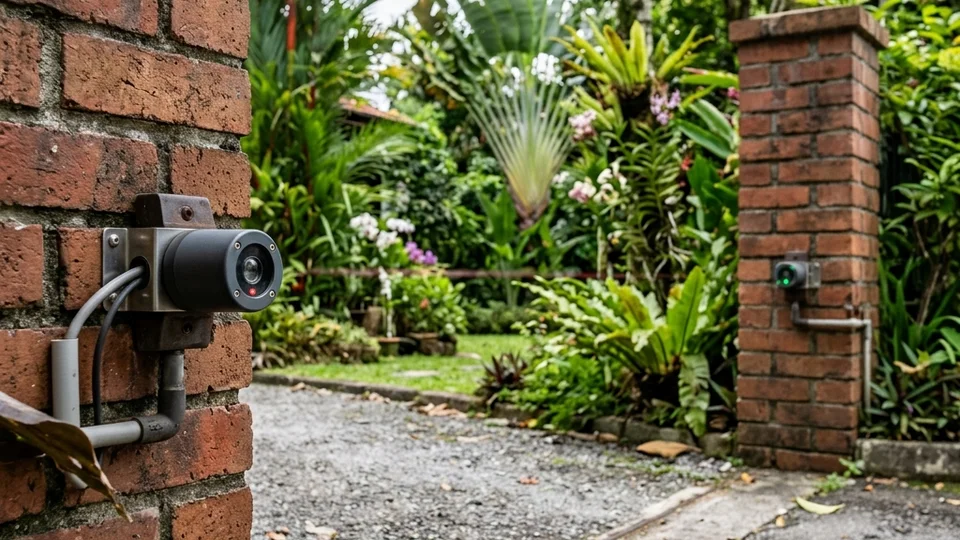
Safety devices help prevent injury and property damage. A gate can weigh several hundred kilograms, and without proper safety protection the consequences of a moving gate striking a person, child, pet or vehicle can be serious. Safety beams and safety edges are not optional accessories: they are part of a complete installation.
The Remote Control
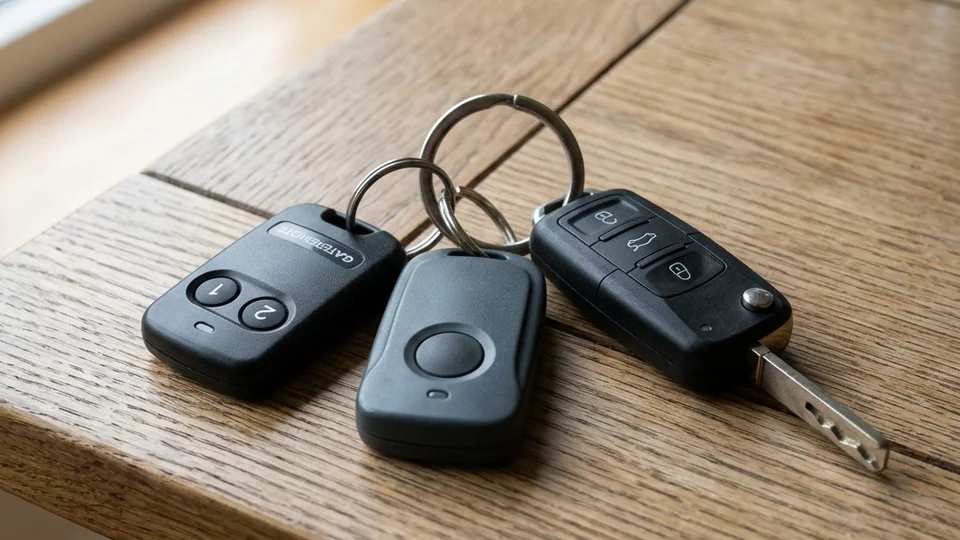
The remote control is what most homeowners interact with most frequently. Modern systems use rolling-code technology: a new encrypted signal is generated every time the button is pressed. Because the code changes with every use, it cannot be copied and replayed by an unauthorised device. This is significantly more secure than older fixed-code systems where the transmitted signal never changes.
The Entry Device
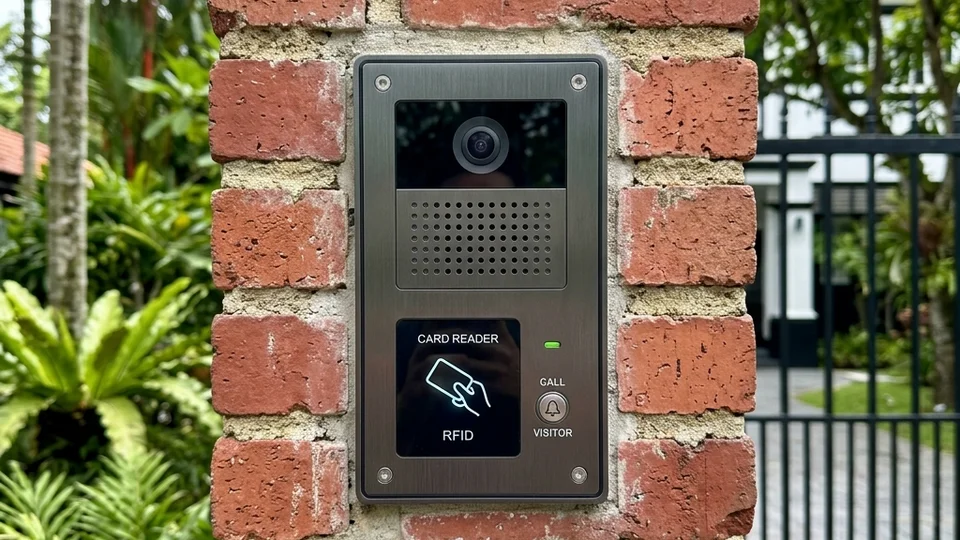
The motor controls movement. Something else must decide who is permitted to trigger it. Depending on the installation, this may be a standalone card or fob reader at the gate post, an audio or video intercom allowing visitors to call before access is granted, or an integrated intercom with a built-in access reader combining visitor communication with credential-based access in a single unit. Integration options are covered in Section 5.
2. Swing Gates vs Sliding Gates
One of the first questions we ask is whether the site suits a swing gate or a sliding gate. Most people have a preference. Our job is to make sure that preference matches the site.
There is no universally better option. The right choice depends on driveway depth, gate weight, gradient and how frequently the gate will operate.
Swing Gates
A swing gate operates like a door. The gate leaf rotates around hinges mounted to a gate post and swings inward into the property. This remains one of the most common gate designs on Singapore landed properties.
The main considerations are driveway depth: there must be enough clearance for the gate to swing fully open: and gradient, as swing gates are not well suited to steeply sloping driveways.
Many people assume swing gates are only suitable for landed homes. That is not true. Swing gates are also used in condominiums, commercial buildings and industrial facilities. The key factor is whether the site allows the gate to swing safely and efficiently.
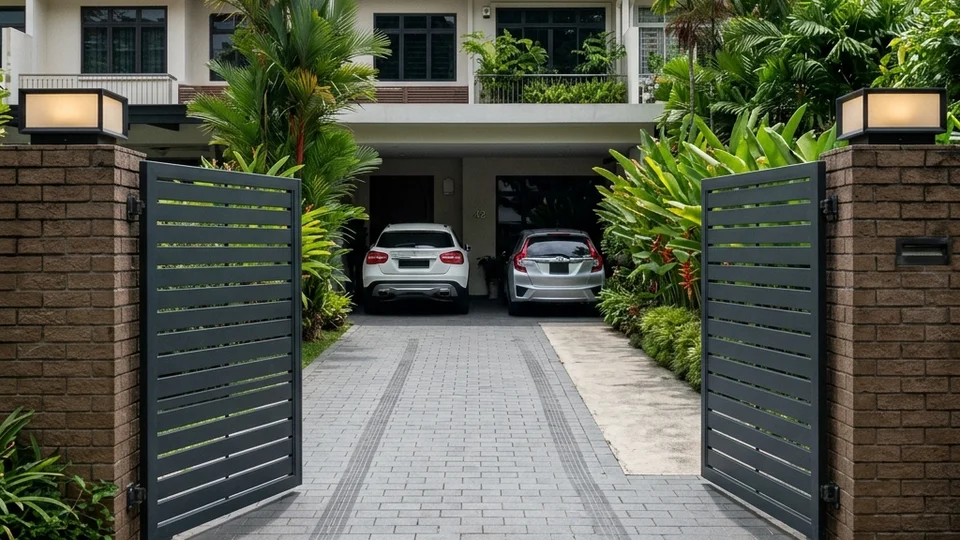
Dual-leaf swing gate at a Singapore terrace house.
Where a gate leaf exceeds approximately 2 metres in width, we recommend a swing arm motor over a concealed motor. A wider gate leaf is heavier and presents a larger surface area to wind. The mechanical arm of a swing arm motor provides better leverage and better resistance to wind loading than a concealed mechanism. For gate leaves within 2 metres, a concealed motor remains a clean and practical choice for most residential installations.
Sliding Gates
A sliding gate moves sideways along a ground track, travelling parallel to the boundary wall rather than swinging inward. We recommend sliding gates where driveway space is limited, where the gate is particularly heavy, or where the driveway is on a slope.
The trade-off is the ground track. It must be kept clean: dirt, debris and stones in the track increase resistance and place additional load on the motor with every cycle.
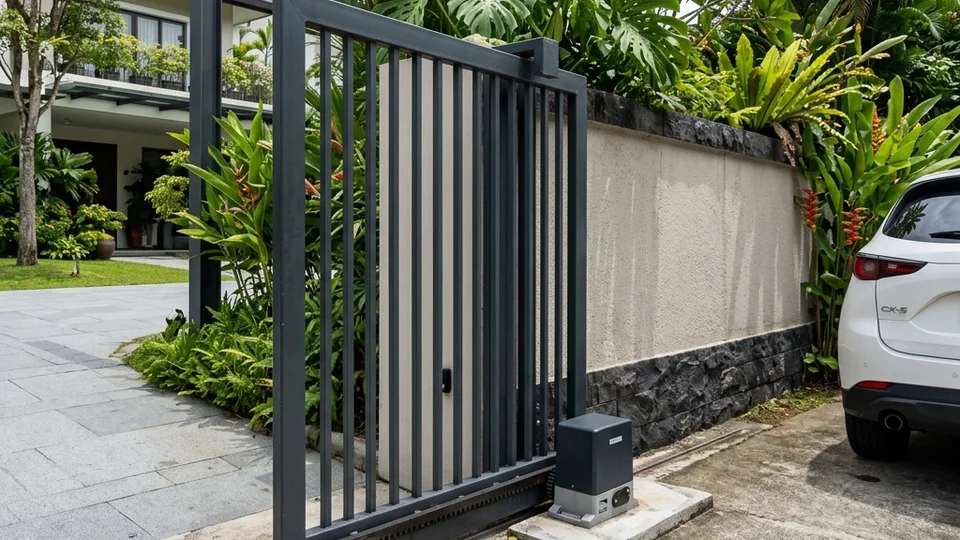
Sliding gate on a ground track: used where driveway depth is limited.
Cantilever Sliding Gates
A cantilever gate is suspended from an upper rail rather than running on a ground track, eliminating the track channel at ground level entirely. We specify cantilever gates for premium residential properties or sites where ground conditions make track installation difficult.
| Situation | Recommended Option |
|---|---|
| Standard landed property, leaf under 2m wide | Swing gate: concealed motor |
| Swing gate leaf wider than 2m | Swing gate: arm motor |
| Limited driveway depth | Sliding gate |
| Heavy steel gate | Sliding gate |
| Sloping driveway | Sliding gate |
| Premium finish, no ground track preferred | Cantilever sliding gate |
3. Motor Selection
The motor is often the first thing people ask about. We usually make them answer the gate questions first.
Before selecting a motor, we look at gate type, gate width, gate weight, expected daily usage, wind loading and site conditions. Only after that do we decide which motor is appropriate.
In fact, many of the motor failures we encounter are symptoms of an underlying mechanical problem rather than the motor itself. A motor working hard every day wears out faster than one with operating headroom. This is why we generally prefer to size a motor slightly above the minimum requirement rather than exactly at the limit.
Concealed Swing Motors
Concealed motors are installed within the gate post or below the gate structure, hiding the mechanism entirely. Because no mechanical components are visible on the exterior, they provide the cleanest possible appearance and are popular on premium residential properties and architect-designed homes.
The trade-offs are higher installation cost, drainage requirements that must be carefully managed to prevent water accumulation in the motor housing, and more complex access for servicing. We recommend concealed motors for gate leaves up to approximately 2 metres in width.
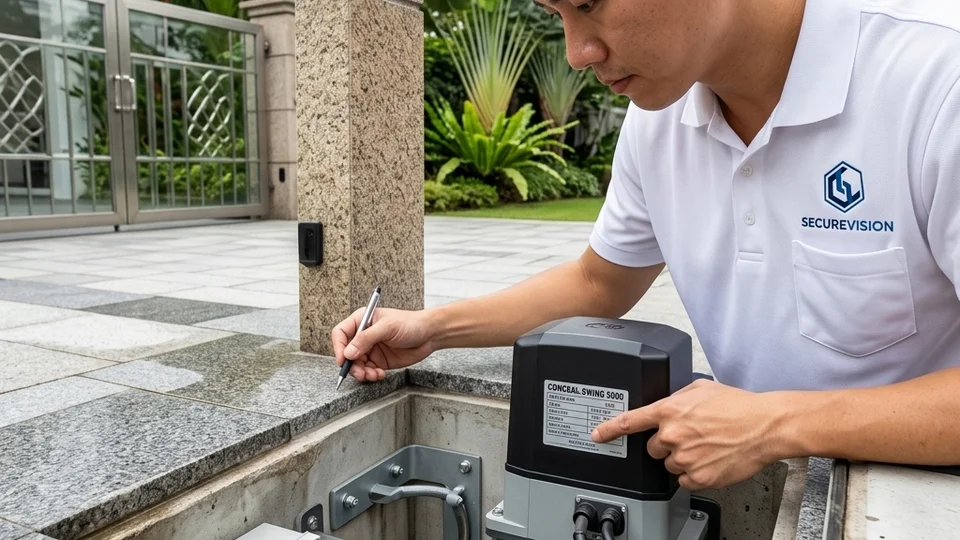
Concealed motor: no visible mechanism on the exterior.
Swing Arm Motors
Swing arm motors use a visible mechanical arm connected directly to the gate leaf. Although the arm remains visible, these motors are more robust, easier to service and suitable for a wider range of gate sizes and weights. Over the years, we have often recommended swing arm motors for gates that are unusually heavy or exposed to strong wind conditions. Although they may not look as elegant as concealed motors, they often provide better long-term reliability for demanding applications.
We specify swing arm motors where the gate leaf exceeds 2 metres, where the gate is particularly heavy, or where wind loading is a significant consideration.
Sliding Gate Motors
Sliding gate motors drive a gear rack: a toothed metal strip fixed along the base of the gate: using a drive gear on the motor. As the motor turns, the gate travels along its track. These motors are designed for heavier gates and higher daily cycle counts and are commonly specified for industrial properties, commercial buildings and large residential sliding gates.
Why Gate Weight Matters
This is the most misunderstood factor in motor selection. Two gates may look almost identical but have very different weights depending on materials. The motor does not care whether the gate is steel, aluminium, decorative or expensive. It only knows how much effort it takes to move it. A motor undersized for the gate weight works harder with every cycle, wears faster and fails earlier.
For sliding gates in particular, weight is the critical variable because the motor is pushing the gate horizontally along a track.
Duty Cycle Ratings
Gate motors are rated for a number of operating cycles per day. A motor designed for residential use will handle a home gate comfortably but may fail prematurely on a factory entrance running hundreds of cycles daily. Matching the duty cycle rating to actual usage is as important as matching the motor to gate weight. Usage matters: sometimes it matters more than gate size.
We recommend selecting a motor with capacity above the gate's actual weight and expected cycle count. This provides operating headroom and compensates for Singapore's humidity, mechanical wear over time, ageing hinges and the increased friction that develops in any mechanical system. A motor running comfortably within its design limits will almost always outlast one that was specified too tightly from day one.
4. Access Methods
The motor moves the gate. Something else decides who can trigger it. This distinction matters because many property owners focus entirely on the motor and give little thought to how access will actually be managed day to day.
Today, gate systems can be operated using remote controls, key fobs, access cards, smartphone applications, intercom systems, keypads and licence plate recognition. The right choice depends on the property, the number of users and the level of control required.
Smartphone Control
Many modern gate systems can be controlled directly from a smartphone via Wi-Fi or a cloud-based application. This allows the gate to be opened remotely, admitting deliveries, granting contractor access and monitoring gate activity from anywhere. It is particularly useful for homeowners who travel or spend significant time away from the property.
Because smartphone access depends on internet connectivity, we recommend maintaining a secondary access method: a remote or access card: as a backup.

Smartphone gate control: open the gate remotely from anywhere.
Card and Fob Access
RFID cards and key fobs are common where multiple users require access or where access rights need to be managed centrally. If a card is lost, it can be removed from the system without affecting anyone else. Access can also be restricted by time period: for example, limiting a helper's gate access to working hours only.
QR Code Access
Where the gate is integrated with an intercom or access reader that supports QR code functionality, temporary codes can be issued to visitors, delivery personnel and contractors for controlled single-use or time-limited access. This eliminates the need for physical credentials for short-term visitors.
Loop Detectors
A loop detector is a sensor embedded in the ground that detects a vehicle's metal mass. In landed property installations, loop detectors are sometimes installed on long driveways to detect a departing vehicle and trigger the gate to open automatically for exit: removing the need for a remote on the way out.
In condominiums, loop detectors are commonly used at egress lanes. A vehicle approaching the exit triggers the detector, which opens the gate automatically without the driver needing to present any credential.
Licence Plate Recognition
Licence plate recognition systems identify authorised vehicles by their registration plates. When a recognised vehicle approaches, the camera captures the plate, the software verifies it against an approved list and the gate opens automatically. No remote, no card, no phone required.
LPR is increasingly used in condominiums, private estates and commercial properties where seamless vehicle access is a priority. For more detail, see our Vehicle and LPR Management systems page.
5. Car Park Barriers
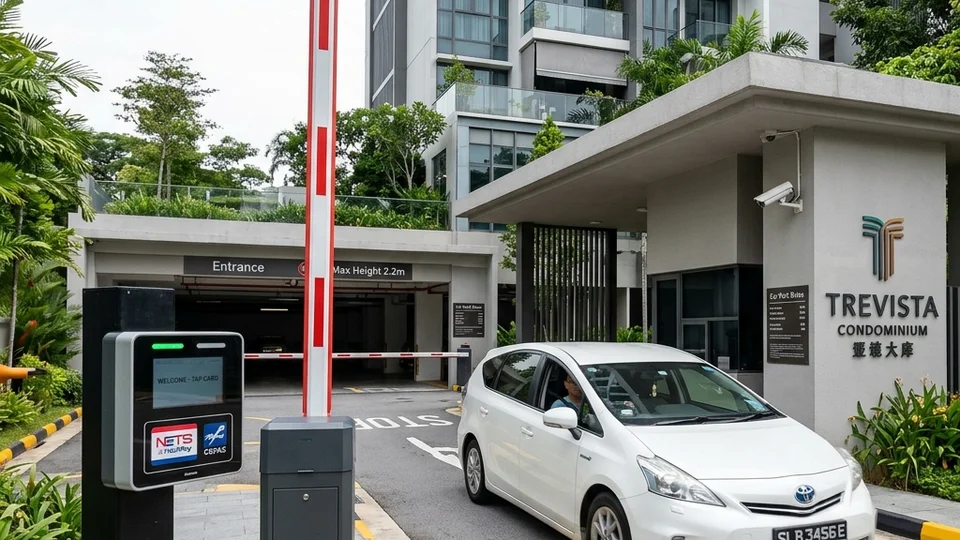
Boom barrier at a Singapore condominium car park entrance.
Many people assume auto gates and car park barriers are essentially the same thing. Both control vehicle access. Both use motors. Both integrate with access systems. However, they are designed for different purposes.
An auto gate creates a physical barrier across the full opening. When closed, it restricts vehicles and pedestrians. A car park barrier uses a boom arm that controls vehicle movement but does not prevent pedestrians from walking around it.
A barrier is designed for high vehicle throughput. A typical residential gate may open 10 to 20 times a day. A condominium car park barrier may cycle several hundred times. The mechanical design, motor specifications and duty cycle requirements are fundamentally different.
If your objective is perimeter security, use a gate. If your objective is efficient high-volume vehicle throughput with pedestrian access remaining open, use a barrier. In larger developments, we often specify both: the barrier manages traffic flow while the gate provides perimeter security at a separate entrance.
Barrier vs Gate: Which Should You Use?
| Requirement | Gate | Barrier |
|---|---|---|
| Controls vehicle access | ✓ | ✓ |
| Restricts pedestrians | ✓ | ✗ |
| High vehicle throughput | Limited | Excellent |
| Suitable for condominiums | ✓ | ✓ |
| Suitable for landed homes | ✓ | Usually no |
Integration Options
Modern barriers can be integrated with access control systems, intercom systems, visitor management systems, QR code readers, licence plate recognition cameras and loop detectors. Loop detectors are standard in most condominium barrier installations, used to detect vehicle presence at the exit lane and trigger the arm to raise automatically for egress.
6. Safety Devices
Safety devices are among the most important components in any gate installation and among the most frequently cut from quotations to reduce the price.
A moving gate can weigh several hundred kilograms. A swing gate or sliding gate at full speed can cause serious injury if it strikes a person, child, pet or vehicle. For this reason, safety devices must never be treated as optional.
Safety Beams
A safety beam consists of a transmitter and receiver mounted on opposite sides of the gate opening. An invisible infrared beam is projected across the opening. If anything interrupts the beam while the gate is closing, the control board stops or reverses the gate immediately: before any contact occurs.
Without a safety beam, the gate only reacts after making physical contact through its built-in force detection. That is too late.
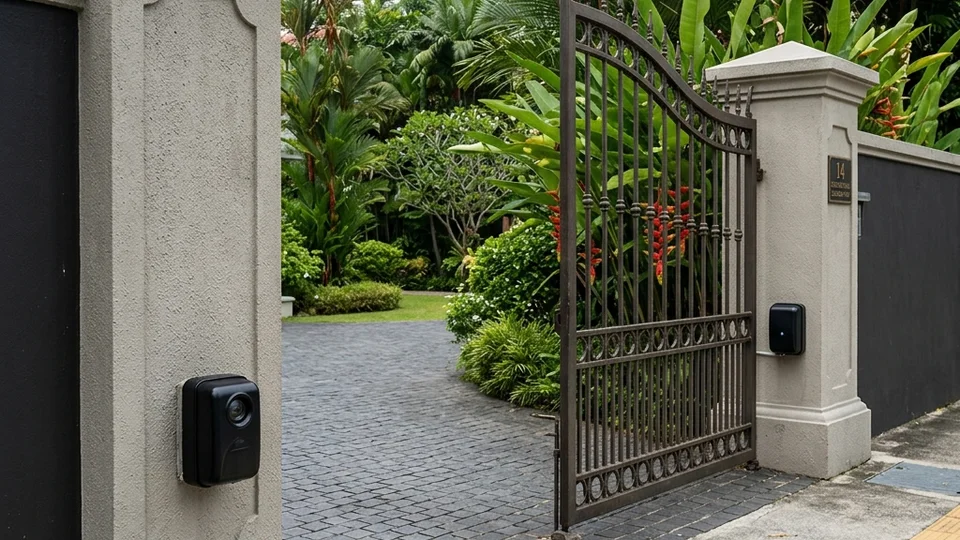
Photocell safety beam: halts the gate before contact occurs.
Safety Edges
A safety edge is a pressure-sensitive strip mounted to the leading edge of the gate leaf. If the gate makes contact with any object, the strip sends an immediate stop signal to the control board. We recommend safety edges on all sliding gate installations and on swing gates in high-traffic environments.
Obstacle Detection
Most modern motors include built-in obstacle detection that monitors resistance during operation and stops or reverses if excessive resistance is detected. This is a useful secondary layer of protection, but it should not replace dedicated safety beams and safety edges.
Safety beams and safety edges are standard on every system we install: not optional additions. If you are comparing quotations and a competitor's price does not include safety devices, the scope is not equivalent. Ask them to add it, then compare the prices again.
7. Power Failure Behaviour
One of the most common questions homeowners ask is what happens to the gate during a power failure. The answer surprises many people.
Unlike side gate electric locks: which can be backed by a battery system: auto gate motors for swing and sliding gates run on 230VAC mains power. They are not battery-backed.
When mains power is lost, the motor stops and the gate stays in its last position. If the gate was closed when the power failed, it stays closed. A power failure does not compromise perimeter security. The gate stays shut.
Think about what would happen if every gate automatically opened during a power outage. A neighbourhood-wide power failure would instantly compromise the security of every property at the same time. This is why most systems are designed to hold their last position.
Operating the Gate Manually During a Power Failure
Because the motor is not running, the gate must be released mechanically before it can be moved by hand.
Swing gates use a centre lock with a solenoid-operated latch. A bypass key releases the solenoid and allows the gate to be pushed open manually. Sliding gates use a gear rack driven by the motor. A bypass key disengages the gear rack so the gate can be pushed along its track.
We regularly receive calls from homeowners who cannot exit during a power failure because they cannot find the bypass key. The key is usually stored in a small compartment on or near the motor housing. Find it now: before you need it in the dark.
Car Park Barriers During a Power Failure
Car park barriers also run on mains power. On power failure, the boom arm stays in its last position: typically lowered. Most barriers include a manual crank to raise the arm by hand.
For applications where the barrier must automatically raise on power failure: certain managed estates or critical exit points: an optional capacitor can be fitted. This stores energy and releases it on power failure to raise the arm automatically. For most residential and commercial installations, this is not required.
8. Site Assessment & Planning

Site assessment in progress at a Singapore landed property.
A good gate installation starts on site, not in a showroom.
We cannot determine the correct motor and system configuration from photographs or a telephone conversation alone. Gate width, gate weight, ground conditions, drainage, post condition, power supply routing and the location of the electrical isolator must all be confirmed in person.
Why Drainage Matters
Drainage is particularly critical for concealed motor installations. Concealed motors are installed within the gate post structure. If water accumulates there, corrosion and electrical faults follow. Drainage must be treated as part of the installation scope, not an afterthought.
Why Gate Posts Matter
The motor transfers all its operating force into the gate posts. Posts that are weak, poorly constructed or beginning to shift will crack, move or cause the gate to fall out of alignment. We have seen gate posts that look solid from the outside but have no steel reinforcement inside. These fail over time. A proper site assessment identifies structural issues before the installation begins.
Electrical Isolator Requirement
An electrical isolator must be installed near every gate motor: on landed properties, condominiums, commercial buildings and industrial sites without exception. The isolator allows the power supply to be safely disconnected for servicing or motor replacement without going back to the main distribution board.
Electrical Supply Routing
The distance between the distribution board and the motor location affects both installation cost and complexity. Cable routing: whether surface-mounted, buried in conduit or run through existing ducting: needs to be planned as part of the site assessment. Cable planning also covers future integrations: intercom, smartphone access, LPR. Adding cables after construction is always more difficult and more expensive. A few additional conduits during the original works cost very little. The absence of them can cost a great deal later.
| Assessment Point | What We Check | Why It Matters |
|---|---|---|
| Gate opening width | Clear measurement between posts | Minimum 3m clear opening for single-lane vehicle access |
| Post and pillar condition | Material, reinforcement, and crack inspection | Brick pillars without steel reinforcement crack under motor forces over time |
| Gate weight and leaf width | Measured or estimated from material and dimensions | Determines motor model, power requirements, and motor type |
| Drainage | Ground slope and drainage channel condition | Critical for concealed motor longevity |
| Power supply routing | Distance from nearest DB, conduit options | Determines cable size, isolator position, and whether a dedicated circuit is required |
| Ground conditions | Surface type, slope | Affects track embedding for sliding gates and safety beam mounting positions |
9. Investment Guide
The cost of an automatic gate system depends on gate type, motor selection, civil works, electrical works, safety devices and access control integration. Because every site is different, a site assessment is usually required before a final quotation can be prepared.
Why the Cheapest Quote Is Not Always the Lowest Cost
When comparing quotations, it is important to understand what is actually included. Differences between quotations often come down to motor quality, inclusion of safety devices, installation workmanship, warranty coverage and after-sales support. A lower upfront price can result in higher maintenance and replacement costs over the life of the system.
Questions to Ask Before Accepting a Quote
Before accepting a quotation, confirm whether it includes: safety beams and safety edges, cabling and conduit, civil works where required, an electrical isolator, commissioning and testing, user training, warranty period and after-sales support. Two quotations that appear similar in price may include very different scopes of work.
Be cautious of quotations that list only the motor price. A quote that omits safety devices, cabling, civil preparation or the electrical isolator will be cheaper on paper: but not in practice. These items will be added as variations during installation.
10. Installation Process
A typical residential auto gate installation takes one to two days. Larger or more complex projects require additional time depending on the scope of civil and electrical works.
| Stage | What Happens | Who Is Involved |
|---|---|---|
| 1. Site Assessment | Gate dimensions, weight, power requirements, drainage, and site conditions confirmed | Securevision engineer |
| 2. Civil Preparation | Ground tracks, conduit trenches, motor mounting locations, and drainage channels prepared where required | Civil contractor (coordinated by Securevision) |
| 3. Electrical Works | Power routed from the distribution board to the motor location. Electrical isolator installed near the motor | Licensed electrician |
| 4. Motor Installation | Motor mounted, aligned, and connected to the control board. Travel limits set | Securevision technician |
| 5. Safety Device Installation | Safety beams and safety edges installed, aligned, and tested | Securevision technician |
| 6. Commissioning | Full cycle test, safety device verification, remote programming, bypass key handover and user briefing | Securevision technician + homeowner |
User Training
Every installation should end with a user briefing. Homeowners should know how to use the remote, where the bypass key is and how to use it, what the safety devices do and how to recognise a basic fault. This reduces unnecessary service calls and helps the system last longer.
11. Maintenance & Servicing

Lubricating the gear rack: part of an annual service visit.
Singapore's climate is demanding for gate systems. Heat, humidity and frequent heavy rainfall place continuous stress on mechanical and electrical components. Regular maintenance is the single most effective way to extend system life and avoid unexpected failures.
How Long Should a Gate Motor Last?
A well-maintained gate system in regular residential use can be expected to provide 5 to 10 years of reliable service. But the motor is only part of the equation.
The overall service life depends heavily on the condition of the entire mechanical system. Track cleanliness matters. Lubrication matters: use a silicone-based or lithium-based grease on gear racks, rollers and hinges; general-purpose spray lubricants such as WD-40 attract dust and grit and accelerate wear. Gate alignment matters. Hinge condition matters.
The gate usually determines how long the motor lasts, not the other way around.
- Track cleanliness: dirt, stones, and mud in the ground track increase resistance and place additional load on the motor
- Lubrication: wheels, gears, rollers (for sliding gates), and hinges must be kept properly lubricated using an appropriate product such as a silicone-based or lithium-based grease. General-purpose oils and spray lubricants such as WD-40 are not suitable: they attract dust and grit and can accelerate wear over time
- Gate balance and alignment: a gate that is sagging, warped, or misaligned causes friction that puts continuous stress on the motor
- Hinge condition: worn or poorly maintained hinges on swing gates cause the gate to drop and drag, increasing the load on the motor with every cycle
Gear Slippage
In some older or poorly maintained systems, wear on the gear rack or motor drive gear can cause gear slippage: where the gate fails to complete its full travel or drifts back after reaching its position. This is not always immediately obvious and can be mistaken for a motor or control board fault. Regular inspection of the gear rack and drive gear is part of a thorough annual service.
Annual Service Checklist
A proper annual service should cover: lubrication of all moving parts with appropriate products; cleaning of the ground track; inspection and adjustment of gate alignment and balance; tightening of all electrical connections; testing of safety beams and safety edges; full operational test; and visual inspection of hinges, rollers, brackets and hardware.
Between Service Visits
Homeowners can perform simple checks between visits: keep safety beam lenses clean and free of dust and cobwebs; listen for unusual sounds: grinding, squeaking or knocking that was not there before; watch for hesitation, scraping or incomplete gate travel; check that the remote operates from a normal distance. Problems caught early are almost always cheaper to fix than problems that are left to develop.
12. Common Faults & Troubleshooting
Most gate faults have relatively straightforward causes. Understanding the symptoms helps you decide whether the issue is minor or whether professional attention is required.
| Fault | Most Common Cause | First Check |
|---|---|---|
| One side of swing gate does not open fully | Incorrect limit settings, mechanical obstruction, worn brackets, or misalignment | Check for physical obstruction. If clear, limit settings likely need adjustment: call for service |
| Gate does not close properly at the centre | Gate sagging, worn hinges, misaligned brackets, or structural post movement | In most cases the motor is working correctly: the issue is with the gate structure. Inspect hinges and gate leaf for sag |
| Gate reverses when closing | Safety beam obstruction, misaligned beams, or excessive mechanical friction | Check safety beam lenses for webs or debris. Clean and retry. If clear, check beam alignment |
| Gate stops halfway | Obstruction, motor overload, limit switch fault, or safety device activation | Clear any visible obstruction. If it repeats, call for service: limit recalibration likely needed |
| Gate making unusual noises | Lack of lubrication, worn bearings or rollers, loose hardware, or gear wear | Lubricate gear rack and hinges immediately. If noise persists, call for service |
| Gate scrapes the ground | Gate sagging, hinge wear, or ground settlement | Inspect hinges. Do not ignore: scraping accelerates motor wear significantly |
| Gate stopped working after a thunderstorm | Electrical surge: control board failure is the most common result | Confirm power supply is intact at the isolator. If yes, control board inspection needed: call for service |
| Remote control not working | Flat battery, lost programming, or receiver fault | Try a second remote. If neither works, check the isolator and motor power supply |
| Remote only works at short range | Weak battery, antenna issue, or radio frequency interference | Replace remote battery first. If no improvement, check receiver antenna |
| Gate opens by itself | Faulty remote, electrical interference, water ingress, or control board fault | Investigate promptly: this has direct security implications |
| Motor hums but gate does not move | Failed motor capacitor, mechanical jam, or significant motor wear | Professional servicing required |
| Gate only closes when button is held | Safety beam fault: control board in safety hold mode | Check safety beam alignment and lens condition as the first step |
| Safety beam light blinking | Dirty lenses, misalignment, wiring fault, or component fault | Clean lenses and check alignment. If blinking continues, wiring or component inspection needed |
Which System Is Right for My Property?
After going through gate types, motor selection and access methods, most property owners want a clear recommendation. The table below provides a general starting point. Every site is different, and a site assessment will always give a more precise answer.
| Situation | Typical Recommendation |
|---|---|
| Standard landed home, gate leaf under 2m | Concealed swing motor |
| Premium architectural home | Concealed swing motor |
| Wide or heavy swing gate (leaf over 2m) | Swing arm motor |
| Limited driveway depth | Sliding gate |
| Sloping driveway | Sliding gate |
| Long driveway: exit convenience | Swing or sliding gate with loop detector for egress |
| Industrial property | Heavy-duty sliding gate |
| Condominium car park | Boom barrier system |
| High-security development | Boom barrier with LPR integration |
After more than 37 years of installing and maintaining gate systems across Singapore, we keep coming back to the same conclusions.
Most long-term gate problems are not caused by the brand of motor. They are caused by poor planning, incorrect motor selection, or a gate structure that was never properly assessed.
Property owners often spend considerable time comparing motor brands while paying little attention to the gate itself, the condition of hinges and rollers, drainage around the motor housing, and whether the installer will still be available to support the system in five years.
Select the right gate type for the site. Match the motor to the gate weight, width and usage. Install proper safety devices without compromise. Ensure spare parts and support are available locally. Carry out annual maintenance.
A motor correctly matched to the gate and the application will almost always outperform a premium motor that was incorrectly specified. A properly maintained system will almost always outlast a neglected one. That is what we tell every homeowner, and it is what we apply to every installation we carry out.
Frequently Asked Questions
What is the difference between a swing gate and a sliding gate?
A swing gate opens like a door and requires space within the property for the gate leaves to swing inward. A sliding gate moves sideways along a ground track and is preferred where driveway depth is limited or the gate is particularly heavy. Neither is universally better: the right choice depends on the site.
Can I automate my existing gate?
In many cases, yes. If the gate structure remains sound and the hinges and rollers are in acceptable condition, a motor can often be added without replacing the gate. A site assessment will confirm suitability and identify any mechanical issues that should be addressed before the motor is installed.
How do I choose the right gate motor?
Base the decision on gate type, gate weight, gate width and expected daily cycle count: not price alone. A motor that is correctly specified for the gate and the usage will almost always outperform one chosen on price.
How long does a gate motor last?
A well-maintained system in regular residential use typically provides 5 to 10 years of service. The condition of the entire mechanical system: track, hinges, rollers and gate alignment: has as much influence on service life as the motor itself.
Does my swing gate need a safety beam?
Yes. We install safety beams on every system we commission. A safety beam prevents contact from occurring. Built-in obstacle detection only responds after contact has already happened: and by then it may be too late.
What happens to my gate during a power failure?
Auto gate motors run on 230VAC mains power and are not battery-backed. On power failure, the gate stays in its last position. If it was closed, it stays closed: perimeter security is preserved. A bypass key is required to release the gate mechanically for manual operation.
What happens to a car park barrier during a power failure?
The barrier arm stays in its last position. A manual crank allows it to be raised by hand. An optional capacitor can be fitted to raise the arm automatically on power failure: this is typically specified for managed estates with specific egress requirements.
Can I open my gate using my mobile phone?
Many modern systems support smartphone control through Wi-Fi or cloud-based applications. We recommend maintaining a secondary access method: a remote or access card: in case internet connectivity is unavailable.
Can my gate work with an intercom system?
Yes. Modern intercom systems can be integrated with gate motors, allowing the gate to be released remotely after a visitor calls in.
Can licence plate recognition open my gate automatically?
Yes. LPR systems can recognise approved vehicles and trigger the gate to open automatically on approach. No remote, no card, no phone required.
Can visitors access the gate using a QR code?
Yes, where the gate is integrated with an intercom or access reader that supports QR code functionality. Temporary codes can be issued for single-use or time-limited access.
Why does my gate not close properly at the centre?
Common causes include gate sagging, worn hinges, misaligned brackets and structural post movement. In most cases the motor is working correctly: the issue is with the gate structure itself.
Why does my gate reverse when closing?
Usually a safety response: the system has detected excessive resistance or a safety beam obstruction. Check safety beam alignment and lens condition before assuming a motor fault.
Why is my remote control not working?
The most common causes are a flat battery, lost programming or a receiver fault. Try a second remote and check the motor power supply at the isolator first.
How often should my gate be serviced?
Residential gate systems should be serviced annually.
How long does installation take?
Most residential installations are completed within one to two days, depending on the scope of civil and electrical works required.
How do I choose the right installer?
Look beyond the motor brand. Consider the installer's experience, whether safety devices are included as standard, quality of workmanship, spare parts availability locally, and whether the company will still be available to support the system in five years.