
Car park barriers are one of the most common vehicle access systems in Singapore. The barrier arm is only the visible part: the real design decisions involve traffic flow, access methods, visitor management and long-term reliability. This guide covers everything an MCST, managing agent or property manager needs to know before specifying or replacing a car park barrier system.
A car park barrier controls vehicle access. It is not a security gate: pedestrians can walk around the boom arm.
Duty cycle is the most important specification. A barrier rated for 300 cycles per day will fail prematurely on a site running 600 cycles.
Loop detectors are the most overlooked component and the most common cause of barrier complaints.
Visitor management is where most systems underperform. A system that handles residents smoothly but causes visitors to queue at the guard post has not been fully designed.
Anti-passback controls reduce tailgating and credential sharing without additional hardware.
Power failure behaviour must be specified upfront: barriers do not raise automatically unless a capacitor has been fitted.
Season parking management is a core software function: managing agents should be able to update vehicle records themselves without calling the installer.
The best barrier system is usually the one residents barely notice.
1. What Is a Car Park Barrier?
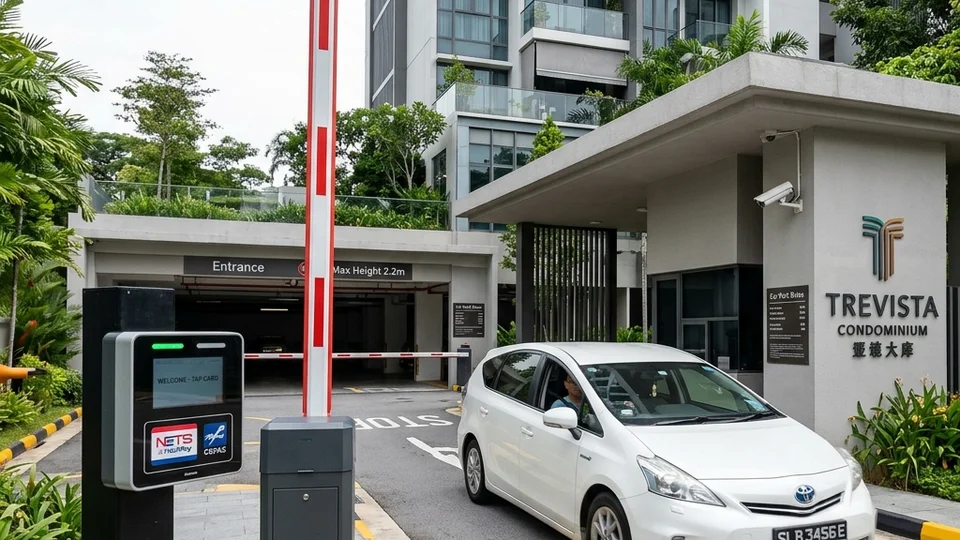
A car park barrier system controls vehicle access into and out of a property. Its primary role is to determine who can enter, when they can enter, and under what conditions they can enter. The system then physically controls access through a barrier arm that raises and lowers when the correct conditions are met.
Barrier systems are commonly used because they provide a practical way of managing vehicle movement without the cost and complexity of full-height gates. They can be found at condominiums, commercial buildings, factories, schools, offices and private developments across Singapore.
Most people are familiar with barriers from car parks and condominiums. The experience is straightforward: approach the reader, present a card or let the camera read your plate, the arm rises, you drive through. What is less visible is everything that makes that experience work: the loop detectors embedded in the ground, the access control system verifying the credential, the management software logging every entry and exit, and the backup systems keeping everything running during a power failure.
The arm is the visible part. The system behind it is where the real design decisions are made.
Different properties have different objectives. For some, the goal is preventing unauthorised parking. For others, it is managing resident access, controlling visitor traffic or automating vehicle entry. Common reasons include resident vehicle access, season parking management, visitor management, commercial parking control and traffic flow management. The objective is not always security: in many cases, it is convenience and operational efficiency.
2. Barriers vs Gates
One of the most common misconceptions is that a barrier provides security. It does not. A barrier controls vehicles. A gate provides a physical obstacle. This distinction matters.
A barrier is effective at controlling vehicle access, managing traffic flow, reducing unauthorised parking and supporting automated access systems. What a barrier does not do is restrict pedestrian access, prevent tailgating, stop a determined vehicle, or secure the perimeter.
This does not make barriers ineffective. It means they should be evaluated based on the role they were designed to perform. If perimeter security is required, barriers should be combined with gates, fencing, CCTV and security personnel.
In practice, most condominium developments use barriers for the car park and a separate pedestrian gate or turnstile for the pedestrian entrance. These are two separate systems addressing two separate objectives.
| Requirement | Barrier | Gate |
|---|---|---|
| Controls vehicle access | ✓ | ✓ |
| Restricts pedestrian access | ✗ | ✓ |
| High daily vehicle volume | ✓ | Limited |
| Condominium car park | ✓ | Sometimes |
| Landed home driveway | Rarely | ✓ |
| Commercial car park | ✓ | Sometimes |
| Industrial facility | ✓ | ✓ |
| Perimeter security objective | ✗ | ✓ |
| Vehicle throughput objective | ✓ | ✗ |
3. How a Barrier System Works
Most barrier systems follow the same basic process. A vehicle approaches the entry lane. The driver presents a credential: access card, key fob, licence plate, mobile app or QR code. The system verifies authorisation. The barrier arm lifts. The vehicle passes through. The barrier closes after the vehicle has cleared the lane.
The process sounds simple. Many of the most important design decisions happen behind the scenes.
The Barrier Motor and Arm
The motor raises and lowers the boom arm. The arm is typically made from aluminium or fibreglass to reduce weight and resist corrosion. Arm length ranges from 2.5 metres for a standard lane to 6 metres or longer for wide industrial entrances. On most residential and commercial installations, a straight arm is used. Folding arms are available where overhead clearance is limited.
The Control Board
The control board is the brain of the system. It receives signals from access readers, loop detectors, intercoms and management systems and decides whether to raise the arm. It also manages timing: how long the arm stays raised, when to close, and what to do when a vehicle is still under the arm.
Loop Detectors
Loop detectors are copper coils embedded in the ground at entry and exit points. They detect a vehicle's metal mass and send a signal to the control board. Most installations use at least two loops per lane: one to detect vehicle approach and trigger the access system, and one to detect when the vehicle has fully passed so the arm can close safely. Loop detectors are one of the most important and most overlooked components: most barrier reliability complaints trace back to loop detector issues rather than the barrier motor itself.
Access Readers and Intercom
The access reader verifies the credential: whether that is an RFID card, LPR camera, QR code reader or intercom. Different lanes often use different access methods: residents via LPR or card, visitors via intercom or QR code, exit lanes via loop detector alone.
Management Software
Modern barrier systems connect to a management platform that logs every vehicle entry and exit, manages the authorised vehicle database, issues visitor passes and provides reporting. Season parking management is a core function in residential installations. The platform manages which units hold active season passes, which vehicles are authorised under each pass, renewal dates and removal when a resident moves out. In well-designed systems, managing agents can update the vehicle database directly through a web portal or app without requiring the installer to make changes: this is an important operational capability that is frequently overlooked when evaluating quotations.
4. Where Barriers Are Used
Condominiums
The most common application in Singapore. A condominium with 200 to 500 units may have two to four barrier lanes: separate entry and exit lanes, possibly a dedicated visitor lane. Residents typically access via LPR or access card. Visitors use an intercom or pre-issued QR code.
Commercial Buildings and Business Parks
Office buildings and business parks use barriers at basement car park entrances. Access is typically by access card or season parking pass. Visitor parking may be managed through a ticketing system or a reception-controlled intercom.
Industrial Facilities and Logistics Hubs
Industrial sites often have wider lanes, longer arms and higher traffic volumes. Delivery vehicles, heavy goods vehicles and staff vehicles may all use the same lanes. LPR is increasingly used for delivery vehicle management.
Hospitals and Healthcare Facilities
Hospitals require barriers that can handle high traffic volume while managing priority access for emergency vehicles, ambulances and staff. These installations require more detailed planning around traffic flow and emergency override procedures.
Schools, Institutions and Mixed-Use Developments
Used to manage staff access, visitor access and student drop-off areas. Multi-storey car parks and mixed-use developments often integrate barriers with a car park management system that tracks lot availability, manages season parking and handles cashless payment.
5. Barrier Types
Not all barriers are the same. The right type depends on lane width, overhead clearance, traffic volume and the level of security required.
Standard Straight Arm Barrier
The most common type for condominium and commercial car parks. Arm lengths of 3 to 4.5 metres cover most standard single-lane entrances. Reliable, cost-effective and straightforward to maintain. Suitable for most residential and commercial applications.
Typical investment: SGD 3,800 – 4,800 per barrier
Folding or Bi-Folding Arm Barrier
Where overhead clearance is limited: basement car parks with low ceilings, undercroft entries: a folding arm folds upward rather than rotating fully vertical. This reduces the clearance height required while maintaining full lane coverage.
Typical investment: SGD 5,500 – 7,500 per barrier
Fence Arm Barrier
Some barrier models include a lower fence or lattice structure beneath the arm. This provides additional visual deterrence and makes it harder for pedestrians to duck under the raised arm. Used where a visual deterrent effect is preferred, where the arm span is wide, or for aesthetic reasons on premium developments. Performance and duty cycle are the same as a standard straight arm barrier: the difference is the arm design only.
High-Speed Barrier
Designed for sites with high traffic volumes where throughput is critical. The arm opens and closes faster than standard systems. Suitable for large condominiums, commercial car parks and high-traffic facilities where queuing at the entry lane is a concern.
Road Blocker and Rising Kerb
Anti-ram barriers designed for high-security applications. Installed flush with the road surface and rise to block vehicle passage when activated. Typically found at government buildings, data centres and critical infrastructure rather than standard commercial or residential installations.
For most condominium and commercial applications, a standard straight arm barrier with the correct duty cycle rating is the appropriate solution. The choice of barrier type matters less than correct duty cycle specification and proper loop detector design. We have seen premium high-speed barriers fail prematurely because the duty cycle was undersized, and standard barriers running reliably for seven years because the specification matched the actual traffic volume.
6. Traffic Volume and Duty Cycle
Duty cycle is the most important specification in barrier selection: and the one most frequently overlooked.
Duty cycle refers to how many operating cycles: one cycle equals the arm raising and lowering once: the barrier is designed to sustain per day without premature wear. A barrier rated for 300 cycles per day installed on a site running 600 cycles will experience accelerated wear, higher maintenance frequency and early failure. We have seen this repeatedly.
The question is not whether the barrier can open. The question is how many times it must open every day.
For a condominium, multiply the number of units by the average daily trips per vehicle: typically 2 to 3 return journeys: and factor in delivery and visitor traffic. A 300-unit development with two vehicles per unit averaging two return trips is already running 1,200 vehicle movements per day, split across the number of lanes.
Before specifying a barrier, we calculate the actual daily cycle count for the site. This number drives motor selection, arm material and maintenance intervals. We almost always recommend specifying a barrier with a duty cycle rating above the calculated requirement: the additional headroom compensates for peak periods, mechanical wear over time and any future increase in traffic volume.
7. Why Barriers Fail Prematurely
Many people assume a barrier fails because the motor wears out. In reality, the motor is often not the problem. Most premature barrier failures trace back to poor specification, poor installation, environmental conditions or lack of maintenance.
Incorrect Duty Cycle Selection
A barrier designed for light-duty use may work perfectly at a small office. The same barrier installed at a condominium with several hundred vehicles entering and exiting every day will struggle. The result is increased wear, more frequent breakdowns, higher maintenance costs and reduced service life. The barrier should be selected based on actual traffic volume rather than purchase price alone.
Poor Loop Detector Design
Because loop detectors are buried beneath the road surface, most people forget they exist. When a barrier behaves unexpectedly, the motor is often blamed first. In many cases, the real issue lies with the loop detector. Poor loop design can result in missed vehicle detection, premature arm closure, false triggering and tailgating risks.
Vehicle Impact Damage
Barrier arms occasionally get struck by vehicles. Even when the damage appears minor, the impact may affect arm alignment, linkages, springs and internal mechanisms. Repeated impacts shorten equipment life significantly. Replacing the arm repeatedly without investigating the root cause: poor lane visibility, inadequate signage, driver behaviour: does not solve the problem.
Water Ingress and Drainage Problems
Barrier systems operate outdoors. Poor drainage allows water to accumulate around the barrier housing and electrical components. Over time this leads to corrosion, electrical faults, sensor failures and reduced equipment lifespan. Proper drainage is often just as important as the barrier itself: and is frequently overlooked during site planning.
Lack of Preventive Maintenance
A barrier operating hundreds of times per day is a mechanical system under constant use. Routine maintenance allows wear items to be identified before they cause failures. A properly specified and maintained barrier can provide many years of reliable service. A poorly maintained barrier may begin experiencing problems much sooner.
8. Access Methods
The barrier controls movement. Something else decides which vehicles are permitted to pass. This is where most barrier systems are underspecified: property managers focus on the barrier and give insufficient attention to how different users will actually gain access.
Access Cards and Key Fobs
The traditional approach. Residents or staff present a card or fob to a reader at the entry lane. Cards are reliable, proven and familiar: but they create a credential management burden. Lost cards, damaged cards, residents who forget their card and tailgate instead are day-to-day management issues in any card-based system.
Most access systems support anti-passback: a control that prevents the same card from being used to enter twice without a corresponding exit being recorded. This discourages card sharing and reduces tailgating. We recommend enabling anti-passback as a standard setting on all residential installations.
Long Range RFID Tags
Long-range RFID systems allow vehicles to be identified automatically as they approach, without the driver needing to lower the window or present anything. A tag mounted inside the vehicle is detected from several metres away. These remain popular for resident access in many condominiums and commercial developments.
Licence Plate Recognition
LPR systems identify authorised vehicles by their registration plates. The vehicle approaches, the camera reads the plate, the system checks the database, the arm rises. No card, no fob, no phone required. For residents, LPR provides a genuinely seamless experience. For estate managers, it provides a complete vehicle access log: every vehicle, every entry and exit, timestamped. We cover LPR in detail in Section 9.
Mobile App Access
Residents can use a smartphone application to open barriers, manage visitors, issue temporary access and monitor access activity. Particularly useful for temporary access, contractors, delivery personnel and visitors. Reduces dependence on physical credentials and can simplify administration significantly.
QR Code Access
Temporary QR codes can be issued to visitors in advance via email, WhatsApp or an estate management app. The visitor drives up, presents the QR code on their phone screen to a reader at the entry lane, and the arm raises. No guard intervention required. The visit is logged automatically.
Loop Detector: Automatic Exit
On exit lanes, a loop detector detects the vehicle approaching and raises the arm automatically. No credential is required to exit. This is standard on most residential installations. In car parks where exit control is required: paid parking or time-limited visitor bays: a card reader or ticket validator is added at the exit lane.
IU / EPS Reader (Singapore-specific)
Singapore vehicles are fitted with an In-Vehicle Unit (IU): the same device used for Electronic Road Pricing. A car park EPS antenna (Electronic Parking System antenna) reads the vehicle's IU wirelessly as it approaches the entry lane, without any action from the driver. The barrier raises automatically for authorised IU numbers. This provides a hands-free entry experience similar to LPR but uses the IU number rather than the licence plate as the vehicle identifier.
Singapore is currently transitioning from the current IU to the new On-Board Unit (OBU) under ERP 2.0, mandatory for all Singapore-registered vehicles from 1 January 2027. The OBU antenna is backward-compatible with existing car park EPS gantries: no hardware change is required at the barrier end. Systems installed today will continue to work with OBU-equipped vehicles without modification.
IU/EPS reading is a uniquely Singapore access method, used primarily in managed car parks that require fully hands-free resident entry without the camera infrastructure required by LPR. Many newer installations combine both: LPR as the primary method and IU/EPS as a fallback where plate recognition is unreliable.
9. Licence Plate Recognition
Licence plate recognition has moved from a premium option to a standard specification for most new condominium barrier installations. Instead of presenting a card or tag, the vehicle's registration number becomes the credential. As the vehicle approaches, the camera captures the plate, the system verifies authorisation and the barrier opens automatically.
Why LPR Has Become Popular
Residents do not need to lower windows, present cards, search for credentials or press buttons. The vehicle simply approaches and enters. For many developments, this significantly improves the resident experience: and a better resident experience means fewer guard post calls and fewer complaints to the managing agent.
What Makes LPR Work Reliably
Camera position is critical. The camera must be mounted at the correct height and angle to capture the plate clearly across the range of vehicle types using the lane: from low sports cars to tall lorries. Lighting matters too. Most LPR cameras include an infrared illuminator for night operation, but lane lighting should be considered as part of the installation design. Processing speed and accuracy affect the user experience: a system that makes residents wait five seconds at the entry lane will generate complaints regardless of how accurate it is.
Resident and Visitor LPR
Resident vehicles are registered in the system database: typically one or two plates per unit, plus approved staff or family vehicles where required. When a registered plate approaches, access is automatic. Visitor vehicles can be pre-registered by a resident through an estate app, granting temporary access for a defined window: eliminating the need for the visitor to use an intercom.
What LPR Cannot Do
LPR does not prevent a vehicle from entering if someone holds a valid plate image in front of the camera. It also cannot identify who is driving the vehicle. For this reason, LPR is a convenience and efficiency tool for managed residential and commercial car parks: not a substitute for access control in high-security applications.
LPR provides an access method that does not depend on vehicle-mounted hardware supplied by third parties. As Singapore transitions to ERP 2.0 and the new OBU, LPR's independence from in-vehicle hardware is one reason it continues to gain adoption alongside IU/EPS-based systems.
10. Visitor and Delivery Management
Visitor and delivery management is where most barrier systems underperform. Residents experience seamless access via LPR or card. Visitors arrive and do not know what to do. The intercom is unclear. The guard post is not answering. A queue forms. Residents tailgate through to avoid waiting. The guard post gets a complaint.
This is not a barrier problem. It is a visitor management design problem.
Pre-Registered QR Passes
Residents issue a visit pass to expected visitors through an estate management app or portal. The visitor receives a QR code by WhatsApp or email. On arrival, the visitor presents the QR code at a dedicated reader lane. The arm raises without guard intervention. The visit is logged.
Walk-In Visitors via Intercom
Unexpected visitors use the intercom. The guard post or resident answers, verifies the visitor and releases the barrier. Video intercom improves verification speed and accuracy: the guard can see the visitor's face and vehicle on screen before deciding whether to grant access.
Delivery Management
Delivery vehicles: courier services, food delivery, parcel services: require a different approach from guest visitors. Options include a dedicated delivery lane with a simplified access method, a timed QR code issued for a defined window, or a guard-controlled release. We generally recommend a dedicated delivery lane where site layout allows, to prevent delivery queues blocking the resident entry lane.
Contractor and Service Vehicle Access
Contractors and service providers require time-limited access, typically managed through a contractor pass system or pre-registered plate. Access should be logged and limited to approved hours.
Tailgating
Tailgating: a second vehicle following through the entry lane immediately after an authorised vehicle without presenting any credential: is one of the most common security gaps in condominium car parks. Measures to reduce tailgating include tightening the arm close-delay so the arm drops promptly after the authorised vehicle clears the safety loop, installing CCTV cameras covering the entry lane, and enabling anti-passback logic in the access management software.
Anti-Passback
Anti-passback prevents the same credential: card, plate or IU number: from being used to enter twice in a row without a corresponding exit being recorded. If a resident uses their access card to enter, then passes the card back to a second driver, anti-passback prevents the second use from raising the arm. Most modern access management platforms support anti-passback as a standard feature. It is rarely mentioned in quotations but is worth asking about specifically: particularly where tailgating complaints are already being received.
A visitor management system should reduce work for the guard post, not create more work. If security officers are constantly handling routine visitor requests that could be automated, the system is not operating efficiently. Good automation allows security personnel to focus on exceptions rather than routine transactions.
11. Resident Experience Matters
A good barrier system is almost invisible. Residents should not have to think about it. The system should simply work.
When residents have to search for access cards, reverse because a reader failed, queue behind visitors, or call the guard post regularly, the barrier has become part of the problem rather than part of the solution.
This is why resident experience should be considered during system design: not as an afterthought. The objective is not simply to install equipment. The objective is to create a smooth and reliable access experience for everyone who uses the car park every day.
When we evaluate a barrier installation, we ask one simple question: can a resident drive in and out without thinking about the barrier system at all? If the answer is yes, the system is working. If residents regularly need to stop, search, wait or call someone, the design has a problem: regardless of what the barrier arm itself is doing. Design for the user experience first. The equipment specification follows from that.
12. Site Assessment and Planning
A barrier specification cannot be completed from a floor plan or a telephone conversation. Every site has conditions that affect the final design: and some of those conditions only become visible on site.
Lane Width and Traffic Flow
Standard single-lane entries require a minimum clear width of 3 metres. Lane width determines arm length, which affects motor specification. Understanding traffic flow: how many vehicles use the lane, whether there are peak periods, whether there is sufficient stacking distance before the barrier: influences both equipment selection and lane design.
Turning Radius and Approach Geometry
The approach to the barrier must allow vehicles to align correctly with the lane before reaching the reader. Insufficient turning radius causes vehicles to approach at an angle, leading to difficult card reader access and LPR read failures.
Underground Services
Loop detector coils are embedded beneath the road surface. Before cutting begins, underground services must be identified: power cables, telecommunications cables, water pipes and drainage. Identifying these services early avoids costly surprises during installation.
Drainage and Ground Condition
Poor drainage allows water to accumulate around the barrier base. If the road surface is in poor condition, civil works are required before installation starts. Water pooling at the barrier base affects motor and electronics longevity significantly.
Electrical Supply and Future Expansion
The barrier motor, access readers, LPR cameras and intercom all require power. Cable routing and circuit capacity must be confirmed on site. Planning for future upgrades: LPR, visitor management, mobile credentials: during initial installation costs very little. Adding these capabilities later is almost always more expensive.
| Assessment Point | What We Check | Why It Matters |
|---|---|---|
| Lane width | Clear measurement, kerb to kerb | Determines arm length and barrier placement |
| Turning radius | Approach geometry | Affects card reader and LPR alignment |
| Loop detector positions | Approach and exit zones | Controls arm timing and tailgate prevention |
| Ground condition | Surface, drainage, structural integrity | Civil works scope and motor longevity |
| Electrical supply | DB location, circuit capacity, cable route | Installation cost and circuit specification |
| Overhead clearance | Minimum height at full arm raise | Required for folding arm or arm length decision |
| Guard post sightlines | Visibility from guard post to entry lane | Affects intercom design and monitoring setup |
| Underground services | Cables, pipes, drainage | Prevents costly surprises during road cutting |
13. Understanding Loop Detectors
Loop detectors are one of the most critical components of a barrier system: and one of the most rarely discussed. A loop detector consists of a wire coil embedded beneath the road surface. When a vehicle passes over the loop, the metal mass of the vehicle changes the electromagnetic field of the coil, and the control board detects this change to control barrier operation.
Most installations use at least two loops per lane: an approach loop that detects the vehicle arriving and triggers the access system, and a safety loop positioned beneath the barrier arm that prevents the arm from closing while a vehicle is still underneath it.
Why Loop Detectors Matter
Without reliable vehicle detection, barriers may close too early, fail to open, or create safety risks. Many apparent barrier faults: arms that close on vehicles, barriers that fail to respond, erratic operation: ultimately trace back to loop detector issues rather than the barrier motor. When a barrier behaves unexpectedly, the motor is often blamed first. In many cases, the real issue lies with the loop detector.
Common Problems and Maintenance
Sensitivity settings that are too high cause false triggers from nearby traffic. Settings that are too low cause the detector to miss vehicles. Damaged coils: from poor installation or road movement: produce unreliable signals. Coils installed too close together can interfere with each other. These are design and installation issues, not equipment failures.
Loop detectors should be included in every preventive maintenance visit. Sensitivity should be checked and recalibrated as road surfaces settle and vehicle types change. A loop detector correctly calibrated on installation day may need adjustment six months later.
We regularly attend barrier service calls where the managing agent reports that the motor is faulty. On site, the motor is functioning correctly. The loop detector: which nobody has checked or cleaned since installation: is the issue. Loop detector maintenance is not optional. It is as important as motor maintenance, and in our experience, more often the cause of problems.
14. Power Failure Behaviour
This is a question every managing agent should ask before accepting any barrier specification: and one that is often left unasked until there is a power failure.
The default behaviour of most car park barriers during a power failure depends on how the system has been configured.
Fail-Safe Operation
The barrier arm automatically raises when power is lost. This prioritises vehicle movement and emergency access. Vehicles can exit freely but unauthorised vehicles may also enter until power is restored. Commonly specified where preventing traffic congestion during a power outage takes priority over access control.
Fail-Secure Operation
The barrier remains in its last position when power is lost. For a barrier that was down when power failed, this means vehicles cannot enter or exit without manual intervention. For a condominium car park barrier, an arm-down power failure means residents cannot exit. This has happened at a number of developments in Singapore and generates significant resident complaints.
The Capacitor Option
A capacitor can be fitted to store enough energy to raise the arm automatically when power is lost. When mains power fails, the capacitor discharges and raises the arm, allowing vehicles to exit. The arm stays raised until power is restored. We recommend the capacitor option for developments where the car park is the primary resident exit route.
Emergency Vehicle Access and Manual Release
Emergency access should be considered during system design. If a fire appliance, ambulance or other emergency vehicle requires access during a power outage, staff should know exactly how the barrier will be released. Emergency access should never be delayed because of a barrier system. Every barrier includes a manual release that allows the arm to be raised by hand. We confirm manual release procedures at every commissioning handover.
15. Installation Considerations
A successful barrier project depends on more than selecting the correct equipment. Modern barrier systems rely on network connectivity for LPR, visitor management and cloud-based platforms: a barrier project should be viewed as both a civil works project and an IT project.
| Stage | What Happens |
|---|---|
| 1. Site Assessment | Lane dimensions, loop detector positions, electrical routing and access system requirements confirmed on site. Civil works scope identified. |
| 2. Civil Works | Loop detector channels cut into road surface, coils embedded. Conduit laid for power and data cables. Drainage and surface preparation completed. |
| 3. Electrical Works | Power routed from distribution board to barrier locations by licensed electrician. Isolator installed near each barrier for safe servicing. |
| 4. Installation | Barrier motor installed and aligned. Access readers, LPR cameras, intercoms and QR readers mounted and connected to control board and management system. |
| 5. Configuration | Loop detectors calibrated. Access rights programmed. LPR databases loaded. Visitor management workflows configured and tested. Power failure behaviour confirmed. |
| 6. Commissioning | Full system test. Guard staff briefed on daily operation, fault recognition and manual release. Managing agent briefed on access management and reporting. Maintenance schedule agreed. |
16. Maintenance and Lifecycle Management
A car park barrier operates every day. In a condominium with 300 units, the barriers may cycle 500 or more times daily: more than 180,000 cycles per year on each lane. At that volume, preventive maintenance is not optional. We recommend quarterly preventive maintenance for high-usage sites such as condominiums.
What Maintenance Covers
Mechanical: lubrication of pivot points, spring and linkage inspection, arm condition and alignment, fastener check.
Loop detectors: sensitivity check and recalibration, induction coil condition, trigger timing confirmation.
Safety devices: obstruction detection verification, safety loop operation test.
Access readers and cameras: lens cleaning on LPR cameras, reader operation verification, card and fob function check.
Electrical: control board inspection, power supply check, connection tightening.
Software and database: access rights audit, expired credentials removal, firmware updates, access log backup.
Communication: intercom operation test, network connectivity verification, management software health check.
Between Service Visits
Guard staff and managing agents can perform simple checks between professional visits. Listen for unusual mechanical sounds from the motor. Check that the arm rises and lowers smoothly without hesitation. Confirm that LPR is reading plates correctly during approach. Report any loop detector failures promptly: arm not rising on approach, arm closing before vehicle has fully cleared. A fault caught early is almost always less expensive to repair than one left to develop.
17. Common Problems and Troubleshooting
Most apparent barrier faults are not motor failures. The access system, loop detectors and control board should be checked as a whole before assuming the motor is the cause.
| Fault | Most Common Cause | First Check |
|---|---|---|
| Arm does not rise on approach | Loop detector fault or miscalibration | Check loop detector sensitivity setting |
| Arm rises before vehicle fully passes | Exit loop position or calibration | Adjust exit loop sensitivity or position |
| Arm closes on vehicle still under it | Safety loop fault or arm timing | Check safety loop and control board settings |
| Arm rises slowly or incompletely | Motor wear, mechanical resistance, low voltage | Lubricate pivot points; check power supply |
| Barrier closes too quickly | Loop detector settings, timing configuration | Check loop detector settings: not usually a motor problem |
| Barrier remains open | Failed loop detector, obstruction detection active | Inspect full system before resuming normal operation |
| LPR not reading plates | Camera angle, lighting, dirty lens | Clean lens; check camera alignment |
| LPR misreading plates | Plate condition, vehicle speed, image quality | Adjust camera position; check IR illuminator |
| Card reader not responding | Power fault, reader failure, damaged card | Check power to reader; test with known good card |
| QR code reader not scanning | Dirty lens, lighting, positioning | Clean lens; adjust reader height |
| Barrier not responding after power failure | Capacitor not fitted or depleted | Use manual release; check capacitor condition |
| Frequent arm strikes | Poor lane visibility, inadequate signage, driver behaviour | Identify root cause: replacing the arm repeatedly solves nothing |
| Arm vibrating during operation | Loose arm attachment, wind loading | Check and tighten all arm attachment points |
| Guard intercom no answer | Power fault, network issue, staffing gap | Check power and network to intercom unit |
18. Investment Guide
The cost of a car park barrier installation depends on the number of lanes, the barrier type, the access system selected, civil works scope and the management software platform. Because every site is different, a site assessment is required before a quotation can be finalised.
| Component | Typical Range |
|---|---|
| Standard boom barrier (per lane) | SGD 3,800 – 4,800 |
| Folding arm barrier (per lane) | SGD 5,500 – 7,500 |
| RFID card reader (per lane) | SGD 800 – 1,500 |
| LPR camera (per lane) | SGD 1,800 – 3,500 |
| Video intercom (per lane) | SGD 1,200 – 2,500 |
| QR code reader (per lane) | SGD 600 – 1,200 |
| Loop detector installation (per lane) | SGD 400 – 800 |
| Civil works: lane cutting and conduit (per lane) | SGD 800 – 2,000 |
| Management software (per site) | SGD 2,000 – 8,000 setup + monthly fee |
Indicative pricing only. All figures exclude platform fees, management software licences, server or PC hardware, tablets or display screens at guard posts, consumables, training, and any other accessories required for a complete installation. Actual costs depend on site conditions, number of lanes, civil works scope, electrical works, system integration requirements and the specific equipment specified. A site assessment is required before any firm quotation can be prepared.
A full replacement of a two-lane entry and one-lane exit system at a mid-sized condominium: including barriers, LPR, intercom, QR visitor access, loop detectors, civil works and management software: typically falls in the range of SGD 35,000 to 65,000 depending on site conditions and system scope. Ongoing costs include quarterly maintenance, monthly software fees where applicable, and replacement parts. These should be factored into the MCST's long-term maintenance fund planning.
When comparing quotations, avoid focusing only on the barrier price. Items commonly excluded include civil works, electrical works, network switches, tablets or display screens, software licences, annual platform subscriptions, visitor management modules and training. Two quotations may appear similar while containing very different scopes. Always compare the complete solution.
19. Choosing a Barrier Contractor
The quality of the contractor often has a greater impact on the outcome than the brand selected. A contractor should be able to explain why a particular barrier was selected, how the traffic flow was assessed, how visitor access will be managed and how future expansion can be accommodated. The discussion should focus on operational outcomes rather than equipment specifications alone.
Questions to Ask Before Committing
How was the duty cycle calculated? The answer should reference the actual daily vehicle count for the site. A standard barrier model quoted without reference to your traffic volume means the specification has not been done properly.
What happens to the barrier during a power failure? The installer should explain clearly whether the barrier holds its position, raises automatically or requires manual intervention. Ask whether a capacitor option has been included.
How are visitors handled? Ask for a walkthrough of the complete visitor journey: from arrival at the entry lane to access being granted. If the answer relies entirely on the guard post for all visitor access, the system design is incomplete.
What loop detector positions are proposed? A qualified installer should explain where the approach and exit loops will be positioned and why. Vague answers here suggest the installation has not been properly planned.
Who manages the access database after installation? Confirm who is responsible, what tools are provided and how quickly changes take effect. Managing agents should be able to update vehicle records themselves without calling the installer.
What maintenance is included and what is extra? Get specific answers on warranty coverage, post-warranty maintenance schedule and callout response times.
Who supports the system in five years? Ask whether the installer has been supporting the same brand in Singapore for at least five years and whether spare parts: particularly control boards: are held locally.
Think Beyond Today's Requirements
Vehicle access requirements often evolve. The selected solution should ideally support LPR upgrades, visitor management integration, mobile credentials and intercom integration. Planning ahead usually costs less than redesigning later.
Securevision Verdict
Many people begin a barrier project by comparing equipment. In practice, that is usually the wrong place to start.
We have been designing and installing car park barrier systems at Singapore condominiums, commercial buildings and industrial facilities for more than 37 years. The most common mistake we see is an MCST or managing agent replacing a barrier system without addressing the underlying design problems that caused the previous system to underperform.
A new barrier installed in the same poorly designed lane, with the same inadequate loop detector positions, and without a visitor management solution, will develop the same problems within a few years.
The better question is: what experience do we want residents, visitors and security staff to have? The answer influences barrier selection, access methods, visitor management, LPR requirements and system integration: far more than the barrier arm itself.
Before specifying any barrier system, define what a successful outcome looks like. How should residents enter? How should visitors be handled? What should the guard post be responsible for? What happens during a power failure? The answers should drive the specification. The equipment comes after.
A good barrier system is not measured by how quickly the arm opens. It is measured by how smoothly vehicles move through the property every day. The best systems are usually the ones that residents barely notice.
Frequently Asked Questions
What is the difference between a car park barrier and an auto gate?
An auto gate creates a full physical barrier across the opening, restricting both vehicles and pedestrians. A car park barrier uses a boom arm that controls vehicle movement but allows pedestrians to walk around it. Gates are used for perimeter security. Barriers are used for high-volume vehicle traffic management.
Is a barrier more secure than a gate?
Not in the same way. A barrier controls vehicles. A gate provides a physical obstacle. The two serve different purposes and are often used together in larger developments.
Should we choose LPR or access cards?
Both remain widely used. LPR provides a more seamless experience: residents do not need to lower their window or present a card. For many modern developments, LPR has become the preferred resident access method, with cards retained as a backup credential.
How many cycles per day should my barrier be rated for?
Calculate your site's actual daily vehicle count: number of units multiplied by average daily vehicle trips, plus visitor and delivery traffic: then divide by the number of lanes. We recommend specifying a barrier rated at least 30% above the calculated daily count to allow operating headroom.
What happens during a power failure?
The behaviour depends on system configuration. Some barriers are configured to raise automatically on power failure. Others hold their last position. A capacitor option can be fitted to raise the arm automatically. Every barrier also includes a manual release for guard operation. This should be determined during system design: not after a power outage has occurred.
Can the barrier open automatically without any credential?
Yes, on exit lanes. A loop detector detects the vehicle approaching the exit and raises the arm automatically. On entry lanes, a credential is typically required.
What is the IU/EPS reader?
A Singapore-specific access method that reads the In-Vehicle Unit (IU) fitted to all Singapore-registered vehicles: the same device used for Electronic Road Pricing. The reader identifies the vehicle wirelessly without any driver action, similar to LPR but using the IU number rather than the licence plate.
Will the IU/EPS system still work after ERP 2.0?
Yes. The new On-Board Unit replacing the IU under ERP 2.0 is backward-compatible with existing car park EPS gantries. No hardware change is required at the barrier end. The mandatory OBU transition date is 1 January 2027.
What is anti-passback?
Anti-passback prevents the same credential from being used to enter twice without a corresponding exit being recorded. It discourages card sharing and reduces tailgating. Most modern access management platforms support it as a standard feature: ask about it specifically when evaluating quotations.
How does a visitor QR code system work?
The resident issues a visit pass through an estate management app or portal. The visitor receives a unique QR code by WhatsApp or email. On arrival, the visitor presents the code at the entry lane reader. The arm rises. The visit is logged. The code expires after the defined access window.
How often should barriers be serviced?
We recommend quarterly preventive maintenance for high-usage sites such as condominiums. Annual servicing is the minimum for lower-usage commercial sites.
Can an existing barrier system be upgraded with LPR?
In many cases, yes. If the control board supports external inputs and the lane has suitable mounting positions for an LPR camera, a retrofit is often feasible. A site assessment will confirm compatibility.
What is the typical lifespan of a car park barrier?
A properly specified and maintained barrier will typically provide five to seven years of reliable service at residential and commercial usage levels. High-traffic industrial installations may have a shorter service life depending on actual daily cycle counts.
How long does installation take?
A standard two-to-three lane barrier replacement typically takes two to four days for installation, excluding civil works. Civil works: loop detector embedding, conduit: are usually done separately and may require an additional one to two days.
Do we still need security guards?
Technology reduces routine workload but security personnel continue to play an important role in handling exceptions, incidents and visitor management. Technology should support security operations, not replace them entirely.
How do I plan for a barrier replacement at my condominium?
Start with a review of the current system's pain points: what is generating complaints, what is failing, what is working. Commission a site assessment to confirm lane layout, loop positions and access system scope. Request quotations that specify duty cycle rating, access methods, power failure provision and visitor management workflow. Compare on full scope, not just the barrier price.