Upgrade Obsolete Intercom Systems Before They Become a Risk
Older intercom systems are becoming harder to maintain, harder to support, and harder to trust: especially in modern residential and managed properties.
Designed for condominiums and residential properties across Singapore since .
In Short
What an Intercom Upgrade Is Really About
Many condominium intercom systems continue operating long after manufacturer support, spare parts, and technical expertise have disappeared. An intercom upgrade is usually not driven by a desire for new technology. It is driven by increasing breakdowns, resident complaints, repair uncertainty, and growing maintenance costs that make continued operation more expensive than planned replacement.
The best upgrade projects focus on three things: restoring long-term reliability, reusing as much existing infrastructure as possible, and completing the transition with minimal disruption to residents. Most systems do not fail overnight. They deteriorate gradually until breakdowns become a normal part of operations: at which point the planning options are narrower and the costs are higher.
Many Intercom Systems Are Still Running: But Already Outdated
Across many condominiums and residential developments, intercom systems installed years ago are still in operation. They may still function: but behind the surface, they are reaching the edge of failure.
No Spare Parts
Replacement parts are no longer readily available for legacy proprietary architectures. We often see estates spending months searching for components that were discontinued years ago: each breakdown becoming a longer and more expensive exercise than the one before.
No Vendor Support
Manufacturers have often discontinued support for older analogue or digital models. When the technical support desk no longer exists, the estate is dependent on whoever still has knowledge of an obsolete system: a pool that shrinks every year.
Slower Repairs
Repairs are becoming significantly slower and more expensive as expertise becomes scarce. The repair that used to take a day now takes a week while parts are sourced. Each breakdown reduces resident confidence and increases pressure on the managing agent.
Poor Quality
Audio and video quality no longer meet current expectations for security and clarity. A system that cannot clearly identify a visitor at night is not providing the access control function the estate installed it to perform.
When Intercom Systems Fail, It Affects More Than Communication
The intercom system is not just a convenience: it is a critical part of your property's access control layer. When it becomes unreliable, it creates operational friction that cascades through the estate. Visitors and deliveries are delayed at the entrance. Residents cannot verify guests. Guards are called to manually open gates for entries that should be handled automatically. And when verification is bypassed because the system cannot be trusted, the security function it was installed to provide is gone.
In many cases, failure does not happen all at once. It degrades gradually until the system can no longer be repaired: and by that point, the planning window for a managed, low-disruption upgrade has passed.
The Impact of Obsolete Systems
Repairing an Obsolete System Is Often a Short-Term Fix
For older intercom systems, maintenance becomes increasingly difficult because spare parts are discontinued and system architecture is outdated or proprietary. Each repair extends the system slightly: but increases long-term uncertainty and cost. At some point, replacement is not a choice. It becomes necessary.
Proprietary Lock-in
Old systems often use non-standard cabling or proprietary signals that do not work with modern components. This means the only option when something fails is to source the exact original part: which becomes progressively harder as the system ages and the manufacturer's supply chain winds down.
End-of-Life Status
Many legacy vendors have completely exited the intercom market, leaving no technical support desk available. When the manufacturer no longer exists in this form, there is no path for firmware updates, security patches, or technical guidance: the system is frozen at its last supported state and deteriorating from there.
Cumulative Costs
The total cost of multiple incremental repairs often exceeds the cost of a modern, supported IP upgrade: without any of the reliability improvement. Many councils are surprised to find, when they add up service callouts over three to five years, that the cumulative cost of repair already equals or exceeds what a planned upgrade would have cost.
Common Mistakes We See in Intercom Upgrade Projects
After reviewing ageing intercom systems across Singapore condominiums, several issues appear repeatedly.
Waiting Until the System Fails Completely
Many councils only begin planning after a major failure: when units across multiple blocks have lost intercom function, residents are complaining loudly, and the managing agent is under pressure to produce a solution quickly. At that stage, the options are narrower, the timelines are compressed, and the negotiating position with contractors is weaker. Planning before failure occurs produces a better outcome at lower cost.
Comparing New Systems Before Assessing Existing Infrastructure
The first question in an intercom upgrade should not be "which intercom should we buy?" It should be "what infrastructure can we retain?" The answer to the second question determines how much the first question costs. An upgrade designed around existing cabling and backbone infrastructure is substantially cheaper and less disruptive than one that assumes full replacement from the outset.
Focusing Only on Hardware
Resident onboarding: getting residents to download the app, enrol their credentials, and understand the new visitor workflow: is consistently more challenging than the physical installation. Many upgrade projects receive complaints not because the hardware failed but because residents were not prepared for the change. Communication planning should start before installation begins, not after handover.
Assuming Every Upgrade Requires Complete Rewiring
Many estates are surprised to discover that existing 2-wire or Cat5 cabling can carry a modern IP intercom system with the right signal conversion technology. The assumption that a full upgrade requires full recabling is one of the most common reasons estates defer the decision: and one of the most frequently incorrect assumptions we encounter during site surveys.
A Practitioner Observation
The most productive intercom upgrade conversations start with the managing agent describing a specific service callout that made them realise the system was no longer viable: a part that took eight weeks to source, a block that was without intercom for a month, a repair that cost more than expected and solved less than hoped. Starting from a real operational failure produces a much clearer brief than starting from a theoretical desire for new technology.
Plan the Upgrade Before Failure Forces It
Securevision helps properties move from reactive replacement to a planned, professional upgrade path. We design for reliability, usability, and long-term support: without unnecessary disruption.
Site Survey
Walk every intercom point and assess current hardware condition, cabling type, and infrastructure viability before recommending anything. Nothing is specified until we have seen the site.
Infra Audit
Determine what existing cabling and backbone infrastructure can be reused to reduce cost and resident disruption. The audit result shapes the entire project scope: and frequently makes the upgrade significantly more affordable than councils initially expected.
Custom Design
Design the upgrade around your estate's specific layout, unit count, entry points, and resident access requirements. Every estate is different. The design is not adapted from a template.
Phased Rollout
Execute installation in phases: typically block by block: to minimise disruption, with full commissioning and resident handover at each stage. The existing system remains active until each phase is confirmed working.
What a Modern Intercom Upgrade Should Deliver
A modern upgrade focuses on three areas: hardware clarity, resident convenience, and infrastructure efficiency.
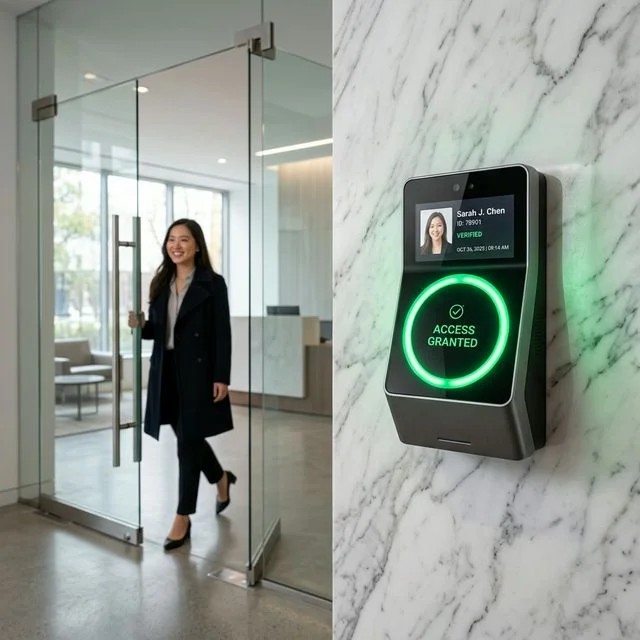
Modern IP Intercom System
Replace legacy analogue hardware with high-definition IP-based intercom stations. High-resolution video allows residents and guards to clearly identify visitors day and night. Audio quality with echo cancellation eliminates the degraded call quality that residents of older estates have learned to tolerate. The system is digitally maintainable: software updates, remote diagnostics, and technical support are standard, not exceptional.

Mobile App Integration
Residents are no longer tied to the wall-mounted monitor. They receive visitor calls on their mobile phone, can view the visitor on video, and release the door or gate remotely: whether they are at home or away from the estate. Call logs with snapshots are retained in the app. For residents who prefer the monitor, it remains fully functional alongside the mobile app.
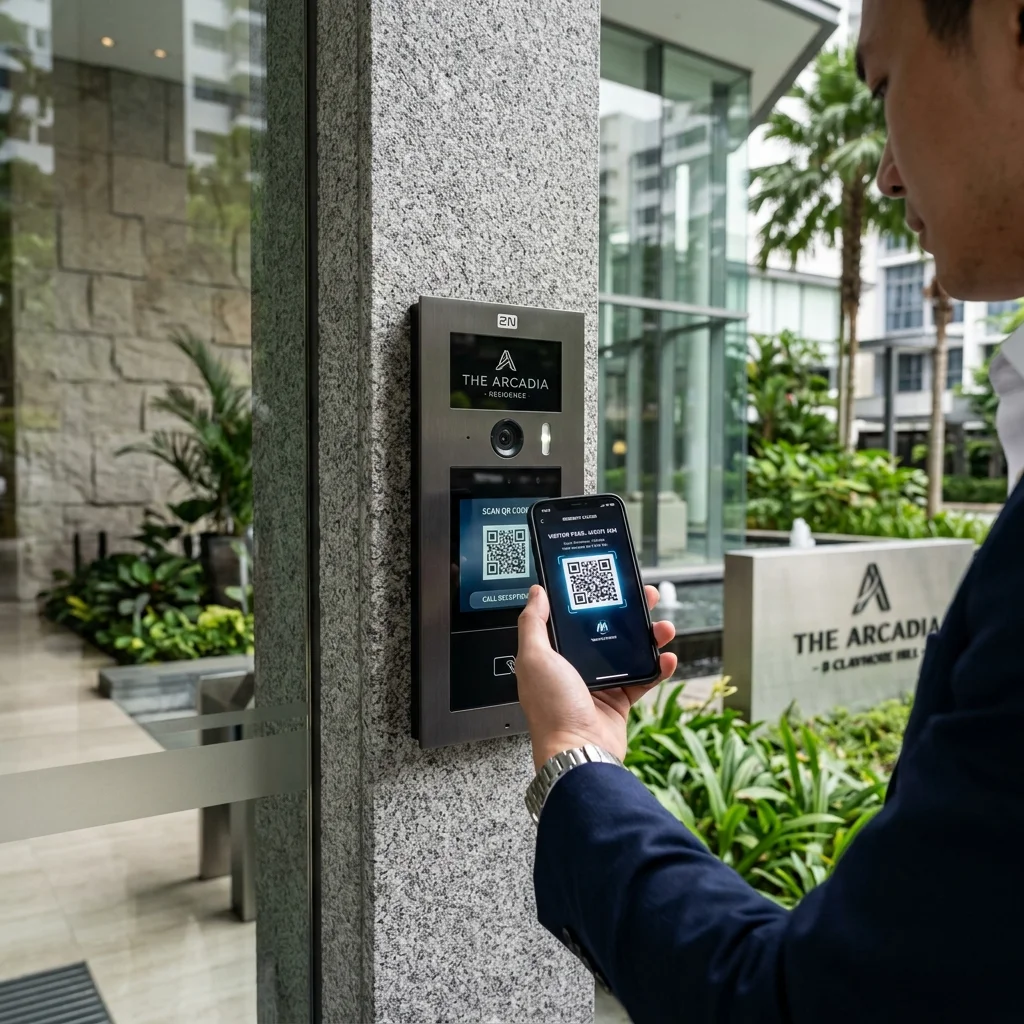
Beyond Just "Press and Call"
Modern intercoms serve as multi-functional access points. Casual guests call through the standard directory. Pre-registered visitors receive a QR code or temporary PIN that allows entry without requiring the resident to answer a call. Contractors receive time-limited access credentials. All entry events are logged: whether handled by the resident, the guard, or the system automatically.
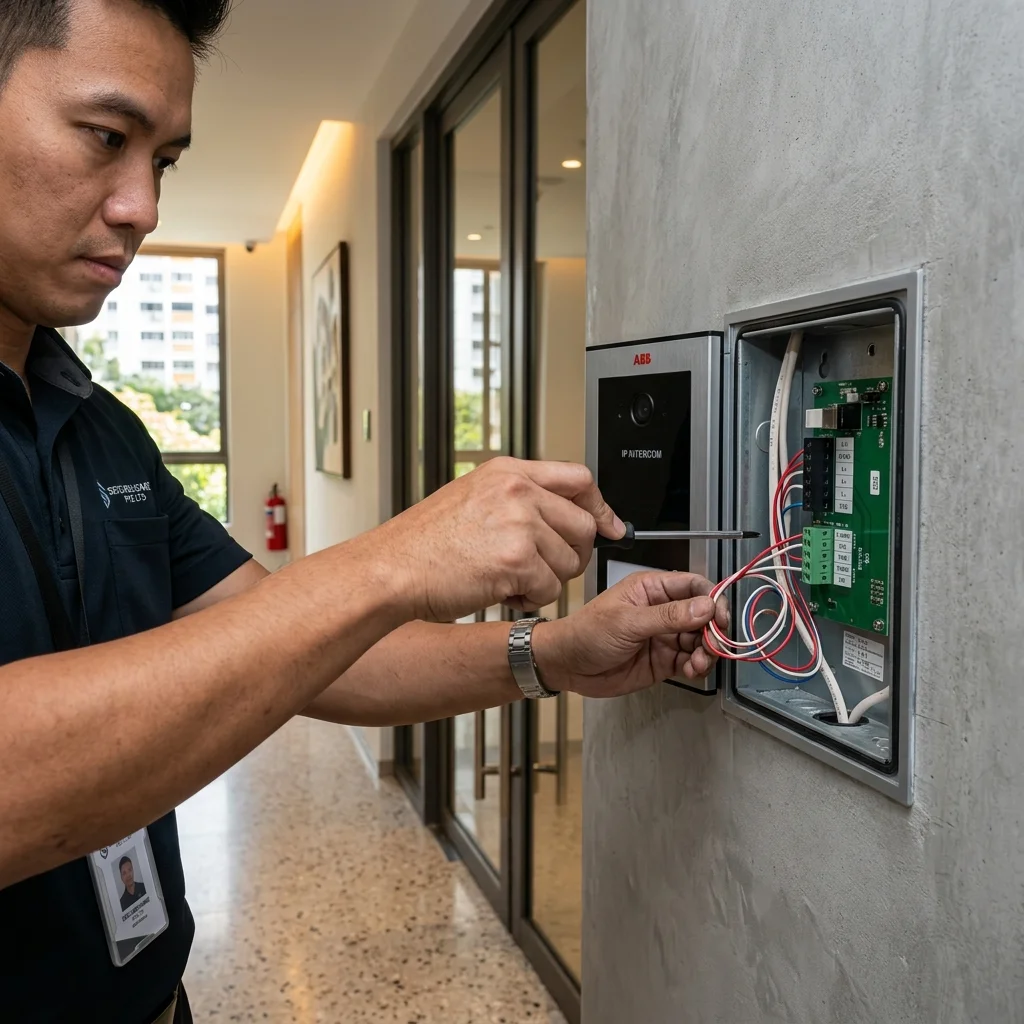
Infrastructure Reuse Where Possible
We use specialised technology to run modern IP signals over existing cables where feasible: one of our strongest advantages over full-replacement approaches. Running the new system over existing 2-wire cabling significantly reduces the project cost and the disruption to residents during installation. We assess reuse potential during the site survey and present it honestly: where it is not feasible, we explain why before the scope is agreed.
Most Relevant for Ageing Residential and Managed Properties
Especially effective for estates where maintenance costs are surfacing as a recurring budget item.

Condominiums & MCSTs
Where existing systems are reaching end-of-life and finding replacement parts is becoming difficult or impossible. Many councils begin the upgrade conversation after a service callout that produced a repair quote larger than expected: and the realisation that the next one will be worse.

Older Developments
Where systems no longer meet resident expectations for mobile connectivity, visitor convenience, or video clarity. Resident expectations for technology have changed significantly in recent years. A system that was adequate ten years ago is now a source of daily friction.

Upgrading Properties
Where an intercom upgrade is part of a broader shift toward automation, better security, or access control modernisation. An intercom upgrade that connects to visitor management, LPR, and the estate management platform delivers substantially more value than one addressed as a standalone project.
What Changes After an Intercom Upgrade
A properly designed upgrade improves both reliability and the daily experience for every resident. The changes are operational rather than cosmetic: the system becomes something the estate manages rather than something it manages around.
Service callouts after transition to a supported IP platform
sourcing uncertainty on well-supported modern systems
Key Areas of Improvement
Clearer, lag-free audio and video communication at all entrance points. Significant reduction in breakdowns and unplanned maintenance costs. Reduced reliance on guards for guest verification, as residents handle routine entries from their mobile app. Improved resident satisfaction with mobile access features and faster visitor handling. Reliable audit logs for all entrance activity: accessible to management for governance and incident review without manual compilation.
What Affects the Cost of an Intercom Upgrade?
Two condominiums with similar unit counts can have very different upgrade costs depending on infrastructure condition, estate layout, and integration requirements.
Number of Units and Blocks
Each residential unit typically requires a door station or indoor monitor replacement. Multi-block estates require more phasing time and proportionally more hardware: particularly where blocks have different intercom architectures that need to be standardised as part of the upgrade.
Existing Cabling Infrastructure
Whether the estate's existing cabling can carry the new system is the single biggest cost variable in most intercom upgrades. Where 2-wire reuse is feasible, the saving is substantial. Where full recabling is required, it extends the project timeline and cost considerably. We assess this before agreeing any scope.
Number of Entrance Panels
Each lobby, pedestrian gate, vehicle entry point, and side access point requiring an intercom panel adds to the hardware scope. Large estates with multiple entrance points per block have proportionally more panel hardware than compact single-entry developments.
Mobile App and Platform Requirements
Enabling resident mobile access requires a platform licence and backend configuration in addition to the hardware. The platform cost is often an ongoing subscription that affects how the MCST presents the investment at the AGM. We present both the capital and subscription cost components clearly in every proposal.
Visitor Management Integration
Connecting the intercom upgrade to a visitor management platform: so that visitor pre-registration, QR access, and digital logs are all handled through one system: adds configuration scope but delivers substantially more operational value than the intercom hardware alone. The decision is whether to address visitor management at the same time as the hardware upgrade, or defer it to a later phase.
Access Control Integration
Integrating the intercom with the estate's access control system: so that intercom events, door releases, and resident credentials are linked in a common audit log: is more straightforward to design at the time of the intercom upgrade than to retrofit afterwards. The scope depends on the access control system already in place and the level of integration required.
A Practitioner Observation
The most consistent cost-saving we achieve in intercom upgrade projects comes from identifying cabling reuse potential before the scope is written. Many councils assume full recabling is required and budget accordingly: then discover during the site survey that significant portions of the existing infrastructure can be retained. The survey takes half a day. The clarity it provides shapes the entire proposal and often changes the council's view of whether the project is affordable.
Why Properties Trust Securevision for Intercom Upgrades
Experience with Legacy Systems
We understand older intercom architectures: from analogue buzzers to early digital systems: and how to transition them safely. That experience is what allows us to assess infrastructure reuse potential accurately and design upgrades that do not require more replacement than is genuinely necessary.
Disruption-Free Upgrades
We plan around your existing infrastructure and resident usage schedules to ensure the upgrade happens with minimal impact on daily life. Phased installation by block, clear resident communication templates, and a maintained existing system throughout the transition are standard on every project.
Designed for Long-Term Support
We focus on open-standard and well-supported systems that remain maintainable for years: not just until the warranty ends. The objective is restoring long-term reliability, not introducing a new dependency on a different proprietary system.
Explore Related Insights
How to Tell If Your Intercom System Needs Replacement
The five critical signs that your property's communication system is approaching the fail zone.
Read Insight →Intercom Upgrade vs Repair: What Property Managers Should Know
Long-term costs and operational stability when deciding between maintenance and modernisation.
Read Insight →Modern Intercom Systems for Condominiums in Singapore
IP-based intercom technology, mobile apps, and QR access for local estates.
Read Insight →Free Resource: Intercom System Health Checklist
A structured scoring framework for MCSTs to assess obsolescence risk and repair viability.
👉 Get the ChecklistFrequently Asked Questions
Questions we hear from MCST councils and managing agents planning an intercom upgrade.
How do I know if my intercom system needs replacing rather than repairing?
The key indicators are: spare parts are no longer available from the manufacturer or distributor, repair technicians with knowledge of the system are becoming increasingly difficult to find, the cost of recent repairs has been escalating without resolving the underlying reliability problems, or the system can no longer support features that residents expect. If any of these apply, replacement planning is more practical than continued repair.
Can existing intercom wiring be reused in an upgrade?
Often yes. Many modern IP intercom systems are designed to run over existing 2-wire cabling using signal conversion technology, which means the wiring installed years ago can carry a new system without full recabling. Whether this is feasible depends on cable condition, run lengths, and the specific intercom system being installed. We assess wiring reuse potential as part of every site survey before any scope is agreed.
How long does an intercom upgrade take?
For a mid-sized estate of 200 to 400 units, a full intercom replacement typically takes three to six weeks depending on access scheduling with residents and whether cabling work is required. We phase the installation block by block to ensure no section of the estate is without intercom coverage at any point during the project. A detailed phasing schedule is provided as part of the proposal.
Will residents lose intercom service during the upgrade?
No, if the project is properly phased. We keep the existing system active for each block or section until the new system is fully commissioned and tested for that block. Residents are notified of their changeover date in advance. Guard coverage is maintained at all entry points throughout the installation period.
Can residents use mobile phones instead of the wall-mounted indoor monitor?
Yes. Modern IP intercom systems support mobile app integration: residents receive visitor calls on their smartphone, can view the visitor on video, and release the door or gate remotely from the app whether they are at home or away from the estate. The wall-mounted indoor monitor remains available for residents who prefer it.
What happens if the internet connection at the estate fails?
The intercom system continues to function for on-site calls between the entrance panel and the indoor monitor even without internet connectivity: the local network within the estate handles the call. Mobile app calls that depend on internet routing will not connect during an outage, but local monitor calls and guard-operated door release remain available.
Can the upgrade be done block by block rather than all at once?
Yes, and this is our standard approach for large estates. Phasing the installation by block allows the project to proceed without disrupting the entire estate simultaneously, allows resident communication to be managed in manageable batches, and allows the management team to gain operational familiarity with the new system before it covers the full estate.
Should we repair or replace our intercom system?
The honest answer depends on three factors: whether spare parts are still available, whether the existing infrastructure can support a new system, and whether the total cost of continued repairs is approaching or exceeding the cost of replacement. We provide a written assessment of all three factors during the site survey. Many councils are surprised to find that the cumulative cost of repairs over recent years has already exceeded what a planned upgrade would have cost.
Ready to Plan Your Intercom Upgrade?
Tell us about your estate. We will assess your current system, check what infrastructure can be reused, and design a modern upgrade that works for your residents.
Licensed by the Police Force: Licence · Serving Singapore since 2006