- A burglar alarm is only useful if it can communicate with the monitoring centre; detecting the intrusion is only half the job.
- Banks treat communication failures as a serious security risk and will not accept a single point of failure in their alarm systems.
- Leased lines were introduced because relying solely on telephone lines created an unacceptable window of vulnerability between test signals.
- True redundancy requires communication paths that are physically and logically independent; two cables in the same conduit do not count.
- Modern alarm systems use IP and mobile data networks as their dual-path equivalent; what was once available only to banks is now standard for any well-specified system.
- The principle is unchanged across all these technologies: a single point of failure in the communication path is a vulnerability that must be eliminated.
The Alarm Worked Perfectly. The Communication Did Not.
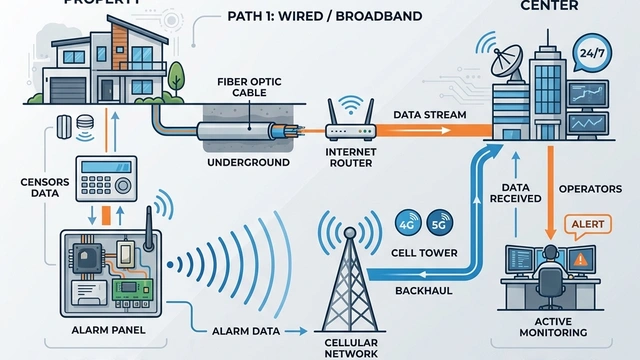
Imagine this situation. A burglar enters a property. The motion detector triggers. The alarm panel activates. The siren sounds. Everything works exactly as it should; except the monitoring centre never receives the signal. The communication path failed. The alarm did its job. The message never got through.
This is one of the most important vulnerabilities in any alarm system, and one of the least visible. The detector, the panel, and the siren are all things you can see and test. The communication path between the panel and the monitoring centre is easy to overlook. High-security sites learned that lesson long before most residential installers took it seriously.
KEY POINT
An alarm system that cannot communicate is only doing half its job. Detecting the intrusion matters. Getting that detection to the people who can act on it matters equally.
Why Banks Think Differently

Banks take security seriously for the obvious reason; money. But there is another driver that is often even more important: trust. A successful break-in at a bank does not only result in financial loss. It damages customer confidence and the bank's reputation in ways that take years to repair.
For that reason, banks have always been unwilling to accept a single point of failure in their security systems. If a communication path fails, there must be another way for the alarm signal to reach the monitoring centre. This philosophy; eliminate the single point of failure; shaped alarm communications for decades and eventually influenced how the rest of the industry designed systems for everyone else.
KEY POINT
Banks were not overengineering. They were applying a straightforward risk management principle: any system component that can fail silently, without anyone knowing; is a vulnerability. The communication path was that component.
Why a Telephone Line Was Not Enough
In the previous article, I explained why monitoring centres adopted seven-day polling cycles; the compromise between reliability and telephone infrastructure cost. Even with polling, a communication failure would only be detected at the next scheduled test signal. For a residential account, that window was typically a week. For a bank, a week of undetected communication failure was simply not acceptable.
Imagine the telephone line was damaged the day after the last test signal. The monitoring centre would not discover the fault until the next scheduled check; potentially six days later. Even if the interval was reduced to daily polling, there was still a window of vulnerability. For a high-security site where the consequences of a missed alarm could be severe, any undetected window was one too many.
KEY POINT
Polling reduced the detection window for communication failures. It did not eliminate it. Banks needed a solution that would detect a communication fault not within a week, or even a day, but within seconds.
The Leased Line Solution
This is where leased lines became important. Unlike a normal telephone line that only became active when a call was made, a leased line was permanently connected between the protected premises and the monitoring centre. Think of it as a dedicated communication path that was always live, not a line you dialled, but a circuit that simply existed between two points at all times.
The advantage was significant. If the communication path was interrupted for any reason; a cut cable, equipment failure, or communication fault; the monitoring centre would know almost immediately. There was no polling interval to wait for. The permanent connection meant any interruption caused an immediate loss of signal at the receiving end, and that loss was flagged instantly. For banks, this reduced the communication vulnerability from days to seconds.
The cost was higher than a standard telephone line. Leased circuits required dedicated infrastructure and attracted higher rental charges. But for a bank, the cost of a missed alarm was far greater than the cost of the line. The calculation was straightforward.
KEY POINT
A leased line did not make the alarm system more sensitive or the detectors more capable. It changed one thing: the speed at which a communication failure was detected. For high-security sites, that speed was everything.
Why Banks Kept the Telephone Line Too
Interestingly, the leased line did not replace the telephone line in most bank installations. Both were retained; deliberately. The logic was simple: if the leased line failed, the alarm could still communicate using the PSTN telephone line. If the telephone line failed, the leased line remained available. Two paths meant that a single failure could not silence the alarm entirely.
This is the principle of redundancy, and it is the same principle applied in IT infrastructure, aviation, and engineering wherever the cost of failure is high. Never rely on a single point of failure. Banks were applying it to alarm communications long before the concept became common language in security system design. What it required was not just two communication channels, but two channels that could fail independently of each other.
DESIGN RULE
Redundancy only works when the backup can operate independently of the primary. Two channels that share a common power supply, a common cable route, or a common network switch are not truly redundant; a single fault can still take both down at once.
True Redundancy Means Different Paths
Having two communication channels is only useful if they are genuinely independent. This is a detail many people overlook, and it is where good security engineering separates itself from installations that merely look redundant on paper.
In high-security installations, it was not enough to simply run two cables. Security engineers ensured that the leased line and telephone line took different physical routes into and through the building wherever possible. The reason was straightforward: if both cables entered the building through the same conduit or trench, a single cable cut; accidental or deliberate; could disable both communication paths simultaneously. That defeats the point entirely.
In Singapore, this physical path diversity is worth thinking about carefully. Many buildings; particularly older HDB blocks and some condominiums; have a single entry point for all telecommunications infrastructure. Both the broadband cable and the mobile network signal enter from the same riser. True physical diversity may not be achievable at the building level. In those situations, the independence must come from technology diversity; making sure the two paths use genuinely different infrastructure, such as wired IP and cellular mobile data, so that a single exchange failure or cable cut cannot affect both simultaneously.
DESIGN RULE
When specifying dual communication paths, ask whether the two paths share any common infrastructure; same cable route, same exchange, same network provider. The more they share, the less independent they actually are. The objective is to ensure no single physical or logical failure can silence both.
The Modern Version: IP and Mobile Data
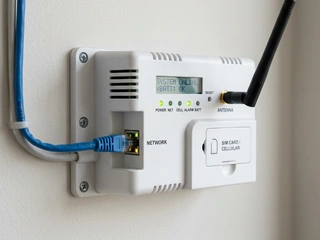
Today's alarm systems use a different combination of technologies to achieve the same objective. The leased line and PSTN telephone pair has been replaced, for most installations, by IP network and mobile data network, typically broadband for the primary path and 4G or 5G cellular as the backup.
The IP connection travels through the fibre broadband infrastructure. The backup communication uses the mobile network; a completely separate physical infrastructure owned by different network operators, routing through different exchanges, and unaffected by a fibre cable cut or broadband equipment failure. If the broadband service fails, the alarm continues to communicate through the mobile network. If the router fails, the cellular module in the alarm panel activates independently. If the fibre cable is physically damaged, cellular data continues uninterrupted.
What was once available only to banks and high-security commercial facilities; dual-path communication with genuinely independent channels; is now standard in any well-specified alarm system. The hardware cost has come down significantly. The principle has not changed at all.
KEY POINT
IP plus cellular is not simply a modern convenience feature. It is the residential and commercial equivalent of the bank's leased line plus PSTN combination; two genuinely independent communication paths that cannot both be taken down by the same single failure.
What Banks Taught the Security Industry
The lesson the banking industry taught the security industry is straightforward: redundancy only works when the backup is genuinely independent. Simply having two communication channels is not enough if they share a common failure point. They should use different technologies, follow different physical routes, and avoid common dependencies wherever possible.
This principle remains as important today as it was thirty years ago, because the underlying risk has not changed. A communication path can still fail; through cable damage, equipment fault, network outage, or deliberate interference. The only reliable defence against any of these is a second path that is not affected by the same event. Technology changes. Risk management does not.
KEY POINT
The question to ask about any dual-path alarm system is not "does it have two communication channels?" but "can both channels fail from the same single cause?" If the answer is yes, the redundancy is incomplete.
What Homeowners Can Learn From Banks
Most homeowners do not need bank-level security. But the communication path question is worth asking regardless of the size or value of what you are protecting.
When evaluating an alarm system, ask how it communicates with the monitoring centre and what happens if that primary path fails. If the system communicates only over IP and the broadband router goes down, does the alarm panel have a cellular backup that activates automatically? If the system relies solely on the mobile network, what happens in a localised cellular outage? These are not theoretical concerns; broadband outages and cellular disruptions both happen, and they happen at unpredictable times.
Also ask how quickly a communication failure is detected. A system that polls once a day will not tell your monitoring centre about a broken connection until the following day. A system with continuous IP supervision will flag it within minutes. The difference matters most during the period between a communication failure and its detection, and that is precisely the window a determined intruder might exploit.
The homeowner who asks these questions before installation is in a much stronger position than the one who discovers the communication path was a single point of failure after an incident. Banks learned that lesson at scale. The principle applies equally to a three-bedroom apartment in Tampines.
Securevision Verdict
Over the years, alarm communications have evolved from PSTN telephone lines through leased lines, GSM networks, IP communications, and today's dual-path systems. The technology has improved with each generation. The underlying lesson from the banking industry has not changed.
The alarm signal must reach the right people at the right time. Detecting the intrusion is only half the job. The other half is making sure the signal gets through; reliably, quickly, and regardless of what happens to any single communication path. Whether you are protecting a bank, a retail shop, or a home in Singapore, that principle is the same.
In Short
The alarm industry arrived at dual-path monitoring because banks demanded it first. A system that relies on a single communication channel; whether telephone line, internet connection, or mobile data; has a single point of failure that a determined intruder can exploit. The right answer for high-value residential and commercial properties is the same answer banks settled on decades ago: two independent communication paths that do not share infrastructure, so that cutting one leaves the other intact.

Frequently asked questions
What are alarm communication paths?
Alarm communication paths are the routes by which a burglar alarm panel sends signals to a central monitoring station. When an alarm is triggered, the panel transmits an alert through these paths. The most common paths today are broadband internet, mobile data (GSM/4G), and traditional telephone lines. The reliability of alarm monitoring depends directly on the reliability of the communication path.
Why do some alarm systems use two communication paths?
Using two independent communication paths means that if one is disrupted; whether by a fault, a network outage, or deliberate interference; the system can still transmit through the other. This is called dual-path or redundant communication. A system with only one communication path has a single point of failure that can prevent the monitoring centre from receiving an alarm signal even when the detector and panel are working correctly.
What happens if a burglar cuts the telephone line?
On a single-path system using a telephone line, cutting the line would prevent alarm signals from reaching the monitoring centre. On a dual-path system, the panel would detect the loss of the primary path and automatically switch to the secondary path, typically mobile data, to continue transmitting. The monitoring centre would also receive a line-cut alert, which is itself treated as a potential security event.
What is GSM backup in a burglar alarm system?
GSM backup refers to a mobile data module built into or added to an alarm panel that allows it to communicate over a mobile network when the primary internet or telephone connection is unavailable. When the panel detects loss of its primary communication path, it automatically switches to the GSM module to continue transmitting to the monitoring centre.
What does path integrity monitoring mean?
Path integrity monitoring means the alarm system periodically tests its communication path; sending a check signal to the monitoring centre and confirming a response; rather than waiting for an actual alarm event to discover that the communication has failed. If the check signal goes unanswered, the monitoring centre treats this as a fault condition and follows up immediately.
How often does an alarm panel test its communication path?
The frequency of path testing varies by system configuration and monitoring station requirements. Some systems test every few minutes, others hourly. High-security installations may poll more frequently. The polling interval is a balance between detection speed and network load; a system that polls every minute will detect a communication failure far sooner than one that polls daily.
What is dual-path monitoring and do I need it?
Dual-path monitoring means the alarm panel maintains two independent communication paths to the monitoring centre simultaneously. For residential properties in Singapore, a system with internet as primary and mobile data as backup is a practical and cost-effective dual-path configuration. For commercial or high-value properties, dual-path is strongly recommended.
Can my alarm panel communicate over 4G or 5G?
Yes. Most modern alarm panels support 4G LTE communication modules, and some manufacturers are beginning to support 5G. The mobile data module is typically a SIM-based device inside the panel. The specific network generation supported depends on the panel model and the module fitted. For most Singapore applications, 4G coverage is reliable and sufficient for alarm communication purposes.
What is the difference between IP monitoring and telephone monitoring?
IP monitoring transmits alarm signals over an internet connection using data protocols, while telephone monitoring used the public switched telephone network (PSTN) to transmit signals over a voice or data call. IP monitoring is faster, cheaper to operate, and supports richer event data. Telephone monitoring is now largely obsolete in Singapore as the PSTN network has been decommissioned in favour of fibre and mobile infrastructure.
How do I know if my alarm system has dual-path communication?
Check the alarm panel's specification sheet or ask your installer. A dual-path system will have at least two communication modules, typically one for broadband internet and one for mobile data. You can also ask your monitoring centre to confirm how many paths your panel is currently reporting. If you are uncertain, request a system review; the communication configuration is one of the most important aspects of alarm performance.
Does cutting the power affect alarm communication?
Not immediately. A properly installed alarm panel has a backup battery that maintains operation during a power cut. Communication modules, including mobile data; continue to function on battery power for a period determined by battery capacity. The monitoring centre receives a mains-fail alert when power is lost, allowing them to monitor the situation proactively.