- The biggest difference between traditional and modern intercom systems is not video quality; it is architecture. Traditional systems use dedicated proprietary wiring. Modern IP systems use the same standard network cabling as computers, cameras, and Wi-Fi.
- Traditional systems become obsolete not because they stop working but because manufacturers discontinue support, spare parts disappear, and the systems can no longer evolve to meet resident expectations.
- Modern IP intercom systems use Power over Ethernet (PoE); the same network cable carries both data and power, eliminating the need for separate power supplies at each door station.
- Most Singapore condominium intercom upgrade projects do not require full rewiring; portions of the existing riser cabling can often be reused, but a site survey is always required before any conclusion can be made.
- Modern systems have evolved beyond visitor calls into full access management platforms; supporting visitor QR codes, pre-registration, digital visitor logs, lift integration, and CCTV linkage.
- Visitor images and call recordings captured by IP intercom systems are personal data under Singapore's PDPA; organisations need a defined retention policy and restricted access to those records.
What Most People Think an Intercom Does
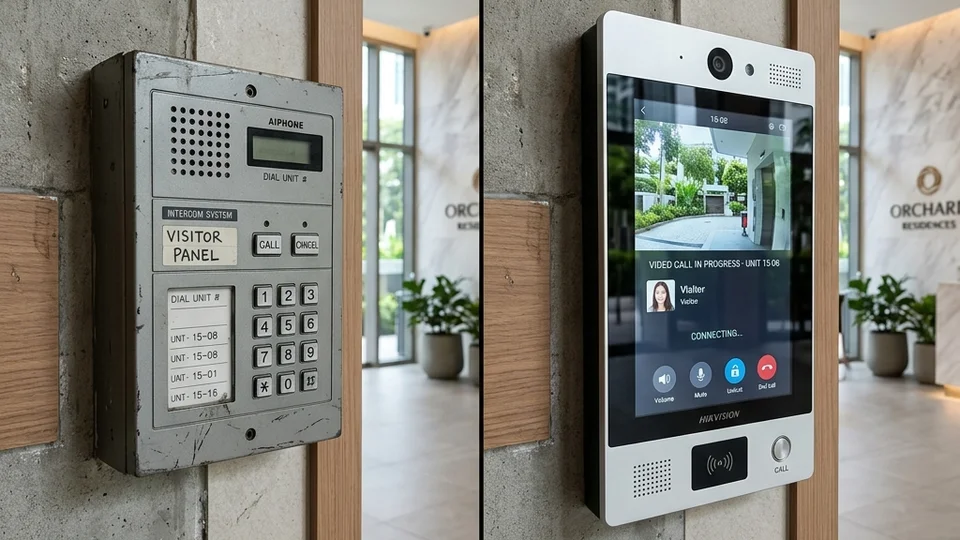
Most people think of an intercom as a doorbell with a speaker. Someone presses a button at the entrance. The resident picks up a handset or answers on their phone. The door opens. That basic function has not changed. What has changed enormously is how that function is delivered; the architecture behind it, the infrastructure it depends on, and what it can do beyond a simple visitor call.
Intercom systems have undergone one of the biggest transformations in the security industry over the past decade. What was once a dedicated communication device connected by proprietary wiring has evolved into a cloud-connected platform that routes visitor calls to smartphones anywhere in the world, maintains a digital visitor log, integrates with lift controls, and forms part of the estate's overall access management infrastructure.
Understanding that evolution matters because it explains why some intercom systems continue serving buildings well for twenty years while others eventually become impossible to maintain, expand, or support, not because they have failed, but because the ecosystem around them has disappeared. It also explains why the most common question we hear from MCST councils: "the system is still working, why should we upgrade?"; does not always have a simple answer.
How Traditional Intercom Systems Were Built
Traditional intercom systems were built around dedicated wiring running between each component. A visitor panel at the lobby connected to a central controller, which connected to individual handsets in each residential unit through multi-core cables specific to that manufacturer's system. Audio and video signals travelled through these dedicated cables. Everything was self-contained. No internet connection was required, and none of the infrastructure was shared with any other building system.
These systems were generally reliable. Many installed in Singapore condominiums in the 1990s and early 2000s are still operating today. The engineering was sound and the components were built to last. The problem is not the hardware; it is what happens to the ecosystem around it over time.
When a manufacturer discontinues a product line, the supply chain for replacement parts gradually contracts. The distributor sells down existing stock. When that runs out, contractors look to other contractors who may have salvaged components from decommissioned estates. Eventually there are no parts left. At that point, every fault becomes a replacement discussion rather than a repair decision, and the council finds itself making an urgent upgrade decision rather than a planned one.
Traditional systems also have structural limitations that make expansion difficult. Adding a new visitor panel, extending to a new block, or integrating with a mobile application typically requires additional proprietary wiring and hardware that may no longer be available. The system that was correctly specified for the original development can become a constraint on how the estate can evolve.
KEY POINT
Traditional intercom systems do not become obsolete because they stop working. They become obsolete because the ecosystem supporting them; spare parts, technical support, expansion hardware; gradually disappears. The system may still function the day the last spare part runs out. It simply cannot be repaired when the next fault occurs.
How Modern IP Intercom Systems Are Different
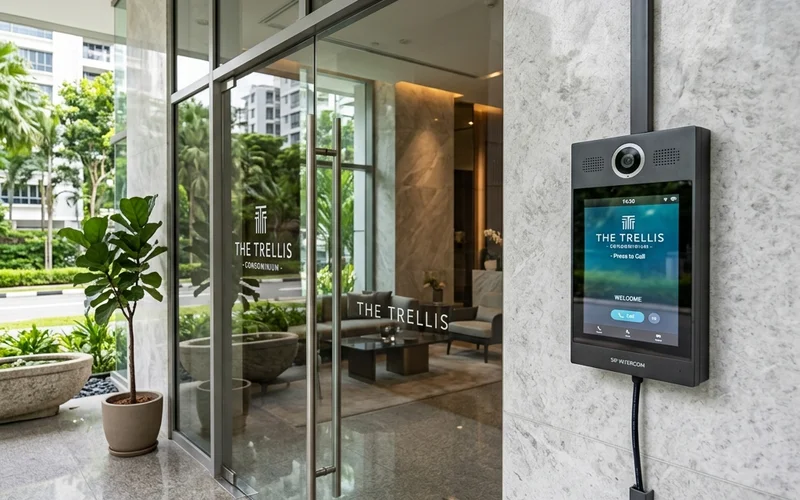
Modern IP intercom systems take a fundamentally different approach to architecture. Instead of dedicated proprietary wiring, they operate over standard network infrastructure; the same Cat5e or Cat6 cabling used by computers, CCTV cameras, and Wi-Fi access points throughout the building. Each intercom component; door station, indoor monitor, controller; has its own IP address and communicates over the building's data network.
This architectural shift changes almost everything about how the system can be managed, expanded, and integrated with other systems. Adding a new door station means connecting it to the nearest network point rather than running dedicated intercom cabling from the entrance to the comms room. Updating firmware, changing user permissions, and managing the resident directory all happen through a software interface rather than at the hardware level. The system can be monitored and managed remotely, which reduces the time and cost of routine maintenance.
Power over Ethernet; One Cable Does Everything
One of the most practically significant features of modern IP intercom systems is Power over Ethernet (PoE). The same network cable that carries data also delivers power to the device; a door station, indoor monitor, or lobby panel does not need a separate power supply at the installation point. The PoE switch in the communications room powers all connected devices through their network cables. This simplifies installation considerably compared to traditional systems that required both a data cable and a power run to each panel, and it makes future additions straightforward; a new door station needs only a network connection.
Open Standards and Long-Term Supportability
Many modern IP intercom systems use SIP; Session Initiation Protocol; the same open communication standard used in VoIP telephone systems and video conferencing platforms. Because SIP is an open standard rather than a proprietary protocol, devices from different manufacturers can often communicate with each other, and the system is not locked into a single supplier's ecosystem. If one manufacturer discontinues a product or closes a Singapore operation, the infrastructure can often continue working with another manufacturer's hardware without rewiring.
This is a significant change from the proprietary model of traditional systems. For MCST councils thinking about the next fifteen years, the question of whether the intercom platform will remain supportable; regardless of what happens to any individual manufacturer; is one of the most important factors in a long-term specification decision.
Securevision's View
We often visit condominiums where the existing intercom system is still functioning reasonably well. Residents can answer calls, visitors can reach units, and the basic function is intact. The problem is not functionality; it is the gap between what the system provides and what residents now expect. Residents who answer visitor calls on a smartphone in other contexts find it inconvenient to be tied to a handset inside the apartment. That expectation gap is often what drives the upgrade conversation, before the spare parts situation forces it.
The Wiring Question; Do We Need to Rewire the Whole Building?
The first question almost every MCST council asks when an intercom upgrade is being discussed is whether the building will need to be fully rewired. It is an understandable concern. In a condominium of 200 or 300 units, the prospect of running new cables to every apartment is daunting in terms of cost, disruption, and the practical difficulty of coordinating access to occupied units.
The honest answer is: it depends, and a site survey is always required before any conclusion can be made. However, the common assumption that a full rewire is inevitable is frequently incorrect.
Some modern IP intercom platforms include adapters that allow the system to operate over existing 2-wire or 4-wire intercom cabling rather than requiring new Cat5e or Cat6 runs to every unit. Whether existing cabling can be reused depends on the cable type, its condition, and the distances involved; all of which need to be assessed on site. In many Singapore condominium projects we have managed, portions of the existing riser cabling have been retained, with new cabling required only in specific areas where the existing infrastructure was unsuitable. The result is a modern IP system at significantly lower cost and disruption than a complete rewire would have required.
For the connection between residential units and the floor distribution point, the approach varies by system; some use the existing intercom cable with adapters, others provide new indoor monitors that connect wirelessly to the building's Wi-Fi, and others replace the in-unit handset with a smartphone application that requires no in-unit cabling at all. Each approach has different implications for cost, resident experience, and long-term maintenance.
PLANNING POINT
Do not assume a full rewire is required before getting a site assessment. In many projects, the actual cabling scope is significantly less than initially feared. Equally, do not assume existing cabling can definitely be reused; the only reliable way to confirm this is a proper infrastructure assessment before any equipment is specified.
What Modern Intercom Systems Can Do Beyond Visitor Calls

For many years, intercom systems had a single purpose. A visitor pressed a button, a resident answered, and the door opened. Modern IP-based systems have evolved significantly beyond that core function, and understanding what they can do helps property owners evaluate whether an upgrade would deliver value beyond simply replacing old hardware.
Smartphone Access
The most immediately impactful feature of modern IP intercom systems is routing visitor calls to residents' smartphones. When a visitor presses the call button at the lobby, the call is sent over the internet to the resident's phone; wherever they are. The resident sees live video of the visitor, speaks to them, and can release the door from anywhere with an internet connection. For households where both adults work during the day, this eliminates the problem of missed deliveries, contractors who cannot enter, and visitors left waiting at the lobby with no way to reach anyone.
Visitor Management
Modern intercom platforms increasingly include visitor management capabilities that change how an estate handles non-resident access. Residents can pre-register expected visitors and issue a QR code that the visitor presents at the lobby panel for automatic access, without needing to call the unit at all. Contractors can be issued time-limited access credentials that expire automatically. Delivery personnel can be granted temporary access to a specific lobby or letter box area. The system maintains a digital log of every visitor entry automatically, replacing manual visitor books with a searchable, time-stamped record. This log constitutes personal data under Singapore's PDPA; estates using visitor management features need a defined retention policy and restricted access to those records.
Lift Integration
When a modern intercom system is integrated with the building's lift controls, granting visitor access at the lobby can simultaneously activate the correct floor destination in the lift; so the visitor can travel directly to the resident's floor without being able to access other floors. This is increasingly standard in new Singapore condominium intercom installations and is one of the most commonly requested features in upgrade projects, because it removes the need for a security officer to escort visitors to the correct floor.
CCTV Integration
Integration between the intercom and CCTV systems means that every visitor call event can trigger an automatic camera image capture at the entrance; so the system records not just that a call was made and answered, but what the visitor actually looked like at that moment. For incident investigation and for providing evidence in disputes, this combination is significantly more useful than either system operating independently.
Securevision's View
The intercom has evolved from a communication device into an access management platform. The most successful upgrade projects we manage are the ones where the council understands this shift before the project begins; because it changes how the scope is defined, what the system needs to integrate with, and how residents are briefed on what to expect. An intercom upgrade that is presented to residents as "replacing the handsets" will generate less enthusiasm and more complaints than one presented as "giving you smartphone access to your front door and QR codes for your visitors."
Why More Properties Are Upgrading Now
One observation we have made consistently over the past five years is that many intercom upgrades today are not driven by system failure. They are driven by a combination of changing resident expectations, approaching end-of-support for existing platforms, and the desire to avoid making an upgrade decision under pressure rather than planning it properly.
Residents today use video calls, app-based services, and remote management tools in every other part of their lives. They arrive at their condominium accustomed to being able to manage things from their phone and find it genuinely inconvenient to be tied to a handset inside the apartment for visitor calls. For managing agents, the administration of an older system; managing a physical directory, sourcing parts, coordinating repairs that never quite resolve the underlying issue; consumes time that a modern platform would handle automatically. For MCST councils, the knowledge that spare parts for the existing system are becoming harder to source is a legitimate governance concern, because the alternative to planning a proactive upgrade is making a reactive one under pressure when the next significant fault occurs.
The most successful upgrades we have been involved in were planned while the existing system was still operational. The council had time to evaluate options properly, communicate with residents about what was changing and why, and manage the transition without urgency. When a system fails unexpectedly; particularly in a large development; decisions have to be made quickly, options are more limited, and the disruption to residents during the transition is harder to manage.
Signs It May Be Time to Evaluate Options
| Sign | What It Means | Recommended Action |
|---|---|---|
| Spare parts are becoming difficult to source | Manufacturer support has ended or stock is depleted | Begin upgrade planning before the next failure |
| Residents want smartphone access | Expectation gap between system capability and resident lifestyle | Assess whether current system can be extended or needs replacement |
| Repairs are becoming more frequent | System reaching end of practical service life | Request a full infrastructure assessment |
| Maintenance costs are rising annually | Each repair is more complex than the last | Model repair cost trajectory against upgrade cost |
| Intercom issues appear regularly in AGM discussions | Resident frustration has reached formal governance level | Present upgrade options at the next council meeting |
| The system cannot be expanded | New blocks, new entry points, or new requirements cannot be accommodated | Evaluate modern platforms that support the estate's future requirements |
For a detailed discussion of the upgrade decision, including spare parts availability, resident onboarding, re-cabling considerations, and typical project timelines; see our companion article: Condominium Intercom Upgrade; When Should Your Estate Start Planning?
Frequently Asked Questions
What is the biggest difference between traditional and modern intercom systems?
The biggest difference is architecture. Traditional intercom systems use dedicated proprietary wiring; each component connects through cables specific to that manufacturer's system. Modern IP intercom systems use standard network cabling (Cat5e or Cat6), the same infrastructure used by computers, cameras, and Wi-Fi. This means modern systems can be managed remotely, expanded without specialist cabling, integrated with other building systems, and are not dependent on a single manufacturer's continued support.
Why do older intercom systems become obsolete even when they still work?
Older systems become obsolete primarily because of what happens to the ecosystem around them rather than the hardware itself. When a manufacturer discontinues a product line, spare parts become harder to source, technical support disappears, and expansion becomes impossible. A system that is functioning today may have no replacement parts available if a fault occurs next year. The hardware outlasts the supply chain that supports it, and that is typically what drives the upgrade decision.
Do we need to rewire the entire condominium to upgrade to an IP intercom?
Not necessarily. Some modern IP intercom platforms can operate over existing 2-wire or 4-wire intercom cabling using adapters. Whether your existing cabling can be reused depends on its type, condition, and the run distances involved; all of which require a site assessment to confirm. In many Singapore condominium projects, portions of the existing riser cabling are retained, with new cabling required only where the infrastructure is inadequate. Do not assume a full rewire is inevitable before getting a proper assessment.
What is PoE and why does it matter for intercoms?
PoE stands for Power over Ethernet. It means the same network cable that carries data to a device also delivers electrical power; so a door station or indoor monitor does not need a separate power supply at the installation point. The PoE switch in the communications room powers all connected devices through their network cables. This simplifies installation significantly compared to traditional systems, which required both a data connection and a separate power run to each panel.
What is SIP and why is it important for long-term supportability?
SIP stands for Session Initiation Protocol; the open communication standard used in VoIP telephone systems and video conferencing platforms. An intercom system that uses SIP is not locked into a single manufacturer's ecosystem. If a manufacturer discontinues a product or closes its Singapore operation, the infrastructure can often continue working with another manufacturer's hardware. For MCST councils thinking about the next fifteen years, an open-standard platform provides significantly more flexibility than a proprietary one.
What is lift integration and how does it work?
Lift integration means the intercom system is connected to the building's lift controls. When a resident grants a visitor access through the lobby, the system simultaneously activates the correct floor destination in the lift; so the visitor can travel directly to the resident's floor without being able to access other floors. This removes the need for a security officer to escort visitors and is one of the most commonly requested features in Singapore condominium intercom upgrade projects.
Can residents answer intercom calls on their smartphones?
Yes; this is a standard feature of modern IP intercom systems. When a visitor presses the call button at the lobby, the system routes the call over the internet to the resident's smartphone. The resident sees live video of the visitor, speaks to them through the app, and can release the door remotely. For residents who are away from home during the day, this eliminates the problem of missed deliveries and visitors who cannot reach anyone. Most systems allow multiple family members to receive calls simultaneously.
What is a visitor management platform?
A visitor management platform is software that handles how non-residents access the estate; beyond a simple call-and-answer process. Residents can pre-register expected visitors and issue QR codes for automatic lobby access. Contractors can be given time-limited credentials that expire automatically. Deliveries can be managed through designated access windows. The system maintains a digital log of every visitor entry, replacing manual visitor books. This log is personal data under Singapore's PDPA and requires a defined retention policy.
Are visitor images and call recordings personal data under Singapore's PDPA?
Yes. Images captured at the entrance when a visitor calls, and any call recordings retained by the system, constitute personal data under the Personal Data Protection Act. Estates operating modern intercom systems that capture visitor images or recordings need a clear retention policy defining how long these records are kept, who has access to them, and how they are protected. Most systems can be configured to delete records automatically after a defined period. A retention period of 30 days is a commonly used starting point for residential estates.
What happens to the intercom system if the internet goes down?
A properly designed modern intercom system should continue operating locally even if internet connectivity is temporarily unavailable. Residents can still communicate with visitors through indoor monitors, and doors can still be released through the local network. What is affected during an internet outage is the cloud-based functionality; smartphone app notifications, remote door release from outside the building, and cloud management portals. These resume automatically once internet connectivity is restored.
How long do intercom systems typically last?
The hardware in a well-maintained intercom system can remain operational for ten to fifteen years or longer. However, the practical service life; the period during which the system can be adequately maintained and supported; is often shorter. Spare parts for many Singapore condominium systems installed in the late 2000s and early 2010s are now becoming difficult to source, even though the hardware itself may still be functioning. A system's supportability, not just its functionality, is what determines when an upgrade becomes necessary.
In Short
The shift from traditional to IP intercom is not simply an upgrade in video quality or features; it is a fundamental change in architecture. Modern IP systems use standard network infrastructure, open communication protocols, and cloud-connected management platforms. They can route visitor calls to smartphones, integrate with lifts and CCTV, support visitor management, and be expanded and maintained without specialist proprietary hardware. Older systems become obsolete not because they fail but because the ecosystem supporting them disappears. Understanding this distinction is what helps property owners and MCST councils make upgrade decisions at the right time; before a system failure forces an urgent response rather than a planned one. For the technical detail on how the components work, see our companion article: How Intercom Systems Work.