- Alarm monitoring has evolved from telephone-line diallers to always-connected IP communications, and the transition was accelerated by the global retirement of copper PSTN networks.
- The PSTN era worked well but had a fundamental limitation: communication supervision could only be as frequent as the telephone infrastructure could support.
- IP monitoring did not just replace the telephone line; it changed how alarm supervision is framed, from periodic check-ins to continuous connection monitoring.
- Singapore's telecommunications providers have progressively migrated from copper to fibre, effectively ending the practical life of PSTN diallers for new alarm installations.
- Modern alarm panels are increasingly designed around IP and mobile communications from the ground up; some no longer include PSTN ports at all.
- The dual-path principle established in the PSTN era; primary path plus independent backup; remains equally important in the IP era, now implemented as broadband plus 4G cellular.
Where the Previous Articles Left Off
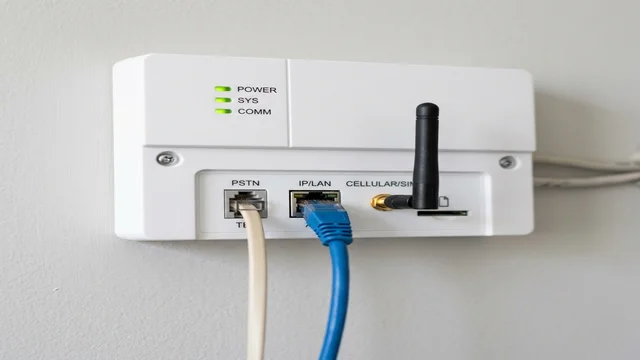
The earlier articles in this series covered how telephone line alarm monitoring worked; the dialler, the Contact ID protocol, the seven-day polling cycle, and why monitoring centres had to manage telephone line capacity so carefully when handling tens of thousands of accounts. The last article explained why high-security sites like banks moved beyond single telephone lines to dual-path systems with leased line backup.
This article covers what happened next; the transition from PSTN monitoring to IP-based monitoring, why it happened when it did, and what changed when the telephone line was no longer the foundation of alarm communication.
The short version: the security industry did not choose to move away from PSTN entirely on its own. The telecommunications industry made the decision for it.
KEY POINT
The transition from PSTN to IP was not simply a technology upgrade chosen by the alarm industry. It was a forced migration driven by telecommunications providers retiring the copper infrastructure that PSTN alarm diallers depended on.
The Telecommunications Industry Forced the Change
For decades, the security industry relied on the copper telephone network; the Public Switched Telephone Network, or PSTN, as the foundation of alarm monitoring. The network was ubiquitous, reliable for its purpose, and already connected to almost every property that needed protection. Alarm panels were designed around it. Monitoring centres were built around it. The entire operational model of alarm monitoring was structured around the assumption that every monitored property had a working telephone line.
That assumption started breaking down in the 2000s. As customers moved towards fibre broadband, mobile communications, and VoIP services, telecommunications providers around the world began retiring their legacy copper infrastructure. The United States saw this at scale; major carriers progressively migrated customers away from analogue telephone services as the economics of maintaining ageing copper networks became increasingly difficult to justify. This created a serious problem for the alarm industry because millions of alarm communicators still depended on PSTN diallers.
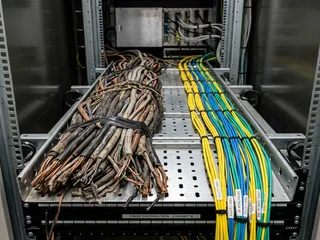
Singapore's telecommunications providers went through a parallel transition. Residential and commercial services were progressively migrated from copper to fibre, effectively ending the practical life of PSTN alarm diallers for new installations. Properties with existing PSTN-based alarm systems faced a choice: upgrade the communicator or lose monitoring capability when the copper line was eventually retired.
The security industry did not lead this change. It responded to it. And in responding, it made a transition that turned out to produce a significantly better monitoring capability than PSTN had ever offered.
SINGAPORE CONTEXT
If your alarm system was installed more than ten years ago and has not had its communicator upgraded, it may still be using a PSTN dialler. As copper infrastructure continues to be retired, that communicator will eventually lose the ability to reach the monitoring centre. This is worth checking with your alarm company before it becomes a problem.
What IP Monitoring Actually Changed
Most people assume that IP monitoring is simply telephone line monitoring using the internet instead of a copper wire. The underlying process looks similar; alarm fires, panel sends a signal, monitoring centre receives it and responds. But IP monitoring changed something more fundamental than the medium. It changed how supervision itself is framed.
With PSTN monitoring, the central question was: has the panel called the monitoring centre recently? The answer was assessed against the polling schedule, if the last test signal arrived within the expected window, communication was assumed to be working. The monitoring centre had no visibility into the communication path between polling events. It simply waited for the next call and hoped nothing had gone wrong in the interval.
With IP monitoring, the question becomes: is the panel communicating right now? Instead of waiting for a scheduled call, the monitoring centre can maintain a persistent or near-persistent connection with the alarm panel. A communication failure is not detected at the next polling event; it is detected when the connection drops, which in a well-configured IP monitoring system happens within minutes rather than days.
That shift, from periodic check-ins to continuous supervision; is the most significant operational change that IP monitoring introduced. Everything else is an improvement in degree. This is a difference in kind.
KEY POINT
PSTN monitoring asked: did the panel call recently? IP monitoring asks: is the panel connected now? The first question has a window of hours or days where the answer is unknown. The second question has a window measured in minutes or seconds. That difference determines how quickly a communication failure is caught.
From Weekly Checks to Continuous Supervision
The practical consequence of this shift is significant. In the PSTN era, a monitoring centre operating on a seven-day polling cycle had a worst-case fault detection window of nearly a week. A property whose telephone line was cut on Tuesday might not be identified as unreachable until the following Monday. For most residential accounts, that was considered an acceptable operational compromise. For high-security sites, it was not, which is why banks and similar facilities invested in leased lines and other dedicated communication methods as described in the previous article.
With modern IP monitoring, the same fault detection that once took days now takes minutes. A well-configured IP monitoring platform will flag a disconnected panel within a few minutes of the connection dropping. More sophisticated implementations use persistent TCP connections or frequent heartbeat signals that bring fault detection down to seconds. The monitoring centre no longer needs to distinguish between "the panel is silent because nothing has happened" and "the panel is silent because it cannot communicate"; because the connection itself provides continuous evidence of reachability.
For the property owner, this translates into a monitoring service where a communication failure is caught and investigated before a week passes, before a day passes, and in most cases before an hour passes. That is a fundamentally different level of assurance from what PSTN monitoring could offer.
KEY POINT
The seven-day polling window was not a design choice; it was a constraint imposed by telephone infrastructure costs. IP monitoring removed that constraint. The monitoring centre can now maintain the communication health visibility that high-security sites once paid premium prices for leased lines to achieve.
The New Generation of Alarm Panels
As the transition accelerated, alarm manufacturers adapted. The first generation of IP-capable panels retained PSTN connectivity as a fallback; a pragmatic response to a market where many properties still had working telephone lines and monitoring centres still had PSTN receiving infrastructure. These panels treated IP as the preferred path and PSTN as the backup.
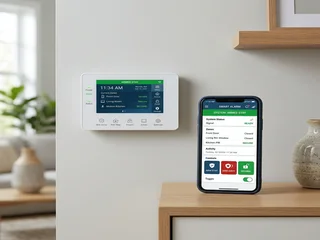
The next generation went further. Leading manufacturers began designing panels with IP and mobile communications as the primary architecture, with PSTN treated as a legacy feature for backwards compatibility. More recently, some manufacturers have removed PSTN connectivity entirely from newer models; a clear signal that the copper telephone line is no longer part of the design assumption for new alarm installations.
This shift is visible in the product lines of manufacturers across the industry. The design language has changed. Where panels once led with their PSTN dialler specifications, current product documentation leads with IP connectivity, cloud integration, mobile app features, and cellular backup specifications. The telephone line is either a footnote or absent entirely.
PLANNING POINT
When specifying a new alarm panel today, PSTN compatibility is rarely relevant. What matters is the IP communication specification, the quality of the cellular backup module, and how the panel integrates with the monitoring centre's platform. If a supplier leads with PSTN dialler specifications as a feature, that is a signal about how current their product range is.
Why the Dual-Path Principle Still Applies
The retirement of PSTN did not retire the principle that motivated leased lines and backup communication paths in the first place. IP networks can fail. Broadband services go down. Routers fail. Fibre cables get cut. The specific failure modes are different from PSTN, but the fundamental vulnerability is the same: a single communication path is a single point of failure.
This is why modern well-specified alarm systems use IP as the primary communication path and 4G or 5G cellular as an independent backup. The two paths use genuinely different infrastructure; fixed broadband and mobile network; so that a failure affecting one does not automatically affect the other. A broadband outage does not take down the cellular link. A mobile network disruption in a localised area does not affect the wired IP connection. For most scenarios involving the kinds of communication failures that alarm systems actually encounter, two independent paths are sufficient.
What changed from the PSTN era is not the principle; it is the cost and accessibility of implementing it. In the PSTN era, dual-path redundancy required a leased line, which was expensive and only practical for high-security commercial sites. Today, the equivalent redundancy is achieved by adding a 4G cellular module to the alarm panel; a modest cost that is accessible to residential and small commercial installations alike. The bank-level principle is now a standard feature of any properly specified alarm system.
DESIGN RULE
In the IP era, "does this alarm system have a backup communication path?" is as important a question as it was in the PSTN era. The technology delivering that backup has changed, from a leased line to a cellular module, but the reason for having it has not.
What This Means in Practice
The transition from PSTN to IP monitoring represents the most significant change in alarm communications since the dialler replaced earlier signalling methods. It is not simply a newer version of the same thing. It changed the operational model of monitoring, from a system that checked in periodically and hoped the path was clear between checks, to one that maintains continuous visibility of communication health and catches failures in near-real time.
For property owners, the practical implication is straightforward: if your alarm system still relies on a PSTN dialler for monitoring, the communication capability of your system is materially weaker than what current technology provides, and it will become weaker still as copper infrastructure continues to be retired. An upgrade to IP monitoring with cellular backup is not a luxury addition to an existing system. It is the current standard for professional alarm monitoring.
The objective of alarm monitoring has not changed since the earliest days of telephone line communications: detect the event, communicate it quickly, get the right response. What has changed is how reliably and how quickly the communication part of that sequence can be executed. IP monitoring, with a properly specified backup path, delivers a level of communication reliability that was simply not achievable with PSTN; regardless of how carefully the monitoring centre managed its telephone infrastructure.
Securevision Verdict
The move from PSTN to IP monitoring was one of the most consequential changes in the history of alarm communications. It was not driven by the security industry choosing a better technology; it was forced by the retirement of the telephone infrastructure the industry had built itself around.
The result, however, was a genuine improvement. Continuous supervision. Near-real-time fault detection. Richer communication channels. Panels designed from the ground up for networked connectivity rather than telephone calls. In security, information is only useful if it arrives in time. IP monitoring has made that a much more reliable proposition than PSTN ever could.
In Short
The transition from PSTN to IP monitoring was not simply a technology change; it was a fundamental improvement in the reliability and capability of alarm communication. Weekly telephone polling has been replaced by continuous supervision. Single-path communication has been replaced by dual-path resilience. Static event codes have been replaced by rich data including images and video. If your alarm system still relies on a PSTN dialler, it is not just outdated; it is relying on infrastructure that no longer exists in Singapore. Updating the communication module is one of the most impactful improvements that can be made to an existing alarm installation.

Frequently asked questions
What is PSTN and why is it relevant to burglar alarms?
PSTN stands for Public Switched Telephone Network; the traditional copper telephone infrastructure. Early burglar alarm systems communicated with monitoring centres by making telephone calls over the PSTN. In Singapore, the PSTN has been decommissioned in favour of fibre broadband and mobile networks. Alarm panels that rely on PSTN communication can no longer make calls to monitoring centres and need to be upgraded.
What replaced PSTN for alarm monitoring?
IP monitoring; communicating over broadband internet; has replaced PSTN as the primary alarm communication path in Singapore. Most modern alarm panels support IP communication as standard. Mobile data (GSM/4G) is used as a backup path when the internet connection is unavailable, providing dual-path resilience that was not achievable with PSTN.
What is IP alarm monitoring?
IP alarm monitoring transmits alarm signals from the panel to the monitoring centre over a broadband internet connection using data protocols. Signals are transmitted faster than with PSTN, carry richer event data, and the connection can be continuously supervised; allowing the monitoring centre to detect communication failures within seconds rather than days.
What is the difference between IP monitoring and GSM monitoring?
IP monitoring uses the broadband internet connection at the property. GSM monitoring uses the mobile data network through a SIM-based module in the alarm panel. Both are superior to PSTN in speed and reliability. The best practice for modern alarm systems is to use both as a dual-path configuration; IP as primary, GSM as backup; so that if the internet connection fails, the mobile data path maintains monitoring continuity.
How do I know if my alarm panel uses PSTN?
If your alarm panel has a telephone line socket (an RJ11 connector) and uses a telephone line for communication, it is PSTN-based. You can also ask your alarm installer or check the panel documentation. If your property's telephone line has been disconnected as part of Singapore's PSTN decommissioning, your panel may have already lost its communication capability without you being aware of it.
Can a PSTN alarm panel be upgraded to IP without replacing the whole panel?
In many cases, yes. Some panels accept add-on communication modules that replace the PSTN dialler with an IP communicator or GSM module. Whether this is possible depends on the specific panel model and the availability of compatible upgrade modules. An alarm installer can assess whether your panel supports a communication upgrade or whether panel replacement is necessary.
What is continuous supervision in IP alarm monitoring?
Continuous supervision means the alarm panel sends regular check signals to the monitoring centre; every few minutes or continuously, and the monitoring centre confirms each signal. If a check signal is not received within the expected window, the monitoring centre treats this as a communication fault and investigates. This is far more reliable than the weekly polling used in PSTN-era monitoring, where a communication failure could go undetected for days.
What is dual-path alarm communication?
Dual-path communication means the alarm panel maintains two independent communication paths to the monitoring centre simultaneously, typically broadband internet as the primary and mobile data as the backup. If the internet connection fails, the panel automatically switches to the mobile path, and the monitoring centre receives a communication-fault notification. Dual-path communication eliminates the single point of failure that PSTN-only monitoring had.
Does the PSTN transition affect my alarm monitoring contract?
If your alarm system still relies on a PSTN dialler and the telephone line has been disconnected, your monitoring centre may already be receiving no signals from your panel; meaning your alarm is effectively unmonitored without your knowledge. Contact your alarm installer or monitoring centre to confirm the current communication status of your panel. If PSTN communication has been lost, this needs to be addressed urgently.
What should I do if my alarm panel needs a communication upgrade?
Contact your alarm installer for a communication path assessment. They should confirm the current status of your panel's communication, advise whether an add-on module can upgrade the communication capability, or recommend a panel replacement if the current panel cannot support IP or GSM communication. The communication upgrade is one of the most important improvements to the security effectiveness of an older alarm installation.