- Modern alarm systems allow homeowners to monitor alarms directly via mobile apps; self-monitoring has become a practical option for many properties.
- Self-monitoring works well when someone is reliably available to receive notifications and act on them. It has a critical weakness when nobody is available.
- Professional monitoring centres operate 24 hours a day and follow established response procedures regardless of whether the property owner is reachable.
- The value of professional monitoring is not the technology; it is the guaranteed human response at any hour.
- A hybrid approach; reporting to both the homeowner and a monitoring centre simultaneously; is increasingly common and often the most practical solution.
- There is no universal answer. The right choice depends on lifestyle, how often the property is vacant, and what the consequences of a missed alarm would be.
The Question I Get Asked Most Often
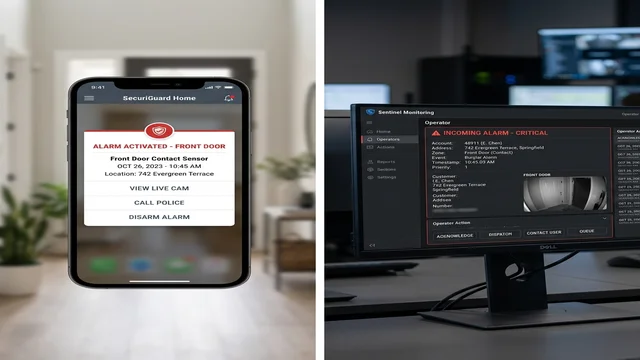
Whenever someone installs a new alarm system, the question eventually comes up: do I really need a monitoring centre? It is a fair question. Modern alarm systems send notifications directly to your phone. If an alarm fires, you receive an alert immediately. You can open the app, check the CCTV cameras, and decide what to do. So why pay for a monitoring service?
The honest answer is that it depends on what level of protection you actually want, and more specifically, on what happens when you are not available to respond.
KEY POINT
An alarm system is only as useful as the response it generates. The question is not whether you can receive a notification; it is whether someone will always be available to act on it.
How Self-Monitoring Works
Self-monitoring is exactly what it sounds like. The alarm system reports directly to you; through mobile app push notifications, SMS alerts, or email, and you decide what action to take. If the alarm activates, you receive the alert and respond accordingly.
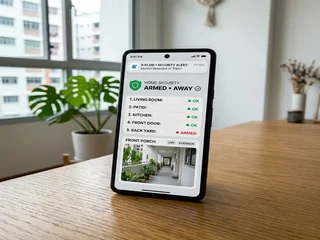
This approach has become genuinely practical because modern alarm systems handle it well. The notifications are immediate, the apps are well-designed, and if you have CCTV linked to the system you can often assess the situation visually before deciding whether to call anyone. There are no monthly monitoring fees, no operators, no response procedures to set up. For the right homeowner in the right situation, this is a perfectly adequate level of protection.
The biggest advantage is control. You decide what happens next. You are not dependent on a monitoring centre's interpretation of the event or their contact list. If the alarm fires and you can see on your cameras that it is a false activation, you can simply dismiss it without any further process. If it looks genuine, you can call the police directly. Many Singapore homeowners; particularly those in occupied condominiums where they are home most evenings; operate successfully this way.
KEY POINT
Self-monitoring is not an inferior version of professional monitoring. For a homeowner who is reliably available and comfortable using the technology, it is a valid choice. The question is whether your lifestyle actually matches those conditions consistently enough to rely on it.
The Problem Nobody Talks About
The weakness of self-monitoring is not in the technology. It is in the assumption that someone is always available to receive and act on a notification. That assumption breaks down more often than most people expect.
You are in a meeting with your phone on silent. You are driving. Your battery is flat. You are overseas on a long-haul flight with no connectivity. You are asleep and the notification sounds like the dozens of other alerts your phone generates overnight. The alarm system may perform perfectly. The notification may be sent successfully. But if nobody sees it in time, no action is taken, and the window between the alarm firing and any response occurring could be hours.
This is the single most important limitation of self-monitoring. It works consistently well when you are available. It has a complete gap when you are not. For many homeowners, that gap is rare enough that self-monitoring remains the right choice. For others; those who travel frequently, have properties that are often vacant, or where the consequences of a missed alarm would be serious, that gap is exactly the scenario they need to plan for.
KEY POINT
Self-monitoring is only as reliable as your own availability. Before committing to it, think honestly about the moments when you genuinely cannot respond immediately, and ask whether those moments are rare exceptions or regular occurrences.
What a Monitoring Centre Does Differently
As covered in the earlier article on Central Monitoring Stations, a professional monitoring centre operates 24 hours a day, every day of the year. When an alarm occurs, trained operators receive the signal and follow the response procedure set up for that account; contacting the property owner, reaching out to keyholders, verifying the alarm event, and escalating if necessary.
The monitoring centre does not sleep. It does not go on holiday. It does not forget to charge its phone. That is the value being provided, not a superior technology, but a guaranteed human response regardless of what you are doing or where you are when the alarm fires.
KEY POINT
Professional monitoring does not make your alarm system more sensitive or your detectors more capable. It ensures that when an alarm fires, a trained person with a defined response procedure will act on it; whether you are asleep, overseas, or simply unreachable.
A Real Example
Imagine you are on a two-week holiday overseas. At 2.30am Singapore time, your alarm activates.
With self-monitoring, a notification appears on your phone. Whether you see it depends on where you are, what time zone you are in, whether you have mobile connectivity at that moment, and whether your phone is within reach. If you do see it, you then need to decide what to do from a different country in the middle of the night; call a neighbour, call the police, call a family member. Every step depends on you being reachable and capable of acting.
With professional monitoring, the monitoring centre receives the alarm immediately. Verification procedures begin. Keyholders are contacted. Appropriate action is taken based on the instructions you provided when setting up the account. None of this depends on your availability. The response process runs regardless of where you are or what you are doing.
The difference is not the technology. The difference is the response.
PLANNING POINT
Think about the last time you took a two-week holiday. Was there a period during that trip when you would genuinely not have been able to respond to an alarm notification within 30 minutes? If the answer is yes, that is the gap professional monitoring fills.
When Self-Monitoring Makes Sense
Self-monitoring works well for homeowners whose properties are occupied most of the time and who are genuinely comfortable and consistent about checking notifications. A family in a condominium where someone is home most evenings, with a few cameras covering the main entry points, and where travel is occasional; this is a realistic self-monitoring scenario. The alarm fires, the notification arrives, someone at home or nearby can check and respond. The gap that matters in the overseas scenario simply does not arise very often.
It also works well as a complement to other security measures. A property in a managed estate with security guards at the gate, where the alarm adds a layer of detection but the primary physical response is handled by on-site security, may not need 24-hour monitoring centre support. The notification goes to the homeowner as information; the physical response comes from the estate security team.
KEY POINT
Self-monitoring is not about cutting corners on security. It is about matching the monitoring approach to the actual risk profile of the property and the realistic availability of the people responsible for responding.
When Professional Monitoring Makes Sense
Professional monitoring becomes significantly more valuable when the property is frequently vacant, when the owner travels regularly, or when the consequences of a missed alarm would be serious. A landed property in a quiet residential street, unoccupied during the owner's regular overseas trips, is a good example. Nobody nearby, no on-site security, and an owner who may not be reachable for hours. In that situation, a monitoring centre with a current keyholder list and a defined response procedure is not optional; it is the difference between a functioning alarm system and a very expensive noise generator.
Commercial premises operate similarly. A shopfront in a retail mall, a factory unit, a medical clinic after hours; these are properties where the occupants are absent for long predictable periods, where the value of the assets inside makes them worthwhile targets, and where the owner cannot realistically be the first responder at 3am. Professional monitoring is how you ensure that someone always is.
PLANNING POINT
The more predictably vacant your property is, the more valuable professional monitoring becomes. A property that is empty every night is a fundamentally different risk profile from one where someone is home most evenings. Match the monitoring approach to the actual occupancy pattern.
The Hybrid Approach; The Best of Both
Increasingly, the most practical approach for many Singapore homeowners and businesses is neither purely self-monitoring nor purely professional monitoring; it is both simultaneously.
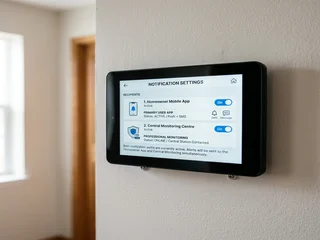
Modern alarm platforms make this straightforward. When an alarm fires, the signal goes to both the homeowner's mobile app and the monitoring centre at the same time. The homeowner receives the notification and can act immediately if they are available; checking the cameras, dismissing a false alarm before the monitoring centre needs to escalate it, or providing context to the operator who calls. The monitoring centre receives the same signal and begins its verification process regardless, ensuring the response happens with or without the homeowner's involvement.
For many Singapore homeowners, this hybrid configuration is the most sensible default. You get the direct visibility and control of self-monitoring on normal days, and the guaranteed response of professional monitoring on the days when you cannot respond personally. The incremental cost of adding monitoring centre coverage to a system that already has mobile app notification is modest, and the gap it fills; the overseas holiday, the dead phone, the 3am alarm nobody sees; is exactly the gap where the stakes are highest.
KEY POINT
Hybrid monitoring is not a compromise; it is the approach that honestly accounts for the fact that no homeowner is reliably available 24 hours a day. The mobile app handles the normal cases. The monitoring centre handles the gaps.
There Is No Right or Wrong Answer
One mistake I see often is people assuming that professional monitoring is always the right choice. It is not, for a property that is almost always occupied with attentive owners, the additional cost may not be justified. The opposite mistake is equally common: assuming that a mobile app notification is equivalent to professional monitoring. It is not; a notification that nobody sees is not a response.
The honest answer is that the right approach depends on your lifestyle, how often your property is genuinely vacant, the risk profile of what you are protecting, and what you can realistically commit to in terms of availability. A solution that works perfectly for one homeowner may be completely unsuitable for another.
What matters is that you make the decision deliberately; thinking through the scenarios where your chosen approach works, and the scenarios where it does not; rather than defaulting to whichever option requires less thought. The alarm system does its job reliably. The monitoring arrangement determines what happens next.
Securevision Verdict
Modern alarm systems have given homeowners more choices than ever before. Self-monitoring can be effective, especially for properties that are frequently occupied and owners who are reliably available. Professional monitoring adds another layer of protection by ensuring someone is always watching, even when you cannot be.
The decision is not really about technology. It is about response. An alarm is only valuable if someone takes action when it activates. The question to answer honestly is: under your real-world conditions, who will that person be, and will they always be available?
In Short
Self-monitoring and professional monitoring are not competing choices; they solve different problems. Self-monitoring puts the responsibility for response directly in your hands, which is an advantage if you are reliably available and want direct control. Professional monitoring provides structured, 24-hour coverage that does not depend on you being reachable. For properties where security is a genuine priority, the hybrid approach; receiving your own alerts while also having a monitoring centre as a backup; delivers the best of both without requiring you to choose between them.

Frequently asked questions
What is the difference between self-monitoring and professional alarm monitoring?
Self-monitoring sends alarm notifications directly to your smartphone, relying on you to receive the alert and decide what to do. Professional monitoring connects the alarm to a central monitoring station staffed 24 hours a day, where trained operators receive signals, verify events, and initiate responses according to a pre-agreed protocol, without requiring any action from the property owner.
How does self-monitoring work?
A self-monitored alarm system sends push notifications to a smartphone app when a detector triggers or an alarm condition occurs. The property owner receives the alert, views any associated camera footage, and decides how to respond; visiting the property, calling a keyholder, or contacting the police. Self-monitoring relies entirely on the owner being available and responsive at all times, including at night.
What are the advantages of self-monitoring?
Self-monitoring gives direct control to the property owner, eliminates the monthly monitoring fee, and provides instant notification to the person best placed to assess the situation. It is well-suited to properties where the owner is consistently reachable, where camera verification is possible, and where the primary concern is awareness rather than a structured emergency response.
What are the disadvantages of self-monitoring?
Self-monitoring fails when the property owner is asleep, in a meeting, travelling, or simply does not notice the notification in time. It places the burden of response entirely on one person with no backup. There is no structured protocol for escalation and no guarantee that a response will occur within a useful timeframe. For a genuine intrusion at 3am, the quality of self-monitoring depends entirely on whether the owner wakes up and responds effectively.
What does a professional monitoring centre do that self-monitoring cannot?
A professional monitoring centre operates 24 hours a day with trained operators who follow structured response protocols regardless of the time or circumstances. They maintain a keyholder contact list, have established relationships with emergency services, and can escalate a response even when the property owner cannot be reached. This structured, independent response capability is what professional monitoring provides over and above self-monitoring.
Can I have both self-monitoring and professional monitoring at the same time?
Yes. Many modern alarm systems support both simultaneously. The panel sends alerts to the monitoring centre and also sends push notifications to the owner's smartphone. This hybrid approach means the owner receives direct notification and can respond if available, while the monitoring centre provides professional coverage as a backup if the owner does not respond in time.
How much does professional alarm monitoring cost in Singapore?
Professional monitoring in Singapore typically costs between $20 and $60 per month depending on the level of service, the monitoring centre, and any additional features such as video verification or key holding. The specific cost should be confirmed with the monitoring centre and installer during system specification. The monthly fee should be compared against the risk and consequence of an unresponded intrusion.
When does self-monitoring make sense?
Self-monitoring is a reasonable approach for: holiday homes or storage properties where someone can reliably attend within an acceptable time; commercial properties with an on-site security team; properties where the owner is consistently contactable and near enough to respond; or as a supplementary layer on top of professional monitoring. It is less appropriate as the sole response mechanism for primary residences or high-value commercial properties.
What should I look for when choosing a professional monitoring centre?
Look for: 24-hour staffing with trained operators; clear response protocols for different event types; transparent reporting; Singapore familiarity for emergency contact procedures; and an uptime track record. Ask about average response times from signal receipt to operator action, and confirm how the monitoring centre handles situations where they cannot reach any keyholder.
Can I switch from self-monitoring to professional monitoring later?
Yes. Most modern alarm panels support both modes, and switching to professional monitoring typically involves signing a monitoring agreement and providing the monitoring centre with the panel communication details and a keyholder list. Your installer can facilitate the switch and confirm the panel is correctly configured to communicate with the chosen monitoring centre.