HOSPITALITY CASE STUDY 📍 333 Orchard Road, Singapore 5-Star Hotel - Twin Tower Complex

Securing 50+ Fire Emergency Doors Across Asia-Pacific's Largest Hilton Property

EM lock access control, centralised ZKTeco CV monitoring, and full fire alarm integration for the Hilton Singapore Orchard's stairwell network - without disrupting a fully operational 1,080-room hotel.

50+ Fire Emergency Doors Secured
7+ Stairwells Across Twin Towers
3 Months Installation (Phased)
76 Floors Across Both Towers
Police Licensed | | Sites Protected
\n
Project Snapshot

The Hilton Singapore Orchard is the largest Hilton property in the Asia-Pacific region - a twin-tower complex with 1,080 rooms, seven-plus stairwells, and a retail podium spanning four floors at Mandarin Gallery. While its fire emergency doors are required by code to open freely in one direction for safe egress, the building's security team faced a persistent problem: those same doors, left unmonitored, created unsupervised access paths throughout the vertical structure of both towers. Securevision was engaged to resolve this without compromising the fire egress function - or disrupting a fully operational luxury hotel.

Client Hilton Singapore Orchard
Location 333 Orchard Road, Singapore 238867
Sector Hospitality - 5-Star Hotel
Project Type New installation - phased rollout across live operation
Completion December 2025
Scale 50+ fire emergency doors, 7+ stairwells, 76 floors across twin towers
Technologies Implemented
ZKTeco CV security management software for centralised door monitoring, status display, and remote override control.
EM Locks Electromagnetic locks rated for fire emergency door applications - fail-safe release on power or signal loss.
Break-Glass Units Manual override glass-break stations at every secured door for immediate local release without system access.
Fire Alarm Interface Hardwired integration to the building fire alarm panel - all EM locks release simultaneously on any fire alarm activation.
The Challenge

Open by Design, Unsecured by Default - a 76-Floor Problem

Fire emergency doors exist to save lives. Under Singapore's fire safety regulations, these doors must remain free to open in the direction of egress at all times - they cannot simply be locked. But in a twin-tower hotel complex with over 1,080 rooms, seven-plus stairwells, and a shared four-level retail podium below, that mandatory openness creates a secondary problem: the same doors that allow safe evacuation also provide uncontrolled vertical access throughout the building.

Guests, staff, and unauthorised persons could traverse the full height of both towers - Tower 1 at 36 floors, Tower 2 at 40 floors - through stairwells that had no monitoring, no access control, and no audit trail. The security team had no visibility into which doors were open, when, or who had passed through. Any incident investigation was hindered by a complete absence of door-level data.

The added complexity was operational: the Hilton Singapore Orchard is a continuously operating luxury hotel. Any installation work had to be executed without interruption to guests or housekeeping - meaning no floor-wide shutdowns, no visible construction disruption in guest corridors, and no extended downtime on any individual door. The project demanded both engineering precision and logistical discipline across a very large, live building.
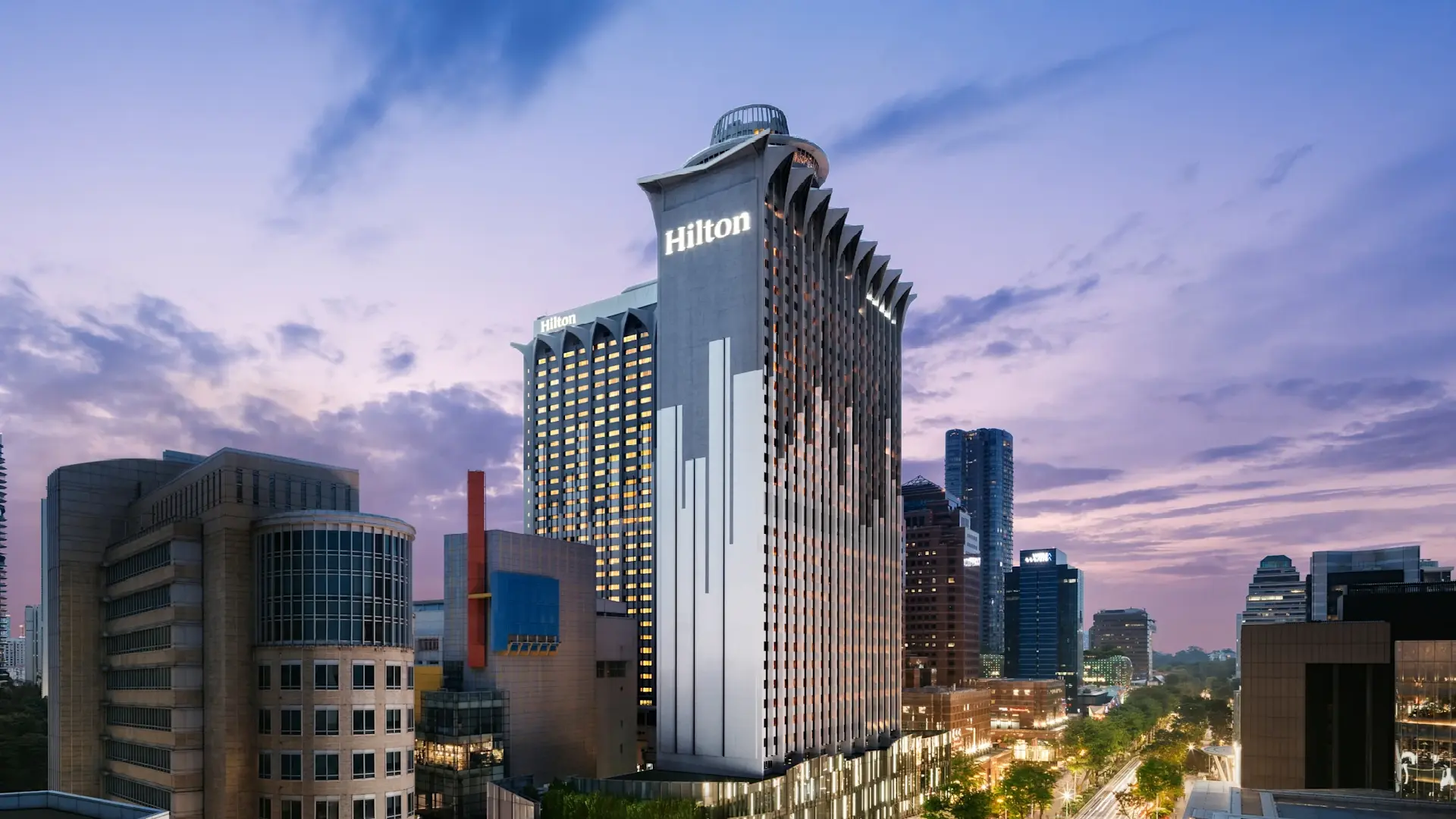
Hilton Singapore Orchard
Fire emergency doors must remain freely openable for egress. The challenge was adding security monitoring and controlled access without compromising that function.
Transformation

From Unmonitored Egress Paths to a Fully Managed Door Network

Security Layer Before Securevision Installation
Door Status Visibility No monitoring - security team had no real-time view of which emergency doors were open or closed All 50+ doors monitored live via ZKTeco CV; door status displayed in the security control room at all times
Vertical Access Control Stairwell doors freely accessible from both sides - no restriction, no audit trail EM locks restrict access from the stairwell side; egress direction remains unobstructed per fire code requirements
Fire Emergency Response No integration - doors remained in whatever state they were in during a fire event All EM locks release simultaneously on fire alarm activation; system integrated directly with the building's fire alarm panel
Manual Override No override mechanism - staff had no means to quickly release a specific door remotely Break-glass units at every door for immediate local release; security room operator can remotely override any individual door via ZKTeco CV
Central Management No central system - each door was entirely independent with no shared management layer Unified ZKTeco CV platform managing all doors as a single network; access event logs retained for investigation and audit
Installation Approach N/A - no prior system in place Phased rollout across 3 months; work coordinated around housekeeping and guest schedules to maintain normal hotel operations throughout
Decision Point

Securing Without Locking - The Fundamental Design Constraint

The central engineering challenge on this project was not which hardware to specify - it was how to add meaningful access control to doors that are legally prohibited from being locked. A conventional electric lock or magnetic strike cannot be applied to a fire emergency door in a way that restricts egress. Any solution had to control access from the non-egress side whilst leaving the push-to-exit direction completely unrestricted, and it had to release instantly and automatically if the building fire alarm activated.

Securevision specified electromagnetic locks in a fail-safe configuration - meaning the lock releases immediately on loss of power or on receipt of a fire alarm signal. This configuration is inherently compatible with fire emergency door requirements: in any fire scenario, the lock is already released before any occupant reaches the door. Combined with break-glass override units at every door and remote override capability from the security control room, the design meets both the fire safety imperative and the hotel's operational security needs without compromise.

Choosing ZKTeco CV as the management platform was equally considered. The hotel's security team needed a single interface to monitor all 50+ doors without learning multiple systems. ZKTeco CV provided the door status visibility, access event logging, and remote override controls the security room required - without requiring the hotel to adopt a broader access control credential infrastructure it did not need for this application.

Our Approach

Phase by Phase, Floor by Floor - Working Around a Live Hotel

A 76-floor twin-tower hotel operating at full capacity cannot be treated as a construction site. Securevision structured the installation as a coordinated phased rollout across three months, working in direct liaison with the hotel's housekeeping and facilities management teams to schedule work zone by zone - ensuring guest corridors were never disrupted and no emergency exit was left non-functional at any point during the project.

🔍

Site Survey & Integration Planning

Securevision conducted a full survey of all stairwells across both towers, identifying door types, frame conditions, cable routing paths, and fire alarm panel locations. The fire alarm interface design was developed and approved before any hardware was ordered, ensuring the integration was engineered - not improvised on-site.

🏗️

Phased Installation by Zone

Installation proceeded floor-by-floor and stairwell-by-stairwell in coordinated phases. Each phase was pre-scheduled with the hotel's housekeeping team to ensure work occurred during periods of minimum guest movement in the relevant zone. No stairwell was left partially commissioned between phases.

🔗

Fire Alarm Integration

Every EM lock was wired in a fail-safe configuration and interfaced with the building's fire alarm panel. On any fire alarm activation across the property, all locks release simultaneously - automatically and without requiring any human intervention from the security team. This integration was tested at every phase sign-off.

🖥️

Control Room Commissioning

ZKTeco CV was installed and configured in the hotel's security control room with all 50+ doors mapped to a single monitoring display. Security operators were trained on live status monitoring, remote door override, and access event log review before the system went live on each phase.

Throughout the project, Securevision's team remained mindful of the hotel's guest experience obligations. Cable runs were routed discreetly, work areas were left clean and unobtrusive at each end-of-day, and no floor was left with partial installation visible to guests. The three-month timeline reflected the discipline of working within a live hospitality environment - not the complexity of the hardware.

The Solution

A Three-Layer Safety and Security Architecture for Every Emergency Door

Each of the 50+ fire emergency doors was treated as a complete, independently safe unit - combining hardware security, intelligent monitoring, and guaranteed fire egress release into a unified system managed from a single control room interface.

Hardware Layer

Fail-Safe EM Locks on Every Door

Electromagnetic locks were installed on the controlled-access (non-egress) side of each fire emergency door. Configured in fail-safe mode, the locks release immediately on any power interruption or fire alarm signal - meeting fire safety code requirements without exception. The egress direction remains completely unobstructed at all times.

Entry Access Control Systems →
Override Layer

Break-Glass Units & Remote Override

A break-glass override unit was installed at every secured door, giving any person on-site the ability to release a specific door immediately without requiring credentials or system access. In parallel, the security control room can remotely override any individual door via ZKTeco CV - providing both local and centralised emergency control.

Access Control & Override Systems →
Management Layer

ZKTeco CV Central Monitoring Platform

All 50+ doors are monitored in real time through ZKTeco's CV security management software, installed in the hotel's security control room. Operators can view the live status of every door across both towers, review access event logs, and issue remote override commands from a single interface - giving the security team complete situational awareness of the stairwell network for the first time.

ZKTeco - Access & Security Platforms →
Equipment Deployed

What Was Installed

A complete EM lock access control network across 50+ fire emergency doors spanning seven-plus stairwells in the Hilton Singapore Orchard's twin-tower complex, integrated with the building's existing fire alarm system and managed via a centralised ZKTeco CV platform.

Fail-Safe EM Locks

50+ units - electromagnetic locks rated for fire emergency door applications, mounted on the controlled-access (non-egress) side of each door. Configured fail-safe: the lock releases immediately on power loss or receipt of a fire alarm signal. The egress direction is unrestricted at all times, compliant with Singapore fire safety regulations.

Entry Access Control →

Break-Glass Override Units

50+ units - one installed at every secured door. Allows any person on-site to release a specific door immediately without credentials or system access. Reset requires a deliberate action, preventing accidental re-lock after a trigger. Operates entirely independently of the ZKTeco CV software layer.

Entry Access Control →

ZKTeco CV Security Management Platform

Installed in the hotel's security control room with all 50+ doors mapped to a single monitoring display. Provides real-time door status across both towers, remote override control for any individual door, access event logging and audit trail, and alarm notifications for door-held-open or door-forced events.

Platform & Management →

Fire Alarm Panel Integration

Hardwired interface between the EM lock network and the building's existing fire alarm panel. On any fire alarm activation, all 50+ EM locks release simultaneously - automatically, with no operator action required. Integration is independent of the ZKTeco CV software layer: power loss or signal loss also triggers full release. Verified against the building's fire alarm panel specification at every installation phase sign-off.

Platform & Management →
Results & Impact

Complete Stairwell Visibility Without Compromising a Single Egress Route

✓ Real-Time Stairwell Awareness

The security control room now has live visibility of the status of all 50+ fire emergency doors across both towers - a capability that did not exist before this installation. Any door held open, forced, or in an unexpected state is flagged immediately.

✓ Fire Code Compliance Maintained

Every EM lock operates in fail-safe mode and is integrated with the building's fire alarm panel. In any fire scenario, all locks release automatically - simultaneously and without requiring any human action. The egress direction is unrestricted at all times under normal operation.

✓ Triple-Layer Override Redundancy

Each door has three independent release mechanisms: automatic fire alarm release, local break-glass override, and remote operator release via ZKTeco CV. No single point of failure can prevent egress - the system is designed so that any one mechanism is sufficient on its own.

✓ Zero Guest Disruption During Installation

The phased three-month rollout was executed without any visible disruption to hotel guests or interruption to housekeeping operations. Work was coordinated zone by zone, and no stairwell was left partially commissioned or out of service at any point during the project.

✓ Vertical Access Now Auditable

For the first time, the hotel's security team has a complete access event log for all stairwell doors across the twin-tower complex. Any incident involving the stairwells can now be investigated with a timestamped record of door activity - providing a level of accountability that previously did not exist.

✓ Scalable Platform for Future Expansion

ZKTeco CV is capable of managing a significantly larger door network. Should the hotel expand access control requirements to additional areas - service entrances, back-of-house zones, or basement levels - the existing platform can accommodate further integration without replacement.

Securevision Insight

In a Live Operation, the Installation Schedule Is Part of the Engineering

Fire emergency door security is a niche application precisely because it sits at the intersection of two requirements that appear to conflict: keeping a door openable and making it secure. The hardware solution - fail-safe EM locks with fire alarm integration - is well understood. What is less often appreciated is that in a fully operational hotel, the logistical engineering of the installation is equally demanding. Working across 76 floors in a building where guests are present around the clock, where housekeeping schedules must be respected, and where no emergency exit can be left non-functional between phases - these are constraints that shape every decision about sequencing, crew size, and sign-off procedure. The three months we spent on this project were not a reflection of the system's complexity. They were a reflection of the care required to install it correctly in a live environment.

Discovery Path

Explore Related Solutions

Every project Securevision delivers draws on multiple systems working together - cameras, access control, intercoms, vehicle management, network infrastructure, and platform software. The cards below show the full range of systems we design and install. Each one links to a deeper explanation of how it works, when it is needed, and what to look for when specifying it.

Ready to Secure Your Property?

Tell us about your site. We'll assess it and design a system that works as one.

Serving Singapore Since 2006