209 AI cameras, 37 biometric access points, and a Salesforce integration that automated credential management end-to-end - deployed across all six levels of SCAPE at Orchard Road.
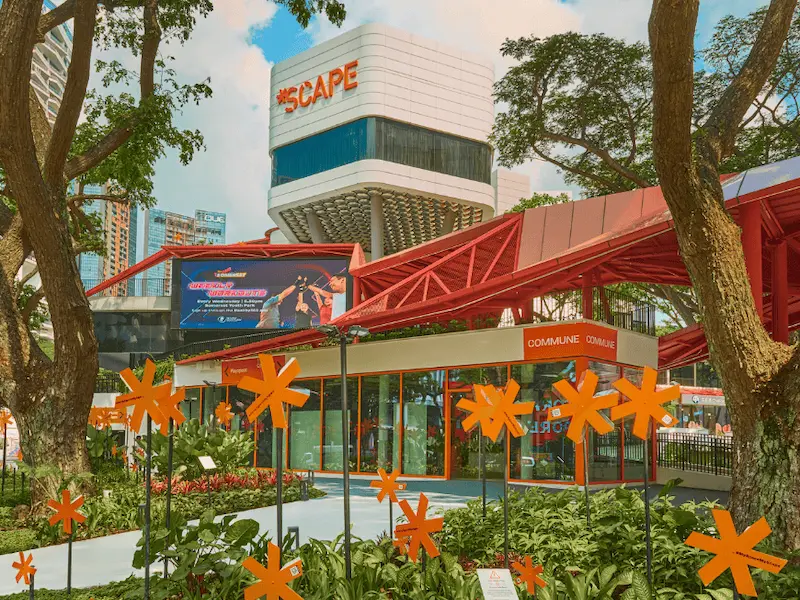
SCAPE is Singapore's flagship youth hub - a six-level facility on Orchard Road serving public youth spaces, bookable event rooms, and restricted operational areas simultaneously. When the facility underwent a major renovation ahead of its 2024 reopening, management took the opportunity to replace an ageing, fragmented security system with a unified AI-powered platform that could scale with the facility's growing operational complexity.
| Client | SCAPE (Non-profit youth organisation, IPC) |
|---|---|
| Location | 2 Orchard Link, Somerset Belt, Singapore |
| Sector | Commercial / Civic & Community Development |
| Project Type | Complete security system upgrade |
| Completion | December 2024 |
| Scale | 209 AI cameras, 37 biometric access points, 6 levels |
SCAPE's six levels - spanning basement parking through rooftop access - serve fundamentally different functions simultaneously. Public youth spaces coexist with bookable private rooms, restricted operational back-of-house, and high-traffic event venues. Each zone required a different security approach. The existing fragmented system had no capacity to deliver unified visibility across all of them.
On the surveillance side, traditional motion-based cameras generated constant false alarms across the high-footfall public areas, overwhelming security staff and delaying responses to genuine incidents. The facility needed cameras that could distinguish between a person entering a restricted zone and a plant moving in the wind - at scale, across every level.
On the access side, the facility relied on physical logbooks and standalone cards that could be lost or shared. Critically, SCAPE uses Salesforce to manage room bookings - but that system was entirely disconnected from access control. Every confirmed booking required manual credential issuance. Every departure required manual revocation. For a facility running dozens of events simultaneously, this created an unsustainable administrative overhead and a persistent credentialing lag.
| Security Layer | Before | Securevision Upgrade |
|---|---|---|
| Surveillance Intelligence | Motion-based cameras generating constant false alarms - no ability to distinguish humans from environmental movement | 209 Milesight AI cameras with edge processing - object-class identification eliminates false alarms entirely |
| Camera Coverage | Partial coverage with blind spots - no panoramic or perimeter intelligence | 100% coverage across all 6 levels - dome, panoramic, vandal-proof, and bullet cameras positioned via pre-installation simulation modelling |
| Access Credentials | Physical cards and logbooks - could be lost, shared, or forgotten; no revocation capability | Face recognition + dynamic QR codes - biometric verification for staff, time-limited QR codes for visitors and event attendees |
| Credential Management | Manual process - staff issued and revoked cards individually for every booking | Fully automated via Salesforce API - booking confirmation triggers credential creation; departure triggers revocation |
| Incident Response | 15-minute average response time - high false alarm volume prevented staff from prioritising genuine incidents | Under 2-minute response - AI filtering surfaces only genuine alerts, reducing guard workload significantly |
| System Integration | No integration - surveillance, access control, and booking system operated as three disconnected platforms | Unified operational view - surveillance and access managed from a single platform, connected to Salesforce for automated credential lifecycle |
A 209-camera deployment could be architected in two fundamentally different ways: centralised, where all video streams are sent to a server for processing; or distributed, where each camera processes its own video locally at the edge. The choice had direct implications for network load, alert latency, and system resilience - all of which matter in a high-footfall public facility.
Securevision specified a distributed edge intelligence architecture - every camera analyses its own video feed locally, generating alerts only when a genuine event is detected. No raw video streams travel the network continuously. This eliminates the bandwidth bottleneck of centralised processing, reduces alert latency from seconds to milliseconds, and ensures the surveillance system continues functioning independently even if the network is temporarily disrupted.
The same logic applied to access control: rather than building a custom credential system, Securevision integrated directly with Salesforce - the platform SCAPE already used for bookings. This removed an entire administrative workflow from the security team's workload. Credentials now follow the booking lifecycle automatically, with no manual intervention required at any stage.
Securevision approached SCAPE as a single integrated security brief - not as three separate system installations. The design process began with a pre-installation simulation of camera positions across all six levels, identifying every coverage gap before any hardware was ordered. The Salesforce integration was architected and tested before access control hardware was commissioned. Every component was designed to contribute to a unified operational picture.
Camera positions were modelled digitally before installation, simulating coverage angles and identifying blind spots across all six levels. This ensured 100% coverage without over-specifying - each camera placement was justified by the coverage gap it closed.
Each camera's AI detection rules were configured to its specific zone - loitering detection in public areas, region-entry alerts in restricted zones, people counting at entry points. Detection logic was matched to the actual risk profile of each location, not applied as a blanket setting.
The integration was designed to handle the full credential lifecycle: room booking confirmation triggers QR code generation, the code is valid only for the specific access point and time window, and it is revoked automatically when the booking ends. No staff action is required at any stage of this workflow.
Both the surveillance VMS and the access control platform were commissioned as a single operational interface in the SCAPE security control room. Security staff were trained to manage all 209 cameras and all 37 access points from one screen - with AI-filtered alerts ensuring only actionable events required their attention.
The result is a system where the security team's time is spent responding to genuine incidents - not processing card requests, chasing false alarms, or monitoring feeds manually.
Three integrated layers - each solving a distinct problem - designed and commissioned as a single unified platform.
209 Milesight AI cameras deployed across all six levels, each performing local video analysis to detect specific events - region entry, loitering, object removal, crowd density. Only genuine alerts reach the security team. False alarm rate for perimeter intrusion: zero, achieved through object-class identification that distinguishes humans from environmental movement.
Surveillance & Detection →37 ZKTeco SpeedFace V4L Pro-QR terminals across all access points. Staff authenticate via face recognition - no cards, no friction. Event attendees and room bookers receive dynamic QR codes automatically generated by the Salesforce integration, valid only for their specific access point and time window. Credentials cannot be shared or reused.
Entry Access Control →A custom API integration connects SCAPE's Salesforce booking system directly to the access control platform. When a room is booked, a QR credential is generated automatically. When the booking ends, access is revoked. The security team no longer touches credential management for routine bookings - the workflow runs end-to-end without human intervention.
Platform & Management →A high-density AI camera network integrated with biometric access control and cloud-redundant VMS - deployed across all six levels of the SCAPE facility at Orchard Road.
Four camera types deployed by zone: 167 dome cameras (5MP) for general indoor coverage with people counting and behaviour detection; 8 panoramic cameras (180°) combining thermal and visible-light sensors for perimeter intelligence; 33 vandal-proof cameras for high-risk or exposed areas; 2 bullet cameras for long-range corridor coverage. All perform edge AI processing locally.
Surveillance & Detection →2 servers deployed in dual-redundant configuration. RAID 6 storage provides fault tolerance across multiple simultaneous drive failures. Cloud backup ensures disaster recovery capability independent of on-site infrastructure. The VMS manages all 209 camera feeds, AI alert routing, and event logging from a single interface in the SCAPE security control room.
Surveillance & Detection →Biometric terminals at all 37 access points across all six levels, providing dual-mode authentication: face recognition for staff (contactless, no credential required) and QR code scanning for visitors and event attendees (dynamic codes generated automatically by the Salesforce integration). Codes are time-limited and access-point specific - they cannot be forwarded or reused.
Entry Access Control →Custom-built integration connecting SCAPE's Salesforce booking platform to the ZKTeco access control system. Triggers on booking confirmation: generates a QR credential valid for the specific access point and booking time window only. Triggers on booking end or cancellation: revokes access automatically. No security staff action required at any stage. The integration handles the full credential lifecycle end-to-end.
Platform & Management →Faster incident response - from a 15-minute average to under 2 minutes, achieved by AI filtering that surfaces only genuine alerts to security staff.
False alarms for perimeter intrusion - eliminated entirely through object-class identification that distinguishes humans from environmental motion.
Automated credential provisioning for room bookings - from confirmation to revocation, the full lifecycle runs without any security staff involvement.
By unifying visual intelligence and access management into a single operational workflow, SCAPE's security team now spends their time responding to real incidents - not processing card requests or filtering through false alarm noise. Guard workload has reduced significantly while the overall safety and accountability of the facility has improved.
The Salesforce integration on this project is a good illustration of what system integration should achieve. A surface-level integration might simply display booking data on the access control screen - useful, but it still requires a person to act on that information. What we built removes the person from the loop entirely: when a booking is confirmed, access is provisioned; when it ends, access is revoked. No staff action, no lag, no credential management overhead. The security team's attention is freed for the work that actually requires human judgement - and that is the correct outcome of any integration worth building.
Every project Securevision delivers draws on multiple systems working together - cameras, access control, intercoms, vehicle management, network infrastructure, and platform software. The cards below show the full range of systems we design and install. Each one links to a deeper explanation of how it works, when it is needed, and what to look for when specifying it.
Tell us about your site. We'll assess it and design a system that works as one.
Serving Singapore Since 2006