Security Decisions for Your Condominium Are Long-Term: Get Them Right the First Time
A structured approach to help MCST councils evaluate ageing systems, reduce resident friction, and plan upgrades with greater confidence.
Serving condominiums and MCSTs across Singapore since .
In Short
A Security Upgrade Is Not Just a System Purchase
For an MCST, a security upgrade is rarely about replacing hardware. It is about improving resident experience, reducing operational friction, managing future maintenance costs, and ensuring the estate remains secure for the next 10 to 15 years. A successful upgrade balances technical requirements with resident expectations, operational realities, and long-term sustainability.
The most expensive upgrade mistakes almost always occur before installation begins: when the wrong system is specified for the wrong reasons, when resident workflows are not considered alongside hardware selection, or when the council focuses on the lowest initial quotation without examining the full cost of ownership. Getting the decision right at the planning stage costs nothing. Getting it wrong costs significantly more than the original upgrade.
What Happens When a Condo Upgrade Is Poorly Planned
For MCST councils, a security upgrade is one of the most visible and scrutinised capital expenditures. When execution fails, the consequences extend far beyond hardware downtime.
Resident Friction
Intercom replacements that frustrate residents with complex interfaces or unreliable app connectivity lead to immediate complaints: and complaints at the next AGM about the council's decision-making.
Technical Silos
Installing systems that do not integrate creates operational gaps, forcing guards to switch between disconnected monitoring platforms and managing agents to maintain separate vendor relationships for each system.
Operational Lag
Poorly planned guard workflows often worsen after implementation: visitor bottlenecks at the gantry, longer verification queues at the lobby, and guard teams that were never trained on the new system's actual capabilities.
Infrastructure Surprises
Underestimating existing cabling or network capacity leads to unexpected variation orders mid-project: additional costs that were not in the AGM budget and require a supplementary council approval.
Costly Rework
Rectifying mistakes after AGM approvals are already secured is difficult, expensive, and damaging to council credibility. The resident who voted against the proposal is the first to raise the variation order at the next meeting.
Common Mistakes We See in Condominium Security Upgrade Projects
After working with condominium councils across Singapore, several issues appear repeatedly: almost always in the planning phase rather than the installation phase.
Starting With Brand Comparison Instead of Outcome Definition
The most common planning mistake is beginning the security upgrade conversation with "which brand should we buy?" rather than "what are we trying to improve?" Councils that start with brand comparison end up with a system specification driven by product availability rather than estate requirements. The first question should be about the problems the estate is actually experiencing: intercom failures, visitor bottlenecks, guard manpower pressure, CCTV gaps: not about product features.
Underestimating Resident Communication Planning
Many technically successful upgrades receive resident complaints because the communication plan was insufficient. Residents who were not told what was changing, when it was changing, and what they needed to do differently will interpret any disruption: even planned and temporary: as a council failure. Around 20% of residents will still be surprised on switchover day regardless of how much communication is provided. A good plan assumes this will happen and has a response ready.
Evaluating Systems in Isolation Instead of Together
Intercom, access control, CCTV, and vehicle management are frequently evaluated and procured separately: often through separate quotation exercises, sometimes from different vendors. The result is systems that were never designed to work together and cannot be managed from a single platform. The estate ends up spending more in total than an integrated upgrade would have cost, and the managing agent ends up maintaining three separate vendor relationships.
Selecting the Lowest Quotation Without Assessing Long-Term Cost
The lowest initial quotation does not always produce the lowest total cost of ownership over the system's service life. A system specified with lower-grade components that requires more frequent maintenance, has limited spare parts availability, or cannot integrate with future technologies may cost significantly more over ten years than a higher initial investment in a well-supported platform. The AGM proposal should include a 10-year cost-of-ownership comparison, not just a capital cost comparison.
A Practitioner Observation
Most councils spend more time comparing equipment brands than discussing resident workflows. In practice, how residents interact with the new intercom system on day one: whether they have downloaded the app, whether they understand the visitor process, whether their vehicle plate is correctly registered: has a greater impact on resident satisfaction than the hardware specification. The technology is the easier part. The transition management is where most upgrade projects succeed or fail.
This Is Not Just a System Purchase
MCST councils are not just buying cameras or readers: they are making decisions that define how the estate operates for the next decade.
Resident Experience
How residents interact with the estate's security daily: from vehicle entry to receiving visitors via their mobile devices: determines how the system is perceived. A system that works reliably and requires minimal effort from residents generates no complaints. A system that requires residents to troubleshoot their own access generates calls to the managing agent's office.
Estate Operability
The security system's design directly affects the efficiency of the guard team and the managing agent's daily operations. An integrated system where all five estate security functions are visible from one dashboard produces a different level of estate oversight than four disconnected systems that each require separate attention.
Maintenance Burden
The long-term cost of ownership: including the availability of spare parts, the responsiveness of technical support, and the ease of adding new units or access points as the estate's needs change: is often more significant over a 10-year system life than the initial capital cost. A system that costs 20% less to purchase but requires twice the maintenance spend is not a saving.
Future-Proofing
Systems that cannot integrate with technologies that will become standard in the next five years: mobile credentials, AI analytics, centralised multi-estate management: lock the estate into a second upgrade sooner than necessary. The platform and its upgrade path matter as much as the hardware at point of installation.
What Triggers a Security Upgrade Decision
Most condominium upgrades do not begin because the council decided it was time. They begin because something has already started failing.
How Securevision Helps MCSTs Make Better Decisions
A structured process that ensures the upgrade is technically sound, operationally efficient, and well-supported through the AGM approval and installation phases.
Estate Review
A comprehensive audit of the current hardware, cabling, network infrastructure, and guard workflows: identifying what is reusable, what is at risk of failure, and what is genuinely inadequate for the estate's current operational requirements.
Gap & Risk Analysis
Identifying the imminent points of failure and security gaps in the current setup: presented in terms that council members and residents can understand, not just technical specifications that mean nothing to a non-specialist audience.
Upgrade Strategy
A structured, phased approach that balances budget, urgency, and resident impact: with a clear cost-benefit analysis including projected maintenance savings and guard reduction opportunities for the AGM presentation.
Implementation & Handover
Executing the transition with minimal disruption: phased installation planned around resident schedules, guard team training on the new system, managing agent briefing on platform operation, and long-term maintenance support.
What We Typically Help MCSTs Review
Intercom & Resident Access
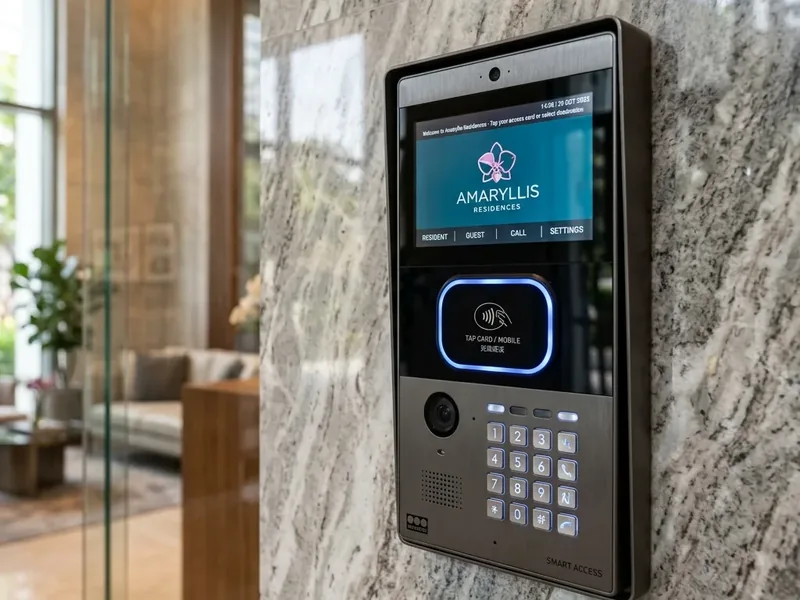
App-based visitor calling from the resident's smartphone, facial recognition and mobile credential access at facility entry points, and lift floor restriction integrated with the access control platform: so the resident credential that opens the gate also calls the lift to their floor.
CCTV & Visibility
4K perimeter surveillance covering car parks, corridors, and facility zones; AI analytics that generate loitering and intrusion alerts rather than requiring guards to watch continuous footage; and incident playback capability that allows the managing agent to review events in seconds rather than hours.
Visitor & Guard Workflows
Digital visitor pre-registration and QR code invitations that allow expected guests to move through the entrance without requiring the guard to call the resident manually; automated guardhouse event logging that replaces the paper visitor book and produces a searchable digital record.
Vehicle & Gantry Operations
LPR-automated resident vehicle entry that processes plates in under 500ms without remote or IU; heavy-duty barriers rated for continuous-cycle estate operation; and tailgating prevention logic that alerts the guard when a second vehicle attempts to follow a recognised plate through the barrier.
Integration & Long-Term Support
Unified platform management that connects CCTV, access control, LPR, and intercom into a single dashboard for the guard team, managing agent, and MCST; fibre infrastructure readiness assessment; and software licensing on a platform with a documented upgrade path for the next 10 years.
Delivered in Occupied Estate Environments
Phased Upgrade Confidence
Securevision has managed large-scale security overhauls for major condominiums across Singapore with no downtime for resident access. Our experience in occupied estate environments means that guard operations and resident convenience are maintained throughout the migration: no phase goes live until it has been tested and signed off.
Our project management standard for every MCST upgrade.
Proven, Compliant, and Built for Long-Term Support
Police Licensed · BCA Registered · · Supporting MCSTs for years
What Affects the Cost of a Condominium Security Upgrade?
Two condominiums with similar unit counts can have very different upgrade costs depending on estate layout, existing infrastructure condition, and the scope of integration required.
Number of Blocks, Entry Points, and Lift Cores
Each vehicle lane requires its own LPR camera and barrier. Each pedestrian gate requires its own intercom panel and access controller. Each lift core requires its own floor restriction integration. The hardware scope scales with the number of controlled points, not just the number of units: a 200-unit single-block estate and a 200-unit four-block estate with separate entry points per block are very different scopes.
Existing Infrastructure and Reuse Potential
Whether existing cabling, fibre backbone, barriers, cameras, and access control hardware can be retained is often the single largest cost variable in a condominium upgrade. Infrastructure in good condition and compatible with the new system reduces the capital cost significantly. We assess reuse potential during the site survey before agreeing any scope: and present the honest case for what can be kept and what needs replacing.
System Integration and Platform Scope
A full integration of CCTV, intercom, LPR, access control, and estate management platform requires configuration work that scales with the number of systems, access points, and resident credentials to be migrated. For estates upgrading from a mixed-vendor environment, the integration scope is more significant than for estates replacing a single integrated system with a newer version of the same architecture.
Phasing and Installation Complexity
Phased installation in an occupied estate takes longer than installation in a vacant building: each zone must be commissioned and tested before residents are transitioned to it, and work schedules must be planned around resident peak hours. The phasing adds time and management overhead to the project, which is reflected in the installation cost. It is the right approach for an occupied estate, but it should be budgeted for accurately.
A Practitioner Observation
The most consistent cost-saving in condominium upgrade projects comes from the infrastructure assessment: identifying what can be retained before the scope is written. Councils that assume full replacement of all cabling and hardware often discover during the site survey that significant portions of the existing infrastructure are serviceable. A project scoped after a thorough survey costs significantly less than one scoped from a floor plan alone.
Frequently Asked Questions
Questions we hear regularly from MCST council members and chairpersons evaluating a security upgrade or vendor change.
How do we get council approval for a security upgrade given the cost involved?
We provide a full upgrade proposal package designed for MCST AGM or EGM presentation: including a written justification, system specification, phased cost options, and a comparison of the current system against what we are proposing. Many councils find this presentation format reduces the number of objections and accelerates the approval process. We can attend the council briefing before the AGM to answer technical questions directly.
Can you work with our existing managing agent and security contractor?
Yes: we work alongside the managing agent and security guarding company throughout the project. We brief the MA on system changes that affect their daily operations, train the guard team on any new equipment, and provide documentation in the format the MA needs for council reporting. We do not require the estate to change its other service providers.
What happens to residents during installation: will there be disruption?
We plan installations around estate peak hours and resident movement patterns. Gate and access control upgrades are done in phases so at least one entry point is always operational. We work with the managing agent to communicate the installation schedule to residents in advance and handle all resident-facing disruption through the MA so the council is not fielding complaints directly.
How long does a typical condominium security upgrade take?
For a standard mid-rise condominium with guardhouse, 2 to 3 vehicle entry points, and an intercom system, a full upgrade typically takes 3 to 6 weeks from approval to commissioning. Larger estates with multiple blocks and extensive perimeter coverage may take 8 to 12 weeks. We provide a detailed project timeline at proposal stage so the council and managing agent can plan accordingly.
Should we upgrade everything at once or in phases?
Phased upgrades are common and practical for most estates. A typical approach prioritises the systems causing the most operational pain in Phase 1, then extends to remaining systems in later phases. Each phase is designed to work as a standalone improvement while connecting to what will be added later. The phasing plan should be agreed before Phase 1 begins: not decided reactively as each phase is completed.
How do we present a security upgrade at the AGM?
The most effective AGM presentations focus on the operational problem being solved: intercom failures, increasing maintenance costs, guard manpower pressure: rather than leading with product specifications. We prepare the proposal in a format that presents the current system's limitations honestly, explains what the upgrade delivers in operational terms, and includes a cost-benefit analysis covering capital cost, maintenance cost, and projected guard reduction saving where applicable.
Can existing estate infrastructure be reused in an upgrade?
Often yes. Existing cabling, fibre backbone, barriers, and in some cases cameras and access control hardware can be retained depending on their condition and compatibility with the new system. Infrastructure reuse is one of the most significant cost variables in a condominium upgrade. We assess reuse potential during the site survey before agreeing any scope and present the honest case for retention or replacement based on what we find.
What if some residents object to the upgrade at the AGM?
Resident objections at AGM are almost always about cost or perceived disruption: rarely about the technology itself. The most effective response is a proposal that addresses both concerns directly: a phased payment approach that spreads the capital cost, and a clear installation plan that demonstrates how resident access will be maintained throughout. We prepare councils for the most common objections before the AGM and can provide written responses to specific concerns raised during the meeting.
Also Relevant To
MCST councils work closely with managing agents and security contractors: understanding each stakeholder's perspective makes for a smoother upgrade process.
Managing Agents
The MA carries the day-to-day operational burden of the estate's security systems. Understanding what makes their work easier helps councils specify the right upgrade outcomes.
Security Contractors
The guarding company's efficiency depends significantly on the technology they work with. Councils who understand the guard team's needs make better procurement decisions.
Condominiums: All Solutions
The full picture of condominium estate security: systems, integration approaches, and what modern estates across Singapore have implemented.
Ready to Plan Your Estate Upgrade?
Tell us about your estate. We will assess the current systems, identify the gaps, and prepare a proposal your council can present with confidence.
Licensed by the Police Force: Licence · Serving Singapore since 2006