Industrial Security Is About Operational Control, Not Just Protection.
Factories, logistics hubs, and tech parks need security that supports throughput, compliance, and safety: not systems that slow operations down.
Securing Singapore industrial properties since .
In Short
Industrial Security Is About Operational Control, Not Just Protection
Industrial security in Singapore is about maintaining operational control while supporting safety and compliance. Factories, logistics hubs, warehouses, and industrial estates require systems that manage people, vehicles, contractors, assets, and restricted zones without disrupting operations. The best industrial security systems combine CCTV, access control, vehicle management, AI analytics, and compliance documentation into a single operational framework.
The most important distinction in industrial security is that the same systems serve two masters simultaneously: the security brief and the WSH brief. The access control record that logs who was in Zone 3 when an incident occurred is the same record that the guard team uses to manage site access. The AI camera that detects an intruder at the perimeter fence is the same camera that detects PPE non-compliance on the production floor. Specifying these as separate projects doubles the cost and halves the integration value. The brief is one system designed to answer both sets of questions automatically.
Security, Safety, and Compliance Are the Same Brief.
Industrial security in Singapore operates under a set of obligations that have no equivalent in commercial or residential environments. The Workplace Safety and Health Act imposes documentation requirements on how people move through hazardous areas, how contractors access plant, and how incidents are recorded. MOM compliance for dormitory and large-scale workforce housing adds another layer. The security system, in this context, is not just a protection tool: it is the infrastructure that generates the compliance evidence the EHS team needs to operate without risk.
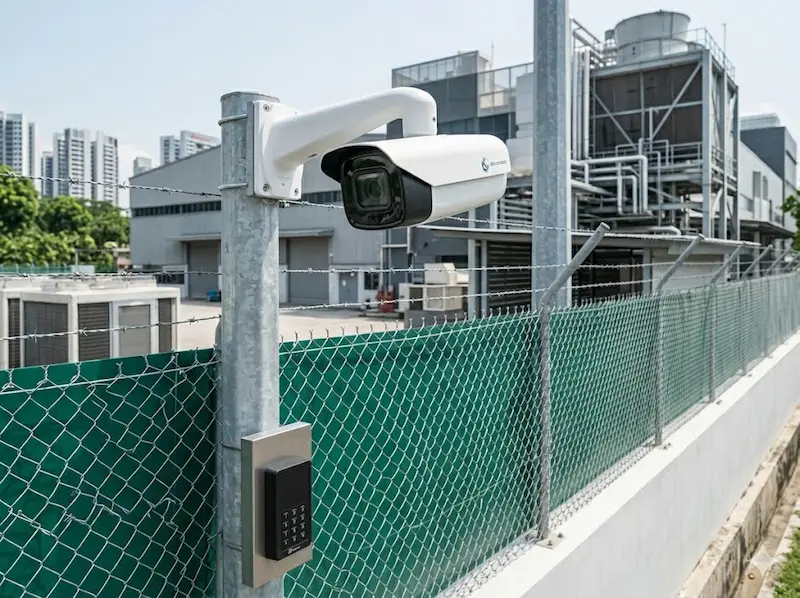
Industrial environments also place demands on hardware that commercial-grade equipment cannot reliably meet. Singapore's industrial sites: Jurong Island, Tuas, Pioneer, Woodlands: operate in conditions of sustained heat, high humidity, airborne particulate, and continuous heavy vehicle traffic. Cameras that fog, readers that corrode, and barriers that fail under high duty cycles are not minor inconveniences: they are operational disruptions and compliance gaps. This guide covers four industrial environments: factories, logistics hubs and warehouses, tech parks and industrial estates, and the safety and compliance systems that apply across all of them.
Common Mistakes We See in Industrial Security Projects
After reviewing factories, logistics hubs, warehouses, and industrial estates across Singapore, several design mistakes appear repeatedly.
Using Commercial Hardware in Industrial Environments
Equipment designed for office buildings: IP65-rated cameras, commercial-grade barriers, standard reader housings: fails prematurely in industrial conditions. Singapore's industrial sites operate under sustained heat, high humidity, and continuous heavy vehicle traffic that degrades commercial hardware well within its rated service life. The cost of replacing failed hardware repeatedly typically exceeds the capital cost difference between commercial-grade and industrial-grade specification within two years of installation.
Treating Security and WSH as Two Separate Projects
The systems that support security and WSH compliance are largely the same systems: access control generates zone access records, AI cameras generate PPE alert logs, visitor management generates contractor entry records. When security and EHS teams specify these independently, the result is duplicated scope, different vendors, and no shared platform. The combined budget could have funded a single integrated system that serves both purposes and produces better records for both simultaneously.
Designing for Average Throughput Instead of Peak Load
The real challenge in logistics and factory security is handling peak vehicle and personnel movement: shift changes, delivery windows, contractor arrival peaks. A gantry system sized for average daily volume that fails during peak load creates operational bottlenecks, guard overload, and security gaps at the moments of highest activity. Throughput audits at actual peak windows, not theoretical averages, should drive the hardware specification.
Specifying Cameras Without Defining Investigation Objectives
The number of cameras installed is not the relevant metric. The relevant metric is whether the footage provides the information needed to answer specific questions when something happens: which bay did the goods leave from, who was in Zone 3 at 14:00, what did the delivery driver do after the guard processed them. Camera positions designed around investigation objectives produce significantly more useful footage than those designed around general coverage targets.
A Practitioner Observation
The most productive industrial security assessments begin not with a camera count or a perimeter plan but with three questions: what are the highest-risk operational events, who needs to know when they occur, and what documentation needs to exist afterwards? The system design that follows from those questions is always more operationally useful than one derived from a square footage estimate and a standard hardware catalogue.
Factories & Manufacturing Plants
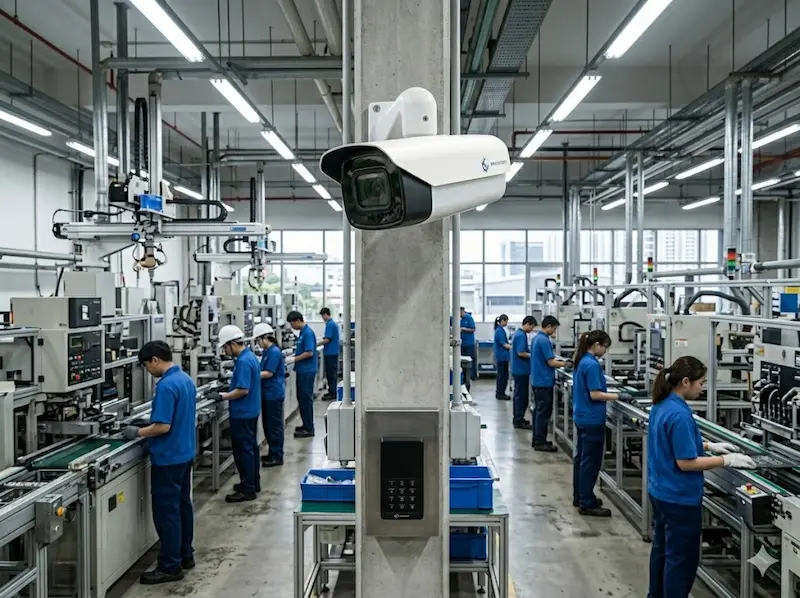
A manufacturing facility is not a building with a production line inside it: it is a set of distinct operational zones that each have different access requirements, different surveillance needs, and different risk profiles. The perimeter is the boundary between the public road and the industrial site. The vehicle yard and loading bays are where goods and contractors enter and leave. The production floor is where the highest-value activity and the highest WSH risk coexist. The utilities and plant rooms are where a failure can halt an entire facility. The security system has to address all four simultaneously.
Perimeter control starts with the site boundary: full-perimeter camera coverage with fence-line intrusion detection, triggering an alert when anyone attempts to breach the boundary outside authorised entry points. Vehicle entry uses LPR cameras at the main gatehouse: fleet vehicles and authorised contractor vehicles are recognised automatically, their entry and exit timestamped against a site record; unrecognised vehicles generate a guard alert for manual verification. For facilities that also house a workforce dormitory or canteen on-site, the same LPR infrastructure logs bus movements and service vehicle arrivals without adding manual guard workload. Access control at internal zone boundaries uses card or biometric readers: production staff have access to their designated production zones, maintenance teams have access to plant rooms and service areas, and contractors are issued time-limited credentials tied to their permit-to-work conditions. A contractor whose permit covers Zone B between 08:00 and 13:00 cannot badge into Zone B at 14:00: the system enforces the permit condition at the physical level, not just the administrative one.
On the production floor, IP cameras with AI analytics take on a role that goes beyond recording. PPE detection continuously monitors workers for compliance with the PPE requirements of each zone: hard hats, high-vis vests, safety footwear: and generates a real-time alert to the EHS supervisor when a non-compliance event is detected, with a camera reference and timestamped image capture. Exclusion zone monitoring around running machinery alerts the control room when a person enters a defined hazard area. These analytics run on the camera hardware itself: no separate analytics server required: and the event logs are formatted for WSH incident documentation. The network infrastructure throughout a factory is typically a mix of wired PoE switches in weatherproof enclosures for camera and access reader connectivity, with dedicated VLANs separating security traffic from the factory's operational IT systems.
WSH Audit Evidence: Generated Automatically: When an MOM inspector requests documentation of zone access, PPE compliance monitoring, or contractor movement records, the VESTA platform generates the required report from the access log and AI alert history. No manual reconstruction, no reliance on paper records. The compliance evidence is a by-product of the security system operating normally: not a separate administrative task that depends on guard diligence.
Logistics Hubs & Warehouses
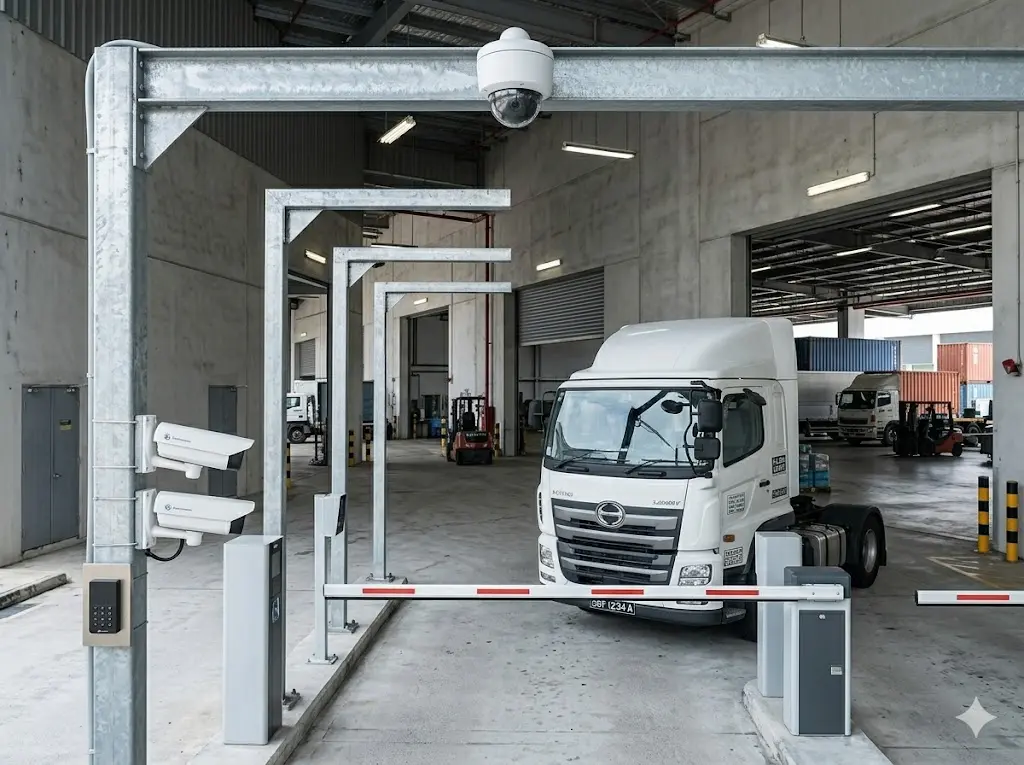
A logistics or warehouse operation is defined by vehicle throughput and goods movement: and both are security and compliance problems simultaneously. The question of who brought what in and when, and who took what out and when, is simultaneously an inventory control question, a client SLA question, and a WSH documentation question. A security system that cannot answer all three is not adequate for a modern Singapore logistics operation.
The gantry is the critical infrastructure point for any logistics facility. LPR cameras at vehicle entry and exit read approaching plates in under 500 milliseconds: fleet vehicles and pre-registered contractor transport enter without stopping, every movement logged against a site record. For facilities with high-cycle vehicle traffic during peak shift windows, the gantry hardware must be rated for the actual throughput: heavy-duty FAAC barriers engineered for continuous operation, not commercial-grade equipment that degrades under industrial cycle loads. Loading bays receive dedicated CCTV coverage with clear sight lines to the bay door, dock plate, and goods transfer zone. When a client raises a shortfall claim or a customs document requires verification of goods arrival, the bay footage is searchable by camera, time window, and: where AI analytics are active: by vehicle type or event detection, retrievable in minutes rather than hours of manual scrubbing. Access control distinguishes permanent warehouse staff from agency workers and one-off delivery drivers: permanent staff use card or biometric credentials, agency workers receive shift-valid credentials that expire at the end of their assigned window, and delivery drivers register at the guardhouse terminal for a temporary site pass. All three populations are logged by name, credential type, zone, and timestamp: generating the named-individual access records that WSH zone documentation requires.
Visitor management at logistics sites has a different character to an office. Many of the visitors to a logistics facility are commercial drivers who arrive unannounced during a delivery window: they are not pre-registered, they are time-pressured, and the guard team is handling multiple vehicle arrivals simultaneously. A digital visitor terminal at the guardhouse: where the driver enters their NRIC or vehicle plate, their delivery reference, and the receiving party: replaces the manual logbook with a searchable digital record, reduces guard processing time per vehicle, and creates the audit trail that the site's client-facing SLA reporting depends on. PoE-managed switches in weatherproof enclosures at each warehouse zone and loading bay level carry the camera and access network: critical infrastructure that needs to be specified for the humidity and temperature conditions of an open-bay warehouse, not for an air-conditioned office building.
Loading Bay as a Security Zone: Every loading bay should be treated as an access-controlled zone, not just a camera coverage area. A door contact on the bay shutter generates an entry event whenever the bay opens: timestamped and logged against the site record. Combined with the camera footage of the bay, this creates a complete record of every goods movement: who authorised the bay opening, what vehicle was present, and what the camera captured during the open window. This record is as valuable for client dispute resolution as it is for WSH documentation.
Tech Parks & Industrial Estates
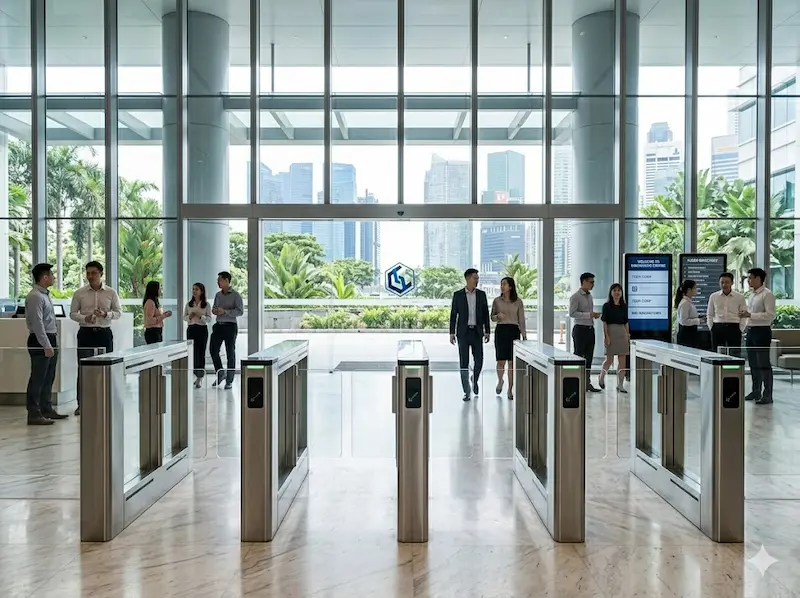
A tech park or multi-tenancy industrial estate is a two-tier security problem. The estate operator needs to control the perimeter, manage shared infrastructure: car parks, loading zones, visitor parking, service corridors: and maintain oversight of the entire site. Each tenant needs to control their own unit independently without any visibility into their neighbours' operations. The system that serves both requirements is architecturally different from either a single-building system or a collection of standalone tenant systems: it requires deliberate two-layer design from the outset.
At the estate level, the security infrastructure covers the perimeter boundary, all vehicle entry and exit gantries, shared car parks and visitor parking, and common-area CCTV. LPR at the estate entry gantry logs every vehicle movement: registered tenant fleet vehicles enter automatically; visitor and delivery vehicles are directed to the guard terminal where the destination tenant is recorded against the vehicle. Turnstiles at the main pedestrian entrance control who can access the estate on foot, with the guard able to issue temporary day passes to visitors at the guardhouse workstation. Perimeter alarm: fence-line intrusion detection or beam-based perimeter sensors: covers the estate boundary with zone-specific alerts, so the guard team knows which section of the perimeter has triggered rather than receiving a generic alert. At the tenant level, each unit has independent card access at the unit entry door, managed by the tenant's own administrator through a separate VESTA portal. The estate manager can see that Unit 12B had a door access event at 11pm; they cannot see who it was or what zone within the unit was accessed. This data separation is architectural, not just a permission setting: it protects the tenant's operational privacy while giving the estate manager the estate-level visibility they are responsible for. The managed network infrastructure: PoE switches distributed throughout the estate, with VLANs separating estate, tenant, and visitor network traffic: is what enables this separation to be maintained reliably.
Tenant Turnover Without a Security Gap: When a tenancy ends, the estate manager deactivates the departing tenant's credential profile and removes their vehicles from the LPR whitelist in a single action from the VESTA dashboard. The new tenant is provisioned with fresh credentials from the same platform: no technician visit, no credential overlap, no security gap during the transition. For an estate with frequent tenancy churn, this centralised credential management is the difference between a manageable process and a persistent administrative risk.
Safety Monitoring, PPE Compliance & WSH Audit Trails
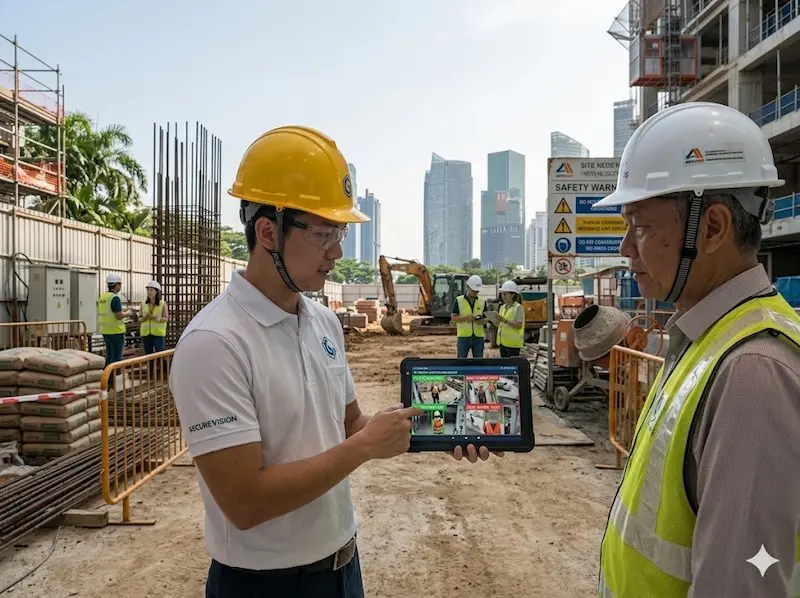
Safety monitoring is the dimension of industrial security that has no equivalent elsewhere. In a factory, a logistics hub, or an industrial plant, the camera network is not just evidence infrastructure: it is part of the WSH management system. How it is configured, what it detects, and what records it generates have direct implications for MOM compliance, incident investigation, and the legal standing of the organisation in the event of a workplace injury. Treating the CCTV system as a security tool and the WSH obligations as a separate administrative matter creates a gap that inspection and incident investigation will expose.
AI analytics on production floor and plant area cameras are configured around the specific safety rules of each zone. A zone that requires hard hats and high-vis vests has analytics configured to detect the absence of either, generating a real-time alert to the duty EHS supervisor with a camera reference and timestamped image. A machinery exclusion zone has analytics that trigger an alert when any person enters the defined boundary: regardless of whether they are wearing the correct PPE. A permit-to-work zone has access control configured to enforce the permit's time window and zone restriction at the physical level: a contractor whose permit covers a specific area from 08:00 to 13:00 cannot badge into that area at 14:00, and the access control system logs the attempted entry. The compliance record is generated by the systems doing their normal job: the EHS team does not need to compile it separately.
Beyond the production floor, safety monitoring extends to operational process compliance. Visitor and contractor management systems create a record of every non-employee who entered the site, when, which zones they accessed, and who authorised their access. For facilities that conduct regular safety inductions for contractors and visitors, the visitor management terminal can be configured to require acknowledgement of site safety rules before a day pass is issued: a timestamped digital record that the visitor completed the induction, rather than a paper form in a filing cabinet. When an MOM inspector requests documentation of zone access records, contractor movement logs, or PPE alert history, the VESTA platform exports the relevant records immediately. When a WSH incident requires investigation: establishing exactly who was in which zone at what time, and whether the correct PPE alert had been generated: the access logs and AI alert history provide a precise, tamper-evident account that a manual guard log cannot.
From Reactive to Proactive: The distinction between a reactive and a proactive industrial safety system is not the sophistication of the hardware: it is whether the system generates an alert before an incident or provides evidence after one. PPE detection that alerts the EHS supervisor in real time is a proactive safety tool. The same camera without analytics is a reactive evidence tool. Both have value; only one prevents incidents. The decision about which to specify is an EHS management decision as much as a security engineering one: and one that Securevision walks through with the EHS team as part of the site assessment.
The System That Serves Two Masters: Security and Compliance.
The same access control record that tells the guard team who is on-site at any given moment tells the EHS team who was in Zone 3 when the incident occurred. The same AI camera that detects an intruder at the perimeter fence detects a worker without a hard hat on the production floor. The same LPR log that manages vehicle throughput at the gantry provides the vehicle movement records that a client's customs audit requires. In industrial security, the value of the system is not measured by what it prevents: it is measured by what it documents, continuously and automatically, across every operation.
Hardware specification for industrial environments is not negotiable. IP67-rated cameras in outdoor and production floor zones. Weatherproof enclosures for network switches in warehouse and loading bay areas. Heavy-duty barriers rated for the actual cycle count of a peak-hour shift change. Biometric readers with stainless steel housings rated for industrial humidity. The difference between commercial-grade and industrial-grade hardware is not a marketing distinction: it is the difference between a system that performs reliably over its service life and one that generates recurring fault calls and replacement costs within eighteen months of installation.
Securevision has been deploying security systems in Singapore's industrial sector since 2006. Every industrial project starts with a site walkthrough, a review of the WSH risk assessment, and a hardware specification built for the conditions of that specific site: not a standard specification adapted from a commercial installation.
Frequently Asked Questions
Questions we hear from operations managers, EHS teams, and plant managers evaluating industrial security systems.
What security systems does an industrial facility typically need?
Most Singapore industrial facilities require four integrated layers: perimeter surveillance and intrusion detection; vehicle access control with LPR at entry and exit gantries; zone-based people access control managing who can enter which area and when; and AI camera analytics for PPE compliance monitoring and exclusion zone detection where WSH obligations require it. The specific configuration depends on the facility type: a factory, logistics hub, and industrial estate each have distinct requirements that shape the system design.
What is the difference between industrial-grade and commercial-grade security hardware?
Industrial-grade hardware is specified for sustained heat, high humidity, airborne particulate, and continuous heavy vehicle traffic. IP67-rated cameras withstand direct water exposure that causes IP65-rated commercial cameras to fog up and fail. Heavy-duty barriers rated for thousands of daily cycles maintain performance under shift-change vehicle loads that degrade commercial barriers within months. Stainless steel access reader housings resist corrosion in humid outdoor environments. The difference is the gap between a system that performs reliably over its service life and one that generates recurring replacement costs.
How does security support WSH compliance in a factory or industrial site?
The access control system generates named-individual zone access records automatically. AI camera analytics generate real-time PPE compliance alerts and log every non-compliance event with a timestamped image. Permit-to-work integration enforces contractor access conditions at the physical level. When an MOM inspector requests documentation, the VESTA platform exports the relevant records immediately. The compliance evidence is generated as a by-product of the security system operating normally: not a separate administrative task.
How are contractors managed in an industrial security system?
Contractors receive time-window credentials tied to their permit-to-work conditions: configured for the zones and hours specified in the permit. Credentials expire automatically when the permit expires and generate an alert if the contractor is still on-site after expiry. All contractor access events are logged by named individual, zone, and timestamp: generating the records required for WSH incident investigation and MOM inspection without manual log compilation.
Can AI cameras reliably detect PPE non-compliance on a busy production floor?
Yes. AI cameras configured for PPE detection continuously monitor the production floor for compliance with zone-specific PPE requirements: hard hats, high-vis vests, safety footwear. Non-compliance events generate an immediate alert to the duty EHS supervisor with a camera reference and image capture. Detection accuracy depends on camera position and lighting: we verify performance during commissioning and adjust camera placement if detection rates do not meet requirements before handover.
How does LPR improve logistics operations compared to manual vehicle checking?
Manual plate checking at the guard post creates bottlenecks during shift changes and peak delivery windows: even a 30-second delay per vehicle compounds into hours of lost throughput across a shift. LPR processes registered fleet vehicles automatically in under 500ms with no guard interaction and no delay. The vehicle log is automatic and complete rather than dependent on the guard's accuracy. Unregistered vehicles generate a guardhouse alert for manual verification: guard time is spent on exceptions rather than routine plate reading.
Can existing cameras and barriers be reused in an industrial security upgrade?
It depends on the age, IP rating, and condition of the existing hardware. Cameras with adequate IP ratings compatible with the new NVR and AI analytics platform may be retainable. Commercial-grade barriers operating at industrial cycle counts are typically near end of service life and are better replaced than retained. We assess existing infrastructure reuse potential during the site survey before agreeing any scope.
Can multiple industrial facilities be managed from one platform?
Yes. The VESTA platform supports multi-site management: access events, vehicle logs, AI alert history, and camera feeds from multiple facilities are accessible from a single dashboard. For manufacturing groups with multiple plants, this allows a central EHS and security team to maintain oversight of all sites without visiting each one. WSH documentation and access records for all facilities are exportable centrally for MOM reporting and group-level compliance management.
The Brands Behind the Systems
Hikvision
IP cameras for industrial environments: AI-analytics models for PPE and exclusion zone monitoring, IP67-rated outdoor cameras for perimeter and yard coverage, Starlight models for outdoor low-light areas.
View Specification →Hikvision LPR
Sub-500ms licence plate recognition at factory and estate entry gantries: fleet vehicle automation, contractor vehicle logging, and visitor pass integration from the VESTA platform.
View LPR Systems →FAAC Barriers
Heavy-duty traffic barriers and turnstiles engineered for continuous industrial cycle loads: specified for the actual vehicle throughput of the site, not commercial-grade equipment under industrial conditions.
View Specification →Access Control
Card and biometric access readers: stainless steel housings rated for industrial humidity: for zone boundary control, permit-to-work enforcement, and visitor day pass management at industrial facilities.
View Specification →VESTA Platform
Centralised platform for industrial security management: access event logs, AI alert history, vehicle movement records, and WSH documentation export for EHS teams and MOM compliance.
Explore VESTA →Omada & Ruijie
Managed PoE switches in weatherproof industrial enclosures: carrying CCTV, access control, and operational IT on separate VLANs throughout factory floors, warehouses, and estate common areas.
View Specification →Go Deeper Into Your Environment
Each industrial sector has a dedicated solutions page covering the operational context, the specific system architecture, and what a well-designed installation looks like in practice.
Factories & Manufacturing
Perimeter control, zone-based access, AI surveillance for PPE and exclusion zones, permit-to-work enforcement, and WSH audit trail generation for Singapore factories and manufacturing plants.
Logistics Hubs & Warehouses
LPR gantry automation, loading bay surveillance, shift-based credential management, visitor and driver logging, and WSH zone documentation for Singapore logistics and warehouse operations.
Tech Parks & Industrial Estates
Two-tier estate and tenant security architecture, turnstile access, LPR vehicle management, perimeter alarm, and centralised credential management for Singapore industrial estates.
Ready to Build the Right System for Your Site?
Every industrial site is different: the environment, the throughput, the WSH obligations, and the operational priorities. Book a site assessment and we will start with the specifics, not a catalogue.
Licensed by the Police Force: Licence · Serving Singapore since 2006