Institutions Serve the Public. Their Security Must Protect It Without Restricting It.
Government offices, schools, and places of worship carry a duty of care: and a security obligation that must not create unnecessary barriers.
Securing Singapore institutions since .
In Short
Security That Earns Its Place in Spaces That Belong to the Public
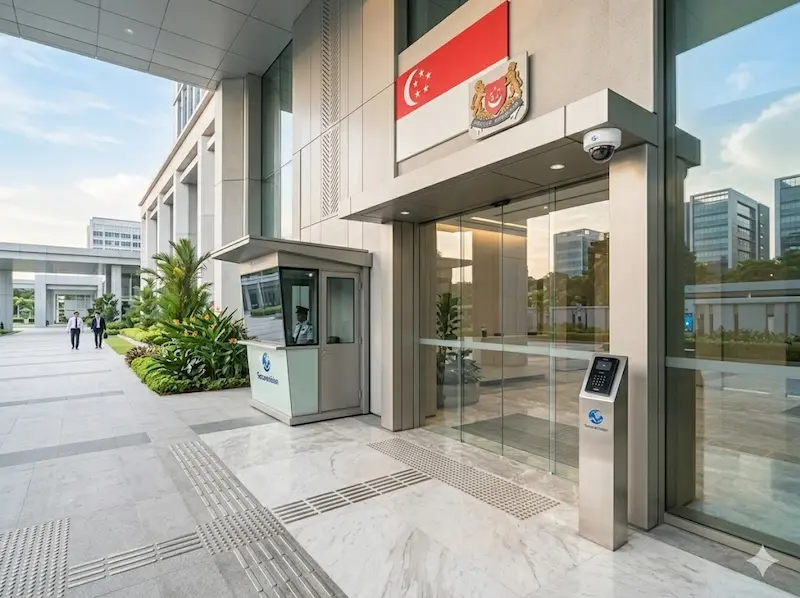
Institutional security has an obligation that commercial and industrial security does not: the people these buildings serve are often there because they have no choice. A resident visiting a statutory board, a child attending school, a congregant entering their place of worship: none of them consented to being surveilled, and the institution carries a responsibility to handle that with proportionality and care. A security system that is overbearing, intrusive, or visually oppressive damages the trust relationship between the institution and the public it serves.
At the same time, Singapore's institutional environments carry real and specific security obligations. Schools have safeguarding duties that extend to every visitor and every access event on campus. Government offices managing sensitive data must maintain audit trails that regulators can inspect at any time. Places of worship receiving large congregations are specifically identified by MHA and SPF as venues that should maintain physical security measures commensurate with their public accessibility. The brief is a system that is effective without being perceptible: invisible to the people it protects, immediate for the people who need to use it.
Public Trust Is the Asset Being Protected.
Institutional security in Singapore operates under a set of obligations that commercial and industrial environments share only partially. The Workplace Safety and Health Act applies to staff. PDPA governs how surveillance data is held and disclosed. MOE Emergency Preparedness requirements govern how schools document and test their lockdown procedures. MHA physical security guidance covers places of worship. The security system must be designed to meet these overlapping obligations: not designed for one and retrofitted to the others.
This guide covers three institutional environments: government and statutory board offices, schools and education centres, and religious and community facilities. Each has a distinct operational character, a distinct visitor population, and a distinct set of obligations. The systems across all three share a common principle: protection without obstruction, visibility without surveillance, and accountability that operates automatically rather than relying on manual processes.
Common Mistakes We See in Institutional Security Projects
After reviewing government offices, schools, and community facilities across Singapore, several design mistakes appear repeatedly.
Applying Commercial or Industrial Security Templates to Institutional Environments
A government office is not a commercial building. A school is not an office. A place of worship is not a retail space. Each of these environments has a distinct character, a distinct user population, and a distinct duty of care: and a security system designed for a different environment will miss the specific requirements of each. The most common version of this mistake is specifying access control designed for a corporate workforce in a school environment where the user population is primarily children who cannot reliably use corporate credential systems.
Treating Camera Placement as a Coverage Exercise Rather Than a Proportionality Decision
In institutional environments, where cameras are placed matters as much as how many cameras are installed. A school that puts cameras in every corridor, or a place of worship that monitors the prayer hall, has created a surveillance atmosphere that damages the environment's core purpose. Camera placement in institutional settings is a proportionality decision: covering the access points and shared areas that carry genuine risk, and deliberately excluding the spaces where surveillance would be intrusive or inappropriate.
No Structured Visitor Verification at Public-Facing Counters
Government offices receiving hundreds of public visitors daily, schools with parent and contractor traffic, and community facilities with event visitors all have one thing in common: the visitor population is large, varied, and partially unknown. Without a structured visitor management flow: digital registration, identity verification, access restriction to the relevant zone: the institution cannot account for who is on its premises at any given time. This gap is rarely apparent during normal operations but becomes significant during an incident investigation or a regulatory inspection.
Installing Emergency Response Capabilities Without Testing Them
A lockdown system that has never been triggered is an unknown quantity. A counter-terrorism alert capability that nobody has practised responding to may not produce the intended response under pressure. Institutional security systems: particularly those with emergency response functions: must be tested with the relevant staff before handover, and the procedure must be documented in a format that new staff can follow without the installer present. We do not hand over a school security system without a lockdown drill. We do not hand over an abandoned baggage detection system without walking the duty coordinator through a simulated alert.
A Practitioner Observation
The most productive institutional security conversations we have begin not with a system specification but with a question about the specific situation the institution is trying to prevent or respond to. A school that has had an unscheduled visitor reach a classroom has a different starting point from one that has never had an incident but wants to be prepared for MOE's emergency preparedness review. A government agency about to undergo its first internal audit has different immediate priorities from one implementing a new public service counter. The system follows from the situation: not the other way around.
Government Offices & Statutory Boards
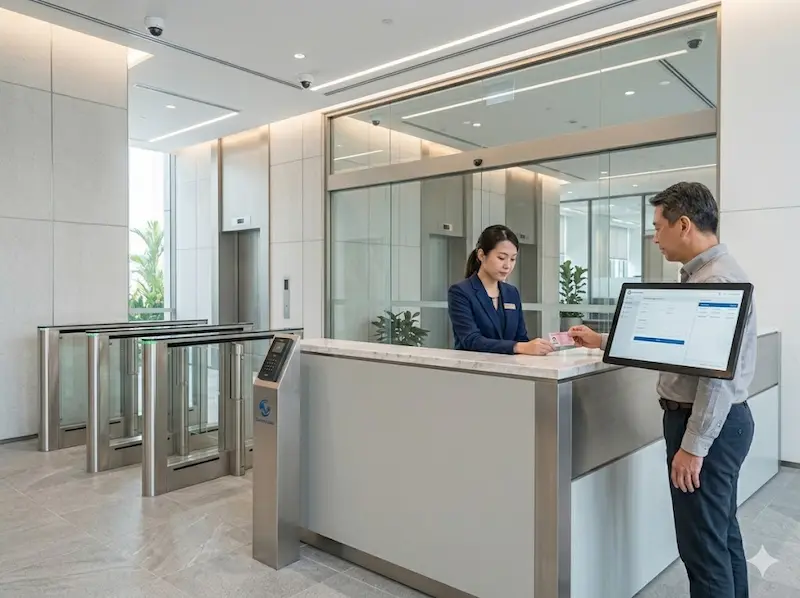
A government office or statutory board facility is a workplace, a public service point, and a regulated entity simultaneously. Staff need frictionless access to do their jobs. Members of the public need managed, dignified access to the services they are entitled to use. And the organisation's operations: the data it holds, the systems it runs, the spaces it manages: need to be auditable at any time to any authorised body. No other workplace category carries all three obligations at once.
Visitor management at the public counter is where the brief begins for most statutory boards. Facilities like CPF, HDB, or NEA receive hundreds of public visitors daily: each needing to be logged, directed to the correct service zone, and restricted from accessing staff-only back-of-house areas. A digital visitor terminal at the lobby registers each arrival: NRIC or passport, appointment reference, service purpose: and issues a visitor pass that permits movement to the relevant service area and nowhere else. The access control system enforces this at the door level: a visitor pass issued for the service counter zone cannot open a door to the finance department. Staff credentials are configured by department and clearance level, with every access event logged by named individual, zone, and timestamp: generating the audit trail that internal audit and regulatory inspections require. For agencies subject to MAS Technology Risk Management guidelines or CSA Critical Information Infrastructure requirements, the access log and footage retention configuration can be set to match the specific retention and tamper-evidence standards those frameworks specify.
CCTV covers all public-facing areas: lobby, waiting areas, counter service zones, and public corridors: with camera positions documented for PDPA compliance and footage retention configured to the agency's specific obligation, which typically exceeds the commercial default. For agencies with sensitive operational areas, camera coverage is extended to server rooms, communications rooms, and other technical infrastructure with the same long-retention configuration. IP phones connecting every desk extension, reception counter, and back-office team on one system replace PSTN lines and allow staff to be reachable on their office extension from any device. Managed PoE switches throughout the building carry CCTV, access control, and the IP phone network on separate VLANs, with network documentation produced as part of the handover package for the agency's IT team.
Procurement-Ready Documentation: Government and statutory board security upgrades operate under procurement governance requirements that most commercial integrators are not structured to meet. Securevision produces pre-installation specifications, equipment schedules, and compliance references in formats suitable for GeBIZ or internal quotation processes. Post-installation, the handover package includes as-built drawings, equipment warranties, system configuration records, and PDPA camera placement documentation: in the formats that government facilities management audit requires, not in the integrator's standard handover template.
Schools, Childcare & Education Centres
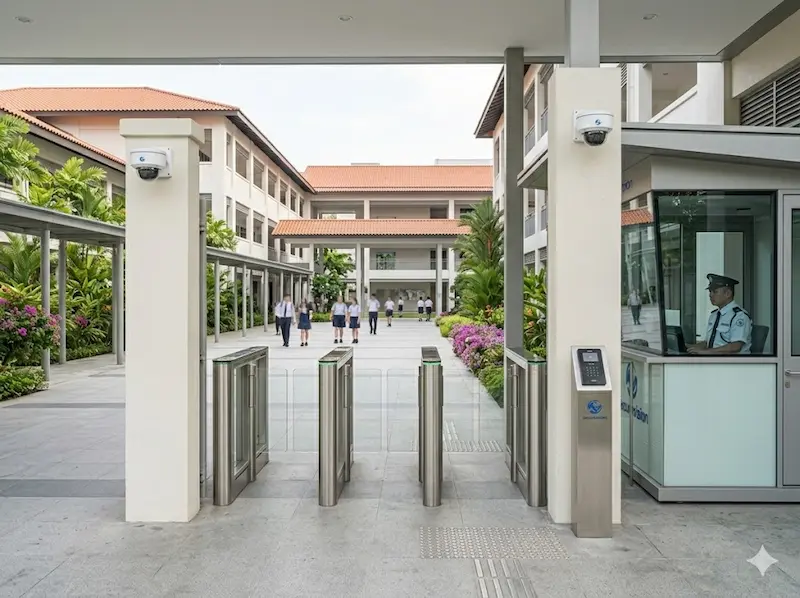
A school security system operates in one of the most demanding access control environments in Singapore. The campus has to be open enough for students, parents, teachers, delivery personnel, and contractors to move through it naturally across a long and complex daily schedule: and secure enough that anyone on campus who should not be there is identified and managed before they reach the student population. These two requirements create a tension that generic commercial access control systems are not designed to resolve.
Perimeter control and visitor management are the first layer. Every entry and exit point on the campus perimeter: main gate, side gates, service entrances: is covered by CCTV with clear sight lines to approaching individuals. The main gate uses an intercom panel with a video call function: visitors announce themselves to the general office, which can see the visitor and release the gate from the office workstation without staff needing to go to the gate. All visitors: parents, contractors, delivery drivers: register at a digital visitor terminal at reception, with their identity logged and a visitor pass issued that restricts their movement to the area they have permission to access. Pre-registered visitors, such as parent volunteers and regular contractors, are logged automatically on arrival; ad-hoc visitors require manual reception approval. The resulting visitor log is searchable, exportable for safeguarding investigations, and available without manual compilation.
Staff access uses card credentials at all internal zone boundaries: the staffroom, the server room, the general office. Student movement within the campus is managed through zoned camera coverage rather than card-based access control: CCTV with AI motion detection monitors corridors, canteen, and external areas, providing the general office with situational awareness of the campus without requiring every student to carry a credential. At specific access-risk points: science laboratories, rooftop plant rooms, swimming pools: physical access control using staff cards prevents unsupervised student entry. Abandoned baggage detection is an AI camera analytics function deployed at the school lobby and main entrance areas: when a bag or parcel is left unattended beyond a defined time threshold, the system generates an alert to the general office: a standard counter-terrorism security measure that Singapore schools are encouraged to adopt under SPF and MHA physical security guidance. IP phones connect the general office, principal's office, staff rooms, and discipline rooms on one internal extension system, with the lockdown protocol built into the access control platform: a single trigger from the general office secures all external campus entry points simultaneously, with the event timestamped and logged.
Lockdown as a Standard Feature: Every school security system we design includes a lockdown protocol: a single action that secures all external perimeter access points simultaneously and generates a timestamped log. We test the lockdown function with the principal and general office team during commissioning and include the procedure documentation in a format compatible with the school's existing emergency response plan. The lockdown capability is not an add-on; it is a standard design requirement, treated the same way as fire exit compliance.
Religious Sites & Community Facilities
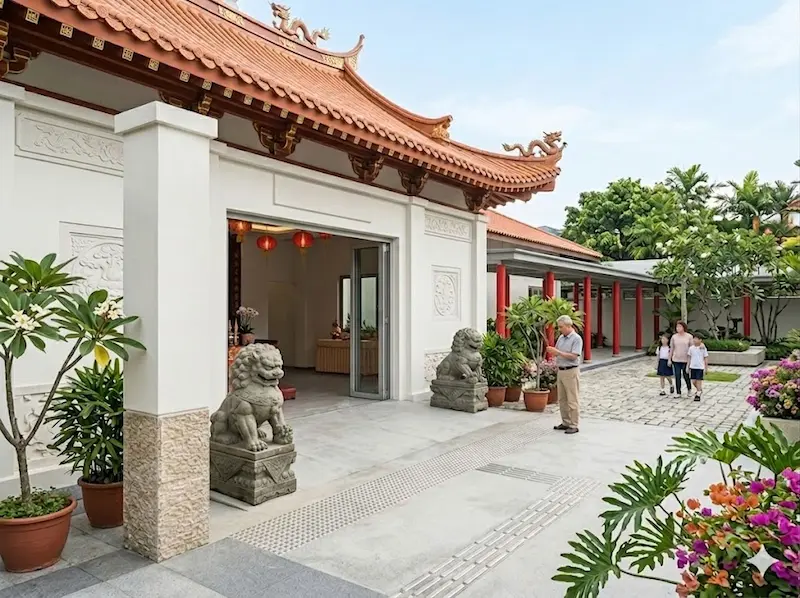
A place of worship is defined by its openness. A church or mosque that feels monitored, controlled, or unwelcoming has failed at its primary purpose: and a security system that creates that feeling is a failure regardless of how technically capable it is. The engineering brief for a religious or community facility is not just what the system detects: it is where the cameras are, where they are not, and how every decision about hardware placement reflects an understanding of the space's character and the community's expectations.
The security case for religious and community facilities in Singapore is, however, significant and well-documented. Singapore's MHA has specifically identified places of worship as facilities that should maintain physical security measures commensurate with their public accessibility: large gatherings of people in publicly known locations, predictable schedules, and open-door entry policies create a threat profile that requires deliberate mitigation. The systems that address this do not need to be visible to worshippers; they need to be effective. CCTV covers all vehicle and pedestrian entry and exit points, car parks, and the corridors leading to restricted staff and operations areas: not the worship hall, not the prayer area, not the spaces where religious activity takes place. AI crowd monitoring at entrance areas provides real-time density data during peak attendance events: a large Singapore church or mosque receiving thousands of visitors across multiple Sunday or Friday sessions needs the operations team to have situational awareness of crowd build-up at each entry point, not a retrospective camera review after an incident has occurred.
Abandoned baggage detection is a specific AI camera analytics function that we deploy at the lobby, main entrance, and car park drop-off areas of religious and community facilities. When a bag, parcel, or unattended object remains stationary beyond a configured time threshold without an associated person in the frame, the system generates an alert to the duty security coordinator or facility manager. This capability is part of the counter-terrorism physical security measures that Singapore's SPF Community Policing Division actively encourages large-congregation venues to implement: and it runs silently in the background without any perceptible change to how the space feels or operates. Access control for staff and volunteers uses card credentials at the operations office, AV room, and donation storage areas: restricting access to the organisation's most sensitive physical assets without imposing any restriction on the congregation's movement in the public spaces. After-hours perimeter monitoring detects movement on-site outside operating hours and alerts a designated response contact, protecting equipment, donation assets, and the building itself during the many hours each week when no staff are present.
Camera Placement by Design, Not Default: We document every camera position before installation and present the placement plan to the church board, mosque management committee, or community centre leadership for review and approval. The documentation covers what each camera sees, what it does not see, and the PDPA basis for each installation. For facilities that display public signage about surveillance: a legal requirement when cameras cover areas visited by members of the public: we provide the standard notice text as part of the handover package. The congregation should know they are protected; they should not feel they are being watched.
The Security System Must Earn Its Place in the Building.
Across all three institutional environments on this page, the security system operates in a context where the people it protects did not choose to be monitored. A student at school, a member of the public at a government counter, a congregant at a service: each of them is present for a purpose that has nothing to do with security, and the system must serve that purpose, not obstruct it.
This imposes a discipline on system design that commercial and industrial environments do not require to the same degree. Camera positions are approved, not assumed. Access control is proportionate to the risk, not maximally restrictive. Visitor management creates a record without creating a fortress. Lockdown protocols exist and are tested, but they are invisible until needed. Abandoned baggage detection runs continuously and silently, as counter-terrorism preparedness built into the fabric of the building, without generating the kind of heightened security atmosphere that would change how people experience the space.
Securevision has installed security systems in government facilities, schools, and places of worship across Singapore since 2006. Every institutional project begins with a conversation about the community being served: before any camera position is proposed or any access policy is designed.
Frequently Asked Questions
Questions we hear from government agencies, school principals, and institutional facilities managers evaluating a security upgrade.
What security systems do government offices and statutory boards typically need?
Most Singapore government and statutory board facilities require visitor management at the public counter; zone-based staff access control separating public service areas from restricted operational zones; CCTV covering all public-facing areas with long-retention configuration for regulatory compliance; and IP communications connecting all staff and service counters on one system. For agencies subject to MAS Technology Risk Management or CSA Critical Information Infrastructure requirements, access log retention and tamper-evidence configuration follow those specific frameworks.
How is security designed for schools without making the campus feel institutional?
The design principle is age-appropriate access architecture: staff credentials at all entry points, visitor flow through a managed reception process, student movement within campus guided by zone-based camera monitoring rather than access card requirements. Camera positions are documented and proportionate. The lockdown capability is built in as a standard feature but operates silently until triggered. The goal is a system that is effective without being perceptible to students as surveillance infrastructure.
What is abandoned baggage detection and do religious facilities need it?
Abandoned baggage detection is an AI camera analytics function that monitors the lobby and entrance areas and generates an alert when a bag or unattended object remains stationary beyond a configured time threshold without an associated person in the frame. Singapore's SPF Community Policing Division actively encourages large-congregation venues to implement this capability as part of their counter-terrorism physical security measures. It runs silently in the background without changing how the space feels to worshippers or visitors.
Can CCTV be installed in a place of worship without intruding on the worship experience?
Yes: the brief for religious facility CCTV is specifically that the security system should be invisible to worshippers. Camera positions cover vehicle and pedestrian entry and exit points, car parks, and corridors leading to restricted areas: not the worship hall, prayer space, or areas where religious activity takes place. We document every camera position before installation and present the placement plan to the church board or mosque management committee for review and approval before any work begins.
What documentation do government agencies receive for compliance and audit purposes?
The handover package includes pre-installation specifications and equipment schedules in formats suitable for GeBIZ or internal quotation processes; post-installation as-built drawings, equipment warranties, and system configuration records; and PDPA camera placement documentation formatted for internal audit and regulatory inspections. We produce this documentation as a standard deliverable, not an optional add-on.
Can existing cameras, cabling, and intercoms be reused in an institutional security upgrade?
Often yes. Existing cameras in adequate condition and compatible with the new NVR may be retained. Cabling that passes a continuity check can typically be reused, and existing intercom wiring may support a new IP video call panel without full replacement. We assess existing infrastructure reuse potential during the site survey before agreeing any scope.
How are lockdown systems installed in schools without disrupting the school day?
We schedule all major installation work during school holidays where possible. Door controller installation, cabling, and access control commissioning are done outside school hours. The lockdown function is tested with school staff: including a full drill: before handover. We provide written lockdown procedure documentation in a format compatible with the school's existing emergency response plan and MOE Emergency Preparedness requirements.
Does Securevision understand the specific procurement requirements for government facilities?
Yes. Government and statutory board security upgrades operate under procurement governance requirements: GeBIZ compliance, specific documentation formats, quotation schedules, and post-installation handover requirements: that most commercial integrators are not structured to meet. We produce pre-installation specifications and post-installation handover packages in the formats that government facilities management and internal audit require.
The Brands Behind the Systems
Hikvision
IP cameras with AI analytics for all institutional environments: abandoned baggage detection, crowd monitoring, and standard surveillance. Long-retention NVR configuration for government and education requirements.
View Specification →Akuvox
IP video intercom panels for school gates and government lobbies: video verification of visitors from the general office or reception desk, with remote gate release and access event logging.
View Specification →RISCO
Burglar alarm systems for after-hours protection of schools and community facilities: PIR, door contacts, external siren, and monitoring centre connection for unoccupied buildings overnight.
View Specification →Access Control
Card and biometric access readers for staff zones, restricted areas, and lockdown-enabled perimeter doors: credential management for institutions with high staff turnover and contractor populations.
Explore Access Systems →Yeastar
IP PBX for government offices and schools: internal extensions across departments, SIP trunking for external calls, and intercom integration as a gate extension for the general office.
View Specification →Omada & Ruijie
Managed PoE switches and WiFi 6 access points: network infrastructure for CCTV, access control, and IP phones across multi-building campuses and multi-floor government facilities.
View Specification →Go Deeper Into Your Environment
Each institutional sector has a dedicated solutions page covering the operational context, common system design challenges, and what a well-considered installation looks like in practice.
Government & Statutory Boards
Visitor management at public-facing scale, zone-based staff access, audit-ready documentation, and procurement-compliant specifications for Singapore government facilities.
Schools & Education Centres
Perimeter control, visitor management, age-appropriate access architecture, lockdown protocol, abandoned baggage detection, and safeguarding documentation for Singapore schools and childcare centres.
Religious & Community Facilities
Open-space surveillance, crowd monitoring, abandoned baggage detection, after-hours perimeter protection, and donation and asset security for Singapore religious organisations and community centres.
Ready to Design Security That Fits Your Institution?
Every institution is different: the community it serves, the spaces it manages, and the obligations it operates under. Book a site assessment and we will start with yours.
Licensed by the Police Force: Licence · Serving Singapore since 2006