What Goes Into a Condominium Security System: and Why Each Part Matters.
From estate CCTV and mobile intercom to LPR vehicle management and centralised monitoring: how condominium security systems work together.
Serving Singapore condominiums and MCSTs since .
In Short
Five Systems. One Complete Estate.
A modern condominium security system is usually built around five core elements: estate CCTV, mobile video intercom with access control, LPR vehicle management, a unified estate management platform, and a manpower strategy that uses technology to extend the guard team's coverage. Each system solves a different problem. Together, they help residents move more easily, guards work more efficiently, and managing agents operate the estate with greater visibility and control.
The value is in the integration, not in any individual system. An estate with excellent CCTV but a manual visitor logbook and a broken intercom is not a secure estate: it is a well-recorded one. The brief is management at scale, not protection in isolation.
Five Systems. One Complete Estate.
A condominium security system is fundamentally different from a residential home system. It serves hundreds of residents, multiple access points, shared facilities used around the clock, and a guard team that cannot be everywhere simultaneously. The brief is not just protection: it is management at scale.
For most Singapore condominiums, the answer is built from five systems: estate CCTV, a mobile video intercom with facility and lift access control, LPR vehicle management, the VESTA management platform, and a remote monitoring approach that reduces manpower dependency without reducing coverage. Each does a specific job. Together, they give the MCST, managing agent, and guard team complete control of the estate.
Common Mistakes We See in Condominium Security Upgrades
After reviewing condominiums across Singapore: estates of all sizes, ages, and management configurations: several issues appear repeatedly.
Upgrading One System at a Time Without a Platform Plan
Many estates replace CCTV in one year, intercom two years later, and add LPR in a third project: each time engaging a different contractor and specifying a different system. The result is three systems that were never designed to work together and cannot be managed from a single dashboard. The guard has three separate screens, the managing agent has three separate maintenance contracts, and the estate has spent more in total than a planned integrated upgrade would have cost. The integration plan should come before the first system is replaced, not after the third.
Starting With Hardware Instead of Workflow
The most common question at the start of a condo security review is "which intercom should we buy?" The more useful starting question is "how should residents, visitors, contractors, and guards interact with the estate's entry points?" The answer to the second question determines the answer to the first: and produces a system specification that is designed around the estate's actual operational requirements rather than a product catalogue comparison.
Underestimating Resident Communication
Many security upgrades succeed technically but generate resident complaints because residents were not told what was changing, when it was changing, and what they needed to do differently. A new mobile app intercom that residents have not downloaded is an intercom system that does not work. Resident communication planning: what changes, when, and how to use the new process: should be part of the project scope, not an afterthought managed by the managing agent on their own after handover.
Overlooking Network Infrastructure
Every system on this page runs on IP: and a weak or poorly configured estate network eventually affects all of them. A camera that drops offline because the PoE switch in the car park is overloaded is not a camera problem. An intercom that lags during calls because the WiFi access point is too far from the panel is not an intercom problem. Network infrastructure is the foundation that determines whether the security system performs reliably for its service life or generates a constant stream of fault calls to the managing agent's office.
A Practitioner Observation
The most productive security review conversations we have with MCST councils start not with "what systems do we need?" but with "what problems are we actually trying to solve?" A council that is frustrated with visitor management at the guardhouse has a different priority from one that is struggling with guard headcount costs or one that cannot investigate incidents because the CCTV coverage has gaps. The system design that follows from a clear problem statement is always better suited to the estate than one that begins with a specification.
Estate CCTV & Surveillance
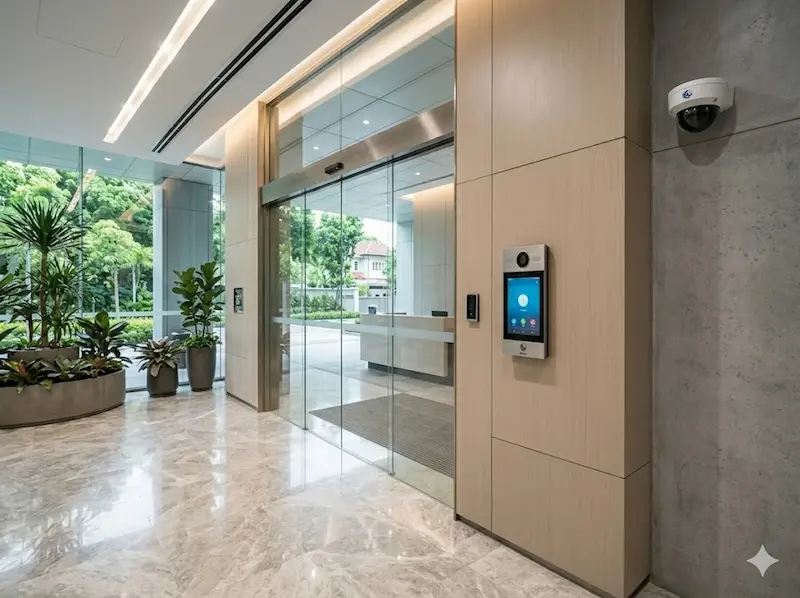
A condominium has a fundamentally different surveillance brief to a private home. The camera network must cover a large and varied estate: car parks, lift lobbies, corridor levels, perimeter fencing, facility zones, and guardhouse approaches: while remaining manageable from a single monitoring station. Achieving this requires deliberate camera selection for each zone, not a uniform specification applied across the entire estate.
In car parks and corridors, we specify wide-angle cameras: typically fisheye or varifocal lenses that provide a 180° or greater field of view: to cover the full width of a bay row or corridor from a single mounting point. A well-positioned wide-angle camera in a car park deck can see the full length of a row and both ends of the aisle from a single ceiling position, where a standard fixed lens would require two or three units to achieve the same coverage. In multi-level car parks, this significantly reduces the camera count and associated cabling cost without creating blind spots.
For open outdoor areas: swimming pools, playgrounds, BBQ pavilions, and recreational lawns: the lighting challenge is different. These zones are in use from early morning to late evening, transitioning from full tropical daylight to artificial lighting at night. We specify Starlight cameras for these locations. Starlight technology uses a larger image sensor that captures usable colour footage in very low ambient light: the level of a moonlit outdoor area or a minimally lit pool deck: without switching to the washed-out monochrome image of standard IR night vision. The result is footage that is both evidentially useful and accurate for identifying individuals, even without additional lighting infrastructure.
Lift lobbies and guardhouse entry points receive AI-capable cameras with smart detection: human silhouette detection that triggers an alert when someone loiters in a lobby during quiet hours, or object abandonment detection at the guardhouse gate. These analytics run on the camera itself, reducing the load on the central NVR and generating targeted alerts rather than continuous recording flags that no one reviews.
The Specification: We specify IP cameras for estate CCTV: wide-angle fisheye models for car parks and internal corridors, Starlight sensor models for pools and outdoor facilities, and AI-capable cameras at access points. All cameras feed into a central NVR at the guardhouse; footage is accessible remotely by the managing agent and by the MCST-designated administrator via the estate management platform, with role-based access that prevents guard-level users from exporting footage without authorisation.
What to consider:
- Wide-angle cameras reduce camera count in car parks and corridors significantly: a fisheye unit at the centre of a corridor covers both directions from one IP address on the switch.
- Starlight cameras at pools and playgrounds are an upgrade over standard IR cameras but not a substitute for adequate facility lighting: the two work together, not interchangeably.
- AI analytics on edge cameras (human detection, loitering alerts) are more useful than blanket motion recording: they generate actionable alerts rather than footage libraries that accumulate without review.
- Plan network switch placement in car park decks and facility buildings during construction or M&E coordination: surface-run conduit to distant IP cameras is a common cost overrun in retrofits.
Visitor Call Panel, Mobile Intercom & Facility Access
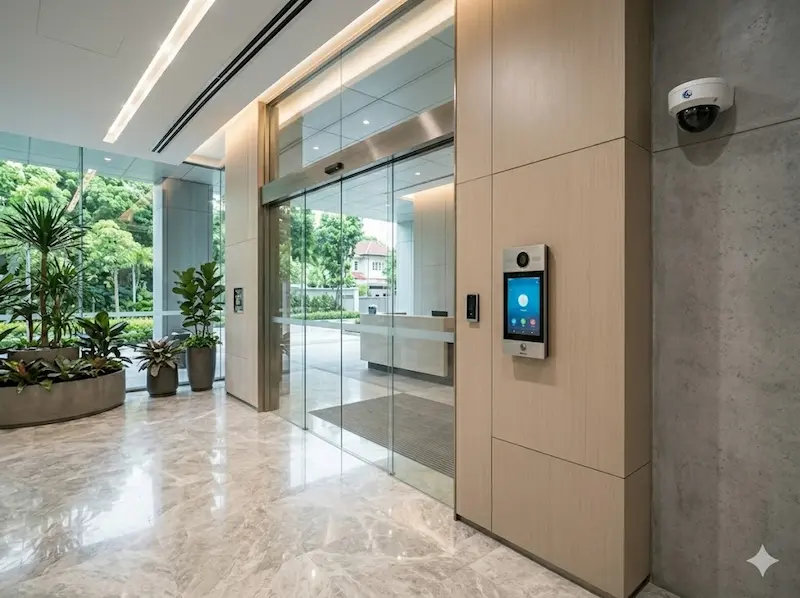
The visitor call panel at the main guardhouse and secondary pedestrian gates is the most used piece of security hardware on a condominium estate: more so than any camera or barrier. It is how every resident receives visitors, how contractors are let in, how delivery drivers announce themselves. For a 200-unit development, that is hundreds of daily interactions. The experience it creates: for residents, visitors, and the guard team: defines how the estate's security system is perceived.
Modern IP video call panels do substantially more than ring a resident. The panel calls the resident's smartphone directly via the mobile app: the resident sees a live video stream of the visitor, speaks to them in real time, and releases the gate with a tap regardless of whether they are in their unit, at the poolside, or overseas. No indoor handset to maintain. No missed calls because the resident was in the shower. The audit trail is automatic: every call, every gate release, every access credential use is timestamped and logged.
The same platform manages facility access and lift access control. Residents use an access card, mobile credential, or facial recognition to enter the gym, function room, BBQ pavilion, and other facilities: outside permitted hours, the door simply does not respond to standard resident credentials. Visitor lift access is managed at the lobby: a visitor whose host has granted a temporary pass can call the lift to their floor without requiring the guard to escort them. Contractor access can be pre-programmed for specific zones and time windows: a maintenance team working in the plant room on Level 3 cannot access residential floors.
For lift integration specifically, the access control system links to the lift controller so that a resident's card or phone credential, when presented at the lobby reader, calls the lift and enables only their floor and the basement car park. Visitors who receive a QR code invitation from their host are permitted their host's floor only. This eliminates the need for a guard to accompany every non-resident to their destination, and removes the common security gap where a visitor granted lobby access can reach any residential floor freely.
Resident Access Beyond the Main Gate: Access cards and mobile credentials provisioned on the same system serve as the resident's key to every access-controlled point on the estate: main gate pedestrian entry, car park barrier (for residents without vehicles using LPR), gym, pool, function room, and lift floor restriction. One credential, managed centrally by the managing agent, revoked instantly on departure. No physical key changeovers, no lost card security incidents that require a system-wide response.
What to consider:
- A mobile app intercom that calls the resident's smartphone: not just a fixed indoor handset: is the difference between a system residents actually use and one they route around.
- Facial recognition at facility entry points removes the need to present a card for everyday access: residents walk up and the door opens; the access event is logged automatically.
- Pre-registered visitor QR codes eliminate the guard's role as escort for invited guests: the system manages the access, the guard manages exceptions.
- For estates with multiple guardhouses or secondary gates, all panels run on the same platform: a visitor who was added for Gate 1 can also enter Gate 2 if permitted, without a second registration.
LPR Vehicle Management
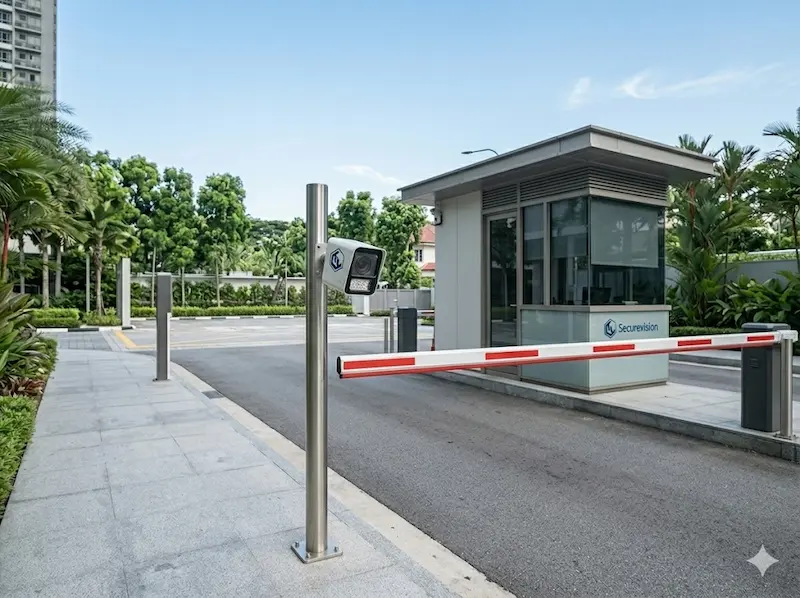
Vehicle management at a condominium is a two-population problem. Residents: whose vehicles are known, registered, and should move through the barrier without friction. Visitors: whose vehicles are unknown, need to be verified, logged, and permitted only when expected. The systems that serve both populations well are different from those that serve only one.
Licence Plate Recognition (LPR) cameras at vehicle entry and exit points read approaching plates and compare them against the registered resident vehicle database in real time. A recognised resident plate triggers the barrier automatically: sub-500ms from camera read to barrier open: with no remote to press, no IU sticker to fail, no card to present through the window. The guard sees the vehicle's registration, unit, and resident name on the guardhouse monitor, and the event is logged automatically. Residents experience a frictionless arrival. Unauthorised vehicles that enter a registered resident's bay: a recurring management complaint on shared-basement estates: are immediately detectable from the access log.
For visitors, LPR works alongside the guard workflow rather than replacing it. A visitor who calls through the intercom panel can be granted a temporary vehicle pass by the guard: the visitor's plate is entered into the system for the duration of the visit, the barrier opens on arrival, and the pass expires automatically at the end of the permitted window. Frequent visitors: a domestic helper's regular transport provider, a resident's family member who visits weekly: can be pre-registered as recurring permits by the managing agent, eliminating repetitive manual authorisation at the guardhouse.
LPR also serves an estate management function that is often underappreciated. The vehicle movement log provides the managing agent with a complete record of every vehicle entry and exit, timestamped and plate-referenced. When a by-law dispute arises over visitor parking, or when an incident in the car park requires investigation, the log is immediately searchable: no manual record to reconstruct, no guard's memory to rely on.
IU-Based vs LPR: Many older condominiums still use IU (In-Vehicle Unit) readers for resident entry: residents tap their IU at the reader to trigger the barrier. IU is reliable but has limitations: it requires a physical unit in each vehicle, fails when the IU battery depletes, and provides no visual verification that the vehicle at the reader is the registered vehicle. LPR provides visual confirmation of the plate and works regardless of whether the resident has remembered to mount the IU or whether the reader is functioning correctly. For estates upgrading from IU, LPR is the standard replacement; for new developments, LPR is the default specification.
What to consider:
- LPR camera positioning is critical: the camera must have a clear, unobstructed sight line to the approaching plate at the correct angle and lighting conditions, day and night.
- For estates with multiple vehicle entry points, all LPR cameras and barriers run on the same platform: a resident whose vehicle is registered at Gate 1 is automatically permitted at Gate 2 without re-registration.
- LPR does not replace the guard at the vehicle gatehouse: it changes their role from manual plate-checker to exception handler and visitor verifier, which is a more effective use of their time.
- Heavy-duty barriers rated for continuous-cycle operation are required for high-volume condominium entry points: commercial-grade barriers specified for lower cycle counts degrade quickly under estate traffic load.
VESTA Management Platform
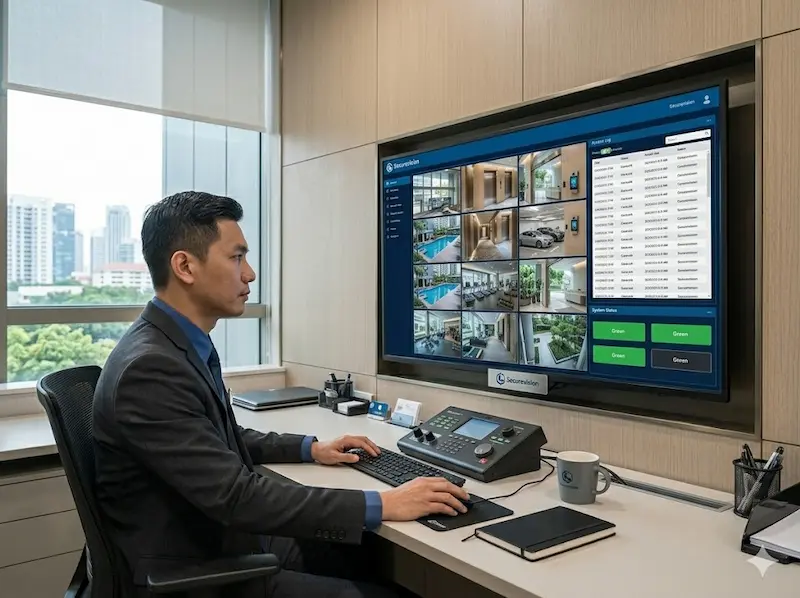
Each of the systems described so far generates data: access events, vehicle movements, camera alerts, facility bookings, visitor logs. Without a platform to aggregate and make sense of this data, the information lives in four separate interfaces that no single person has time to monitor, and incidents are investigated by manually cross-referencing disconnected logs. VESTA is the platform that brings these systems together: and turns raw event data into estate oversight that is actually manageable.
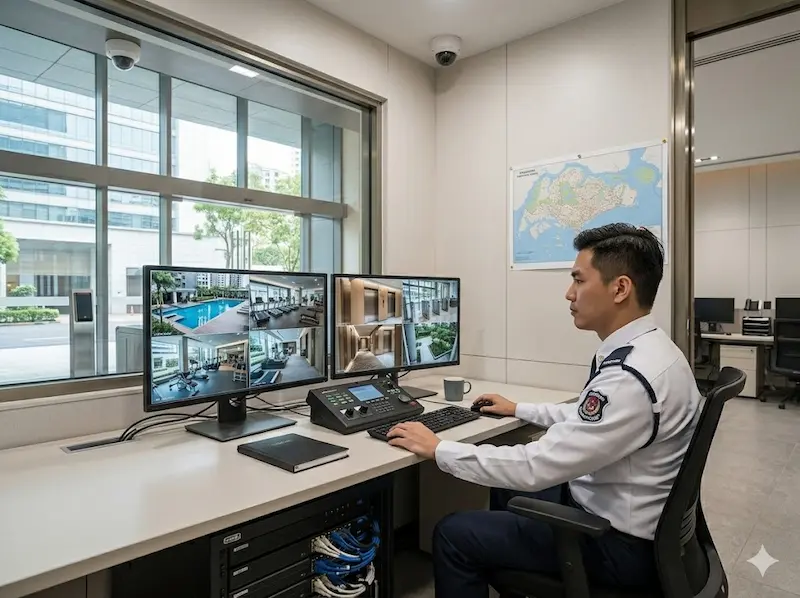
At the guardhouse, VESTA presents the guard with a single workstation view: live camera feeds from key monitoring points, incoming intercom calls from gate panels, vehicle barrier events with LPR-matched plate and resident information, and access control events flagging anomalies. The guard does not need to switch between a camera view, a separate intercom screen, and a manual log sheet: everything is on one screen, in one context. A visitor arrives at the gate, calls through the panel, the guard sees the camera view and the call simultaneously, verifies the visitor, grants access, and the event is logged: in one workflow rather than three.
For the managing agent and MCST, VESTA provides a reporting layer that does not require the guard team to compile anything manually. Visitor summaries, vehicle movement reports, facility access logs, and system health status are generated from the platform and exportable for council meetings, insurance purposes, or by-law enforcement. An MCST investigating a noise complaint at the BBQ pavilion at 11pm has immediate access to the facility access log showing who entered with which credential, and the camera footage timestamped to that event: without a phone call to the integrator.
Remote access is a standard VESTA feature. The managing agent's office can review any camera feed, pull any access report, and receive system fault alerts from any browser or the VESTA mobile app: without being on-site. For estates managed by a firm with multiple properties in their portfolio, VESTA allows a single operations manager to maintain oversight of all of them from one platform.
Resident Credentials Managed in VESTA: When a new resident moves in, the managing agent creates their credential profile in VESTA: access card or mobile credential, permitted access zones, vehicle plate registration, and any facility booking restrictions. When they move out, the profile is deactivated and all credentials revoked from a single action. The credential lifecycle is managed in the platform, not scattered across three separate system interfaces.
What to consider:
- VESTA is most effective when all estate systems: CCTV, access control, LPR, intercom: are integrated from the outset. A mixed-vendor estate where systems are added piecemeal over years typically requires a consolidation project before the platform delivers its full value.
- Role-based access in VESTA means guards, managing agents, and MCST members each see the data relevant to their role: guards cannot export footage or modify credentials; the MA can manage credentials but not access financial reporting.
- System health monitoring in VESTA alerts the managing agent proactively when a camera goes offline, a barrier loop sensor fails, or an access reader loses network connectivity: before residents or guards notice and raise a complaint.
Remote Monitoring & Reducing Manpower Dependency
Manpower is the single largest line item in a condominium's security budget, and the cost is rising. Progressive Wage Model (PWM) requirements have increased guard salaries substantially in recent years, and the pressure on MCST budgets to absorb those increases: while maintaining service quality: is a defining challenge for estate management in Singapore today.
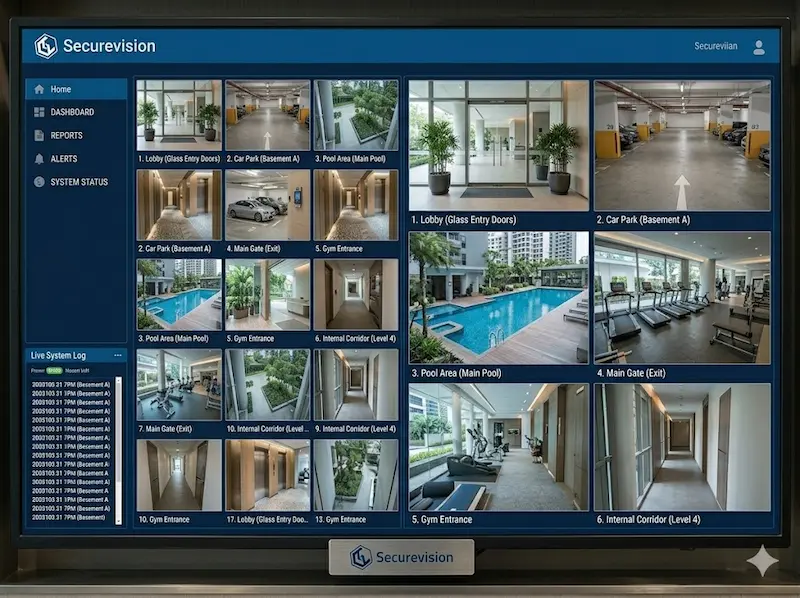
The systems described on this page are not just security tools. They are manpower efficiency tools. LPR handles resident vehicle entry without guard intervention. The mobile intercom handles visitor communication and gate release without the guard needing to leave the guardhouse. Facility access control handles gym and pool entry verification without a guard posted at the door. VESTA alerts the guard to specific events: an unusual access attempt, a camera detecting loitering: instead of requiring the guard to continuously watch 32 camera feeds for anything out of the ordinary. Each system removes a category of manual task from the guard's routine and replaces it with an automated process that is faster, more accurate, and self-documenting.
The result is not fewer guards for the same coverage: it is the same guards providing substantially greater effective coverage. A two-guard estate with integrated LPR, mobile intercom, and VESTA-managed CCTV has significantly more real security capability than a four-guard estate operating with manual logs, paper visitor books, and standalone cameras. The technology does not replace the guard's judgment or response capability: it removes the routine tasks that consume their time and attention.
Remote monitoring extends this further. For estates with a monitoring centre connection, VESTA alerts are routed to a professional operations centre that maintains active oversight during the small hours: when on-site guard fatigue is highest and estate activity is lowest. A CCTV anomaly detected at 3am generates a monitoring centre alert; the operator reviews the feed remotely and contacts the on-site guard or emergency services if warranted. Estates that have implemented this approach report fewer overnight incidents and reduced physical security infrastructure costs compared to maintaining a full overnight guard rotation.
A Practical Model for MCSTs: An estate that adopts LPR, mobile intercom, VESTA platform management, and a monitoring centre connection can typically reduce its guard team by one post while maintaining equivalent or better security coverage. At current PWM-adjusted guard costs in Singapore, this represents an annual saving that substantially exceeds the capital cost of the technology upgrade: making the business case to the AGM straightforward to present.
What to consider:
- Technology-assisted manpower reduction only works when the estate's systems are integrated: a set of standalone cameras and an unconnected intercom panel do not enable reduced guard headcount.
- The guard role changes from task executor to exception responder: training the guard team on the new workflow is as important as the technology installation itself.
- Monitoring centre connection is an ongoing cost, not a one-time capital item: factor it into the estate's security budget alongside the maintenance contract for the installed systems.
- MCSTs presenting a security upgrade proposal to the AGM benefit from a cost comparison that includes projected guard reduction savings: we prepare this as part of our proposal documentation for councils evaluating an upgrade.
How They Work Together
These five systems each do a distinct job: but the estate's security intelligence comes from their integration, not from any individual system in isolation.
A visitor approaches Gate 1 at 7pm and presses the intercom panel. The call panel calls the resident's smartphone via the mobile app. The resident sees the visitor's face on the live video stream, speaks to them, and releases the pedestrian gate with a tap: the access event is logged in VESTA with timestamp, camera reference, and credential used. The visitor parks in the estate's visitor bay; their plate is captured by the LPR camera and recorded against the resident's unit as an expected visit.
At 2am, a CCTV camera at the pool deck with Starlight sensor detects a person who has been stationary for more than 10 minutes. The AI analytics generate a loitering alert in VESTA. The on-duty guard, watching the VESTA dashboard at the guardhouse, sees the alert and reviews the camera feed from the same interface. The monitoring centre, simultaneously notified, confirms the situation remotely. The guard is dispatched: with a specific location, not a general perimeter check order.
When a resident moves out at the end of their tenancy, the managing agent opens the VESTA resident management module, deactivates the credential profile, and removes the vehicle plate from the LPR whitelist. Every access point on the estate: gate, facility doors, lift floors: is simultaneously inaccessible to that credential. No physical key to recover, no card to chase, no contractor visit required.
What Affects the Cost of a Condominium Security Upgrade?
Two estates with identical unit counts can have very different upgrade costs depending on estate layout, existing infrastructure, and the scope of integration required.
Number of Blocks, Entry Points, and Lift Cores
Each vehicle lane requires its own LPR camera and barrier. Each pedestrian gate requires its own intercom panel and access controller. Each lift core requires its own floor restriction integration. A compact single-block estate and a large multi-block development with four vehicle lanes and six pedestrian gates are fundamentally different scopes even at the same unit count.
Existing Infrastructure and Reuse Potential
Estates with functioning fibre backbone, structured cabling in good condition, and compatible existing hardware can be upgraded at lower cost than those where all infrastructure needs to be built. Intercom cabling reuse potential: whether existing 2-wire or Cat5 cabling can carry the new IP system: is often the single largest cost variable in an intercom upgrade. We assess this during the site survey before any scope is agreed.
CCTV Camera Count and Facility Scope
Camera count scales with estate size, the number of facility zones to be covered, and the retention period required. Estates with large outdoor recreational areas, multiple car park levels, and extensive perimeter fencing require proportionally more cameras than compact developments. Storage infrastructure scales with camera count and resolution.
Platform Integration and Credential Migration
Integrating all five systems into the VESTA platform requires configuration work that scales with the number of systems, access points, and resident credentials to be migrated. For estates upgrading from a mixed-vendor environment: where CCTV, intercom, and access control are currently on three separate platforms: the integration scope is more significant than for an estate upgrading from a single integrated system.
A Practitioner Observation
The most consistent cost-saving in condominium security upgrade projects comes from identifying which existing infrastructure can be retained before the scope is written. An estate that assumes full replacement of all cabling and hardware often discovers during the site survey that significant portions of the existing infrastructure are reusable. The site survey is what establishes this clearly: and a project scoped after a thorough survey costs significantly less than one scoped from a floor plan alone.
The Brands Behind the Systems
Hikvision
IP cameras for estate CCTV: wide-angle fisheye models for car parks and corridors, Starlight sensor models for outdoor facilities, and AI-capable cameras at access points.
View Specification →Akuvox
IP video call panels with mobile app for resident-to-visitor communication, facility access control, and lift floor restriction: all on one credential platform.
View Specification →Hikvision LPR
Dedicated LPR cameras with sub-500ms plate recognition: resident vehicles processed automatically, visitor plates logged and managed from the VESTA platform.
View LPR Systems →FAAC Barriers
Heavy-duty traffic barriers rated for continuous-cycle estate operation: integrated with the LPR camera system for automated resident vehicle entry and exit.
View Specification →VESTA Platform
Estate security management platform: unifying CCTV, access control, LPR, and intercom into a single dashboard for the guard team, managing agent, and MCST.
Explore VESTA →Omada & Ruijie
Managed PoE switches and WiFi 6 access points: estate-wide network infrastructure that all security systems rely on, managed from a single cloud-based dashboard.
View Specification →Frequently Asked Questions
Questions we hear from MCST councils, managing agents, and estate managers evaluating condominium security upgrades.
What security systems does a condominium typically need?
Most Singapore condominiums require five integrated systems: estate CCTV covering car parks, corridors, lift lobbies, perimeter, and facilities; a video intercom with mobile app allowing residents to receive visitor calls and release gates from their smartphone; LPR vehicle management for automated resident vehicle entry and visitor logging; an estate management platform unifying all systems into one dashboard; and a manpower strategy that uses technology to extend the guard team's effective coverage.
Can existing intercom wiring be reused in an upgrade?
Often yes. Many modern IP intercom systems are designed to run over existing 2-wire cabling using signal conversion technology. Whether this is feasible depends on cable condition, run lengths, and the specific system being installed. We assess wiring reuse potential during the site survey before agreeing any scope: it is one of the most significant cost variables in an intercom upgrade.
How does LPR compare to IU-based vehicle entry systems?
IU readers require a physical transponder mounted in each resident vehicle and fail when the IU battery depletes. LPR reads the vehicle's number plate visually and provides a timestamped photographic record of every entry and exit event. For estates upgrading from IU, LPR is the standard replacement. The management overhead of an IU system: tracking units issued, replacing failed units, managing readers: is substantially higher than an LPR system.
Can residents use smartphones instead of access cards?
Yes. Mobile credentials allow residents to use their smartphone for the pedestrian gate, car park, gym, facilities, and lift floor restriction. The mobile app also handles visitor intercom calls: the resident receives the visitor's call on their phone, sees a live video stream, and releases the gate with a tap whether at home or elsewhere. Mobile credentials and physical access cards can run in parallel on the same system.
What happens during a network or power outage?
Access control hardware is configured with local storage and offline mode: controlled entry points continue to function during network interruptions using locally cached credentials. Barrier systems are connected to UPS units for short outages. For extended power failures, barriers can be configured to fail-open or fail-closed depending on the security requirement at each entry point. We specify the appropriate fail-safe configuration during the design phase.
How long does an estate-wide security upgrade take?
For a mid-sized estate of 200 to 400 units, a full intercom, LPR, and CCTV upgrade typically takes four to eight weeks depending on cabling work, the number of access points, and whether installation needs to be phased around resident schedules. We present a detailed installation schedule as part of the proposal. No system goes live until it has been fully commissioned and tested for that phase.
Can the upgrade be done in phases rather than all at once?
Yes. Phased upgrades are common for larger estates or those with budget constraints across multiple financial years. A typical approach addresses vehicle access and LPR in Phase 1, intercom and facility access in Phase 2, and platform integration in Phase 3. Each phase delivers standalone value while the estate builds toward the fully integrated system. We design the phasing plan so that systems installed in early phases connect to those added later.
How do MCSTs present a security upgrade proposal at the AGM?
We prepare a proposal package specifically designed for AGM or EGM presentation: covering the current system assessment, the recommended upgrade scope, the projected improvement in estate operations, and a cost-benefit analysis including projected guard reduction savings where applicable. At current PWM-adjusted guard costs in Singapore, the annual saving from a one-post reduction typically exceeds the capital cost of the technology upgrade within two to three years. We can attend the council briefing before the AGM to answer technical questions directly.
Relevant to All Three Condominium Stakeholders
The systems on this page are the foundation of every condominium security upgrade: but the decisions around them are made by three different groups with different priorities.
MCST Councils
MCSTs are responsible for specifying, approving, and funding the upgrade. This guide provides the technical foundation for a well-structured AGM or EGM proposal: systems-level clarity before the procurement conversation begins.
Managing Agents
Managing agents carry the daily operational burden of the estate's security systems. An integrated, VESTA-managed estate is significantly easier to run: fewer vendor calls, automated logs, and a single platform for resident credential management.
Security Contractors
The guard team's effectiveness is directly proportional to the quality of the technology they operate. LPR, VESTA, and integrated CCTV transform the guard role from manual task executor to intelligence-informed responder.
Ready to Plan Your Estate Upgrade?
Book a site assessment: we will walk the estate, review your existing systems, and produce a structured upgrade proposal your council can present with confidence.
Licensed by the Police Force: Licence · Serving Singapore since 2006